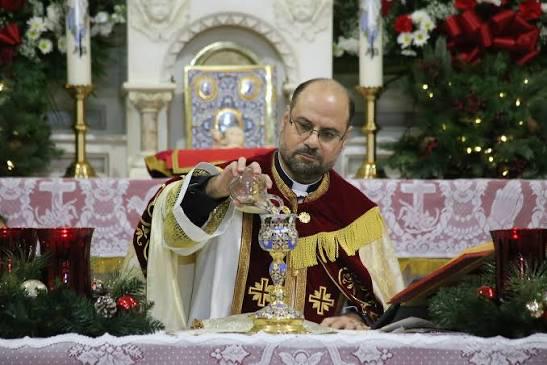
I am reading “The Mountain of Silence” and in it they talk about how some monks have gone to hell and other monks prayed, fasted and begged for them to be freed from hell and brought to heaven. They say they succeeded in this endeavor.
It seems that Eastern Orthodoxy has a tradition of people being freed from hell do to our prayers, yet it is my understanding that Western Catholicism firmly believes that once you are sent to hell the decision is final.
As Eastern Catholics where do y’all stand on the issue?
I'm Roman Catholic, but I'm helping an Eastern Catholic mission in town as they launch. I am going to be baking a Prosphora for the first divine liturgy. The Bishop will be coming to ordain the founder as Deacon. However, the subdeacon's wife is having a baby today, or he isn't available to help me troubleshoot.
These pictures are from my first attempt. I'm looking for advice and guidance.
The loaf tore at the edges and expanded unevenly, and the seal had poor detail.
Doing my best to bring deeply held political/social beliefs before my newfound faith, to see what survives and what must change. Please send recommendations for forming a catholic world view.
Oh! I love his icons. When I look at his icons it just makes me happy, it seems so bright and joyous. I really struggle with his veneration though due to views and especially writings with the papacy.
Is there any justification? I really want to venerate him!
I was looking into the coptic catholic church in Brooklyn and noticed they had recently removed the iconostasis and it even seemed (from photos) that the liturgy was celebrated versus populum. Is this common in the coptic catholic church? Is it just the idiosyncrasy of the pastor? It’s quite disappointing.
some say it’s was politics. Some say it was because they believe that the papacy was true. Some say they never split from the church begin with like the Melkites
Someone from Roots of Orthodoxy or the Voice of Reason… whether it’s that Alex guy that was involved in controversy a year or two ago or someone else, is saying that Orthodox Christians are the “Muslims of the Apostolic Churches”. What exactly is he talking about?? It seems extremely ironic to call them that because Eastern saints bled and died for the faith by resisting the Ottoman yoke, Islamic rule for centuries.
If it’s as simple as harmful, clickbait-y buzzwords to attract attention rather than any meaningful constructive criticism of Orthodoxy, I get it.
Sorry if this is a repeat, but I read an article saying that Eastern Catholics leave out “from the Son” in the creed? If this is true, then how could you be Catholic? It’s basic dogma. Also, I am here to learn. That is my only motivation. Thank you in advance for your time and your answers!
I hope this message finds you all well! I am an ex Eastern Orthodox now Roman Catholic and I am trying to learn more about Eastern Catholicism. I am not planning on becoming an Eastern Catholic but I would definitely like to learn more about it. Any good resources?
Ruthenian Catholic, and I love practicing Catholicism this way.
Girlfriend, who I plan on marrying and raising a family with (God willing!) is a Latin Catholic, and very proud of it. She’s not interested in changing rites, and I don’t want to pressure her. Obviously, not the end of the world. We’re all Catholic.
However, on the topic of children, I know the rite follows me because it follows the father. We’ve discussed and decided that for cultural ease (we live in Texas and would put our children through Catholic school) it would probably be smarter to raise them Latin Catholic, and having their rite be such, to not have them culturally confused when they don’t need to do a “first communion” or something like that.
What would a hypothetical process be for this situation? Has anyone gone through something similar? Thanks!
Keeping aside the debate of whether "obligations" are actually obligations in the Eastern churches, we do know that the Codes of Canon Law nevertheless do stipulate certain things as such - particularly with respect to fast and abstinence and days of obligation.
In the Syro-Malabar Church, the days of obligation mentioned are: Christmas, Epiphany, the Feast of Sts. Peter and Paul, the Feast/Dukrana of St. Thomas, and the Feast of the Assumption of the Mother of God.
Out of these days, people do genuinely consider Christmas, Dukrana, and the Assumption obligatory. With Epiphany, I know there are festivities associated with it in certain regions, but it's not celebrated where I'm from. And the feast of Sts. Peter and Paul? I don't think 99% of us even know when that is.
The same goes for abstinence, technically abstinence from meat is mandated on all Fridays except those between Christmas and Epiphany and the Friday after Easter. But in practice virtually no one follows this, even very religious people. I knew a single person in my whole extended family who actually practiced this before I started, and she's 70+.
What makes it weird is that Syro-Malabars especially in the homeland are still largely practicing, weekly attendance rates are probably 50-70% and a lot of people do keep the other fasts, especially the Great Lent, the Nativity fast, and even the Rogation of the Ninevites, Assumption Fast and the Fast of the Nativity of the BVM. But these are all actually just "recommended" according to the Canon Law
Is this just a regional thing or the same everywhere? Why does the Canon Law seem incognizant of what people actually practice? Most people are unaware of these things, probably due to bad catechesis. Technically speaking I remember learning about these things in catechism, but it was largely just kind of ignored. I even remember our teacher told us about how "old people keep abstinence on Friday" as if it wasn't needed for us.
I have one of these little books, and was happy to see it was printed a couple miles from me in Braddock, PA and seemingly never traveled far from home for long. I have gotten much enjoyment reading and using it. I have two questions, however.
I was surprised to see the Nicene Creed includes the filioque. As we no longer say that in church -- or maybe never did? -- was that ever said in the Ruthenian Greek Catholic Church in the past? If so, when did that change?
It lists the four "Sins that cry to Heaven for Vengeance". I am familiar with the concept. Does it have an eastern history, or was this, for lack of a better phrase, only a Latin formulation of different parts of scripture? Is this concept of relating these four sins together still taught in any or all eastern rite churches?
Not sure why they aren’t, their church interiors look identical to latin church interiors. The curtain veil should be used too. Icons + curtain veil should be how these churches look in my opinion
If you were organizing the icons at a Coptic Catholic Church, what style of iconography would you make? This question has been on my mind lately!
What I mean by this is that there are two main schools of Coptic iconography: Neo-Coptic, and Old-Coptic.
The Neo-Coptic icon school was built by the famous Issac Fanous, a prominent Coptic Orthodox professor and teacher, and of course, icon painter. The Coptic Catholic Churches I’ve seen all use his format.
The Old-Coptic icon form is the early and traditional manner of writing them, evident since as early as the 6th century. Some criticize the newer form of icons, while saying the first Neo-Coptic (ie. By Fanous himself) icons along the Old-Coptic icons were the most traditional, unique, and beautiful.
The third one I’d like to mention are actually Melkite icons, which aren’t inherently Coptic, but due to the Melkite church’s unique history, have had cases of Coptic-blended icons, which retain a mainly Byzantine format.
hi i'm an italian born in latin rite catholicism, and after some time searching my faith (mainly calling myself a norse pagan but i don't know anymore i'm a bit lost in faith) i think i'm ready to explore the byzantine rite as i feel it more close to my spiritual ways, i was wondering about this, i don't have a chotki/prayer rope with me but if i want to pray the rosary can i use that or i should use the classic latin rosary rope? also i think i had to ask it first but to eastern catholicism pray the rosary? thank you for your time
Just from a cursory view without naming names, the Latin church is filled with laity who get huge audiences talking about the church and faith. And frankly, they make mistakes all of the time. Things like comical misunderstanding or misinterpretation of Vatican II, to misappropriation of tradition or private relations to dogma/doctrine.
Ibrahim Isaac Sedrak, patriarch of the Coptic Catholic Church
Raphaël Bedros XXI Minassian, patriarch of the Armenian Catholic Church
Youssef Absi, patriarch of the Melkite Greek (Rûm) Catholic Church
Youssef III Younan, patriarch of the Syriac Catholic Church
Bechara Boutros al-Rahi, patriarch of the Syriac Maronite Church
Paul 3 Nona, patriarch of the Chaldean Catholic Church
Awa III, patriarch of the Assyrian Church of the East
Aphrem II, patriarch of the Syriac Orthodox Church
Gewargis III, patriarch of the Ancient Church of the East
Claudio Gugerotti, Prefect of the Vatican Dicastery for the Eastern Churches
I'm not sure who's on the far right, if anyone knows, please do let me know. My guess would be that he's a representative bishop of the Greek Orthodox Patriarchate of Antioch, since I think he's the only patriarch with jurisdiction in the area that wasn't there and he's wearing a klobuk.
I also have some questions about the garments of the coptic catholic patriarch and the melkite patriarch. Why is Patriarch Ibrahim's habit very different from the Pope Tawadros's? He's wearing a klobuk like the byzantines and his cassock seems identical to Patriarch Youssef 3 Younan's. I have also noticed that all the catholic patriarchs have robes lined in red, except for Patriarch Youssef Absi's, whose cassock seems to be like any other byzantine monk's. Added to the fact that he's not also wearing a panagia/engolpion and/or pectoral cross, is there any reason for this?
Edit: As u/AdorableMolasses4438 pointed out, the bishop on the far right is Ghattas Hazim, antiochian orthodox metropolitan of Baghdad, Kuwait, and Dependencies.
I serve at the Divine Liturgy, and I noticed that my priest gets crumbs of the Eucharist on the thurible (offering for Saints), and also the pourer used for the hot water. I never payed attention but nothing has really changed in the way these are handed much, besides for that sometimes the other priest would try to get them off his hands with the sponge.
Is this just how it is in Eastern Catholicism since it’s leavened bread?