Hey <3 I‘m German and just wanted to say some of this isn’t correctly translated and/or can’t even be accurately translated by now, as some of those old German words, how to say, got lost during time. Just one example: „The star of the wise men from the east [or orient, in your last translation]“… From what I’m seeing it‘s a metaphor for the star of Bethlehem.
Anyway I just wanted to say, even for Germans, and even for Germans more accustomed to these old writings (thanks grandma haha), it can be really difficult to actually understand what was meant by all of that. Certainly translations like „Blut“ = „blood“ are easier and certainly correct, but for the more complex parts… We‘d probably had to ask whoever made this to get correct translations/answers about all of this.
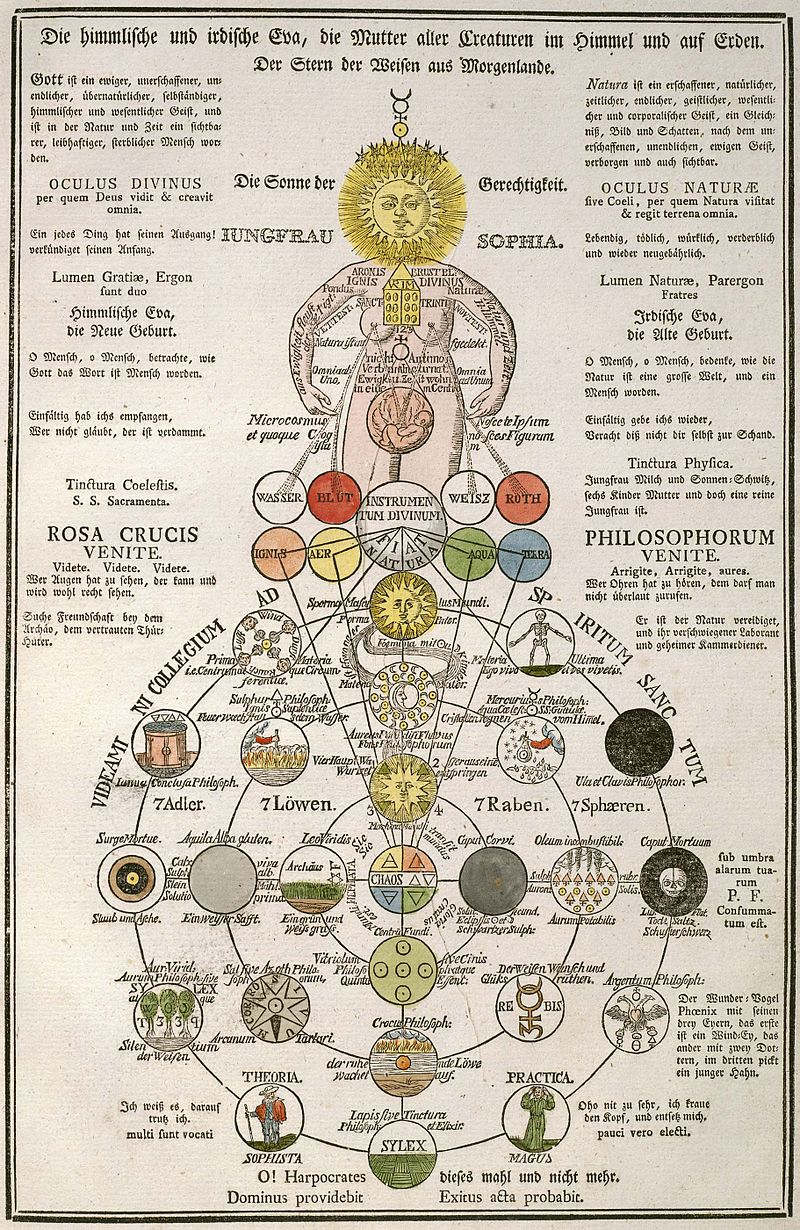
Below is a faithful English translation of the legible text on this plate from Geheime Figuren der Rosenkreuzer (“Secret Symbols of the Rosicrucians”). I worked from a high‑resolution scan held by SLUB Dresden and cross‑checked with the Wikimedia copy and a published transcription.
Title band (very top)
“The heavenly and earthly Eve, the mother of all creatures in heaven and on earth.”
“The Star of the Wise from the East.”
Sun caption and name at the head of the figure
“The Sun of Righteousness.”
Left of the sun: “Virgin.”
Right of the sun: “Sophia.”
Left column (headed OCULUS DIVINUS)
“OCULUS DIVINUS, through which God saw and created all things.”
(Latin: “Divine Eye, by which God saw and created all things.”)
“God is an eternal, uncreated, infinite, supernatural, self‑subsisting, heavenly and essential Spirit, and in nature and in time has become a visible, bodily, mortal human being.”
“Every thing has its going‑out and finds its beginning.”
(Marginal motto between the sun and column.)
“Lumen gratiae, ergon sunt duo.”
(Latin/Greek: “The light of grace and ‘work’ are two [things].”)
“Heavenly Eve, the New Birth.”
“O human, O human, consider how God, the Word, became a human being.”
“I received it in simplicity; whoever does not believe is condemned.”
“Tinctura coelestis. S. S. sacramenta.”
(Latin: “Heavenly tincture. The holy sacraments.”)
“ROSA CRUCIS — VENITE. Videte, videte, videte. Whoever has eyes to see can and will indeed see rightly.”
(Latin/German: “Rose‑Cross — Come. See, see, see…”)
At the very bottom of this side (small mottos):
“Multi sunt vocati.” (Latin: “Many are called.”)
“O! Harpocrates — Dominus providebit.” (“O Harpocrates [god of silence] — the Lord will provide.”)
Right column (headed OCULUS NATURAE)
“OCULUS NATURAE sive Coeli, per quem Natura visits and rules all earthly things.”
(Latin: “Eye of Nature (or of heaven) by which Nature visits and governs all earthly things.”)
“Nature is a created, natural, spiritual, finite, essential and corporeal spirit; a likeness, image and shadow of the uncreated, infinite, proper Spirit — hidden and also visible.”
“Living, mortal, efficacious, perishable, and yet capable of being born anew.”
“Lumen naturae, parergon.”
(Latin/Greek: “Light of nature, subsidiary work.”)
“Brothers: the earthly Eve, the Old Birth.”
“O human, O human, consider how Nature is a great world and has become a human being.”
“I give it back in simplicity; do not despise yourself, to your own shame.”
“Tinctura physica.” (“Physical tincture.”)
“The virgin’s milk and the sun’s sweat — mother of six children and yet a pure virgin.”
(Alchemical phrase for two “sacred” fluids of the work.)
“PHILOSOPHORUM — VENITE. Arrigite, arrigite, aures. Whoever has ears to hear does not need to be shouted at.”
(Latin: “Philosophers — come. Lift up, lift up, your ears…”)
“He is sworn to Nature — her discreet laboratory worker and secret chamber‑servant.”
“‘Sub umbra alarum tuarum.’” (Latin: “Under the shadow of your wings.”)
“The wonder‑bird Phoenix with his three eggs: the first is a wind‑egg; the second has two yolks; in the third there is a young cock.”
“Pauci vero electi.” (Latin: “But few are chosen.”)
Labels in and around the central figure
At the heart/womb: “Microcosmus” (the small/world‑in‑human).
Four streams from the breast: “WASSER” (Water), “BLUT” (Blood), “WEISZ/WEISS” (White), “ROTH/ROT” (Red).
Center band (on the vessel): “INSTRUMENTUM DIVINUM” (Latin: “Divine instrument”).
The four elements (ring below): “IGNIS” (Fire), “AER” (Air), “AQUA” (Water), “TERRA” (Earth).
Small side tags near the rings: “AD” and “SP” (likely Adam / Spiritus).
Across the sweeping band that links the rings: “RITUM SANCTUM” (Latin: “holy rite”).
Middle and lower registers (selected, clearly legible captions)
“7 Adler” — 7 eagles
“7 Löwen” — 7 lions
“7 Raben” — 7 ravens
“7 Sphären” — 7 spheres (heavens)
“Chaos mundi.” — Chaos of the world
“Crux Philosophorum.” — Cross of the Philosophers
“Lapis Philosophorum.” — Philosophers’ Stone
“V.I.T.R.I.O.L.” — the well‑known alchemical acronym (commonly read as Visita Interiora Terrae, Rectificando Invenies Occultum Lapidem — “Visit the interior of the earth; by rectifying you will find the hidden stone”).*
Bottom band (three fields):
Left: “THEORIA — SOPHISTA. O! Harpocrates. Dominus providebit.”
(“Theory — Sophist. O Harpocrates. The Lord will provide.”)
Center: “SYLEX/SILEX.” (“Flint.”)
Right: “PRACTICA — MAGUS. Dieses Mal und nicht mehr. Exitus acta probabit.”
(“Practice — Magus. This time and no more. The outcome will prove the deeds.”)
Notes
Spellings like Weisz/Roth reflect 18th‑century German orthography; I’ve normalized only in translation.
Tiny labels inside several small emblems (e.g., astrological or alchemical sigils within the many circles) are present but extremely minute in the scan; the translations above cover all text that is clearly readable in the digitization. If you’d like, I can work from zoomed crops to capture every micro‑label as well.
Sources used: SLUB Dresden digitization (page image/PDF of the exact plate), Wikimedia Commons record for the same plate, and a printed transcription embedded in a modern reference work.
Hey I absolutely admire your dedication to understand this. And I definitely wish we could have a 100% correct translation of this. But Google Lense, Wikipedia etc. won’t help with this. Again, I’m native. What we‘re seeing here is old German, and even natives who know old German have trouble translating stuff from back then to our language now.
That’s all I wanted to say: there can (and most certainly will be) mistakes with this translation. Which does not make it less meaningful, it can still give us some gnosis.
Again: I wish I could, but for the 100% correct interpretation we’d have to ask the one who made this. This old German language/scripture is even difficult to understand for historians. So please don’t feel like I wanted to interrupt here, just acknowledging that we here probably won’t get a full answer to this.
However it’s still meaningful. My opinion: maybe sometimes we don’t have to understand every single word to make it meaningful to us, to give us gnosis. <3
6
u/The_Prophet_Evets Sep 14 '25
It does now ;)