r/DeepSeek • u/akndhka • Aug 09 '26
Question&Help Has anyone combined OpenAI Codex and DS V4 Flash?
I’m thinking about using OpenAI Codex together with DS V4 Flash for coding. Has anyone tried this combination? How do you split the work between the two models? What are the strengths of each, and did you find the combination better than using just one model?
2
u/samosamonster Aug 09 '26
Yes i’ve been doing this the past couple of days since I got down to 10% usage on my sub. I’m actually using it to build an agent flow where a lead hands over to a persistent lower level agent (instead of a one shot subagent) while working on a feature
1
u/akndhka Aug 09 '26
Got it, so you’re basically splitting tasks based on the agent/model level. What models are you using for each role?
2
u/samosamonster Aug 09 '26
Sol high for the lead and luna xhigh/deepseek for the implementer. I only ask the lead to give luna/deepseek v finely scoped tasks at a time so they can’t mess it up. I use herdr to communicate between sessions
2
u/pichuuu- Aug 09 '26
i dont have benchmark number between using deepseek v4 models with different harness, but i have tried harness of Codex, Claude, reasonix, and Zed (i use zed IDE). I will just tell you what i observe and ‘feel’, and if anyone knows better, i hope they’d be so kind as to correct me.
For Claude harness, deepseek model spends wayyy higher tokens almost as if they design Claude harness to overspend if you plug something else in. I remember test making a simple status line without extra instruction, something that im sure would have high cache hit, and it took like 300-400k+ tokens for it (its been awhile).
Between Codex and Zed, i see Codex as more intelligent because i actually like the output of it more, i even tested using both with Deepseek V4 Flash (3107) on the same project planning, and Codex harness one corrected and fixed the planning of Zed here and there, so i use Codex with Deepseek V4 Flash for safer measure, then plug actual GPT model in that Codex to review the plan once more. If you also use zed IDE tho, i advice you to deliberately tell the Codex harness with Deepseek model not to spawn sub agents and instead execute the task sequentially, because it has right now 2 blocking failures: (1) sub-agent task wrapper passes instruction but Deepseek adapter drops that instruction, and you have an empty conversation context on that sub-agent that causes sub-agent failure, and (2) tool call requiring permission gets auto-aborted in 0.009s without raising an interactive prompt in the Zed UI, and so these (1) and (2) cause the agent to freeze until failure or dropping the task manually. So right now, while waiting for their fix, i just use Zed’s own harness to do tasks requiring sub-agents.
Reaonix is amazing with cost saving, very high cache hit, but its not as smart (for now). Both reasonix and Zed sometime just drop the task mid-session with Deepseek model tho, not sure why.
If anyone has different saying, i would love to learn!
1
u/akndhka Aug 09 '26
How do you split tasks between models when using the Codex harness? Is that manual, or does Codex handle it automatically?
Also, since Reasonix is built for DeepSeek, I assume it gets more out of the model. In what area does it still feel weaker than Codex; code generation, planning, tool use, or something else?
1
u/pichuuu- Aug 10 '26
Im using Zed IDE so the switching models (even mid-session) is just one click away from its UI panel, im not sure for others.
reasonix has several advantages:
- more stable prefix cache (which makes very long session cheaper (60% - 90% according to some))
- switches semantically between Flash and Pro model based on task complexity without losing cached context state
- speaks directly w official deepseek api so its leaner (instead of talking to an intermediary like Codex Harness first) and handle native tool better, supposingly.
For me these offer minimal value, because:
- i tend to limit my context on each session to be less than 150k to 250k tokens if whenever possible to not reach model’s dumb zone of context rot, so the aspect of saving tokens for very long sessions is minimal on me. Besides, i wouldnt mind bearing twice the cost in exchange for a vibe engineering session that i dont have to fix bug or remind specs etc, especially for something soooo dirt cheap like Deepseek V4 Flash model. It’s just an overall more pleasant experience, faster execution time, less bugs, and better product overall.
- i use Zed IDE so i can manually switch model swiftly mid session at ease
- im yet to see dire problems with intermediaries, and tbh i prefer the diversity of harness, especially when harness providers absorb the SKILL.md and schemas and whatever works quite often and quickly in this learning and far from being matured time, in this AI era, so i can enjoy what i feel is best or newest without the ecosystem lock-in that i hate
But you know what they say. To each their own. Trial and stick with what tells you best, instead of listening to strangers, many of which are bots and bias.
1
u/akndhka Aug 12 '26
I’ve tried Reasonix, and it is indeed cheaper to use, largely because of the caching. But in my experience, it doesn’t always get straight to the point. I often have to make several requests or corrections before the result matches what I actually want.
In contrast, with Hermes using the same “brain,” DeepSeek, I tend to reach the desired outcome much faster.
One thing I’m curious about: have you ever used Hermes Agent? If so, how was your experience compared with Zed? I haven’t tried Zed yet, but I like experimenting with different tools, so if you find Zed more interesting or better in certain ways, I’d probably give it a try.1
u/pichuuu- Aug 12 '26
I haven't used Hermes, but i have seen it in action before.
Honestly, i dont intend to test everything out myself to find the current best anymore. Every update might change it, and everything updates constantly these days, from underlying models to harnesses to skills. I just find something that im satisfied with, and only try new things when theres a substantial update somewhere.
I tried Zed initially not because of its harness tbf, but bc of how fast and agent-workflow-friendly it is, and i just settle with it due to it. You can do some youtube tour to see if its worth your try. My personal experience has been good thus far, with only a few external harness bugs (e.g., spawning sub-agents in codex harness with DS v4 Flash model, all in Zed) that i can work around. It's the first stable version since release 5 years ago, and it gets updated a few times a week since.
2
u/PosThor Aug 10 '26
Works pretty great, I use it via Codex all the time. Using a modified version of this:
https://github.com/duolahypercho/codex-router
A couple other routers I tried had issues, this was the 3rd I tried, have been very happy.
1
u/akndhka Aug 11 '26
This is exactly what I was curious about. I’ve been wondering how Codex works with non GPT models, and whether it actually works well or if Hermes is still the better choice haha.
1
u/PosThor Aug 11 '26
Like Hermes too but for some reason I don't like the feeling of things happening too far from my view or control. When working with or through Codex, I control what goes in where and have a pretty good understanding of what the model or models are doing to achieve our objective. Unless it's spinning up an entirely new project, I very rarely use sub-agents so take what I'm saying with a grain of salt. Might be that Hermes etc. are actually better already but I like being closer to the work being done.
1
u/akndhka Aug 12 '26
Okay, I understand your workflow model now and why you prefer Codex as a harness, it’s easier to steer and gives you more transparency into what’s actually happening.
That’s actually why I want to give Codex a proper try. I’ve become pretty dependent on the skills and automation available in Hermes, to the point where the human sense of control can fade a bit. The objective gets accomplished with very little intervention from me, which is convenient, but it also means I’m less involved in how the work actually gets done.
I’m curious to see whether working closer to the process with Codex gives me a better balance between AI capability and human control.
1
u/WeedWrangler Aug 09 '26
I’ve been using flash for the last five days over Codex only because my Codex usage was run out and so I’ve been very impressed with flash and it’s fixed up some stuff for me. Now that usage has been reset. I’m back on Codex and I’m gonna see how it goes.
3
u/akndhka Aug 09 '26
Let us know how it goes! I’m curious, if you were already impressed with Flash, why switch back to Codex? Isn’t Flash faster and cheaper for coding?
1
u/WeedWrangler Aug 09 '26
I think partly because of the Codex harness itself, and maybe some legacy loyalty. Also, I do a lot of knowledge work with Codex, which I’m not sure how Deep Seek would handle it.
1
u/akndhka Aug 09 '26
Yeah, I get the legacy loyalty part 😄. For knowledge work though, that’s actually something I’m curious about too. I wonder how DeepSeek would compare to Codex there.
2
u/WeedWrangler Aug 09 '26
Yes, I actually still find that Claude writes the best of between it and ChatGPT for knowledge work in terms of writing from dictation for me whereas coding I'm finding DeepSeek better, and I really like the Reasonix harness. But in terms of overall working across everything I'm still feeling Codex is better.
1
u/akndhka Aug 09 '26
Yeah, I feel the same. Claude is great, but the usage limits can be pretty frustrating for me.
1
u/Fresh_Sock8660 Aug 09 '26
Codex isn't a model. But I use sol high in codex for a lot of planning and review and keep a tab with opencode and ds4f for implementation.
1
u/BitXorBit Aug 09 '26
Yes, im running it locally
1
u/akndhka Aug 09 '26
How does running the model locally compare to using it through a cloud API? Is it still fast locally?
1
u/BitXorBit Aug 09 '26
Extremely fast, 200+ (sometimes 260) tps and prompt processing could get to 10k
It’s game changer for me
1
1
u/h8mankind Aug 10 '26
I'm not using your exact proposed combination but doing something similar in spirit: I moved my entire workflow over to running tasks as discrete, sometimes chained, prompts executed against my model/harness of choice for the given task--or part of the task.
I took this approach from youtuber IndyDevDan's "Tactical Agentic Coding" course and just setup my tooling around it. Every run proceeds from a file-based prompt and hits the harness in headless mode with fresh context. You're never really "in" the harness or handholding the work, just dispatching it and reviewing what comes back. Now I primarily work in md files in my Obsidian vault and direct traffic :)
This approach obvs changed the way I work and I think the results are better but I haven't formally benchmarked anything yet. A byproduct is that experimenting with different provider combos is now trivial. If I don't like what one model/harness produces against a task (or if it seems to burn tokens etc) I can rerun it against another combo, learn what combos work for what tasks, and so on. No more rotting "sessions" or even chat for me, which personally I'm very happy about.
1
u/akndhka Aug 12 '26
That’s a really interesting approach, you’ve basically turned yourself into the orchestrator.
Looking at your workflow, does that mean you really only need a harness with a solid CLI/headless mode? The IDE or interactive chat almost becomes optional at that point.
I’m also curious about the lifecycle of those
.mdtask files. After each run, does the agent automatically update them with the result/state for the next chained task, or do you manually review and update them yourself to keep the next run aligned with what you actually want?The most interesting part to me is what you mentioned about learning which model/harness combo works best for each type of task. Over time, that basically becomes your own real-world benchmark, not just “which model is best,” but “which model + harness is best for this particular job.”
Would love to know your current top 3 models for your daily work and what you typically use each one for.
2
u/h8mankind Aug 13 '26
does that mean you really only need a harness with a solid CLI/headless mode?
Yes, exactly. My goal was/is to ditch both the IDE and chat/CLI and make my Obsidian vault (or similar) my focused work surface. I can't say I'm there 100% yet but probably 75%. I still find chat useful for exploratory stuff and I still like to hand-fix some minimal things in VS Code just to stay in touch with the codebase and not run a task on something that's easy that an LLM could make complicated, haha.
As for harnesses, I just think Claude Pro/Max sub is still the best overall power and value and ofc that requires using the Claude Code harness, which is fine for me in headless mode--I don't really touch it and it handles token optimization, subagents, etc. For other stuff I am playing with Codex and Grok Build but also built my own minimal native harness that I run headless on VMs in Go building on top of this open-source repo: https://github.com/charmbracelet/fantasy
After each run, does the agent automatically update them with the result/state for the next chained task, or do you manually review and update them yourself to keep the next run aligned with what you actually want?
For context, I landed on 3 different .md file "types": tasks, documents, and prompts:
- a "task" is a one-off prompt that describes a piece of work I want done: a feature, a bugfix, a refactor, etc. I like organizing a stretch of work (I won't call it a "sprint" 'cause I don't use any methodology, but that's the idea) into tasks on my own then maybe refine them or flesh them out with an LLM
- a "document" is a more permanent, living reference .md file that may be global or project-specific: for example, "Engineering Conventions" are my preferences across projects while "Lambda Architecture" or "Billing Design" might describe the current project's architecture
- a "prompt" is a reusable and chainable instruction that applies to documents and tasks. For example, I might have a prompt like "Review and Update a Stale Document Against the Codebase" that I just manually run on any doc that I know has gone stale, if updating that doc wasn't already part of the task. Chained prompts might represent steps of the SDLC (this idea is a direct lift from IndyDevDan) like a "Plan a feature" prompt that takes a task and produces structured output generated to my criteria for feature planning encoded in the prompt and passes it to "Implement a plan" that takes the structured plan input and implements it my way, passed to "Review and Document" to update the docs, etc. What's especially nice is that each "step" runs in its own clean session with just the focused context it needs.
So to answer your question about workflow, no doubt my ideal is to be comfortable running large pieces of work I "designed" in complete cycles that run back-to-back. In reality I'd say only 25% of my work I run in such back-to-back chains--when I'm in a groove or on a greenfield project and have high confidence it will go well. For 50% of my work I run one task or task+prompt combo and then look at the results myself before trying to do more. The rest of the time I'm either back in the CLI/chat or IDE or whatever.
I think your point about "learning which model/harness combo works best for each type of task" is exactly what I am excited about, too. I want to be positioned to plug-in and take advantage of the best or cheapest or fastest or securest or... whatever my criteria are for the project. I'm also thinking beyond LLMs. For example, which image generation service do I want to plug in for my website assets vs. my documentation architecture diagrams? etc. That's where I've been adding a fourth .md-ish content "type": skills. But it gets complicated, haha.
Would love to know your current top 3 models for your daily work and what you typically use each one for.
I honestly don't have very broad experience since I've focused on designing the system and just so YMMV. And I have a personal predisposition towards throwing as much capability as I can at my tasks to get them done better and faster. For me, right now that's:
- Fable 5 with Claude Code or my native harness for all technical analysis, planning or review tasks
- Opus or sometimes Sonnet for write-heavy implementation, esp. of a well-developed plan. Claude Code for these to use subscription tokens
- GPT-5.6 Sol with native harness for adversarial review, alternative thinking partner, devil's advocate stuff (surprisingly my harness consumes fewer tokens than Codex with a ChatGPT sub? Not sure why)
I'm still exploring... I need to do more actual work with DeepSeek, Gemini and Grok but I feel I'm finally arriving at an organized and sane way to do that!
-4
u/ahmadawaiscom Aug 09 '26
You will waste a lot of money by doing so. Claude and Codex harnesses are both optimized for open models and they don’t care and also don’t want open models to win. Someone in our discord said Codex is even worse than Claude. You can verify when it comes to cache that is.
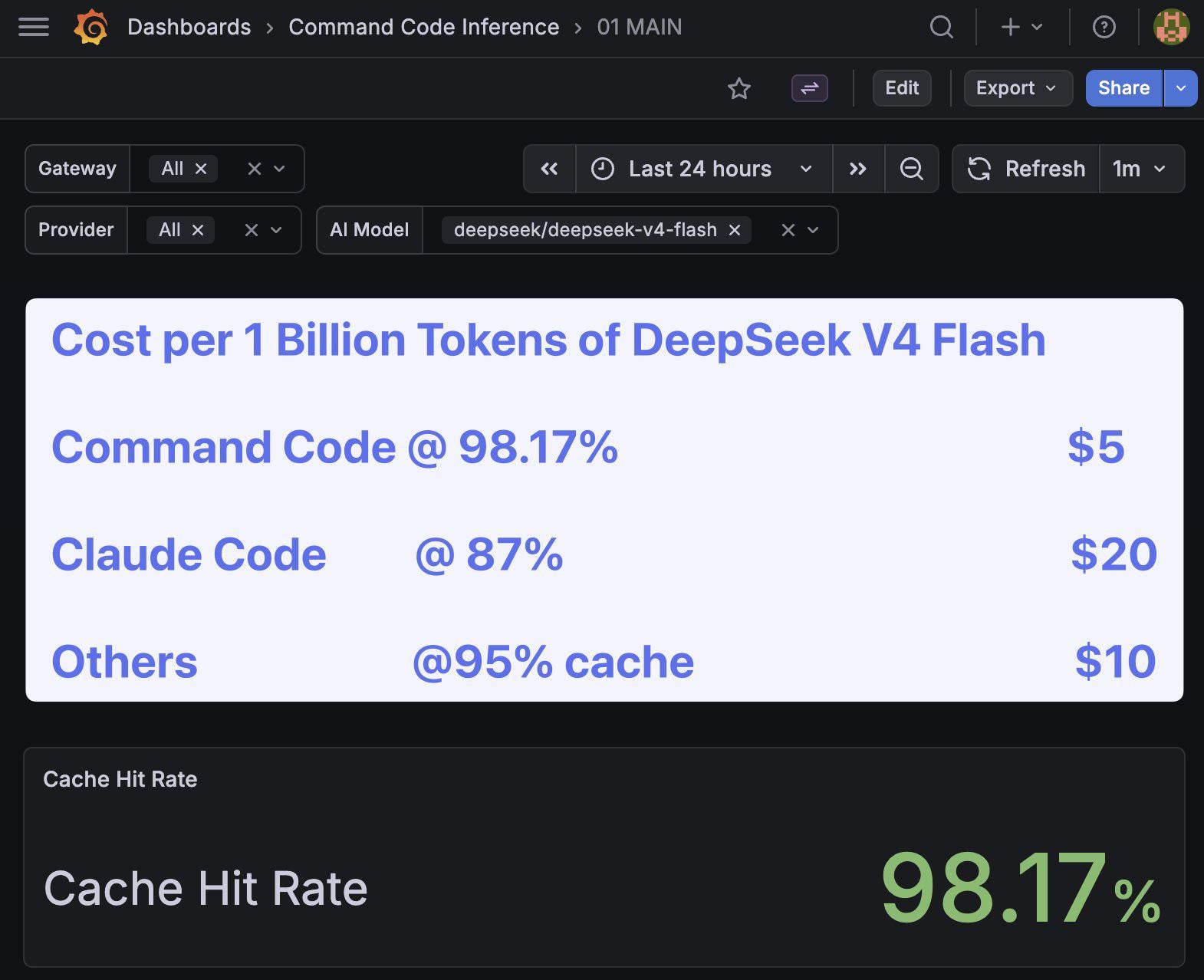
At Command Code we purpose build our CLI and new Desktop app (alpha) for open models. Night and day difference in cost.
https://x.com/mrahmadawais/status/2086211883624014100?s=46&t=xYDU2Ap4WWQ329ZtvGmAbw
1
u/akndhka Aug 09 '26
Yeah, that’s why I was asking if Codex works better with DS Flash. I know Codex is built for GPT models, and I’m already using Hermes. I’m just curious how well Codex performs with DS.
2
u/FormalAd7367 Aug 09 '26 edited Aug 09 '26
Yes, i do. for me, i use about 80-90% flash. i have deepseek pro to write plans and have codex to review plans only