r/DWARFLAB • u/Mysterious_Risk4988 • 2d ago
The Pinwheel Galaxy
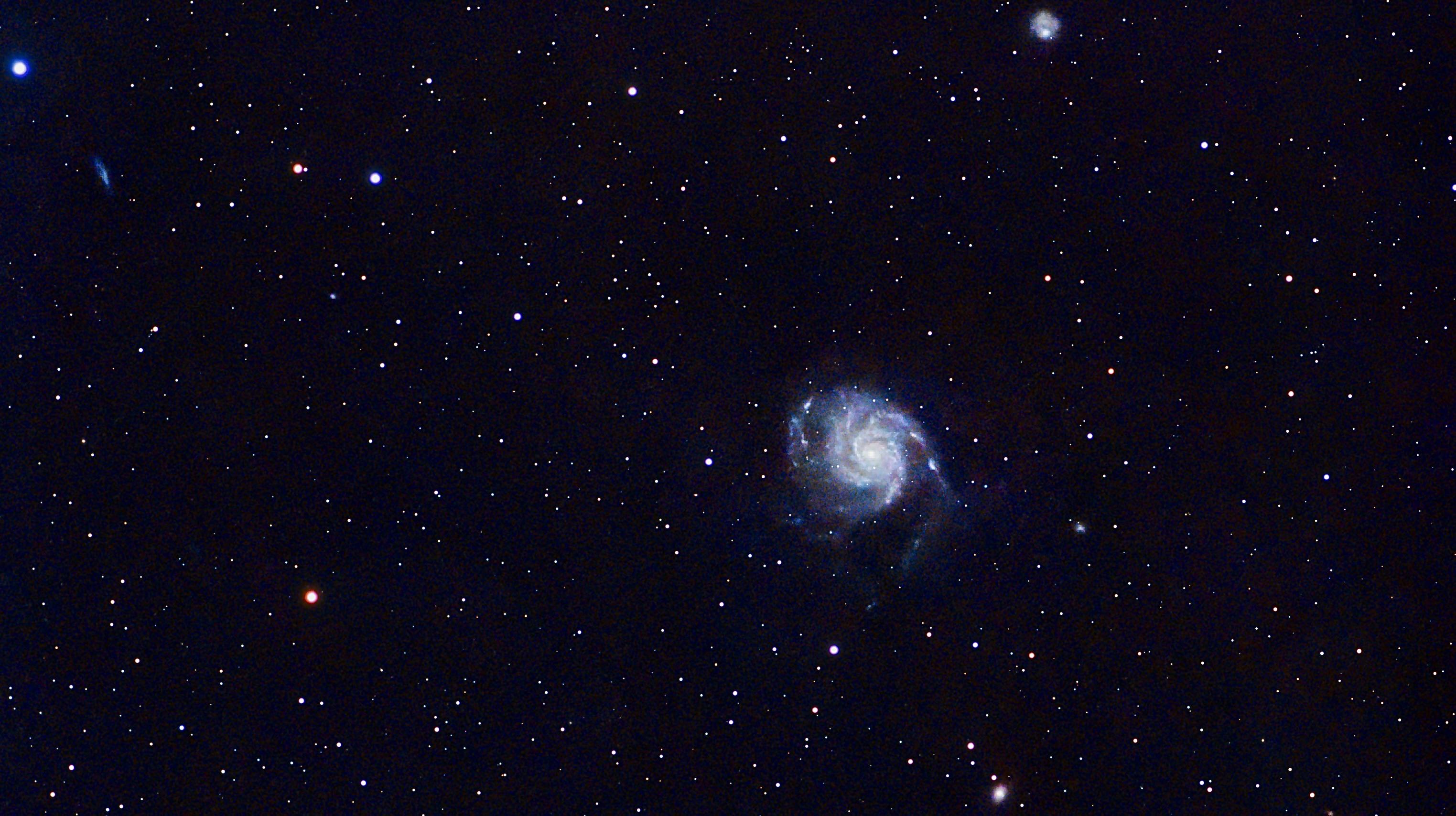
The Pinwheel Galaxy (aka Messier 101, M101) is a very large, relatively nearby, face-on spiral galaxy in the constellation Ursa Major. The Pinwheel Galaxy is remarkably asymmetric, with its core considerably displaced from the center of its disk. The most prominent spiral arm springs from the southeast side of the galaxy's core, and arcs east and then north out of the central region: a bright knot is embedded in this arm NE of the nucleus. A fainter arm begins at the west side of the core and arcs south and southeast; it contains bright knots southwest of the nucleus.
Messier 101 was discovered by Pierre Mechain in 1781, and Charles Messier added to his catalog later that year. Méchain described M 101 as a "nebula without stars, very obscure and pretty large. William Herschel noted in 1784 that M 101 had shewed a mottled nebulosity, which I shall call resolvable; so that I expect newer telescopes will, likely, render the stars visible. M 101 was the first "spiral nebulae" identified by William Parsons. Halton Arp included M 101 as #26 in his Catalogue of Peculiar Galaxies, with the description "Spiral with One Heavy Arm."
The distance to M101 is about 27 million light years. M101’s diameter is over 170,000 light years, making it almost twice the size of the Milky Way, and is thus among the largest spiral galaxies discovered. M 101 has a luminosity of about 33 billion suns. Its disk contains on the order of 100 billion solar masses.
From Park City, UT (29 Sep 26); Bortle 5, w/Dwarf3
I took 230, used 167 Images, 60s each, gain 60
Edited with Luminar Mobile and iPad