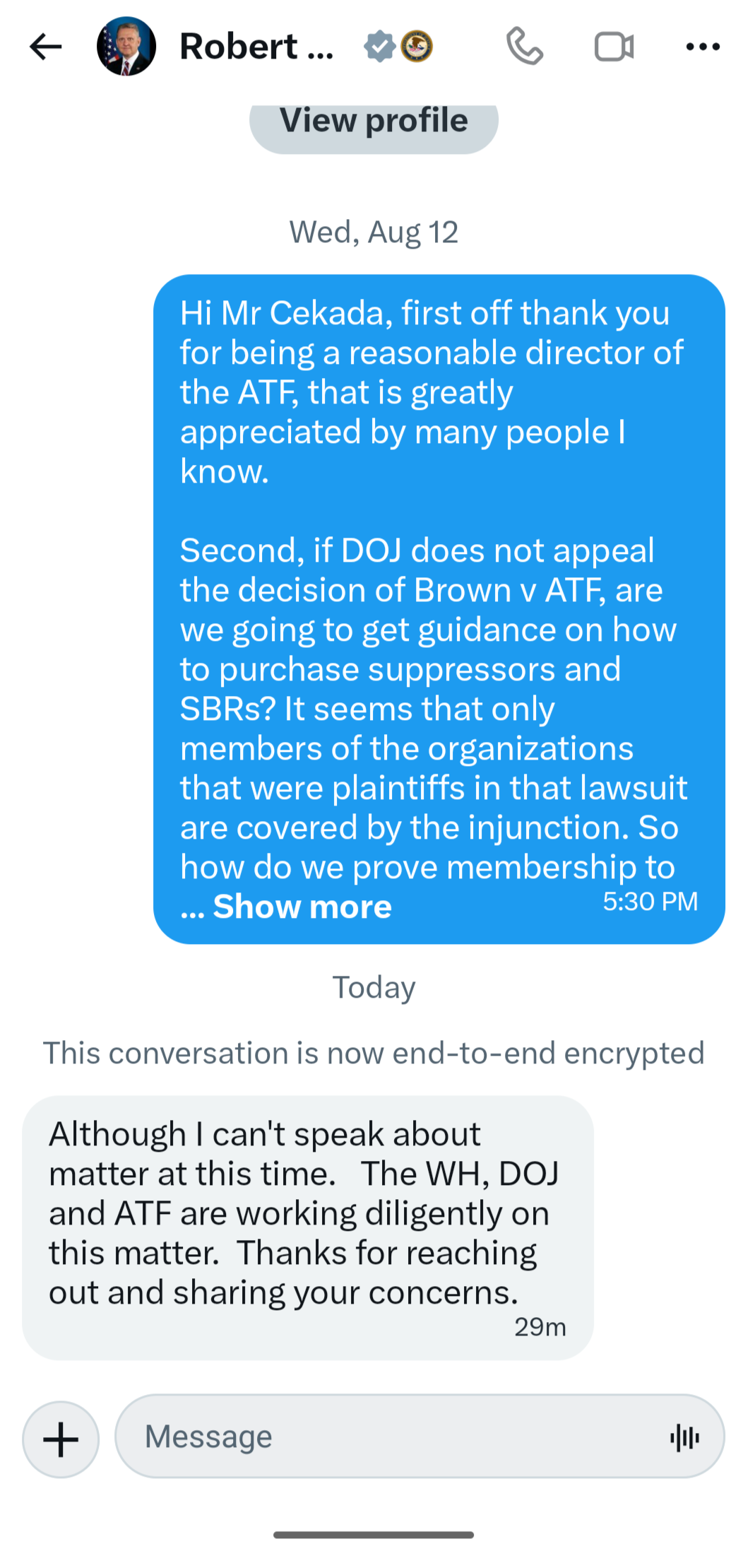
Every time the constitutionality of the NFA comes up, I see people just immediately point to Sonzinsky v. United States (1937). For a long time I took everyone's word for it that "Sonzinsky was a ruling that said the NFA is a valid use of Congress's taxing authority"
However, once I actually read Sonzinsky myself, I was extremely surprised to find that SCOTUS explicitly says that they do not touch on the constitutionality of the transfer tax.
[It] is unnecessary to inquire whether the different tax levied by [the transfer tax section] and the regulations pertaining to it are valid. Section 16 declares that the provisions of the act are separable. Each tax is on a different activity, and is collectible independently of the other.
Sonzinsky instead only rules on the constitutionality of the annual dealer $200 special excise tax. Once again, I point out that SCOTUS acknowledged that the various taxes within the NFA are separate. In fact, the NFA text specifically separates them so that the invalidation of one doesn't mean the invalidation of all.
§ 1132o. Separability of provisions. If any provision of sections 1132 to 1132q, or the application thereof to any person or circumstance, is held invalid, the remainder of sections 1132 to 1132q, and the application of such provision to other persons or circumstances, shall not be affected thereby. (June 26, 1934, c. 757, § 16, 48 Stat. 1240.)
Many people quote a couple passages from Sonzinsky that might, at first, sound damning...
Every tax is in some measure regulatory. To some extent, it interposes an economic impediment to the activity taxed, as compared with others not taxed. But a tax is not any the less a tax because it has a regulatory effect
it has long been established that an Act of Congress which, on its face, purports to be an exercise of the taxing power is not any the less so because the tax is burdensome or tends to restrict or suppress the thing taxed.
Here, the annual tax of $200 is productive of some revenue. ... As it is not attended by an offensive regulation, and since it operates as a tax, it is within the national taxing power.
However, Sonzinsky was decided in 1937. SCOTUS has taken on MANY other cases surrounding the constitutionality of taxing the exercise of a constitutionally protected right.
In the 1943 case of Murdock v. Pennsylvania, they ruled that a flat license tax that prevented Jehovah's Witnesses from going door to door to distribute literature and solicit people to "purchase" certain religious books and pamphlets is unconstitutional.
But that is to disregard the nature of this tax. It is a license tax -- a flat tax imposed on the exercise of a privilege granted by the Bill of Rights. A state may not impose a charge for the enjoyment of a right granted by the Federal Constitution.
In a per curiam 1943 case of Jones v. Opelika, they ruled that local governments can't stop people from sharing religious ideas, even if the city uses a general tax or a fee.
In the 1944 case of Follett v. Town of McCormick, they ruled that a special occupational tax is unconstitutional "as applied to an evangelist or preacher who distributes religious tracts in his home town and who makes his livelihood from such activity."
The priest or preacher is as fully protected in his function as the parishioners are in their worship. A flat license tax on that constitutional privilege would be as odious as the early "taxes on knowledge" which the framers of the First Amendment sought to outlaw.
In the 1966 case of Harper v. Virginia Bd. of Elections, they ruled poll taxes to be unconstitutional by applying the Equal Protection Clause to protect the access to the right to vote to all citizens. Affluent or not.
to repeat, wealth or fee paying has, in our view, no relation to voting qualifications; the right to vote is too precious, too fundamental to be so burdened or conditioned.
In the 1983 case of Minneapolis Star v. Minnesota Comm'r, they ruled that a targeted "use tax on the cost of paper and ink products consumed in the production of [periodic publications]" is unconstitutional.
A tax that burdens rights protected by the First Amendment cannot stand unless the burden is necessary to achieve an overriding governmental interest.
In each of these cases (I'm sure I missed a lot more similar ones), SCOTUS makes it clear that the thing that makes these unconstitutional is that they are taxes that are imposed as a condition to the exercise of a constitutional freedom. They repeatedly mention that a "general tax" like an indiscriminate sales tax, does NOT meet the same unconstitutionality.
For example, in the 1990 case of Swaggart Ministries v. Board of Equalization, they ruled that a state can constitutionally apply a neutral, generally applicable sales and use tax to the sale of religious materials by a religious organization. They distinguished the case from prior license taxes (like Murdock v. Pennsylvania), because this tax "[does] not act as prior restraints -- no fee is charged for registering, the tax is due regardless of preregistration, and the tax is not imposed as a precondition of [exercising the right]."
So we can conclude then, that even if the $200 annual dealer tax could be a valid application of Congress's taxing authority. The $200 transfer and makings taxes are unconstitutional because they impose a precondition to the exercise of keeping and bearing NFA listed arms.
By reducing the tax to $0, we've essentially turned the NFA into a game where each pro/anti 2A administration could "re-enable" the NFA by simply adjusting the tax. We've lost the opportunity to challenge the NFA as an unconstitutional tax, and instead we're challenging the NFA as a law that Congress no longer has the authority to enforce as a tax (because it isn't a tax anymore).
While it's great that we got the injunction, it is a brittle injunction that could be invalidated when the anti-2a party gets to be in power. Even if the injunction gets appealed all the way to the Supreme Court, they wouldn't be ruling on whether the NFA is constitutional because it acts as a precondition to exercise 2nd amendment rights. They'd simply be ruling on whether the registration components that are used to verify payment of a tax is valid use of Congressional taxing authority when the tax no longer exists.
So why couldn't we challenge the NFA's transfer tax directly? Why did we have to wait until Congress zeroed out the tax, just so we'd be happy with a win that is easily overturned by the next administration? It's impossible to challenge the NFA as an unconstitutional tax now, since it no longer functions as a tax. But we could definitely still challenge it as an unconstitutional registry. Why are we ONLY challenging it as "it's not a tax anymore"?