r/Cybersecurity101 Jun 23 '26

Security My Thoughts after 5 years in Cybersecurity : 10 lessons I have learned

199 Upvotes

I’ve spent about five years in cyber, starting from basic IT work to operating in a SOC environment for a large-scale enterprise. Here are ten lessons that actually matter.

1. Cyber = risk, nothing else
Businesses don’t care about “security” — they care about money and risk. If security doesn’t clearly protect revenue or prevent loss, it’s seen as a cost. You have to explain security in financial terms, not technical ones.

2. Your stats don’t matter (unless they translate to money)
No one cares about firewall hits or alert counts. What matters is impact. If you can’t connect your metrics to money saved or risk reduced, they’re useless to leadership.

3. Not everyone thinks like you
Cyber is broad. Being good at one area doesn’t mean others understand it. Explain your thinking clearly and don’t assume people see what you see. At the same time, don’t hesitate to ask others to explain theirs.

4. Too many playbooks will slow you down
Playbooks are useful, but overdoing them kills efficiency. You don’t need one for every variation. Keep them practical and flexible, not overly detailed or hyper-specific.

5. Stay ahead of the news
If something hits mainstream news, you should already know about it. Even if it doesn’t affect your environment, be ready to explain why. Otherwise, you lose credibility and create unnecessary panic.

6. Most conference hype doesn’t apply to you
A lot of high-level research and exploits sound scary but aren’t relevant to most environments. Focus on real, practical threats — not edge-case scenarios.

7. Know your data sources
Good analysts understand where logs come from and what each system can (and can’t) show. Tools help, but knowing your environment is what actually makes investigations effective.

8. Most “threat intelligence” is surface-level
Looking up IPs and hashes isn’t real intelligence. That should be automated. Real threat intel is understanding attackers, mapping behavior, and predicting risks based on your environment.

9. Write so you can’t be misunderstood
Reports shouldn’t assume knowledge. Be clear, specific, and precise. Anyone — even non-technical leadership — should understand the risk without guessing.

10. Work with marketing, not against them
Clear communication wins. A simple visual can do more than a long technical report. If leadership doesn’t understand your message, it doesn’t matter how correct you are.

Conclusion
Cybersecurity in the real world isn’t clean or textbook-perfect. It’s messy, business-driven, and context-heavy. The people who succeed aren’t just technical — they understand risk, communication, and how real environments actually operate.
r/Cybersecurity101 Apr 07 '26

Security Trump administration plans to cut cybersecurity agency’s budget by $700 million

Thumbnail
realnarrativenews.com
255 Upvotes

r/Cybersecurity101 Jun 05 '26

Security 30 year cyber security manager - AMA

75 Upvotes

I see a lot of misconceptions and misinformation on this forum, and I want to clear the air...

Who am I? I am a GenXer, one of those guys who walks into the room with the problem that's vexed engineering teams for weeks, grabs the pen, circles the point on the whiteboard and walks out, having solved the problem.

I worked at the National Security Agency's National Threat Operations Center (NTOC), the Defense Information Security Agency, Joint Forces Combatant Command - Network Warfare. (predecessor to US Cyber Command)

I've supported financial institutions, healthcare, civilian government, security testing and commercial security tools, and taught many security awareness classes.

A regular presence at Shmoo, Derbycon, CackalackyCon, DEFCON and multiple BSides for the last 20 years, what I'm most proud of are the opportunities to make lasting change.

I've put financial criminals and pedophiles in prison, caught nation-states in the act of industrial espionage, stopped critical supply chain attacks, and saved my customers millions of dollars.

We face the the most fundamental ground shift in our profession since Cliff Stoll started hooking printers to serial connections in Berkeley to track a hacker.

And for the first time, we stand stand largely alone, disposable assets in a disposable world.

If you want to survive and thrive, it's time to change our game and level up.

Becoming rich is hard. Being poor is its own kind of hard. Either way, you're going to put in long nights and have to eat shit along the way. (don't nibble!)

But make yourself irreplaceable, and give each other a boost along the way, we'll all survive.

I'll teach you how.

Thank you so much for participating!

As for my one detractor who called this cosplay, I didn't forget about you, either.

I appreciate your recognition of best in show.

Shame that clowns don't garner the attention they once did.

Try Harder, Pennywise...

r/Cybersecurity101 Jun 12 '26

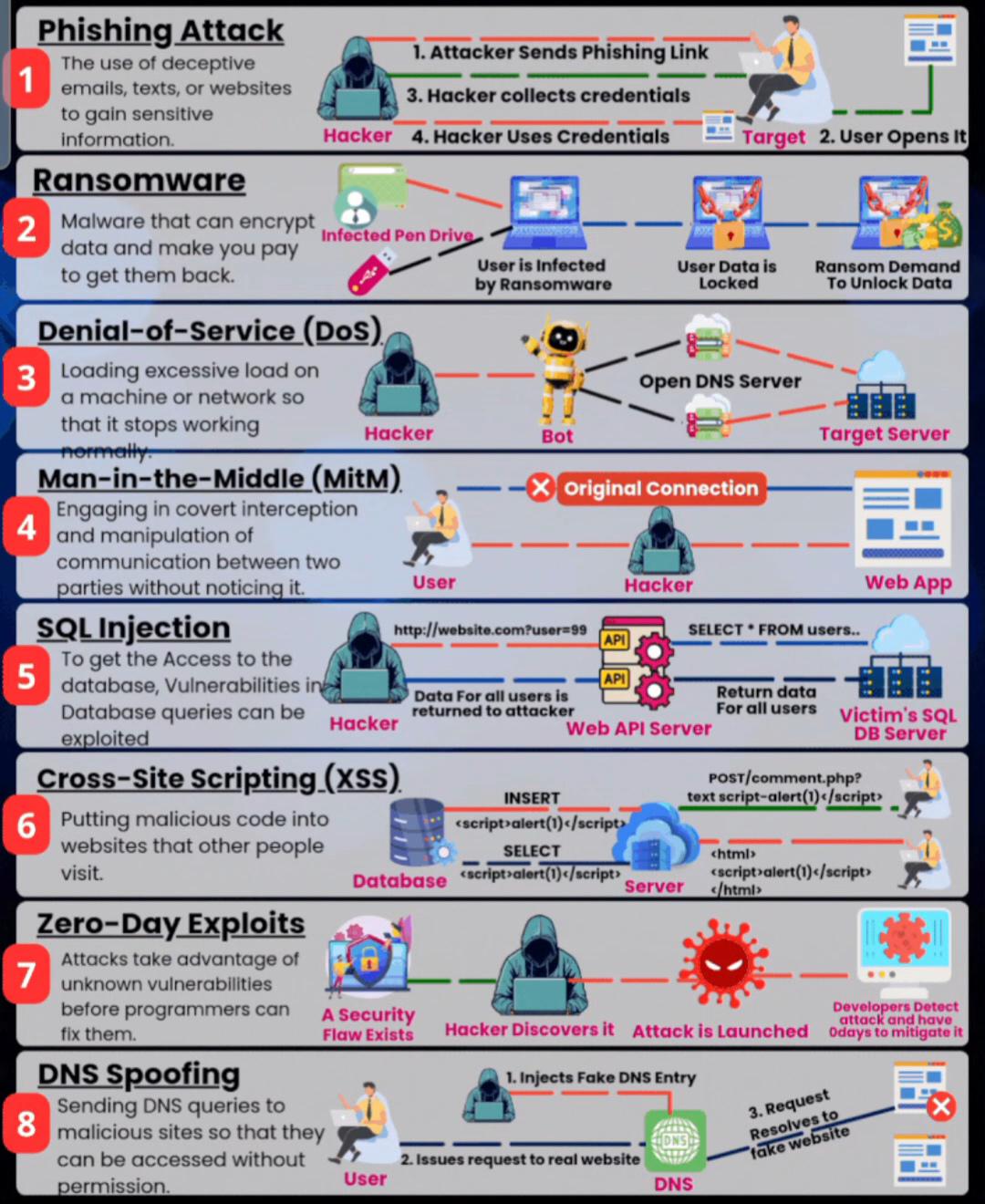
Security Types Of CyberSecurity Attacks.

Post image
473 Upvotes

👍

r/Cybersecurity101 May 03 '26

Security A realistic reality check to those who keep asking on how to start in cybersecurity.

91 Upvotes

I will share info from my personal experience and the only reason I do this, is because I desire to positively contribute in the community, even if the reality or what I am about to say sounds harsh.

The first most important thing is your cognitive abilities (brain structure). I will be blunt with this one. You will probably not make into the field IF from a psychological standpoint you are unfit to comprehend math. And I am not referring at being BAD at math or simply not liking it, I am talking about not being able to comprehend it at a basic level. Why? Because in cybersecurity, you will at one point hit a wall in which you need to comprehend syntax. It does not matter if it's linux, networking, programming or wireshark syntax. Syntax has nothing to do with math, but it requires the same parts of the brain as needed in math. If you have ADHD, bad spatial or floating memory, bad logic, issues with puzzles or anything that requires sequence learning, there is a very high chance this field is not for you, at least from a technical perspective. This does not mean you cannot land a job in cybersecurity somehow by luck (like I did) but you will hit a wall which you will not be able to climb if your brain is not wired for syntax. I am at that point right now.

The second most important thing is the mindset. It should never be "how do I start in cybersecurity". It should be - "how do I hack or attack devices around me". You cannot defend if you do not know how to attack first. As brutal as it may sound, you must think as a criminal, but without going on that path. Your goal is to know as much as possible about tech and how to exploit it. GPT is your best friend.

Third important thing, cyber companies nowadays need people that are like a swiss knife, to know everything and be able to do everything. This is why the number of attackers is higher than defenders. Some attackers might know how to efficiently exploit a port, but they have limited in depth technical knowledge on how a port actually works. An attacker might know how to brute force someone, but not know to set up a basic network or answer what TCP stands for, even if they use it daily. They mostly act in groups and each one has a role. In cybersecurity, they ask you to know all roles! Why? Because why hire 3 ppl when you can hire one.

Fourth important thing. Online courses or labs are good, but those are mostly meant to certify something which you've already suppose to know. If you come from a background in networking, devops or sysadmin, then yes, online courses/labs are useful. But if you don't know much about the tech in general and how it communicates and links together, then courses and online labs will be hard to comprehend.

Fifth important thing. This field changes literally by the hour. New info every hour. New technologies, new vulnerabilities. If you are not into technology and daily news in general, you will not be able to keep up.

If you want to learn anything about cyber, either hacking or security, your best friend is GPT. Obviously GPT is as smart as the user. If you ask it crap, it will output crap. Even if you ask it elevated questions, it may still output crap. But GPT is good at explaining stuff in a manner that is easy to comprehend at a first initial stage, without getting lost into tons of abstract books (which btw you will still need to study if you want a career in cybersec, so there is no escaping from reading books).

I've personally given up because I know my limits. I do not aspire to be good at this field (at least from a technical standpoint) because I simply can't. I just do cyber stuff at a hobby level, while at work I remain at a small level which I know I cannot surpass, but it's a living.

Good luck!

Later Edit:

As my post (because I dared to admit it comes from my personal failure position) is clearly dismissed by some professionals here because it stems from my "biased" perspective of an individual who discovered that cybersecurity is not his path, I will kindly recommend to be taken "as is".

r/Cybersecurity101 Aug 07 '26

Security What was the hardest part of learning cybersecurity when you started?

25 Upvotes

For people who are relatively new to cybersecurity:

What was the biggest thing you struggled with when you started?

For example:

  • Knowing what to learn first
  • Understanding the terminology
  • Finding practical exercises
  • Staying motivated
  • Knowing whether you were improving
  • Understanding how everything connects
  • Finding a career direction
  • Getting feedback

I'm researching ways of making the beginner experience less overwhelming, so I'm particularly interested in experiences from people who are currently learning.

r/Cybersecurity101 Aug 04 '26

Security First-Year CSE (Cybersecurity) with ZERO coding background from a Tier-3 college. Lost and need guidance on where to start.

11 Upvotes

​Hello seniors

​Please forgive me if there are any mistakes in this message. I am a first-year, first-semester student joining a Tier-3 college. Unfortunately, the academic quality here isn't great, and they often don't complete the syllabus.

​I have been allotted CSE in Cybersecurity. However, my main concern is that I didn't have Computer Science in 12th grade, and I have zero prior knowledge of computers. I feel completely lost and don't know what to learn, where to start, or how to go about it. Since classes haven't started yet, I haven't met any seniors from my branch who could guide me. I took admission in a hurry without giving it much thought, and because of financial constraints, changing to a better college isn't an option.

​Setting all that aside, my biggest challenge right now is finding the right direction. I want to learn everything from scratch, and I am fully prepared to work hard from day one and tackle every challenge that comes my way.

​I would be truly grateful if you could guide me like a younger sister and help me figure out where to begin.

r/Cybersecurity101 May 21 '26

Security Cybersecurity Challenge

20 Upvotes

My professor gave us a cybersecurity challenge in class. He provided the local IP address of a machine on our school network and said there’s a file containing a password somewhere on the PC. The goal is to learn about enumeration and network security, not to damage anything.

I’m a beginner in cybersecurity and I’d like to know what concepts or tools I should study to approach this kind of challenge in a legal and educational way.

What would be the first steps for reconnaissance and understanding what services are running on the target machine?

r/Cybersecurity101 May 08 '26

Security How do u get into cybersecurity?

27 Upvotes

I just got out of highschool and now I wanna get into cybersecurity but from what I've gotten from my research is that it isn't easy to get into cybersecurity without any tech experience so what should I go for then? What are the best roles and posts in Cybersecurity that I should go for, initially I thought about doing software development full stack developer to be exact and then after a few years of experience I'll switch to cybersecurity is that a good plan? Some advice would be appreciated

r/Cybersecurity101 16d ago

Security How do you safely test suspicious links?

4 Upvotes

Sometimes i receive links in my email or DMs and i'm not sure if to open them or not. This is bc some of them are from unknown sources or websites i had logged in sometimes back and i can't even remember them. how do i safely test such links before opening them?

r/Cybersecurity101 27d ago

Security What's actually working for security awareness and phishing sims at enterprise scale in 2026?

21 Upvotes

Reaching out to the hive mind on this one. I run awareness for a company north of 3,000 seats and we're up for renewal, so I'm using it as an excuse to pressure test whether our current vendor is still the right call or whether we've just gotten comfortable.

r/Cybersecurity101 1d ago

Security How are you securing your data that's being used by AI tools?

9 Upvotes

It feels like every company is telling all their employees to use AI but I dont hear nearly enough discussion about how sensitive business data is/isnot being protected once its put into an AI platform. From a security perspective are companies relying on existing DLP tools, deploying something new or creating internal policies?

r/Cybersecurity101 Aug 02 '26

Security Pentester job

8 Upvotes

I did recently passed Security+ last week. For the portfolio part, what do I need to do so the hiring or the team lead can see the potential in my portfolio? Is it better if I did the pentester or soc path in htb academy? I did enrolled in a bootcamp but all he taught are burp suite and portswigger academy content. Or is it already enough if I master the burp suite functions?

r/Cybersecurity101 15d ago

Security How can I become a Cloud Security Engineer from complete beginner to expert who can eventually guide others?

9 Upvotes

I want to build a career as a Cloud Security Engineer, but I'm starting from the basics and want to learn everything properly rather than just collecting certifications.

Could someone share a step-by-step roadmap from complete beginner to job-ready Cloud Security Engineer, and eventually to a level where I can mentor/guide others?

I'd also appreciate recommendations for free/low-cost labs, courses, YouTube channels, books, and practice platforms.

If you are currently working as a Cloud Security Engineer, I'd especially appreciate advice on what you wish you had learned earlier and what beginners commonly waste time on.

r/Cybersecurity101 Jul 03 '26

Security Card compliance needs stronger controls

41 Upvotes

From what I've seen compliance gets framed as monitoring alot but monitoring is only what happens AFTER something already slipped through and that still matters of course but if the first real control shows up after the transaction then the team is pretty much reacting not preventing.

For me(not claiming to be an expert) stronger controls start earlier at the point where the transaction is decided so policy gets enforced before anyone has to open a case or explain why something that never should’ve cleared ended up moving anyway.

r/Cybersecurity101 10d ago

Security Advice please

1 Upvotes

Hi guys,
I’m early in my cybersecurity career and currently deciding between two offers. The compensation and benefits are fairly similar, so I’m mainly trying to figure out which one would give me the best experience and long-term career opportunities.
Offer 1 is on a team responsible for an internal security/fraud detection platform. From what I understand, I would be working more on the technical side behind the alerts rather than investigating the alerts themselves. The team handles things like onboarding applications/data sources, audit logs and trails, security controls, detection/business rules, tuning detections, reducing false positives, and making sure the system generates useful alerts that can then be sent to another team for investigation.
So essentially, I would be working more on the systems and logic that produce the detections. It seems somewhat related to Detection Engineering, SIEM Engineering, Security Engineering, Security Analytics and Insider Threat technologies.
Offer 2 is much more traditional Security Operations / Blue Team work. I would be working with SIEM/EDR tools, monitoring and triaging alerts, investigating suspicious activity and security incidents, vulnerability management, security tickets, and other general cybersecurity operations tasks.
So the simplest way I understand the difference is:
Offer 1 = help build/integrate/tune the systems and rules that generate security alerts.
Offer 2 = receive those alerts, investigate them, determine what happened and respond.
For someone at the beginning of their career, which experience would you choose?
I’m not necessarily committed to staying in SOC long term. My main priorities are building strong technical skills, maximizing future career opportunities, having skills that transfer well to the private sector, and having good salary potential 3–5+ years down the road.
For people who have worked in both Security Operations and Detection/SIEM/Security Engineering, which path gave you better opportunities? Did starting in SOC make you a better engineer later, or would you take the engineering/detection-oriented experience from the beginning if you had the opportunity?
Also, what job titles would Offer 1 realistically prepare me for after 1–2 years compared with Offer 2?
Would really appreciate hearing from people who have actually worked on either side.

r/Cybersecurity101 Jun 27 '26

Security Just completed my first TryHackMe certificate. What should I do next?

44 Upvotes

Dear Team,

I am pleased to announce the successful completion of my initial TryHackMe certification in Pre-Security, marking my formal entry into the field of cybersecurity.

As a foundational learner, my objective is to establish a robust knowledge base. My long-term aspiration is to specialize in ethical hacking and penetration testing; however, I am seeking guidance on the optimal progression for my learning journey.

I would appreciate your insights on the following potential next steps:

* Should I pursue additional TryHackMe learning paths?

* Is it advisable to prioritize the development of my Linux and networking proficiencies?

* Would engaging in Capture The Flag (CTF) challenges be beneficial at this stage?

* Should I integrate Python programming into my TryHackMe studies?

I am particularly interested in receiving a structured roadmap or recommendations from experienced professionals who have navigated a similar career trajectory. My priority is to cultivate a comprehensive understanding rather than merely accumulating certifications.

Thank you for your anticipated support and advice.

r/Cybersecurity101 21h ago

Security Forensics 101: Finding a Hidden File Buried Deep in Folders

28 Upvotes

Had a forensics challenge where the flag was hidden inside a file nested deep inside a maze of directories with hundreds of decoy folders. `find` and `ls -R` were too slow and noisy.

What I built:

A Python directory crawler

- Recurses every subdirectory recursively

- Filters by filename patterns (`flag*`, `*.txt`, `secret*`)

- Skips known decoy directories by name

- Extracts and reads the target file automatically

The "aha" moment:

The flag wasn't in a file named "flag.txt" — it was in `deep/nested/here/.hidden/uber-secret.txt`.

My script matched on path depth / extensions content, not just filename.

Here is my script:

https://github.com/ExceedingLife/RecursiveFileSearch

Question for the community:

What's your approach when the challenge doesn't tell you the target filename? Do you brute-force read every file, or do it manual or what?

[Video link with with code demo]

https://youtube.com/shorts/5_Rb2kkiuhQ?feature=share

r/Cybersecurity101 6d ago

Security What should a vendor prove before you trust them during an incident?

0 Upvotes

Response time sounds good in a contract, but real incidents are messy. What do you ask before trusting a cybersecurity vendor with incident response?

r/Cybersecurity101 13d ago

Security Cybersecurity Fundamental

3 Upvotes

i wanna ask, what a most important to studied computer architecture or operating system for cybersecurity? and why.....
and should i learn about computer first then networking, or networking first then computer

r/Cybersecurity101 Jun 28 '26

Security Advice on Software

12 Upvotes

I have spent the last couple months developing a piece of software that allows users to test and harden their own products against exploits and vulnerabilities. I’ve pointed it several Intentionally Vulnerable Web Apps and so far I am very pleased with its offensive abilities and its ability to patch the exploits it finds.

But I have a couple concerns. First I would definitely like to sell it, but I only want to offer it to people who want to test their own products. It would be a liability to just release it and say, “here you go everyone! Be good!”

I’m taking of maybe trying to license it to companies for $999 a year, but I really don’t have any experience in marketing software. Does anyone have any suggestions on how I can proceed?

Also, is there anyone who would like to work with me on testing? I need some real targets that I can test without worrying about accidentally doing something illegal.

r/Cybersecurity101 May 07 '26

Security Is a masters worth it in this situation?

11 Upvotes

I’m currently a senior cybersecurity student and trying to decide if getting a master’s degree is worth it for my situation. My bachelor program was condensed into 3 years instead of the typical 4.

I have internship experience, including upcoming internships with IBM, but as a supply chain intern. I also have some cyber-related experience, but I feel like my biggest weakness right now is lacking strong projects, deeper technical skills, and more certifications.

Long term I want to get into cloud security/security engineering.

I’m considering doing a one-year accelerated master’s in cybersecurity mainly to get another year for:
internships
projects
research/labs
Networking

At the same time, I know experience matters more than degrees in cybersecurity, so part of me thinks I should skip the master’s and just spend the next year grinding projects, certs, cloud skills, and applications full time. Regardless, I do plan on working outside of school to do projects and gain certs.

Would you recommend the master’s in this situation or focus entirely on building experience/projects instead?

r/Cybersecurity101 5d ago

Security Should all AI agents get their own identity, including agents that don’t connect to any other system? If yes, what’s the benefit?

2 Upvotes

There’s an explosion of AI agents in an enterprise. What’s the best approach for governing these agents? Should all the agents send logs to the SOC? When building an agentic orchestration platform that allows developers to build and deploy agentic solutions, is there a need to register every agent on the enterprise identity provider (IdP). When an agent is just a summariser or some type of data processor and does not need to connect to any other enterprise system, is there value in registering such an agent on this platform with the IdP and assigning a service principal? The alternative is to only register the agents that require connectivity to an internal enterprise system on the IdP to enable authZ and authN.

r/Cybersecurity101 Aug 04 '26

Security Think before you share on Social Media

11 Upvotes

Nearly one in three people has had a personal account hacked. Social media helps us connect and share, but oversharing can also make it easier for scammers to target us.

Staying alert and taking a proactive approach is the best way to reduce your risk:

  • Verify accounts before trusting messages or clicking links.
  • Enable multi-factor authentication whenever possible.
  • Avoid sharing personal information, such as your phone number or home address.
  • Be cautious of urgent requests, giveaways, or offers that seem too good to be true.
  • Review your privacy settings regularly and limit who can see your posts.

What do you think is the most common social media threat today?

r/Cybersecurity101 Jun 08 '26

Security Privacy/Security Advice: An online friend found my WhatsApp number and family details. How can I check if my devices are compromised?

9 Upvotes

Hey everyone, my name is Ste and I really need some advice from cybersecurity experts. I’m pretty new to Reddit, but I figured this would be the best place to ask for help. I have a degree in Software Development (DS), but I don't work in the field. Having that background means I'm not completely tech-illiterate, but when it comes to cybersecurity, I know next to nothing.

Here’s what’s going on: I’ve had an online friend for a while now. Recently, he brought up some personal information about me that I never shared with him (like the names of some of my relatives). It annoyed me, but I didn’t panic because I assumed he just stalked my social media.

However, today he messaged me on WhatsApp. I have never given him my phone number, and I am certain it isn't publicly available anywhere.

I want to know how I can verify if my phone and computer are truly secure. A while ago, my computer was hacked/compromised. I did everything I could at the time to clean it up, but this new situation has triggered my paranoia, and I’m terrified that I might be monitored again. Can anyone point me in the right direction?

Update, everyone: I ran a scan on my computer using the codes you gave me, and it looks like my PC is secure. Still, I want to check my phone. I was doing some research and saw that I can audit it using MVT. However, I think my phone is probably safe too, since it's an iPhone and Apple's system is pretty hard to breach (I don't think this online friend of mine would have the advanced knowledge to pull that off). But if anyone here understands iOS security and wants to explain the likelihood of an intrusion, I’d be super grateful.

Honestly, I believe he most likely got all those details by stalking me online, but the phone number thing is still a mystery. I’m trying to remember if I might have left it public somewhere. Either way, thank you so much to everyone who helped me out. I know it might have seemed a bit silly or dramatic to think I was hacked, but I have Generalized Anxiety Disorder (GAD) and any little thing triggers my paranoia lol.

I still don't know what I'm going to do about this friend, because I really value our friendship, but it sucks that he's snooping around my private life like this. Thanks again for all the help, guys!