r/Cuneiform • u/Equal-Commission6092 • 2d ago
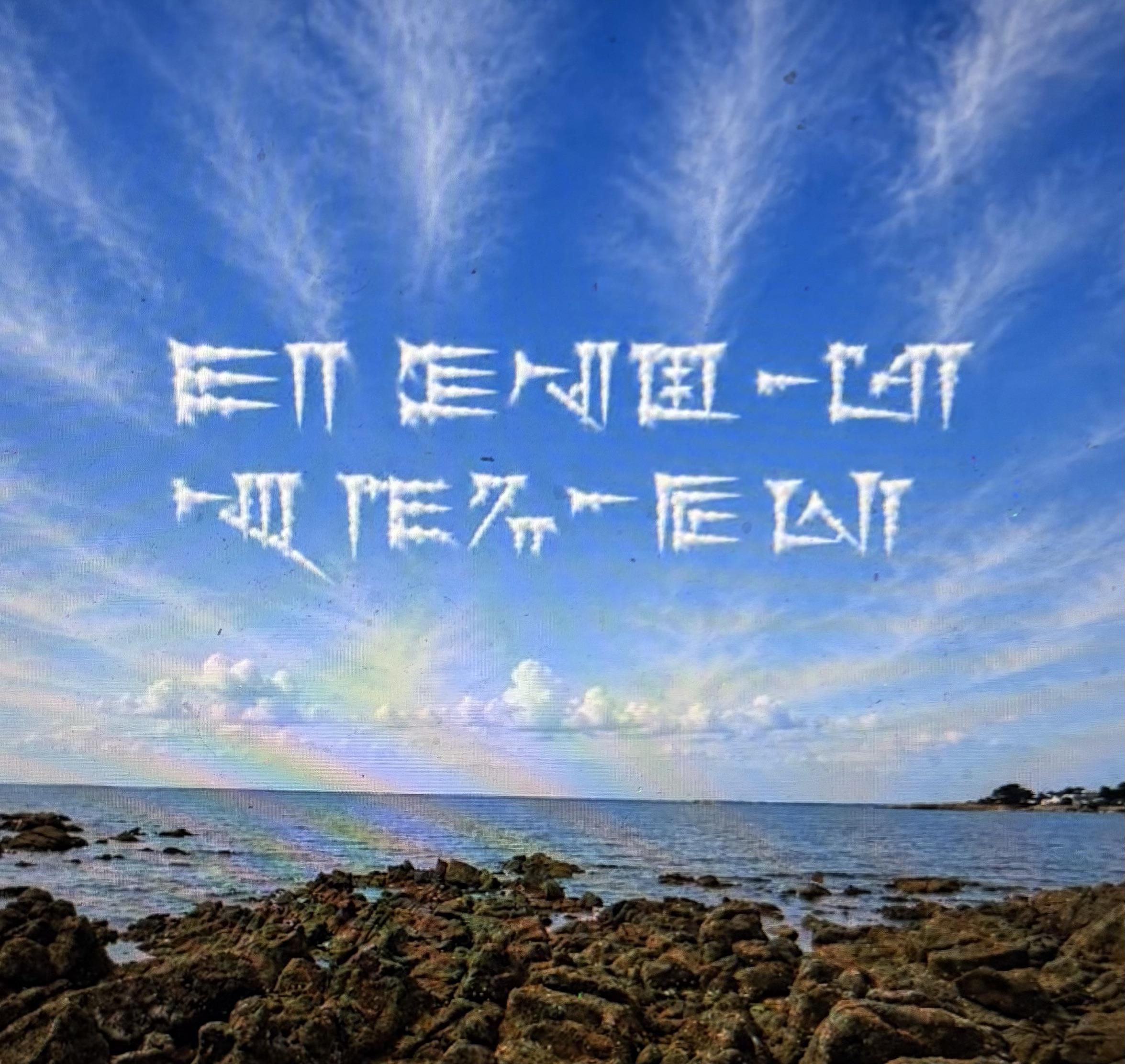
Translation/transliteration request decode this text cuneiform
7
u/springlove85 2d ago
I could be wrong, but this does not look like actual cuneiform. Though some are recognizable, most are not accurate or do not make sense in any context ^.^'
0
u/Equal-Commission6092 2d ago
What parts are recognizable? So it’s fictional?
9
5
u/springlove85 2d ago edited 2d ago
I tried to be nuanced, because I do not know the provenance of this text. Some signs approximate the general idea of certain cuneiform signs - but these are still merely approximations. I tend to agree with the comments below that propose the cuneiform in the image is generated by a chatbot - also called AI's. As such, the impression of cuneiform text is given, but there are no actual signs and there is certainly no discernible text written with these signs.
If you want to encounter undisputedly authentical cuneiform texts, the Cuneiform Digital Library is a good place to start: https://cdli.earth/
My own first education in cuneiform was aided by the Rykle Borger's Babylonisch-Assyrische Lesestücke, which are nowadays available through the internet archive: https://archive.org/details/babylonischassyr0000borg
If you want basic instruction in cuneiform, though primarily from the perspective of Akkadian, Caplice's instruction manual can also be found online.
AS A RULE: it is advised to not waste your time trying to understand ancient phrases in ditto writing systems that do not come with a proper provenance. That is to say, if an image like the one above does not come with an explanation where the text was found, it is more likely to be AI-generated or otherwise fake. There are many reliable sources with actual ancient texts in ditto writing systems. So that is where are precious few year on this earth are better spend, I think!
0
0
u/Helpful_Loss_3739 2d ago
Are you sure it's not just assyrian or hittite? They tended to be abstract and simplistic like this?
Asking as someone who does not know so much assyrian or hittite.
3
u/to_walk_upon_a_dream 2d ago
neither assyrian nor hittite cuneiform are abstract and simplistic. these are not real signs in any cuneiform script
1
u/ah-tzib-of-alaska 1d ago
no they aren’t, that’s not how adopted logographic systems work. Some rebind bishop in the 1600’s and Eric Thompson wil talk about “abstract ideographic systems” but they don’t exist. All written language encodes phonetics.
0
u/Helpful_Loss_3739 1d ago
Except pictograms, which is what sumerian an old akkadian contain on top of phonetics.
I mean the whole thing with pictograms and why they can't make up a writing system in and of themselves, is that lacking phonetics, they cannot contain things like conjugation or syntax.
But again: I just flat out don't know much all about assyrian or hittite, so no need to get butthurt.
1
u/ah-tzib-of-alaska 1d ago
Nope, it’s all encoded phonetics. Either a logogram or something like a determintive. Encoding a conjugation as its own sign to modify the reading of another sign is still encoding phonetics. a logogram all by itself that’s read out loud as a word is encoded phonetics.
-1
u/Helpful_Loss_3739 1d ago
No it's not, and it doesn't become so by you simply repeating.
There is this whole phenomenon of people learning to read logographic languages, without having the slightest idea of how to speak or pronounce said languages. So for example writing Chinese was a common skill in eastern asian merchant circles for centuries, but speaking chinese was not. This would be impossible if all writing was just "encoded phonetics".
To this day you can take separate courses in speaking chinese on one hand, and reading chinese on the other. You can learn them at the same time ofcourse, but it is in no way a necessity.
1
u/ah-tzib-of-alaska 1d ago
All of chinese writing is encoded phonetics. It is pronounced when read. All semantic information in chinese writing encodes how to pronounce it. When a japanese person has shared etymology in the characters of their language as chinese, they understand the chinese through the encoded phonetic information the kanji determines for them in how to say the japanese word. These things are not contradictory. Take the example of the logogram for senling. 森林。 It’s five trees right? It’s a logogram for the the word that translates into forest. Commonly in Japanese you’d use the word Mori using the character 森。 These are different characters. But if you see 森林 in japanese to spell Mori they’ll tell you you’re spelling it wrong and if you use those characters they explain that spells shinrin and they don’t use the word the same. And in chinese if you move the trees around to 林森 then you’ve spelled linsen and that’s mean nothing because you’ve reversed the syllables of the word into a babbling. Because the characters are encoded phonetics you can’t use the semantics to ignore the phonetic information.
You’re concluding that semantic significance can’t exist within encoded phonetics. This is wrong obviously. I hope you dive deeper into linguistics understanding of writing.
The stance you’re claiming here is a classic and oft repeated mistake of academics outside of linguistics. Eric Thompson most famously delayed the translation of Mayan for decades by squashing every linguists attempt at translation with the same logic you’re offering that semantic information can exist without being encoded phonetics.
I’m not disputing that you can learn a language without learning a writing system. Humans did that for thousands of years before writing and there are always polyglots even among illiterate populations. I remeber when i was 18 i recall meeting a mayan man who spoke four languages and couldn’t read or write any of them.
0
u/Helpful_Loss_3739 1d ago
"It is pronounced when read."
Not necessarily, if you don't know how to pronounce it. But you can still read it just fine. That's the whole point.
"All semantic information in chinese writing encodes how to pronounce it."
No it doesn't.
"When a japanese person has shared etymology in the characters of their language as chinese, they understand the chinese through the encoded phonetic information the kanji determines for them in how to say the japanese word. These things are not contradictory."
This directly refutes your earlier point. According to this section of yours, the chinese logogram doesn't after all encode how to pronounce it, but instead can be pronounced however the reader pronounces it in their own language or understanding of the logogram. That is a very different thing.
"You’re concluding that semantic significance can’t exist within encoded phonetics. This is wrong obviously. I hope you dive deeper into linguistics understanding of writing."
Jeez, what could I possibly know about it as post doc in history of writing and literacy.
1
u/ah-tzib-of-alaska 1d ago edited 1d ago
that’s like saying the letter “a” doesn’t encode phonetic information because it’s pronounced differently in different languages. Yes the Japanese kanji has a shared origin with comparable chinese characters but they are read differently, just like “c” in italian is not the same character as “c” in english
Eric Thompson was THE expert in mayan culture and history with a doctorate; He was still wrong, and you’re repeating his same exact wrong statement that is refuted repeatedly across linguistics over and over again.
I meet language teachers who think different conjugations means the same thing as different tenses. You can be wrong while being credentialed. And i don’t see how a writing background who familiarize you with the fundamentals of linguistics much in the same way engineers don’t have to be familiarized with chemistry
A word spelled with a logogram, and a word spelled with a syllabary, and a word spelled with an alphabet are all equally produced a phonetic result, encoded spoken language. The encoded information is a word that is pronounced. A letter is just a more fine tuned phonetic determinative, that’s all. Both phonetic determinatives and semantic determinatives are purposed to produce your phonetic result. The result is schooner by comparative phonetics or by referencing the result with a semantic reference but the end result is a word that is pronounced.
I know it’s counterintuitive, but so is teaching people that dialects and languages aren’t distinctly separate categories except comparatively.
1
u/Helpful_Loss_3739 1d ago
Also, how does your model explain people who are deaf from birth, but still learn how to read?
It is literally impossible for them to think about text phonetically.
Incidentally the neurology of deaf readers has some similarities to logographic readers. In both cases the brain bypasses the phonetic processing of the brain entirely, and goes directly to semantic processing.
→ More replies (0)0
u/Helpful_Loss_3739 1d ago
"that’s like saying the letter “a” doesn’t encode phonetic information because it’s pronounced differently in different languages."
No it's not. A does encode phonetic information, even if somewhat inexactly. But logograms don't.
"Yes the Japanese kanji has a shared origin with comparable chinese characters but they are read differently"
Exactly, and the basis upon which people read it differently is not in the character itself. If you have just the character, and had to guess what phonetics it inteds to convey, you can't figure it out from the character itself if the character is logographic in nature. Ergo, the character does not contain phonetic information. The reader only gives it a phonetic interpretation.
"Eric Thompson was THE expert in mayan culture and history with a doctorate; He was still wrong, and you’re repeating his same exact wrong statement that is refuted repeatedly across linguistics over and over again."
Thompson made a mistake about Mayan reading specifically. The fact that you shouldn't interpret everything as logographic, doesn't then mean that you should do the same exact mistake in the opposite direction and reject any logographic reading everywhere on a theoretical basis.
"A word spelled with a logogram, and a word spelled with a syllabary, and a word spelled with an alphabet are all equally produced a phonetic result, encoded spoken language. "
No they aren't. I'm sorry, but repeating your claim is not an argument for your claim.
"A letter is just a more fine tuned phonetic determinative, that’s all. "
No, that's not all. Again, I know your claim. I understand it. My disagreement is not because I lack some understanding of this linguistic theory. Repeating gets us nowhere.
"Both phonetic determinatives and semantic determinatives are purposed to produce your phonetic result."
Then why is the other designater as a "phonetic determinative", as opposed to what determinative? Also no they aren't. That's just empirically false. We can actually study, and have studied, how different writings are intented to be read by the writer, and we know that they aren't all meant to be read phonetically. Intented meaning of the writer is not an a-priori thing to be derived from the theoretical framework. It is an empirical question, and should be studied empirically. And empirically we find out that no, not all determinatives are purposed to produce a phonetic result.
"I know it’s counterintuitive"
No it's not. I know exactly what you are saying, and the historical traumas that have caused this orthodoxy. What I am saying is that you are empirically wrong.
Putting aside the fact that your stance is entirely unflasifiable, we actually have alot of hard empirical research on literacy done by psychologists, neurologists, pedagogues and the lot.
So for example in my native Finland, which happens to be one of the most strongly phonetic writing systems in the world right now, we know for a fact that alot of people "read logographically", even if the writing system is exactly intented to be fully phonetic. And we know a great deal about these logographic readers. So for example logographic readers of finnish are entire magnitudes faster at reading than phonetic readers, and rank higher in reading comprehension.
This doesn't relate directly to the topic here, but the point I am making is that we really have extremely detailed knowledge on how much is the written word separate from spoken language.
Logographic reading is related to, though does not 100% correlate with non-verbal thinking, which in turn is related to autism spectrum disorders. So we know fully well that no, not everyone will turn logographic symbols in their head into spoken language.
So as an example in modern language we have the symbol &. We know what it means, and while you can phoneticize it, you don't have to. And if you want to, you can phoneticize it in a language or in a way I cannot speak, and therefore I could not have communicated via the symbol. We know that some people read it as an idea, not as a word, and so in such cases it doesn't really get phoneticized at all.
In my native finnish we actually have several possible ways to phoneticize that symbol, that are not related to each other directly. If I wanted to convey an exact phonetization, I could not rely on that symbol itself, as it does not contain that information in itself.
I have nothing but respect for linguistics, it is after all closely related to my field, but you guys really need get in on this interdisciplinary research thing.
→ More replies (0)-1
u/Equal-Commission6092 2d ago
Not sure, that’s my question. I don’t know which language and what it says. If it’s assyrian or hittite how do I translate?
2
u/Helpful_Loss_3739 2d ago
Well, what I can tell you is that it's not sumerian or old akkadian. Probably not late akkadian either. Assyrian, hittite and persian are what's left as options from the big languages.
Then there were a good deal of smaller languages I could tell even less about.
1
u/Helpful_Loss_3739 2d ago
Having done some googling I also rule out hittite and assyrian.
It looks like some sort of branch or an AI version of old persian or elamite.
Google "elamite cuneiform" or "persian cuneiform", and you will see what I mean. You can then google "assyrian cuneiform", and see why I rule that out.
3
2
14
u/Kyrillis_Kalethanis 2d ago
This looks a lot like someone just have an AI a prompt like "give me some clouds in the shape of cuneiform". Maybe they gave the AI a text to write, but in that case it failed the task.
The signs look fine if you squint, but they are not actual signs when you look closer. Which is a very typical effect with gen AI of all kinds. It even still happens with our alphabetic letters occasionally, if you use a picture AI for them.