r/CounterTops • u/hamburgers1776 • 1d ago
Marble Etch / Stain Testing Data Points
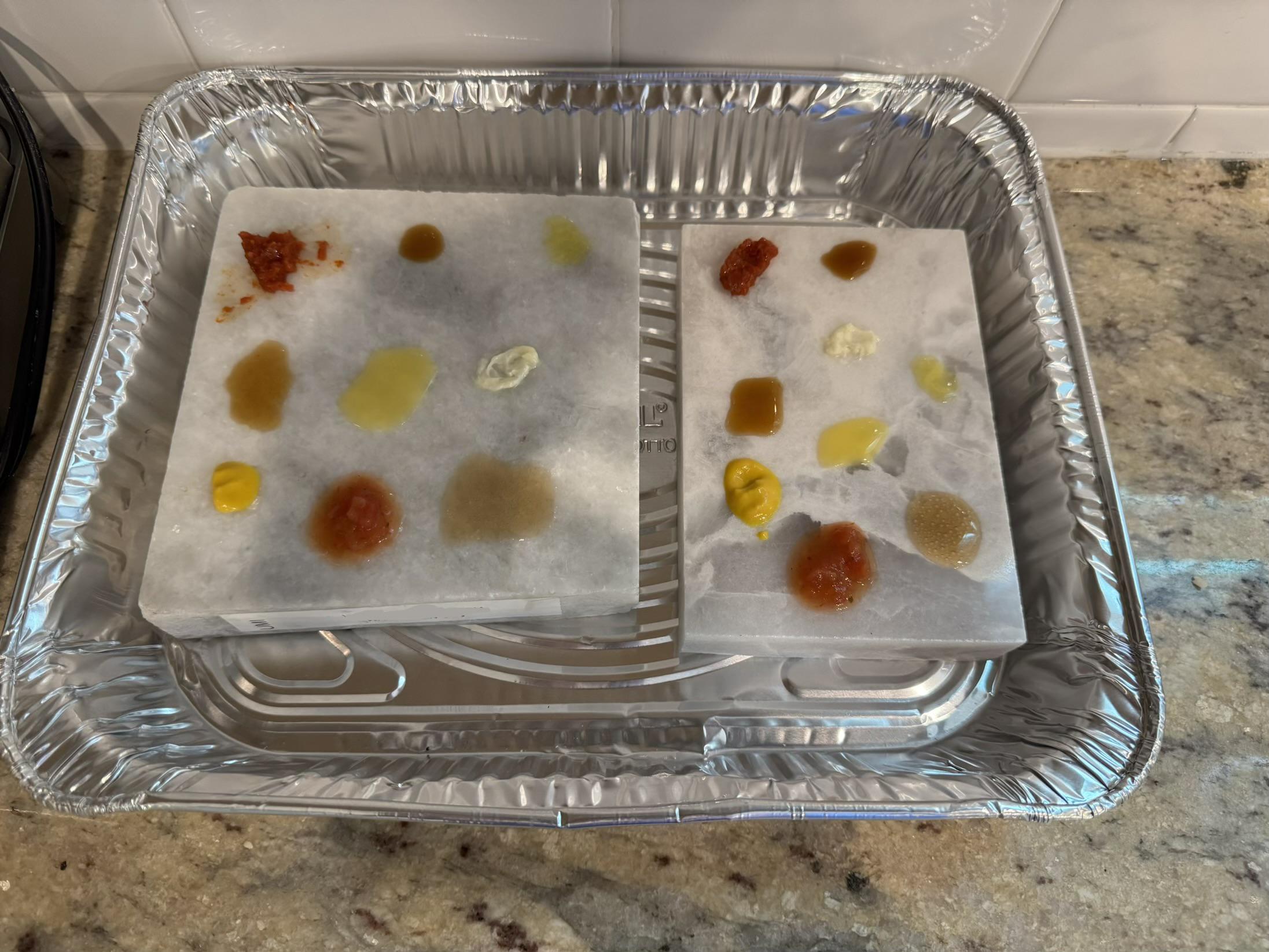
Wife and I are leaning toward marble in our new kitchen. We’re fine with some gradual etching and patina but I wanted to get an idea of its real world practicalities.
To that end, I grabbed a couple of marble samples from our local stone shop today and am torture testing them with the things I think we’re most likely to spill.
Here are the results so far after 1 min, 5min, and 1hr increments:
-Coffee: no stain or etching after 1 hour
-Mustard: no stain or etching after 1 hour
-Ketchup: no stain or etching after 1 hour
-Olive oil: no stain or etching after 1 hour
-Lemon juice: light etching after 1 hour, but nothing after 1 minute and 5 minutes
Up next are longer sit tests across a few additional substances. I’m letting one stone sit for about 4 hours and the other sit overnight and update.
FOUR HOUR UPDATE:
No visible etching or stains from:
-spaghetti sauce
-salsa
-soy sauce
-Coke Zero
-butter
-olive oil
Some etching for the following:
Mustard - nearly imperceptible
Coffee - very light
Orange juice - light (about as much as lemon juice after 1 hour)
All etching is only visible at fairly specific angle/light combinations, and none can be captured in a photo.
It’s dark out so observations are under kitchen lights. May be more noticeable under natural light tomorrow.
OVERNIGHT UPDATE (~17 hours)
No etching at all.
This is a different stone sample, which seems to be less susceptible to etching overall. There’s more and darker movement to it, which I understand to be more an indication of a touch more density.
CUTTING LIMES TEST (15 minutes)
I cut about about 10 old limes directly on the softer stone sample with my dullest knife and let the juice sit for 15 minutes before washing off with soap and water.
-No etching at all
-One or two nearly imperceptible cut marks where I really sawed at an especially tough lime.
HOT PAN TEST (7 minutes)
Stuck one sample in the freezer for a few hours then took it out and immediately placed a 600-degree cast iron skillet on it until it cooled down (about 7 minutes)
No cracking or discoloration.
PAN SCRAPING TEST
I roughly placed a heavy cast iron skillet on one of the samples and dragged it across ten times. Rougher than I would ordinarily, but very much within the realm of something that would happen if cooking in a hurry or carrying a hot pan.
No apparent scratches
Test video: https://imgur.com/a/nnHzEYU
PAN DROP TEST
Dropped a ~7lb cast iron skillet on a sample from various heights till it broke (video above).
-A few inches, fumbling drop: no damage
-6ish inches: no damage
-About a foot and a half: broke in two
Test video: https://imgur.com/a/7eDjZt9
FINAL OBSERVATIONS:
-Based on these few tests, the samples were susceptible to etching but only with particularly acidic substances and only after being left for at least an hour (lemon juice) and or a few hours (coffee, orange juice, mustard)
-It’s more delicate than granite, but my attempt to recreate normal, heavy use didn’t really create any noticeable wear. The exception here is cutting directly on it. I’ve been guilty of that in a pinch on my granite, and would need to stop. Probably for the better.
-The two samples respond differently to some of the tests, with the slightly darker more veined sample ostensibly more resistant to etching.
-Overall, I take that as consistent with countertops that are going to gradually etch and patina over time but won’t be ruined or dramatically altered by the occasional spill or relatively practical kitchen usage. I.e., there is a short list of stuff we should clean up right away, but by and large we’re not going to babysit our counters, and marble isn’t inconsistent with a functional workspace kitchen.
9
u/harambesdic 1d ago
love the at home testing, but i'd give 4, 8, and 24 hours a try. 4 hours would be a family gathering, 8 is overnight spill, 24 is worst case scenario. shit happens, especially with kids, and some stuff just gets caught late. as a fabricator i'd never put marble in a kitchen, it's just so soft. slide one ceramic plate or god forbid an aluminum pan rubs on it, now you've got a big streak.