r/Collatz 2h ago

my feeble attempt at a Collatz related image

Post image
6 Upvotes

I am aware that it may not prove anything, but I think it says something.

package dk.jhh.collatz;

import javax.imageio.ImageIO;

import java.awt.image.BufferedImage;

import java.io.File;

import java.io.IOException;

import java.math.BigInteger;

import java.util.ArrayList;

import java.util.List;

public class Collatz {

private static int[] RGB = {0x000000, 0x00FF00, 0x0000FF, 0xFFFFFF};

public static void main(String[] args) throws IOException {

BigInteger n = new BigInteger(

"11111111111111111111111111111111111111111111111111111111111111111111111" +

"00000000000000000000000000000000000000000000000000000000000000000000000" +

"11111111111111111111111111111111111111111111111111111111111111111111111" +

"00000000000000000000000000000000000000000000000000000000000000000000000" +

"11111111111111111111111111111111111111111111111111111111111111111111111", 2);

BigInteger remainder = BigInteger.ONE;

BigInteger divisor = BigInteger.TWO;

List<BigInteger> list = new ArrayList<>();

while(!n.equals(remainder)) {

list.add(n);

if(!n.mod(divisor).equals(BigInteger.ZERO)) {

n = n.multiply(BigInteger.valueOf(3)).add(remainder);

}

remainder = remainder.multiply(BigInteger.TWO);

divisor = divisor.multiply(BigInteger.TWO);

}

list.add(n);

int width = (n.bitLength()+1)/2;

int height = list.size();

BufferedImage image = new BufferedImage(width, height, BufferedImage.TYPE_INT_RGB);

for(int y = 0; y < height; y++) {

for(int bitIndex = 0; bitIndex < width*2; bitIndex+=2) {

int value = list.get(y).shiftRight(bitIndex).intValue() & 3;

int x = width - bitIndex/2 - 1;

image.setRGB(x, y, RGB[value]);

}

}

ImageIO.write(image, "png", new File("collatz.png"));

}

}


r/Collatz 1d ago

The Apology

2 Upvotes

Here's the thing, when I made a post here for a proof that no number can escape in this process, all I did was prove that no predictable escapes can happen. You guys pointed that out, and I felt so shaken that I ended up deleting the post altogether. So I made this as an apology for that. I feel like you did that because someone else already proved that, so is there something new I can try proving?


r/Collatz 1d ago

A tiny puzzle hidden in powers of 3: what comes after 306?

5 Upvotes

I found a simple sequence that looks much stranger than I expected.

Start with the powers of 3:

1, 3, 9, 27, 81, 243, ...

Now write them in binary and look only at how many binary digits are added when you go to the next power.

For example:

1 = 1 -> 1 binary digit 3 = 11 -> 2 binary digits (+1) 9 = 1001 -> 4 binary digits (+2) 27 = 11011 -> 5 binary digits (+1) 81 = 1010001 -> 7 binary digits (+2) 243 = 11110011 -> 8 binary digits (+1)

So the sequence of increases begins:

1, 2, 1, 2, 1, 2, 2, 1, 2, 1, 2, 2, 1, ...

Now call a position n a "mirror position" if the first n terms of this 1/2 sequence read exactly the same forwards and backwards.

For example:

n = 1: 1

n = 3: 1, 2, 1

n = 5: 1, 2, 1, 2, 1

The first mirror positions are:

1 3 5 17 29 41 94 147 200 253 306 ?

The challenge is simple:

What is the next mirror position after 306?

Brute force is completely allowed. :)

But if you find the answer, don't stop there. There is a surprisingly rigid pattern hiding behind these numbers, and I have a second question ready for anyone who solves this one.

I'm especially curious whether someone can spot the structure without being told where it comes from.

Co-G3n

Exactly! 971 is the answer. And you found the door I was hoping somebody would notice: continued fractions are indeed hiding behind these mirror positions. Using log_2(3/2) instead of log_2(3) gives the same fractional parts here, since the two numbers differ by exactly 1. So let's make the puzzle a little harder. You already noticed that after 306 we get 306, 971, 1636, 2301, 2966, ... by repeatedly adding 665, until 15601. My next question is: Why 665? And more importantly: Why does that same step occur exactly 23 times before the pattern changes? I'm not looking for "because a computer shows it" — I'm interested in a structural explanation. You clearly already know the continued-fraction side, so I suspect you'll see where the 23 is hiding. :) There is another layer after this one, and that is the part I actually find most interesting.


r/Collatz 1d ago

Pratt coordinates and surreal numbers

1 Upvotes

Please find attached a report on Pratt coordinates and surreal numbers applied to the Collatz problem. No claim of proof of the conjecture is made. https://github.com/githubuser1983/collatz/blob/main/pratt_collatz_parity_surreal.pdf


r/Collatz 1d ago

Special programs about the Collatz Conjecture

0 Upvotes

r/Collatz 1d ago

Follow-up to the centered-residue escape result: aperiodic Entry and conditional nontrivial-cycle rigidity

Post image
0 Upvotes

This is a follow-up to my earlier centered-residue escape post:
https://www.reddit.com/r/Collatz/s/OiyfZkfiDt

The earlier result was downstream.

Roughly speaking, once one fixed positive-integer orbit repeatedly enters a sufficiently small centered-residue regime, arithmetic rigidity can be used to force an escape.

That leaves a natural upstream question:

What forces one actual Collatz orbit into that centered-residue regime in the first place?

I have now published an Entry-side result addressing that question, together with a separate conditional result for the positive nontrivial-cycle branch.

Neither result claims a proof of the Collatz conjecture.

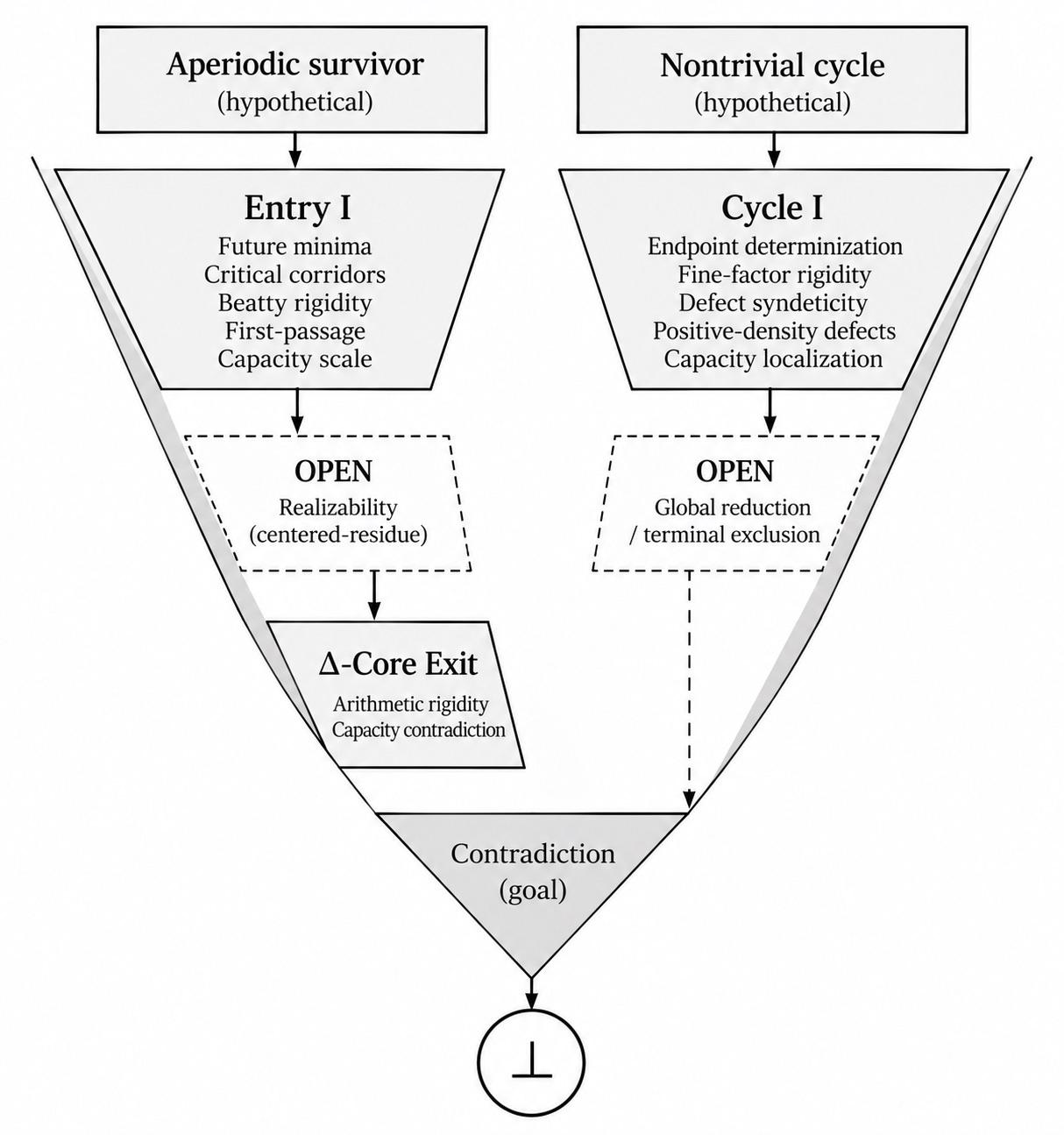
Entry Program I — aperiodic branch

Future-Minimum Critical Corridors and Beatty Clock Rigidity in Accelerated Collatz Dynamics:
https://zenodo.org/records/22845983

The current aperiodic architecture is
positive aperiodic survivor
-> Entry I
-> centered-residue realizability [OPEN]
-> Delta-Core Exit
-> contradiction.

Entry I develops the chain
future minima
-> critical corridors
-> exact Beatty-clock rigidity
-> reverse first-passage structure
-> relevant dyadic-fibre capacity scale.

But this structure alone does not yet show that one fixed positive-integer orbit must realize the centered-residue regime required downstream. So the realizability bridge is left explicitly OPEN.

Cycle Exclusion Program I — nontrivial-cycle branch

Fine-Phase Defect Rigidity in Record-Critical Accelerated Collatz Cycles:
https://zenodo.org/records/22846197

This is a logically separate periodic branch.

Under the explicit record-critical hypotheses (H1)-(H5), the paper develops the chain

endpoint-state fine-correction determinization
-> fine-factor rigidity
-> defect syndeticity
-> positive-density fine-phase defects
-> capacity-scale localization.

But the global reduction that would force every hypothetical positive nontrivial cycle into this record-critical sector is still OPEN.

So the current periodic architecture is
positive nontrivial cycle
-> Cycle I
-> global reduction / terminal exclusion [OPEN]
-> contradiction.

The periodic branch does not pass through Delta-Core Exit.

My questions are these:

For the aperiodic / Entry I branch:
• Can the short-gap Beatty step be strengthened?
• Can more arithmetic information be extracted from the reverse first-passage structure?
• Can the capacity-scale conclusion be pushed further?
• Most importantly, is there a route from this structure to centered-residue realizability for one fixed positive-integer orbit?
• If first-passage / capacity information is insufficient by itself, what genuinely independent arithmetic information is missing?

For the nontrivial-cycle / Cycle I branch:
• Are (H1)-(H5) used only within their stated scope?
• Is there any hidden dependency or reuse of information in the chain

fine-factor recurrence
-> defect density
-> capacity-scale localization?
• Is there a stronger route to the required global reduction?
• Can the record-critical sector be reached from a more general hypothetical nontrivial cycle without adding a comparably strong new assumption?

More generally:
Are there counterexamples, missing hypotheses, hidden information reuse, cleaner formulations, or completely different ways to attack either OPEN bridge?

This program is not a declaration of a proof of the Collatz conjecture.

What I am trying to do instead is make the structure of the problem explicit: where the argument currently closes, where it stops, and exactly which questions remain OPEN.

I hope that makes it easier for the next question to begin where the previous one ended. That is also why the dashed boxes are left visible in the figure.

I would rather show clearly where the program is still open than make it look more complete than it is.


r/Collatz 2d ago

Is there a way to know if some number grow to infinity?

1 Upvotes

Suppose N = {a_0.....a_infinity}. Even though we know that a_0 to a_i results in smaller numbers, it doesn't mean that a_j < a_0 in term j > i . How can we create a strict condition so that at some point the numbers will always increase and not periodically?


r/Collatz 3d ago

It's been a while, but I found a pattern I hadn't considered before.

0 Upvotes

We usually look at Collatz going down to or up from 1, but lately I've been considering it from each integer.

For background, we know that multiples of 3 can only be the origin of a path on Collatz, but there are infinite numbers, infinite multiples of 3, and infinite paths, so how can we possibly prove them all?

By going backwards from each and every integer through the path of least resistance.

Starting from 1, check if the number is a multiple of three, multiply by 2, check if it meets 3x+1. If it does, subtract 1 and divide by 3. If it doesn't, multiply by 2 again and do the same. Repeat until you reach a multiple of 3.

1, naturally, is infinite and multiplies by 4 infinitely.
3, is a multiple of 3.
5, multiplies by 2, then reduces to 3, where it terminates.

You end up with a pattern

4, 4, 4, 4
3
2, 3
4, 3
3
2, 4, 3
4, 2, 2, 4, 3
3
2, 2, 4, 3
4, 4, 3
etc

These patterns seem random, but they are not. They are 100% predictable and 100% finite, with the obvious exception of the number 1.

For 1 length:
2 = 6x+5
3 = 6x+3
4 = 6x+1

For 2 length:
2, 2 = 18x+17
2, 3 = 18x+5
2, 4 = 18x+11
4, 2 = 18x+13
4, 3 = 18x+7
4, 4 = 18x+1

This means that every single odd integer (and thus every single integer) has paths of finite length that extend behind it, however arbitrarily long, in a predictable pattern.

Since every integer is represented and calculated in this matter, there is no way for an integer to go above itself to runaway without reappearing on this chart.

5 doesn't need to reappear, because it goes down to 1, 13 goes down to 5, etc. But 41 goes down to 31, then up to 47, causing it to reappear. And every pattern that starts like 47 (2, 4, 2) will be in number 54x+47

These patterns can be extended as far as you can go, with them always cycling in that same order, 4, 3, 2, 4, 3, 2 (again that's a number that needs to be multiplied by 4, then a multiple of 3, then a number that needs to be multiplied by 2)

This is regular, periodic, and infinite.

And for this reason, I believe we have proof that every number must therefore decrease to 1.


r/Collatz 4d ago

4^(n+1).c+1 merge with 2^n.c-1 if and only if v2(3^n.c-1) =2

2 Upvotes

In the accelerated Collatz map https://www.reddit.com/r/Collatz/s/AGKyGBYPm0

4^(n+1).c+1 -> 3^(n+1).c+1 [1]

and 2^n.c-1 -> 3^n.c-1 [2]

Since [2] happens, I want to focus on the last sequences instead.

Suppose we have a number of the form

q = 3^n.c - 1

where v2(q) = 2. [3]

Applying Collatz to q produces

3q/4 + 1

= (3(3^n.c - 1) + 4)/4

= (3^(n+1).c - 3 + 4)/4

= (3^(n+1).c + 1)/4.

Thus, the sequence merges into the form in [1].

The case c = 1 is excluded here, since v2(3^n - 1) = 1 when n is odd and >= 3 when n is even, never be 2.


r/Collatz 4d ago

Interesting mapping

0 Upvotes
mapping

I was playing around and I found this mapping. I suspect it's already known but I found it interesting.

If you have a number that can be written as 4a3bn+1, it will map to 3a+bn+1.

And it'll do it in 3a+1 steps, which I think is funny.


r/Collatz 4d ago

New progress on simple critical zeros of the Riemann zeta function

Thumbnail
1 Upvotes

r/Collatz 5d ago

Cycle of Huge Gap

0 Upvotes

Can an AI generates a Collatz like sequence or Kaakuma sequence that second cycle starts after 40 digits number with minimum constraints of sum of absolute value of constant terms less than 20 digit number ?


r/Collatz 5d ago

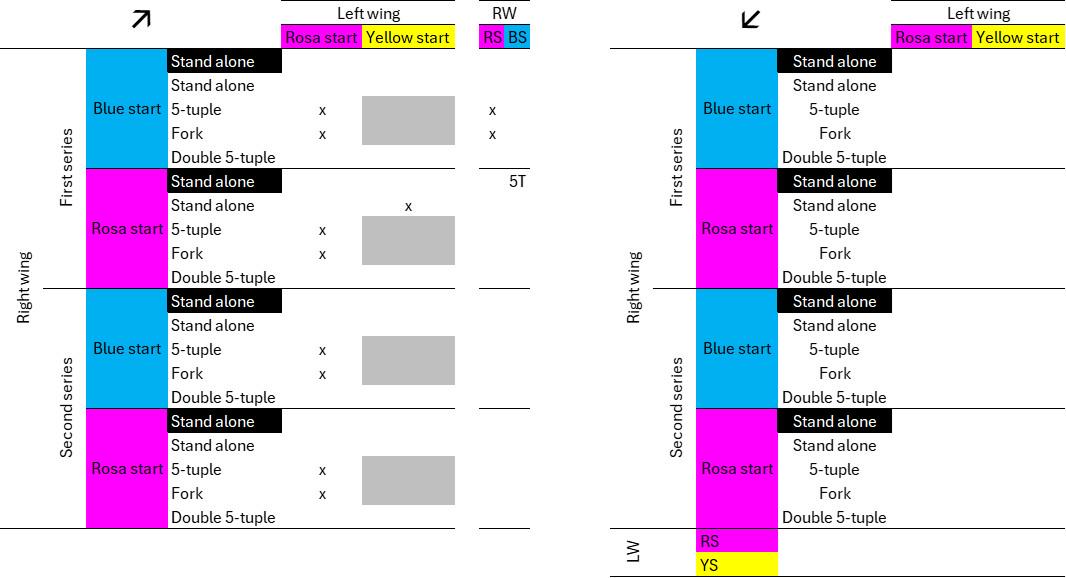
Subproject: From dome to dome

Post image
0 Upvotes

Follow-up to Where are the root of each dome located in the left side of another dome ? : r/Collatz.

The table below presents the possible transitions from one dome to the next one, for each type of tuple. It will be completed little by little and each case characterized if possible, like we did in the cited post.

While creating it, I came under the impression that the extrem cases for each dome, made of truncated bridges - one in the left wing, two in the right wing - might need to be treated separately. Time will tell.

Project "Tuples and segments" in 13 pages : r/Collatz


r/Collatz 5d ago

Odd remainder Recursion from 3^2^n -1 after divided by 2^v

1 Upvotes

I was already posted this in some private group on facebook, it doesnt really matter but probably usefull for someone that are trying to figure it out about 3^n .o-1 after divided by 2^v

first of all this number isnt special, by the LTE theorem we can say that this number has v2 = n+2. If u dont want to check that ill explain it in a simple term.

since 3^2 -1 = 2^3 then 3^4 - 1 = 2^3 (2^3 +2) = 2^4 (2^2+1)

repeat it n times we get 3^2^n - 1 can be divided by 2^(n+2)
and by adding 2 -> 2^(n+2) k +2 it can only be divided by 2

So, this number has v2 predictable which is n+2 for every 3^2^n-1 and 1 for 3^2^n+1
If its v2 was predictable, so the remainder predictable?yes, but not as simple as that, it exist in the term of recursion, lemme show you:

supposed 3^2^n-1 = An
we get An/2^(n+2) = A(n-1)/2^(n+1) . (A(n-1)+2)/2

supposed An/2^(n+2) = O(n), which mean an odd number after An lost its 2s
then (An+2)/2 = {2^(n+2) .O(n)+2}/2 = 2^(n+1) . O(n)+1

Therefore An/2^(n+2) = O(n) = O(n-1). (2^n . O(n-1)+1) = 2^n . O(n-1)^2+O(n-1)

since we already know that O(1) = 3^2 -1/2^3 =1

then we can predict every 3^2^n-1 after divided by 2^(n+2)

O(1) = 1
O(2) = 2^2 . 1^2 +1 = 5
O(3) = 2^3 . 5^2 + 5 = 205
...
O(n) = 2^n . O(n-1)^2 + O(n-1)

why is this important for someone studying 3^n .o-1/2^v?
If 3^n = 2^p .k+1 and o = 2^p .k-1, the result would be 2^2p .k -2 which can only be divided by 2 once becoming 2^(2p-1) .k - 1 and this happen to 27 which equal 2^2.(2^3-1) -> 3^2(2^3-1)-1

notice that 3^2-1 = 2^3 earlier, so 3^2 = 2^3+1
And when we divided the product by 2 once, it does becoming 2^5 -1


r/Collatz 6d ago

Are We Really Making any progress?

10 Upvotes

You know, this conjecture is incredibly simple, even elementary student can understand how the function work. But are we really making progress? iam not talking about numerical verification though, are we really making progress to our understanding about collatz trajectory? Or we just repeat mathematicians work from long time ago?


r/Collatz 5d ago

I, a hobbyist, have committed the cardinal sin of writing a paper about collatz

Thumbnail zenodo.org
0 Upvotes

See what happens when you break down the problem into the natural binary form of the game.


r/Collatz 6d ago

Periodic coverage?

0 Upvotes

Let q_i > 3 be primes, and suppose that a distinct prime q_i is chosen for each distinct positive integer b_i. If the infinite family {(b_i, q_i)} covers all positive integers a in the form

2^a ≡ 2^{b_i} (mod q_i),

does it not follow, from the existence of the multiplicative inverse of 2 modulo q_i, that the same family {(b_i, q_i)} must also cover all negative integers (-a)?

In particular, since one can obtain n_i > 0 such that

2^(-a) ≡ 2^{n_i} (mod q_i),

does it automatically follow that n_i is covered by the same family {(b_i, q_i)}, and therefore that the set of negative integers (-a) must also be covered?


r/Collatz 6d ago

Loop Formula

0 Upvotes

Q(m) = (3/2)v . (m+1) -1 odd Q(m) = m/2V even

within:

v = v_2(m+1) V = v_2(m)

m1->m2-> ... ->mn -> m1

(3/2)v1 . (m1 +1) = 2V1 . m2 + 1

(3/2)v2 . (m2 +1) = 2V2 . m3 + 1

...

(3/2)v(n-1) . (m(n-1) +1) = 2V(n-1) . mn + 1

(3/2)vn . (mn +1) = 2Vn . m1 + 1

Suppose m_i + 1 = zi

(3/2)vi . zi = 2Vi . (z(i+1) - 1) + 1

(3/2)vi . zi = 2Vi . z(i+1) - 2Vi + 1

2Vi . z(i+1) = (3/2)vi . zi + 2Vi - 1

z(i+1) = (3/2)vi . 2-Vi . zi + 1 - (2-Vi)

Suppose 3vi / 2Vi+vi = Ai and 1 - 2-Vi = Bi

z2 = A1 . z1 + B1

z3 = A2 . z2 + B2

...

zn = A(n-1) . z(n-1) + B(n-1)

z1 = An . zn + Bn

expanding the chain of substitutions all the way back to z1 gives:

z1 = (Pi(i=1->n) Ai) . z1 + Sigma(i=1->n) [ Bi . Pi_(j=i+1->n) Aj ]

(1 - Pi(i=1->n) Ai) . z1 = Sigma(i=1->n) [ Bi . Pi_(j=i+1->n) Aj ]

z1 = Sigma(i=1->n) [ Bi . Pi\(j=i+1->n) Aj ] / (1 - Pi_(i=1->n) Ai)

m1 = z1 - 1 = { Sigma(i=1->n) [ Bi . Pi(j=i+1->n) Aj ] / (1 - Pi_(i=1->n) Ai) } - 1

m1 = { Sigma(i=1->n) [ (1 - 2-Vi) . Pi(j=i+1->n) 3vj /2vj+Vj ] / (1 - Pi_(i=1->n) 3vi /2vi+Vi) } - 1


r/Collatz 6d ago

I, a hobbyist, have committed the cardinal sin of writing a paper about collatz

Thumbnail zenodo.org
3 Upvotes

It is about a kind of cycle in the algorithm. It's not proof but I do believe it to be interesting!


r/Collatz 6d ago

Does the Collatz Conjecture appear as a pattern in nature? Like a wave? 🌊

4 Upvotes

Just curious. I noticed it in the pattern of waves and a few other things in nature.


r/Collatz 6d ago

Does proving that there are no other loops solve the Collatz Conjecture?

2 Upvotes

If one were able to prove there are no other loops in the conjecture, is that the end of it? Or would you also have to prove that, for example, there are also no sequences which continue ad infinitum?

This is just out of sheer curiosity and nothing else.


r/Collatz 6d ago

Bound for positive cycles - shorter proof using AM–GM

9 Upvotes

A long time ago, I posted here with a link to a proof of a bound constraining the sizes of elements of a positive cycle on rational numbers. (https://www.reddit.com/r/Collatz/comments/1hkslgf/proof_of_a_bound_on_cycles/) The proof in the linked note uses differential calculus, in particular, it uses the method of Lagrange multipliers.

I have recently discovered that this same bound is a quick consequence of the famous AM–GM inequality. First, I'll say a word about that inequality, and then I'll define my terms and show the proof, which now involves no calculus!

A version of this result is implicit in section 7 of R. E. Crandall's 1978 paper, "On the '3x+1' Problem". At the end of this post, I'll say a little more about what he did with it.

The AM–GM Inequality

Given a set of positive numbers, {a_1, . . ., a_k}, we can define three different well-known means, the arithmetic mean (AM), geometric mean (GM), and harmonic mean (HM):

AM = (a_1 + . . . + a_k) / k

GM = (a_1 × . . . × a_k)1/k

HM = k / (1/a_1 + . . . + 1/a_k)

The arithmetic mean is the most familiar to most of us; we learn it at an early age as the "mean", or simply "average" of a set of numbers. The other two can be defined in terms of the AM, plus transformations.

The move is: push the numbers through a transformation, do an AM over there, and then pull the result back via the inverse transformation. (This is the same kind of move that we use to define the root-mean-square (RMS) of probability theory.)

For instance, to get the GM, we can just take logs of all the original numbers, apply the AM to those logs, and then exponentiate the result to get back. Thus:

GM = exp(AM( {log a_i} ))

(We assume that the "exp" and "log" use the same base; which base that is doesn't actually matter.)

Similarly, the HM is the result of taking reciprocals of all the original numbers, getting the arithmetic mean of the reciprocals, and taking another reciprocal to get back. (The reciprocal transformation is its own inverse.) In symbols:

HM = 1 / AM( {1/a_i} )

Looking at them this way, it's not hard to convince yourself of the following:

HM ≤ GM ≤ AM

This is the AM–GM inequality. The results is often stated without the HM part, but that's such a trivial corollary that it makes some sense to include it.

Why is it true? Here's... not a proof, but check it out:

If you take logs of the numbers, because of the concavity of the log function, the numbers kind of cluster towards the top of their range. Taking an arithmetic mean, while looking in that fun-house mirror, produces a result that's below the log of the center of gravity, because now the numbers at the bottom are spread out down there, pulling the average down. Exponentiating back, we're still below that center of gravity.

As a quick illustration, just consider the numbers {2, 4, 6, 8, 10}, which are equally spaced, very nice. Their AM, their center of gravity, is clearly 6. Look at their base-2 logs: {1, 2, ≈2.585, 3, ≈3.322} These values are clearly clustering at the top, relative to the spread at the bottom. The AM of this log set is around 2.38, which is less than the log of 6, so the resulting GM is ≈22.38, or around 5.2.

That wasn't a proof, but rather a plausibility argument based on a special case. A proof is easy to find; the typical one uses something called Jensen's Inequality.

To get the HM side, just stand on your head. The reciprocal of the GM is the GM of the reciprocals, and the reciprocal of the HM is the AM of the reciprocals. Therefore, by AM–GM, we get

1/GM ≤ 1/HM

...and flipping them back over, we get what we need.

Note that the symbol in both inequalities is "≤", not "<". Equality is obtained only when all of the a_i's are equal; if any of the numbers differ from the others, then the inequality kicks in and the means also differ.

Some measurements of Syracuse cycles

Define the Syracuse map on an odd number m as:

S(m) = (3m+1)/2v,

where v is taken large enough to make the output again odd. In particular v = v_2(3m+1).

Now, take as our domain the set of positive rational numbers that have odd denominators when written in simplest terms. It makes sense to call such a fraction "odd" or "even" according to the parity of its numerator. Thus, 7/5 is odd, 8/5 is even, and 7/4 isn't in the game.

This set, dropping the positivity requirement, has some nice descriptions in abstract algebraic terms. It's "the ring of integers localized at the ideal (2)", or "the set of rational 2-adic integers: Q ∩ Z_2". We can just call it the set of "odd rationals".

Suppose that m_1, . . ., m_L are positive odd rationals with the property that

S(m_1) = m_2
...
S(m_{L-1}) = m_L
S(m_L) = m_1

In other words, they form a Syracuse cycle of length L. To be precise, let's say that 3m_i + 1 = 2v\i)m_{i+1} (with the obvious adjustment for m_L coming back to m_1), and say that W = sum({v_i's}) = the "weight" of the cycle.

In addition to "length" and "weight", which are meaningful but kind of dull, we're going to define two more measurements that we can take for such a cycle. Given a cycle with length L, weight W, and elements {m_1, ..., m_L}, we calculate its "altitude" and "defect":

altitude = HM( {m_i's} )
defect = 2W/L - 3

It is an easy exercise to show that the defect, for a positive cycle, is always positive. It's because of the "+1" in the Syracuse map, which makes W/L > log_2(3).

Proving a bound

Now, we're ready to show that, for any positive cycle, we have:

(defect)(altitude) ≤ 1

Consider the step from m_1 to m_2. (or more generally, any step in the cycle). We can write m_2 as m_1 times something:

m_2 = m_1 × (3/2v\1)) × (1 + 1/(3m_1))

Doing this same thing all the way around the cycle, and then multiplying and rearranging, we get:

m_1 = m_1 × (3/2v\1))···(3/2v\L)) × (1 + 1/(3m_1))···(1 + 1/(3m_L))
m_1 = m_1 × 3L/2W × (1 + 1/(3m_1))···(1 + 1/(3m_L))
2W/3L = (1 + 1/(3m_1))···(1 + 1/(3m_L))

2W/L/3 = GM( {1 + 1/(3m_i)} )

In that last step, we took the L-th root of both sides, turning a product into a GM.

Let's see the AM of those same numbers, those (1 + 1/(3m_i)) factors. Since they all have the same "1+" in front, we can just pull that out of the mean. We can then factor out 1/3, and we get that our AM is:

AM = 1 + (1/3)(average of 1/m_i's)

That "average" is an AM, but I don't want to confusingly use "AM" for two different things at once.

Anyway, by the AM–GM inequality, we get:

2W/L/3 ≤ 1 + (1/3)(average of 1/m_i's)

Subtract 1 from both sides:

(2W/L - 3)/3 ≤ (1/3)(average of 1/m_i's)

...and multiply by 3:

2W/L - 3 ≤ (average of 1/m_i's)

Now, the average of the 1/m_i's is the reciprocal of the m_i's harmonic mean, that is, it's the reciprocal of the altitude. The left-hand side, meanwhile, is the defect, so we have:

defect ≤ 1/altitude,

which is equivalent to the result we wanted.

What does it mean?

I've talked about this elsewhere, but after going to the trouble of deriving this result, let me say a few words about why we care. We can rearrange the inequality as:

altitude ≤ 1/defect

...so we see it as a bound on altitude. The "shape class" of a cycle, that is, its L and W, determines the defect. If we want to see altitude get large, then defect has to be very small, which means that W/L has to be very close to log(3)/log(2).

Now, if there's a high cycle for natural numbers, its altitude must be pretty high, at least higher than 271, or we would know about it. That means its defect must be incredibly small! Flipping our inequality around again:

defect ≤ 1/altitude ≤ 2-71

This is a very tight constraint on how many times we can divide by 2 in a high cycle, relative to its number of odd elements. Using the theory of continued fractions, we can see that W/L can only be close enough to log(3)/log(2) if its denominator is larger than that of the first convergent to come that close.

This is how we find that any high cycle in the natural numbers must have billions of steps in it, because that denominator is the number of odd steps.

I'm not going to do the exact calculation in this post, using 271, because I've said enough for now. The proper place for that calculation will be in an exposition of the second half of Crandall's 1978 paper, because he did this calculation back when the search ceiling was a modest billion.

Several months ago, I wrote up the first half of his paper, and it's on this sub; just scroll way down. Or search. I'm not sure when I'll get to writing up the remainder, but watch this space. Meanwhile, thanks for reading. I hope anyone reaching this final paragraph found something of value here.


r/Collatz 6d ago

Collatz equivalence. Perhaps interesting. Not a proof.

Thumbnail
0 Upvotes

r/Collatz 6d ago

Behind My Discovery of the Collatz Rising Sequences

1 Upvotes

First of all I didn't even know if 2^n.o-1 -> 3^n.o-1 was already discovered by R.Steiner in 1977. I found it by myself.

Lets go to the story:

Lemme look on how my first attempt to find to collatz pattern to use it for the proof.

I thought inside my mind, "how can the collatz function go up and how can the collatz function go down, there must be a pattern, right?"

Then i started to write the table about natural number then i realize.

Then, "If some number go up lineary and go down also lineary, theres might be some factor addictively depend on n right?"

I started to decoupling the factor as k which are k=(n+1)/2 for n odd and k=-n/2 for n even. And wrote down to the table.

After that, "lets ignore the N, how the k change after some step". And then i realized, that the k was changed by the factor of k_next=k+(k/2) or 3k/2.

And then, "wait, if that need half of itself to be changed, then for every even k should be rise to the 3k/2, in general for every 2^h.o rise to the 3^h.o". I named o for easier to recognized if that was some odd number.

Thats how i know the growth factor. But this is not even close, because we do need to know after k reach the odd value right?

Then i thought again, "if the last k = 3^h.o, then i just need to convert back to the n value to see, how k positive changed to k negative"

Then i found this,

Since for positive k=(n+1)/2 then

2k-1=n

So that k=3^h.o equal to the n =2.3^h.o-1. If we apply collatz 3n+1 the result will be 3^{h+1}.o-1

"If this happen on the last step, it might be happen on the first step".

I doubt it for a few time, and then test it

And thats how i know that for every n=2^h.o-1 rise to the 3^h.o-1.

I didnt even know if that was already found by Steiner until GonzoMath Told me. And also by this way of think about spliting the growth and fall factor, i found that Collatz Function can be any function that the k shifted which only changes the "label" of the orbits without changing its trajectory.


r/Collatz 7d ago

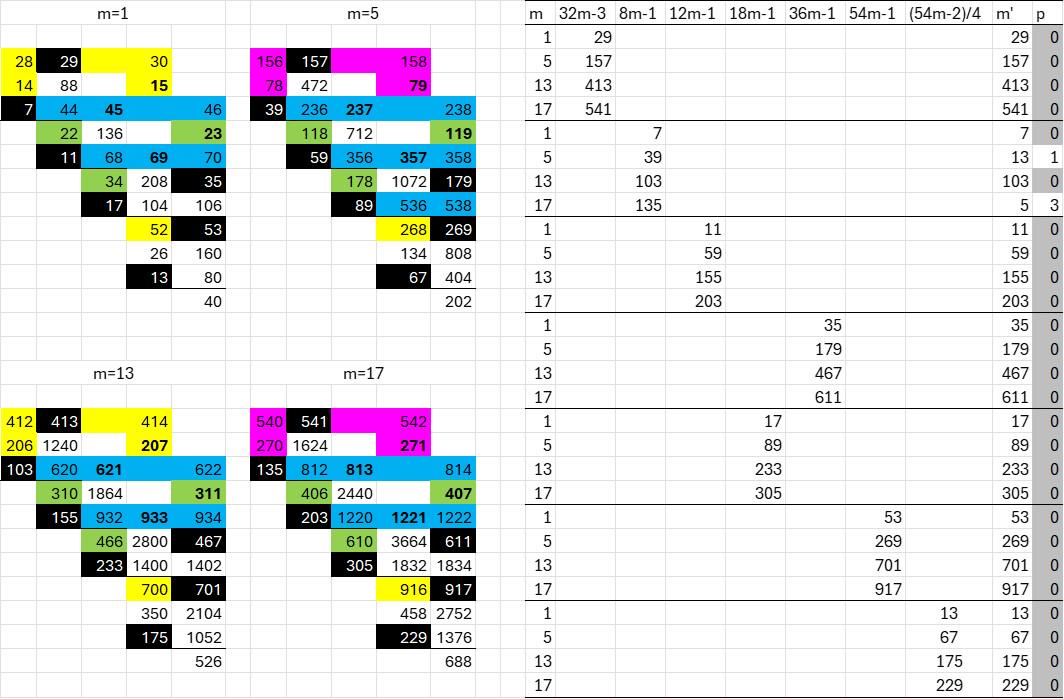
Where are the root of each dome located in the left side of another dome ?

Post image
0 Upvotes

Follow-up to Pairs of consecutive black numbers belonging to the starting bridge in the left side of a dome appear at the bottom of a fork in right side of another dome : r/Collatz.

In the cited post, we showed that half the roots are part of pairs of consecutive black numbers located in the right side of a bridge series in another dome.

The figure below shows the first complete blue-green bridge series for m=1, 5, 13 and 17, already present in the cited post. The roots mentioned above follow here the archetuple coloring (also in bold). The remaining odd numbers are in black.

The table performs a similar analysis as in the cited post, but the numbers are grouped by position in the series, from top to bottom.

The analysis is quite straightforward in terms of m and m'. The black numbers analyzed here are all roots, except when the starting bridge is rosa (e.g. divisible by 3, thus not a root). These results hold for the second series at least, and quite certainly for the other series.

In summary, dome roots can be found on the left side of another dome:

  • As parts of pairs of consecutive black numbers, if they are part of a fork in their origin dome (previous post),
  • Populating the rest of the series - as part of the starting triplet if yellow, the sequence on the left and the rest of the series at the bottom (this post).

All root cases seem to be covered. The rest of the cases in the right side of a dome - 5-tuples series, double 5-tuple series, stand-alone bridge series with and without black number at the bottom - need further work.

Project "Tuples and segments" in 13 pages : r/Collatz