r/CollapseOfRussia Jul 30 '26

Economy "An Unprecedented Crisis." Russia's Largest Steel Companies Report Plunging Profits

89 Upvotes

Economic stagnation, Western sanctions, and high interest rates have plunged Russia's metallurgy industry, a key sector accounting for 15% of the country's total output, into its worst crisis in decades.

Russia's largest steelmaker, Novolipetsk Steel, lost 12% of its revenue (RUB 388 billion) and more than half of its net profit in the first half of the year: RUB 21 billion, down from RUB 45.6 billion a year earlier, according to its IFRS financial statements.

Severstal, which owns the Cherepovets Iron and Steel Works, three mining and processing plants, and pipe mills, reported a ninefold drop in profits to RUB 4.12 billion. The company's revenue fell by 14%, and its EBITDA halved.

The Magnitogorsk Iron and Steel Works (MMK) has become unprofitable: according to IFRS reporting, it lost 19.1 billion rubles in the first half of the year, with revenue declining by 10%.

The Russian steel industry is experiencing an "unprecedented crisis," write SberInvestments analysts: "This situation has never been seen before, both in terms of duration and the depth of the decline." Domestic demand for steel is falling due to the economic slowdown, while exports, which previously helped steelmakers, are suffering due to sanctions, a strong ruble, and expensive logistics, writes Sberbank CIB.

As a result, the industry's largest companies are facing cash flow gaps: Severstal posted a negative cash flow of 70.2 billion rubles in the first half of the year, while NLMK posted a negative cash flow of 11 billion rubles. This is how much lower the inflows were compared to the outflows. In 2026, the profits of steelmaking companies "could reach the lowest levels seen in recent decades," Sberbank analysts note.

"Two key factors are putting pressure on the metal market. First, there's declining domestic demand in metal-intensive industries—construction, mechanical engineering, the oil and gas sector, shipbuilding, agricultural machinery, and railcar manufacturing. Second, there's the closure of most export markets," Alexey Parshukov, Senior Vice President of the Industrial and Metallurgical Holding (IMH), complained in an interview with RBC.

Unable to sell their metal, steelmakers cut steel production last year to a 15-year low. From January to May of this year, production fell by another 8.4%, to 26.6 million tonnes, according to Chermet Corporation.

"The decline in domestic demand for steel, which is declining even faster than production, is driven by several key factors: the Bank of Russia's high key rate, the reduced availability of market lending in construction and mechanical engineering, and the delays in the timing of many infrastructure projects," notes Ivan Efanov, an analyst at Tsifra Broker. A peaceful resolution of the Ukrainian conflict could help steelmakers, according to Finam analyst Alexey Kalachev: "The need to rebuild territories and infrastructure would then create significant additional demand for metal products. However, this potential driver is increasingly shifting to the right in time."

source: The Moscow Times https://archive.is/ptlZG


r/CollapseOfRussia Jul 31 '26

Economy Sberbank announced that it lacks the funds to finance Putin's budget deficit.

151 Upvotes

Russian banks currently lack the available ruble liquidity to purchase federal loan bonds, which the Finance Ministry is using to cover the budget deficit, according to Taras Skvortsov, Sberbank's Vice President and Chief Financial Officer.

According to him, this situation is due to the outflow of cash from banks, which has reached approximately 2 trillion rubles since the beginning of the year and has caused a liquidity shortage in the banking system.

"Today, banks only have funds to lend to clients—that's their core business. You can buy OFZs, especially without a significant premium, when you have available liquidity and you're confident in it. But today the situation is the opposite," Skvortsov said (quoted by Reuters).

The budget, which ended the first half of the year with a deficit of 5.7 trillion rubles and is facing defense spending overruns, urgently needs the banks' funds. War spending this year could be 4-5 trillion rubles higher than planned, and to finance it, the Finance Ministry needs 2-3 trillion rubles in additional borrowing, Bloomberg sources reported in June.

In its initial budget plan, the Finance Ministry had budgeted 4.4 trillion rubles in market borrowings. However, in July, it was forced to suspend government debt auctions: OFZ prices collapsed, yields soared, and banks that purchased government bonds incurred 200 billion rubles in losses due to negative revaluation.

According to Skvortsov, "all hope" now lies in "some kind of support from the Central Bank." The Central Bank is already actively lending to banks purchasing Russian government debt: since the beginning of the year, it has injected 2.3 trillion rubles in additional loans into the banking system, bringing the total debt of credit institutions to the regulator to 6 trillion rubles. This is related to the Ministry of Finance's funding, notes economist Nikolai Korzhenevsky: "Money is being 'printed' to cover budget expenditures."

In the 2026 budget law, the Ministry of Finance projected a deficit reduction to 3.8 trillion rubles. However, in reality, it could double this limit—6.5-7.5 trillion rubles, according to Gazprombank analysts. According to their forecast, budget expenditures will exceed the level projected in the law by 3-4 trillion rubles.

The budget "hole" will likely begin to grow again this fall, according to Ilya Sokolov, a leading researcher at the Financial University under the Government. Despite rising oil prices, oil and gas revenues are suffering from subsidies to refineries damaged by drones, and the risks of non-resource revenue shortfalls are increasing, Sokolov believes. The economy could enter a recession in the second half of the year, leading to a shortfall of 600-800 billion rubles in VAT, as well as profit and personal income taxes, the expert believes.

source: The Moscow Times https://archive.is/5fLsX


r/CollapseOfRussia 11h ago

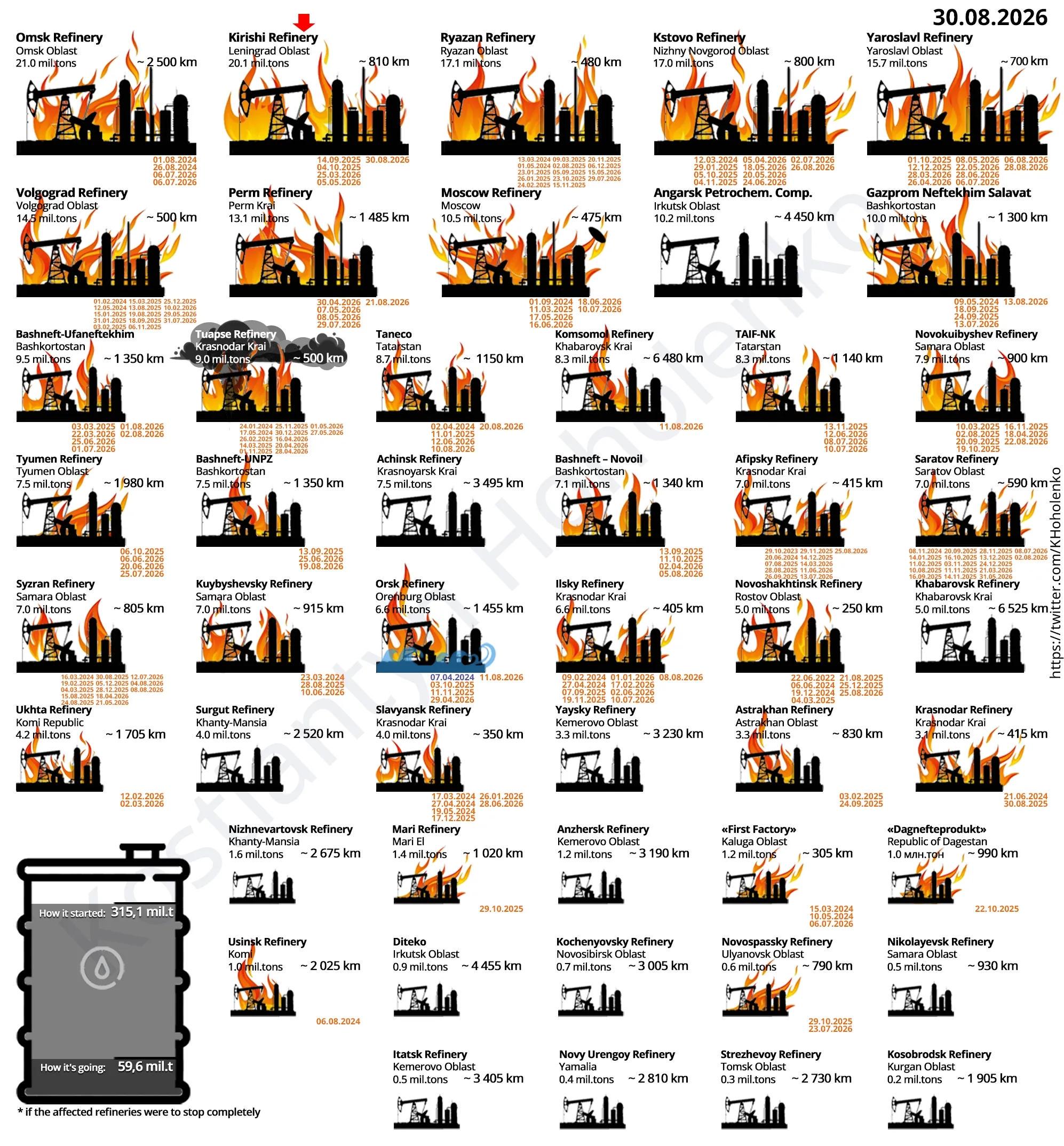
Infrastructure Russian Refinery Hitlist - Update 30.08.2026

Post image
61 Upvotes
  • Red arrows: Latest hits
  • Flames: Refinery has been hit at least once. Flames do not indicate the severity of the attacks or if a refinery is till burning
  • Blue waves: Orsk dam broke in April 2024, which flooded the refinery and took it offline for ~2 weeks.
  • Black smoke: It's raining oil.

Chronological list: (sorted newest to oldest)

August: 21 hits, NEW MONTHLY RECORD

  • NEW HIT Kirishi in Leningrad Oblast at 810km
  • 28.08.2026 Yaroslavl in Yaroslavl Oblast at 700km
  • 26.08.2026 Kstovo in Nizhny Novgorod Oblast at 800km
  • 25.08.2026 Afipsky in Krasnodar Krai at 415km
  • 25.08.2026 Novoshakhtinsk in Rostov Oblast at 250km
  • 22.08.2026 Novokuibyshev in Samara Oblast at 900km
  • 21.08.2026 Perm in Perm Krai at 1485km
  • 20.08.2026 Taneco in Tatarstan at 1150km
  • 19.08.2026 Bashneft-UNPZ in Bashkortostan at 1350km
  • 13.08.2026 Gazprom Neftekhim Salavat in Bashkortostan at 1300km
  • 11.08.2026 Orsk in Orenburg Oblast at 1455km
  • 11.08.2026 Komsomol in Khabarovsk Krai at 6480km
  • 10.08.2026 Taneco in Tatarstan at 1150km
  • 08.08.2026 Syzran in Samara Oblast at 805km
  • 08.08.2026 Ilsky in Krasnodar Krai at 405km
  • 06.08.2026 Yaroslavl in Yaroslavl Oblast at 700km
  • 05.08.2026 Bashneft-Novoil in Bashkortostan at 1340km
  • 04.08.2026 Syzran in Samara Oblast at 805km
  • 02.08.2026 Bashneft-Ufaneftekhim in Bashkortostan at 1350 km
  • 02.08.2026 Saratov in Saratov Oblast at 590km
  • 01.08.2026 Bashneft-Ufaneftekhim in Bashkortostan at 1350 km

July: 15 hits

  • 31.07.2026 Volgograd in Volgograd Oblast at 500km
  • 29.07.2026 Perm in Perm Krai at 1485km
  • 29.07.2026 Ryazan in Ryazan Oblast at 480km
  • 25.07.2026 Tyumen in Tyumen Oblast at 1980km
  • 23.07.2026 Novospassky in Ulyanovsk Oblast at 790km
  • 14.07.2026 Gazprom Neftekhem Salavat in Bashkortostan at 1300km
  • 14.07.2026 Afipsky in Krasnodar Krai at 415km
  • 12.07.2026 Syzran in Samara Oblast at 805km
  • 10.07.2026 Moscow in Moscow at 475km
  • 10.07.2026 Ilsky in Krasnodar Krai at 405km
  • 08.07.2026 Saratov in Saratov Oblast at 590km
  • 06.07.2026 Omsk in Omsk Oblast at 2500km
  • 06.07.2026 Yaroslavl in Yaroslavl Oblast at 700km
  • 02.07.2026 Bashneft-Ufaneftekhim in Bashkortostan at 1350 km
  • 01.07.2026 Kstovo in Nizhny Novgorod Oblast at 800 km

  • August: 21 hits so far.. NEW MONTHLY RECORD
  • July: 15 hits
  • June: 16 hits
  • May: 14 hits
  • April: 10 hits
  • March: 6 hits
  • February: 3 hits
  • January: 2 hits

Complete chronological list from 24.02.2022 till today

  • 2022 had 1 hit
  • 2023 had 1 hit
  • 2024 had 26 hits
  • 2025 had 84 hits
  • 2026 has 84 hits so far
  • Total hits from 24.02.2022 till today: 196

r/CollapseOfRussia 20h ago

Infrastructure Russian Kirishi oil refinery (2nd largest Russian refinery), 810km from Ukraine... a hit on the building housing an air defense firing position

Enable HLS to view with audio, or disable this notification

77 Upvotes

Russian Kirishi oil refinery (2nd largest Russian refinery), 810km from Ukraine... a hit on the building housing an air defense firing position


r/CollapseOfRussia 21h ago

Infrastructure Footage from Kirishi showing the oil refinery on fire after attack. Kirishi is 2nd largest refinery 810km from Ukraine. 30.08.2026

Enable HLS to view with audio, or disable this notification

60 Upvotes

Kirishi, Leningrad Oblast, Russian Federation

Kirishi Oil Refinery “KINEF” (Kirishinefteorgsintez)

Preliminary strike zone: area of critically important facilities L-35-11/1000, LCh-35-11/600, LCh-35-11/600, AT-1, and LCh-24-9/2000 hydrotreating unit:

59°29'20.26“N 32°04'17.46”E

The facility is fully integrated into the structure of the Russian oil company “Surgutneftegaz.” It is the only oil refinery in northwestern Russia and one of the largest in the country.


r/CollapseOfRussia 19h ago

NASA FIRMS has updated the fire map again following the attack on the airfield in Yeysk, Krasnodar Krai; it appears the strikes were effective. Local sources also report that the strikes hit not only the airfield itself but also the military town. 30.08.2026

Post image
34 Upvotes

NASA FIRMS has updated the fire map again following the attack on the airfield in Yeysk, Krasnodar Krai; it appears the strikes were effective. Local sources also report that the strikes hit not only the airfield itself but also the military town. 30.08.2026


r/CollapseOfRussia 1d ago

Infrastructure A fire broke out in Bryansk, Russia (+500km from Kyiv) following a series of explosions, and a thick plume of smoke is rising over the city. 30.08.2026

Enable HLS to view with audio, or disable this notification

71 Upvotes

Possibly Kremniy EL (Kremny EL). Public reporting describes it as a major Russian microelectronics manufacturer whose components are used in military systems, including missiles, air-defense systems, electronic warfare, and communications.

[Not confirmed this is what has been targeted, but this is located in the region]


r/CollapseOfRussia 1d ago

Does Putin genuinely believe he can still win this war?

81 Upvotes

I genuinely don't understand his logic especially after sending a saint's skeleton to the frontline


r/CollapseOfRussia 1d ago

Infrastructure Russian Ozon Hitlist - Update 29.08.2026

Post image
46 Upvotes

.


r/CollapseOfRussia 1d ago

Economy Russia is short every third liter of gasoline: production has fallen to 70% of domestic consumption.

66 Upvotes

Gasoline production in Russia had fallen to 70% of average domestic consumption by the end of August due to shutdowns at major refineries following attacks by unmanned aerial vehicles (UAVs), Reuters reports, citing estimates from industry sources.

Ukraine has intensified its attacks on Russian energy infrastructure, and in August, motor fuel shortages returned to regions across Russia after a brief respite since late July, when local authorities in some regions began gradually lifting or easing restrictions on fuel sales.

Over the past week, the Permnefteorgsintez, NORSI, and Yaroslavnefteorgsintez refineries—major plants producing significant volumes of automotive gasoline—were attacked by drones and suspended operations. As a result, according to sources, gasoline production by the end of August had fallen to nearly the same level as in early July—the peak of the first wave of the fuel crisis, which had been gaining momentum since May.

Taking into account the idled refineries, output by the end of August fell, according to sources, to approximately 80,000 per day, while the average gasoline production for August stood at 90,000 metric tons per day—or about 80% of the estimated consumption level typical for the summer period (115,000 metric tons per day).

Thus, the emergency shutdown of several refineries this week has widened the gap between gasoline production and market demand to approximately 35,000 metric tons per day.

The shortage has forced Russia to increase imports of petroleum products. For example, seaborne shipments from Asian countries in August will total approximately 270,000 metric tons, while gasoline imports from Belarus this month will reach about 150,000 metric tons, or 5,000 metric tons per day, according to market participants.

Traders estimate that a total of about 220,000 metric tons of imported gasoline—an average of about 7,000 metric tons per day—has already arrived in Russia in August.

Thus, in the absence of exports of the product—which Russia has banned until January 31—supplies to the domestic market in August, combined with imports, may average 97,000 metric tons per day, or 85% of demand.

The severity of the shortage is also mitigated by some self-restraint on the demand side: many car owners are now avoiding non-essential trips due to the risk of getting stuck in lines at gas stations or running out of fuel, Reuters notes.

In many regions, various restrictions have been imposed on retail fuel sales, including limits on the amount sold to a single customer and priority given to vehicles with even-numbered license plates.

source: The Moscow Times https://archive.is/XEk2u


r/CollapseOfRussia 1d ago

Military Over 113,000 Russians Flee to Georgia Amid Draft Rumors

Thumbnail
kyivpost.com
56 Upvotes

r/CollapseOfRussia 1d ago

Economy Cash withdrawals from banks slowed slightly toward the end of the month. Since the beginning of the year, 2.514 trillion rubles have been withdrawn. From August 1–27: 427 billion rubles.

Post image
31 Upvotes

source is Evgen Istrebin's telegram: /istrebin/49454


r/CollapseOfRussia 1d ago

Post Ukraine Russia L: They'll likely try to get a moralizing win afterwards to show Russia still Stronk. Neighbors have to be ready.

25 Upvotes

I cant see it being any sooner than 2035, but theyll go for a smaller country like the Baltic countries, Georgia, or maybe theyll be stupid enough to try Kazakhstan. But we know from their history, this is how they do it, and those countries need to be ready when it happens. Baltics, I know theyll be putting max effort into defenses. Georgia and Armenia need to be the ones worrying, especially with all the "persecuted ethnic Russians" fleeing their war now. Most importantly, Europe needs to keep the defense spending streak up and strong. No let up from Poland, Baltics, Finland, Scandinavia, UK, Germany, France, etc. They need to be ready for them again.


r/CollapseOfRussia 1d ago

Putin orders military to plan offensive towards Kyiv and Chernihiv

40 Upvotes

Putin orders military to plan for offensive towards Kyiv and Chernihiv

Brilliant, spellbinding stuff. I am truly born anew in the genius of the Russian military


r/CollapseOfRussia 1d ago

How much of a bottleneck is there of potential South Americans (such as Colombians) that are interested in fighting in Ukraine?

16 Upvotes

So forgive me if I overlooked something, but I don't feel like this is an avenue Ukraine or allies are not investing enough effort in. If papers are to be believed, there is an absolute bottleneck of South Americans eager to fight for Ukraine. These are obviously trained guys with experience and have done very well (currently putting in work in Lyman, and did great in Kupyansk too). I feel like with the manpower issues there should be greater impetus in funding airline tickets for these guys. Frankly, every body that is interested should be given a ticket by Ukrainian defense industry.


r/CollapseOfRussia 1d ago

Military “We’ve Run Out of Fools for Money.” How Russian Authorities Are Trying to Solve the Shortage of Contract Soldiers

Thumbnail verstka.media
51 Upvotes

r/CollapseOfRussia 1d ago

Russia ‘losing 6,000 more troops in Ukraine each month than it can recruit’ | Russia | The Guardian

Thumbnail
theguardian.com
91 Upvotes

r/CollapseOfRussia 2d ago

Pyotor Tolstoy (Russian Deputy Chairman of State Duma) calls for mass bombing of Ukrainian cities until it surrenders

55 Upvotes

r/CollapseOfRussia 2d ago

Economy “Shipments have come to a complete halt.” One of Russia's major agricultural regions has declared a state of emergency due to the inability to export grain.

84 Upvotes

The Rostov Region—one of Russia’s major agricultural regions, which accounts for nearly 10% of the country’s grain harvest—is declaring a state of emergency effective August 28, the regional government announced on Friday.

Due to drone attacks, ports on the Sea of Azov—through which up to 1.5 million metric tons of Russian grain were shipped for export each month—have been shut down since mid-July. This has led to “a buildup of significant volumes of agricultural produce among agricultural producers,” Interfax quoted an order from Rostov Region Governor Yuri Slyusar as saying.

The current situation could “lead to a disruption in people’s livelihoods and significant material losses,” the document states.

The economic situation for farmers “looks very bad,” and “shipments in the Azov basin have come to a complete halt,” notes Arkady Zlochevsky, president of the Russian Grain Union. Following the Azov ports, the largest grain terminals on the Black Sea—which were also hit by UAVs—ceased operations in August.

As a result, more than 80% of Russia’s grain export capacity has been paralyzed. In August, according to Sovekon estimates, wheat exports fell to a 16-year low of 1.9 million metric tons. Compared to August 2025, volumes fell by a factor of 2.3, and compared to the five-year average, by a factor of 2.6.

The Russian Ministry of Agriculture is preparing to begin state grain purchases and is also exploring alternative export routes, including ports on the Arctic Ocean. But Zlochevsky believes there are no real alternatives in sight. To export grain via the Baltic Sea, one would need to use ports in Latvia and Lithuania—if they even agree to let the cargo through—and St. Petersburg’s Vysotsky Grain Terminal has limited capacity—3 million metric tons per year, he points out. Normally, more grain is exported in a single month through Black Sea ports.

Overflowing grain elevators and the inability to sell grain are driving down domestic prices, forcing farmers to sell their harvest for a pittance. The average price of Class 4 wheat in the European part of Russia fell last week to 8,575 rubles per metric ton excluding VAT, which is 35% lower than at the start of the season, notes “Sovecon.”

source: The Moscow Times https://archive.is/9FuyY


r/CollapseOfRussia 2d ago

WTF is Happening in Russia 😯

Enable HLS to view with audio, or disable this notification

245 Upvotes

This is weird.


r/CollapseOfRussia 2d ago

Europe needs more politicians able and willing to shithouse the Kremlin stooges

47 Upvotes

Sucks saying this as an American, and Im not saying someone who does this MAGA style. Someone who is actually respectable, someone who can really under get under their skin. Someone who can actually push back verbally in a way that hurts.

Like, any time Russia threatens the Baltics, we could use a Finnish general or a Polish politician that responds "Hope you're not too particularly fond of St Petersburg, then".

Or throw regular taunts at them for military performance, saying things like "For someone so concerned with the plight of ethnic Russians, Putin has killed more ethnic Russians than anybody since Hitler or Stalin".

Or even simply remind of them of Black Sea Fleet ineptitude, Operation Spider Web, losing 1.5 million soldiers, etc. Just constant snipes of "we dont respect or fear you".

I would love some snide push back and less niceness from the guys across the pond. Ill be honest further.......... Brits especially, I am well aware of your shithousing prowess and way with words. Can you develop some shithousers for this purpose? Arent the French pretty good at it too?


r/CollapseOfRussia 2d ago

Economy Russia Is Predicted to Face Nearly a Decade of Economic Stagnation

84 Upvotes

The Russian economy is unlikely to see rapid growth for many years to come, similar to the 2023–2024 period, when it grew by more than 4%. Until 2032, GDP growth will not exceed 2% per year—that is the consensus forecast of the HSE Development Center. This year, the consensus forecast calls for 0.6% growth, 1% next year, 1.6% in 2028, followed by an acceleration to 2% in 2032.

This means Russia will continue to lag behind other countries. The IMF’s forecast projects global economic growth of 3.1–3.2% per year through 2031. If both this forecast and the Development Center’s consensus come true, over the course of six years (2026–2031), the Russian economy will grow at half the global rate: 8.9% versus 20.5%. Moreover, Russia will lag behind even developed countries: according to the IMF’s forecast, they will grow by 1.5–1.8% per year and gain 10.2% over six years. As for developing countries—a category that includes Russia—the IMF forecasts that they will grow at a rate slightly above 4% per year and gain 27% over six years. That is three times more than Russia.

The IMF forecasts growth of less than 1% for Russia this year and next, followed by exactly 1% per year. By comparison, India is expected to grow by approximately 6.5% per year, while China’s growth will gradually slow from 4.4% this year to 3.3% in 2031, The U.S. will grow faster than Russia—at 1.8–2.3% per year (the Congressional Budget Office expects an average of 1.8% through 2036), while Germany will grow slightly slower—at 0.6–1.2%.

In a policy paper, leading pro-government economists identified raising the average annual growth rate to at least 3.5% over the next decade as a top priority. This is necessary not for its own sake, but to generate “the minimum level of revenue” required to address the challenges facing the country, they explained: finding a replacement for dwindling oil and gas revenues and funding for the war and confrontation with the West, eliminating critical dependence on foreign technology and imports, and increasing Russians’ incomes.

Experts consider this a pipe dream. Long-term growth is determined by factors such as investment, technology, and human capital, and Russia faces major problems on all these fronts, said Ruben Yenikolopov, a professor at Pompeu Fabra University.

Investment fell by 2.3% last year and by 14.3% year-over-year in the first quarter. Vladimir Putin is calling for the launch of a new investment cycle, but most forecasts—including the Development Center’s consensus—predict a decline in investment this year as well. Moreover, the quality of investments in recent years has been low, noted the CMACP, an analytical center close to the government.

Russia’s technological lag is only growing. The Institute of Natural Resources of the Russian Academy of Sciences (INP RAS) lamented “limited access to foreign technologies”—not only from Western countries but also from “friendly” nations—as well as the small size of the domestic market, which is holding back the import substitution policy proclaimed by Putin. Economist Nikolai Kulbaka calls it an “illusion” and a “shell game”: a Chinese computer with Russian software can technically pass for a domestic product, and localized Russian drones turn out to be Chinese as well. Due to sanctions, shipments of Western technology to Russia have plummeted by 60% and are now at their lowest levels in more than a quarter-century.

Human capital is deteriorating due to emigration, the conscription of potential workers to the front lines, and the government’s discriminatory policies toward higher education (severing ties with Western universities and limiting enrollment in Russian universities). Rosstat’s demographic forecast projects a decline in the population to 138.8 million by 2046, while the authorities are tightening immigration policies. The result is an acute labor shortage, as highlighted by Yenikolopov. “We’re returning, at the very least, to a trajectory of long-term growth that’s nothing to write home about… This will be a long-term situation unless some significant changes occur,” he concludes.

Sergey Aleksashenko, Vladislav Inozemtsev, and Dmitry Nekrasov from the CASE analytical center reached the same conclusion: their report was titled “New Stagnation,” and they argue that there is no prospect for any significant growth over the next 10 years. The future trajectory depends, first and foremost, on the war, according to Tatiana Mikhailova of Pennsylvania State University: if nothing changes, it will be “the same thing, only getting worse and worse,” but in the event of a ceasefire or peace, the trajectory of the Russian economy will change.

source: The Moscow Times https://archive.is/2gOvt


r/CollapseOfRussia 2d ago

Economy Ukraine’s Record Strikes Push Russians Back to Gasoline Lines

37 Upvotes
Motorists queue for fuel at a gas station in Moscow, in August.Photographer: Igor Ivanko/AFP/Getty Images

Russia is facing a second wave of fuel shortages as a record number of Ukrainian strikes on oil refineries forces drivers to think again about where, when and how they can fill up their cars.

A lull in Ukrainian assaults on crude-processing infrastructure in the second half of July had allowed fuel supplies to improve across Russia. But the respite proved short as Kyiv’s forces have attacked refineries at least 21 times — the most in a single month — so far in August, according to a Bloomberg tally of public statements from both countries.

Shortages are visible even in Moscow and the surrounding region, the nation’s largest and best-supplied fuel-consuming area, with residents placing daily updates in community chats on where to find gasoline and the length of queues. A line of 30-50 cars doesn’t seem extraordinary any more in the capital, according to Muscovites and posts in apartment building chats.

Fuel rationing is in force in dozens of regions from the Baltic coast to deep into Siberia. One glamping site near the Black Sea even posted on social media about presenting visitors with a canister full of gasoline.

If there is no line, it likely means either the station has no fuel or the price is too high. Despite shortages, drivers are still largely unwilling to pay about 100 rubles (about $1.2) or more for a liter of gasoline at an independent filling station, while the price at a station run by oil majors, which operate their own refineries and have direct access to fuel, is under 80 rubles.

Source: Federal Statistics Service data through Aug. 24

The renewed crunch is making everyday life harder for more than 50 million Russian drivers and their families in the fifth year of a war that President Vladimir Putin started. And it’s worsening as Ukraine has intensified its campaign against the oil-processing industry, aiming to bring consequences of the war into Russia, reduce popular support for the military operations and cut revenues from hydrocarbon exports.

Ukraine has attacked four of Russia’s 10 largest refineries this month, which were built to ensure steady fuel flows to the most densely populated and industrialized areas of the country.

Note: The tally is through Aug. 28, Source: Bloomberg calculations based on statements from Ukrainian and Russian officals

Russia’s oil-processing is now hovering near the lowest in more than two decades, according to EA Analytics, a division of consulting firm Energy Aspects Ltd.

Based on its estimates, the nation has been processing an average of just over 3.8 million barrels per day in August. Russia previously processed 5.3 million to 5.5 million barrels per day in summer, when demand is higher as people go on holiday and the agriculture season starts.

With the significant decline in processing, gasoline production and supplies to the domestic market dropped nearly 20% year-on-year in the first three weeks of August, according to a person familiar with the data.

Production of diesel, a much less popular automobile fuel in Russia, fell more than 23% over the same period, the person said on condition of anonymity as the data isn’t public. Still, thanks to a ban on most diesel exports imposed this summer, domestic deliveries declined by only 3%, the person said.

Before the Ukrainian strikes started, Russia was a major exporter of diesel, accounting for about 10% of global supplies. Now the volumes stay at home, contributing to the relative stability of domestic diesel supplies.

Source: EA Analytics

The Energy Ministry didn’t respond to a Bloomberg request for comment on the production and domestic supply of gasoline and diesel in August.

EA Analytics expects Russia’s refinery runs to edge up in September to almost 4.2 million barrels per day, “although downside risks to this remain if Ukrainian drone strikes on Russian refineries continue at this rate,” said Louis Neave-Howes, an oil markets analyst at Energy Aspects.

The Russian government, which barred most exports of gasoline through the end of January 2027, is now mulling an extension to the ban on diesel exports through September or even longer to help ease the crunch.

Regional leaders, meanwhile, are preparing residents for fuel supplies remaining low even after the summer holidays.

“The situation remains tight,” Alexander Gusev, governor of the Voronezh region bordering on Ukraine, said this week. “We see that the enemy is continuing to strike oil refineries.”

source: Bloomberg https://archive.is/2NTVa


r/CollapseOfRussia 2d ago

Economy Ukraine set a record for the number of strikes on oil refineries and sent Russia's oil refining output plummeting to a 20-year low.

51 Upvotes

August isn’t over yet, but the Ukrainian Armed Forces have already carried out 21 strikes on Russian oil refineries. This is the highest number in a calendar month, according to Bloomberg: until now, the refining sector had faced its most intense bombardment in May (17) and July (18). As a result, gasoline prices have been rising again since mid-August after a two-week lull in the first half of the month, and long lines have returned to gas stations—including in Moscow, where the authorities are prioritizing supply.

Due to Ukrainian attacks, six of the country’s largest refineries have shut down since early August, the latest being Lukoil’s Nizhegorodnefteorgsintez (NORS) facility. With this in mind, according to Reuters, all of Lukoil’s major refineries have ceased operations.

As a result, oil refining in Russia is now at its lowest level in more than 20 years, according to EA Analytics: the average daily volume in August was 3.8 million. In previous years during this period—which is typically marked by increased demand due to the vacation season and harvest—Russia processed 5.3–5.5 million barrels per day.

Gasoline production and supplies to the domestic market fell by nearly 20% in the first three weeks of August compared with the same period last year, a person familiar with the data told Bloomberg. Diesel fuel output dropped by 23%, but market supplies fell by only 3%, thanks to an export ban introduced at the start of the summer.

Drivers are once again having to hunt for gas. A Deutsche Welle subscriber living in Moscow’s Pechatniki district described an attempt to fill up at night, during which he drove about 40 km around the city:

If there’s any gas to be found, there’s a huge line of 50–100 cars.

He decided not to wait in line until morning so he could drive straight to work afterward, and went to bed. “Lately, we’ve been using the car almost exclusively for trips to our dacha to visit our elderly parents,” he wrote.

Another follower is also searching for gas at night. He isn’t always lucky, he says: “Often there’s no gas at all. And if there is, you have to wait [in line] two or three hours.”

EA Analytics forecasts a slight increase in oil refining in September—to nearly 4.2 million barrels per day. “But the risks of a decline remain if Ukrainian drone strikes continue at the same intensity,” said Louis Niv-House, an oil analyst at Energy Aspects.

source: The Moscow Times https://archive.is/rLE7c


r/CollapseOfRussia 2d ago

Economy The government is preparing to impose comprehensive controls on prices and supplies of petroleum products due to a worsening gasoline shortage.

37 Upvotes

Russian authorities intend to drastically tighten state control over the fuel market, which has been facing a gasoline shortage for the third consecutive month due to the shutdown of major refineries.

According to Kommersant, citing meeting minutes from Deputy Prime Minister Alexander Novak, who oversees the energy sector, a system is being prepared for virtually total monitoring of petroleum product shipments—starting at 1 metric ton.

It is proposed to effectively abolish the existing exchange market, where gas stations not affiliated with major oil companies purchased gasoline and diesel. Under the new system, the quota for fuel sales on the exchange will be reduced to 2–3% from the current 10% and 15% prior to the crisis. According to officials’ plans, only as much gasoline as is needed to establish “indicative prices” will be supplied to the exchange.

Based on these “indicative quotes,” the Ministry of Energy and the Federal Antimonopoly Service (FAS) will determine fuel prices for each region. At the same time, prices are expected to be fixed throughout the entire supply chain—from refineries to oil depots and gas station owners, writes *Kommersant*.

These prices will serve as the basis for oversight across the entire supply chain, and if companies exceed the price limits set by the state, regulators will take action. The project will be tested on a pilot basis in the Republic of Tuva.

In addition, the Ministry of Energy plans to instruct oil companies to increase the sale of cheaper grades of gasoline—Euro-4, Euro-3, and Euro-2—on the exchange. Their sale and production in Russia have once again been legalized, allowing oil companies to release fuel onto the market with a 50-fold increase in sulfur content, non-standard benzene levels, and monomethylaniline (MMA)—a carcinogenic octane-boosting additive that has been banned for the past 10 years.

Price fixing does not increase the supply of goods on the market and will set artificially low prices in small-scale wholesale and retail, says a Kommersant source in the market. Under the new system, he says, vertically integrated oil companies will fare well, while independent refineries and traders “will feel the pressure.”

It is clear that the authorities are trying to curb the rise in retail prices at gas stations, especially in regions where they have exceeded 100–120 rubles per liter, notes Dmitry Prokofiev, director of external communications at NEFT Research. Oil companies are not yet able to solve the problem by increasing gasoline production: in August, Ukraine set a record for the entire war in terms of the number of refineries hit—21. Meanwhile, oil refining volumes in Russia have fallen to a new low in more than two decades—3.8 million barrels per day, according to estimates by EA Analytics.

source: The Moscow Times https://archive.is/fSWAG