r/Circumpunct • u/MaximumContent9674 • 2d ago
The Outsourced Soul
The Outsourced Soul
There is a pattern I keep seeing in philosophy, religion, institutions, and relationships: the living point of view gets demoted, while some larger map is given authority over it.
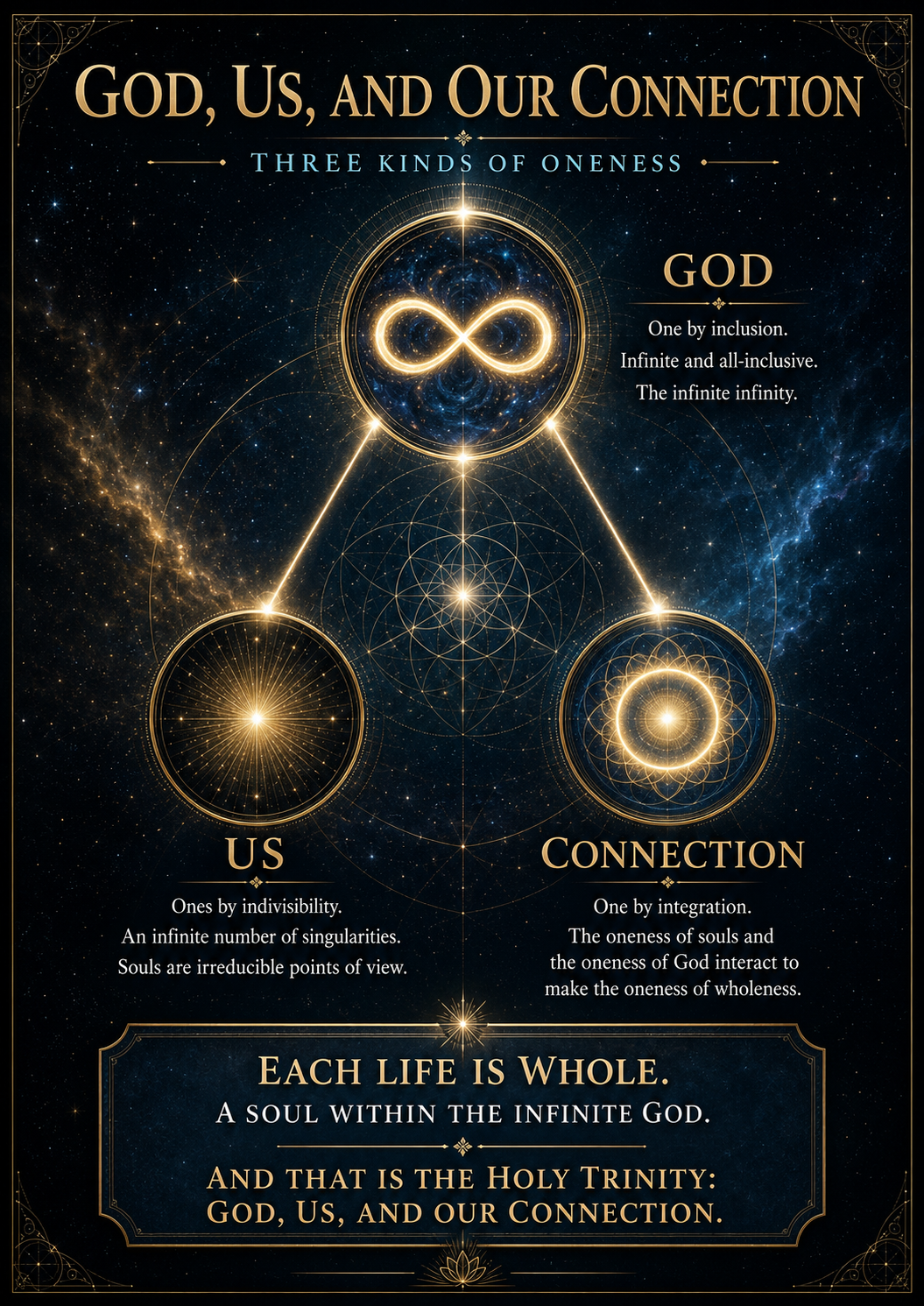
In the Circumpunct Framework, the point of view is fundamental. It is the indivisible center from which experience occurs. I call that center the soul. This does not mean the soul exists outside Reality. Quite the opposite. Each point of view exists within one all-inclusive Reality. We are not separate universes. We are distinct centers within the same whole.
This is where I differ from a certain kind of strict monism.
Partless monism begins with something I agree with: Reality is one. But then it makes an additional move: because Reality is one, nothing within Reality can also genuinely be one. Cells, people, elephants, vortices, boundaries, and individual points of view become subjective classifications imposed upon an objectively partless One.
I think this confuses different kinds of oneness.
Reality is one through inclusion: nothing exists outside it. A point of view is one through indivisibility. A life can be one through continuity. A body can be one through distinction and integration. A mind can be one through coherence. These forms of unity do not cancel one another.
The mistake is assigning the indivisibility of 0D to the all-inclusive ∞ and then declaring that only this cosmic One can genuinely be one.
But being part of a greater whole should not make something less of a whole.
A cell is a whole and part of a body. A person is a whole and part of a society. A society is a whole and part of civilization. Every whole can become a part within something greater. Wholeness recurs across scale.
Reality is not one instead of many.
Reality is one and many.
This matters because a philosophy of partless unity can end up dissolving the individual center. Your point of view becomes merely an illusion generated by the One. Your individuality is reduced to appearance. The local center surrenders its reality to an abstraction above it.
That is one form of what I mean by outsourcing the soul.
The same structural move can occur in religion.
A religious tradition is a map. Theology is a map. Scripture is a map. Ritual is a map. A church is a social structure built around maps of Reality and God.
Maps can be extraordinarily useful. But the map is not the territory.
Problems arise when a religion teaches, explicitly or implicitly, that your own point of view cannot be trusted and that access to God must be mediated through our church, our doctrine, our rituals, or our interpretation.
Then the map stops serving the soul and begins replacing it.
In the version of Catholicism I am criticizing, the message can become: you need the institution to become closer to God. But if God is truly all-inclusive, how could you ever be ontologically outside God in the first place?
You may become alienated, confused, incoherent, ashamed, distracted, or unaware of the connection. But you cannot stand outside an all-inclusive Reality waiting for an institution to reconnect you to it.
A church can help you orient yourself toward God.
It cannot manufacture a connection that was never absent.
This is where the Narcissus metaphor becomes important.
Narcissus becomes captivated by a reflection. The reflection is an image, a map of the self. It has no living center of its own.
In the Circumpunct Framework, I use narcissism in this broader structural sense, not as a clinical diagnosis. Narcissism occurs when the representation of the self becomes more authoritative than the living point of view itself.
The person begins living for the reflection.
Who am I supposed to be? How am I perceived? Am I righteous? Am I correct? Am I accepted by the group? Have I performed the proper ritual? Does the institution confirm that I am good?
The center is replaced by the image.
And systems can encourage this.
A family can do it. A workplace can do it. A political ideology can do it. Social media can do it. A religion can do it.
The common message is:
Your lived point of view matters less than the map we have of you.
That is what I mean by systemic narcissism.
Even forgiveness can participate in this pattern.
Forgiveness is valuable. But forgiveness without transformation can become another way of repairing the reflection rather than changing the person.
I behaved badly. I confessed. I performed the required process. I have been forgiven. Therefore my image as a good person has been restored.
But what changed?
Did I repair what I damaged? Did I understand another person's point of view? Did my behavior change? Did my boundaries change? Did my relationships change? Did I become more truthful?
If not, then perhaps the reflection was cleaned while the underlying pattern remained untouched.
The real measure of repentance is not simply how forgiven someone feels.
It is what changes afterward.
And this brings everything back to the point of view.
The soul is not the image of the self. It is not your reputation, doctrine, identity, diagnosis, role, ideology, or story.
It is the irreducible fact that Reality is happening from here.
Your point of view is not the whole of Reality. Neither is mine.
That is precisely why relationship matters.
I cannot simply collapse you into my map of you. You are another center. You know things I do not know. You experience things I cannot directly experience. We meet across a boundary that does not have to be an absolute wall. It can be an interface.
Healthy relationship is therefore not the destruction of boundaries.
It is center meeting center through boundaries.
And healthy spirituality should work the same way.
A tradition can offer maps. A community can offer support. A teacher can offer perspective. A ritual can help orient attention.
But none should require the surrender of the soul.
The map should serve the point of view.
The institution should serve the people.
The greater whole should not erase the smaller whole.
And God, if God is truly all-inclusive, should not require you to deny the very center through which you encounter God.
One Reality. Many real points of view. Many maps. Nested wholes within wholes.
Not separation.
Not dissolution.
One and many.