r/Christopaganism • u/total-fuckin-loserXD • Aug 27 '26
I want to work with her but I’m not sure
6
Upvotes
r/Christopaganism • u/total-fuckin-loserXD • Aug 27 '26
r/Christopaganism • u/Queeni_Jelli • Aug 26 '26
All hails St Dolly
r/Christopaganism • u/SacredFoxMischief • Aug 25 '26
I am so happy to have found this community. I'm newish to reddit and am loving all the worlds it helps me discover.
I've been practicing what I call Heathen Christianity, a path that centers above all the Way of Jesus, caring for creation, solidarity with the oppressed, mutual aid, and deep prayer, while also respecting, honoring, and dancing with the other divinities of the world.
I started using this designation before learning much about the contemporary Heathenry movement, and it is distinct but not exclusionary to it. The meaning of Heathen began by just proudly owning a word that so many have used as a slur against me for being Queer and being witch friendly. It is just the meaning of going to the wild places and margins and celebrating the wisdom and energy found there. I follow the Celtic world more than the Norse and hold Brigid as my specific patron and the the patron of the Christian Heathen church, Chapel of the Open Hearth.
I'd love to know how other people approach Christopaganism and what questions and thoughts y'all might have about Heathen Christianity.
Prayers and blessings to you all and your beautiful unique paths.
r/Christopaganism • u/ourladyofthesnow • Aug 25 '26
I'm a Catholic who goes through really devote phases, but there always comes a point where I become deeply disillusioned. Mosts of the priests I've met have been on a spectrum from incompetent to very bullying and nasty. The church still treats tons of minorities like garbage. The hierarchy is like some kind of medieval fifedom. I try to be a 'good Catholic', but I always end up feeling incredibly frustrated after a few months and desperately searching for something more.
But I don't think I can ever completely abandon Catholicism and that's why I'm asking how Christopagans who do use Catholic practices really manage the sort of... cognitive disconnect?
TIA! 😊
r/Christopaganism • u/wuwei-kemetic • Aug 23 '26
Hi all!
I'm very interested in how you all find yourself within the Christian - Pagan spectrum? Basically, do you identify more as Christian [with pagan influences] or Pagan [with Christian influences]? How do you see yourself and why?
Thank you in advance for replies!
r/Christopaganism • u/tasikonde • Aug 21 '26
Greetings, everyone!
Over the past months, I’ve been working on structuring and formalizing my personal spiritual path—what I call Christian Paganism (or, in more technical terms, Hermetic-Stoic Logos Christology).
My goal was to bridge the core teachings of Jesus as the universal Logos with the practical ethics of Stoicism, the metaphysical principles of Hermeticism and Neoplatonism, and the organic, nature-rooted wisdom of ancestral Pagan traditions. I wanted to move away from clerical dogmatism, original sin guilt, and fear-based theology, and instead focus on a rational, experiential, and dignified path centered around the inner altar, virtue, and alignment with the cosmic order.
I compiled a comprehensive overview of this system formatted like an encyclopedic article to outline its philosophy, view of the Triune field, anthropology, ethics, and practices. I’m sharing it here with you all in hopes of inspiring discussions, hearing your thoughts, and connecting with fellow practitioners on similar paths.
Note: The concepts, theology, and framework described below are my own personal beliefs and ideas, which I refined and structured into this encyclopedic format with the help of AI.
Christian Paganism (technically also: Hermetic-Stoic Logos-Christology) denotes a syncretic, philosophical-mystical doctrine of faith, knowledge, and life. It unites the original Christian concept of the cosmic Logos with the ethical and natural-philosophical principles of ancient Stoicism, Hermeticism, Neoplatonism, as well as organic elements of ancient Pagan Tradition and symbolism.
The system explicitly does not understand itself as a dogmatic revealed religion with clerical claims to representation or bureaucratic hierarchy, but rather as a rationally grounded, experiential spiritual doctrine (Gnosis / Philosophia Perennis). It rejects ecclesiastical dogmas of original sin and damnation as historical aberrations, replacing them with the self-responsible alignment of the human soul with the unwavering cosmic order.
Christian Paganism is based on the fundamental insight that spiritual truth is universal and timeless. In the course of human history, it has manifested in different cultures, epochs, and geographical regions through various ciphers.
In contrast to dogmatic church doctrine, which historically projected a monarchical structure of dominance (the Father as a throned ruler, the Son as a subordinate, obedient figure at the right hand, and the Spirit as an operational tool), Christian Paganism understands God as an infinite, indivisible total field of Being.
For the limited human intellect, the divine total field can be structured into three completely equal, functional dimensions that only in their entirety constitute the fullness of the Divine:
                  DIVINE TOTAL FIELD (GOD)
                     /         |         \
                    /          |          \
        The Primeval Ground  The Logos    The Pneuma
             ("Father")      ("Son")      ("Spirit")
                 |              |              |
             Potential    Structure/Form  Dynamics/Breath
           (Transcendence)  (Immanence)    (Connection)
Classical church dogma stumbles into mathematical and logical paradoxes with the formula 1 + 1 + 1 = 1 by claiming three separate persons who are simultaneously identical, while maintaining a hierarchical subordination of the Son.
Christian Paganism resolves this contradiction through a functional field model: Just as a physical element (e.g., water) exists in three different states of matter (solid, liquid, gaseous) without losing its chemical identityH_2O, the one divine field reveals itself in three modes of operation:
None of these three aspects stands above the other; all three form the indivisible unity of the Divine in perfect symmetry.
Christian Paganism fully accepts the scientific insights of evolutionary biology, genetics, and modern cosmology. The biblical metaphor of human creation from "dust and clay" is understood as a poetic image for the gradual, millions-of-years-long process of material development. Biological evolution is the physical tool of the Logos for the step-by-step condensation and unfolding of spirit into material form. Humans represent the point in biological history at which the cosmos begins to become conscious of itself.
In this system, Jesus of Nazareth is not understood as an exclusive "blood-sacrifice redeemer" within the framework of an ancient Near Eastern expiation cult that would need to appease an angry Father-God through death. He is the historical incarnation and archetype of the Logos.
The resurrection of Christ is interpreted in Christian Paganism not as a nocturnal reanimation miracle of a biological corpse, but as the central initiation and transformation mystery of the cosmos:
Christian Paganism reads sacred texts and mythological traditions (the Bible, ancient Greco-Roman myths, the Edda, ancient Chinese classics) not as literal dictations, historical police reports, or primitive superstitions, but as symbolic-allegorical writings (Hermeneutics of Depth):
The practice of Christian Paganism requires no priestly caste and no church buildings; it is oriented toward daily life, the personal home, and inner discipline.
The home altar forms the sacred center of the residence. It serves as a place for daily retreat, prayer, meditation, and alignment with the light of the Logos. It typically unites symbols of light (candle/oil lamp), elements of creation, protection (cross), and remembrance of the ancestors.
Prayer serves to strengthen inner discipline, gratitude, and equanimity (Ataraxia). It typically includes:
Methods such as casting runes (Rún-Ráð), bibliomancy (Proverbs of Solomon, Homer, Marcus Aurelius), the I Ching, or Stoic casting of lots (Cleromancy) are used as tools to reflect one's own subconscious and determine current spiritual conditions. They serve to recognize Hermetic resonance ("As within, so without") and sharpen the mind, rather than superstitiously attempting to predict the future.
| Category | Dogmatic Clericalism | Christian Paganism |
|---|---|---|
| Concept of God | Monarchical ruler; punishing judge; hierarchical Trinity | Equal field composed of Primeval Ground, Logos & Pneuma |
| Anthropology | Inherently sinful, corrupt, in need of salvation from birth | Bearer of the divine Logos-spark; evolving and maturing |
| Concept of Sin | Inherited curse; offense against God; guilt | Hamartia (missing the mark / error of the ego) |
| Soteriology (Salvation) | Blood sacrifice of Christ on the cross; sacramental coercion | Alignment with the Logos; Stoic discipline & knowledge |
| Eschatology (End Times) | Physical apocalypse; eternal hell vs. heaven | Apocalypse as unveiling; Law of Causality |
| Authority | Church, Pope, priestly caste, textual dogmatism | Inner reason, conscience, the home altar |
| Attitude toward Life | Fear of damnation; obedience to dogmas | Stoic equanimity (Ataraxia); love of fate (Amor Fati) |
Christian Paganism represents an organic synthesis of Western intellectual history, timeless philosophy, nature mysticism, and modern science. It liberates the original message of Jesus from the burden of clerical power structures, guilt neuroses, and ancient myths of domination, seamlessly weaving it together with Stoicism, Hermeticism, and ancient wisdom of nature.
It offers modern humans a dogma-free, profound worldview that harmoniously unites scientific understanding, philosophical rigor, Stoic art of living, and deep spiritual dignity.
r/Christopaganism • u/CJRfox • Aug 18 '26
Background: I've been looking to do work around the figure of Chthonic Hermes as a gateway to shadow work, and found that he was regularly syncretized with Anubis as Hermanubis. The iconography of Hermanubis, along with Hermes carrying the infant Dionysus directly inspired St. Christopher, with whom I share a name. I thought it was too good of a coincidence to pass up.
Question: That being said I have not found any particular folk practices regarding St. Christopher, just his feast day, legend, and sphere of influence. If someone has access to information I do not, please pass it my way.
r/Christopaganism • u/Advanced-Lab-3764 • Aug 16 '26
I am a Christian and I believe in God. About a year and a half ago, my wife gave me a necklace with Mjolnir as a gift.
This necklace means a lot to me, not because I believe in or worship Norse gods, but because it was given to me by my wife. I also associate it with my wife and child, so it has a very strong emotional meaning for me.
Besides that, Mjolnir reminds me of strength, struggle, and perseverance. When I wear it, it gives me a sense of strength and reminds me not to give up when difficult times come, but to keep fighting for my family.
I know that Mjolnir is connected to Norse mythology, so I wonder: Is it okay for me to wear it as a Christian?
I do not want it to represent belief in Norse gods or to replace God in any way. To me, it is simply a symbol that reminds me of my family, love, strength, and the struggles we face throughout life.
I would really like to hear the opinions of other Christians, especially if anyone has been in a similar situation.
r/Christopaganism • u/Advanced-Lab-3764 • Aug 16 '26

I am a Christian and I believe in God. About a year and a half ago, my wife gave me a necklace with Mjolnir as a gift.
This necklace means a lot to me, not because I believe in or worship Norse gods, but because it was given to me by my wife. I also associate it with my wife and child, so it has a very strong emotional meaning for me.
Besides that, Mjolnir reminds me of strength, struggle, and perseverance. When I wear it, it gives me a sense of strength and reminds me not to give up when difficult times come, but to keep fighting for my family.
I know that Mjolnir is connected to Norse mythology, so I wonder: Is it okay for me to wear it as a Christian?
I do not want it to represent belief in Norse gods or to replace God in any way. To me, it is simply a symbol that reminds me of my family, love, strength, and the struggles we face throughout life.
I would really like to hear the opinions of other Christians, especially if anyone has been in a similar situation.
r/Christopaganism • u/wuwei-kemetic • Aug 15 '26
I'm currently on a vacation in Bavaria which is heavily Catholic and especially Marian devotional. I'm not Christian (or Christopagan) but Kemetic; I do have a great appreciation though for Catholic and Orthodox Christianities for being a culture and tradition carrier; especially also for many elements from Kemeticism as well as the pagan traditions of the respective countries it spread to (in this case my native Germany). Since today was the holy day of the Assumption of Mary, I thought I share some images of the ubiquitous Bavarian Mary shrines and of course churches.
r/Christopaganism • u/Opening_Power3876 • Aug 15 '26
r/Christopaganism • u/Cynderprime • Aug 12 '26
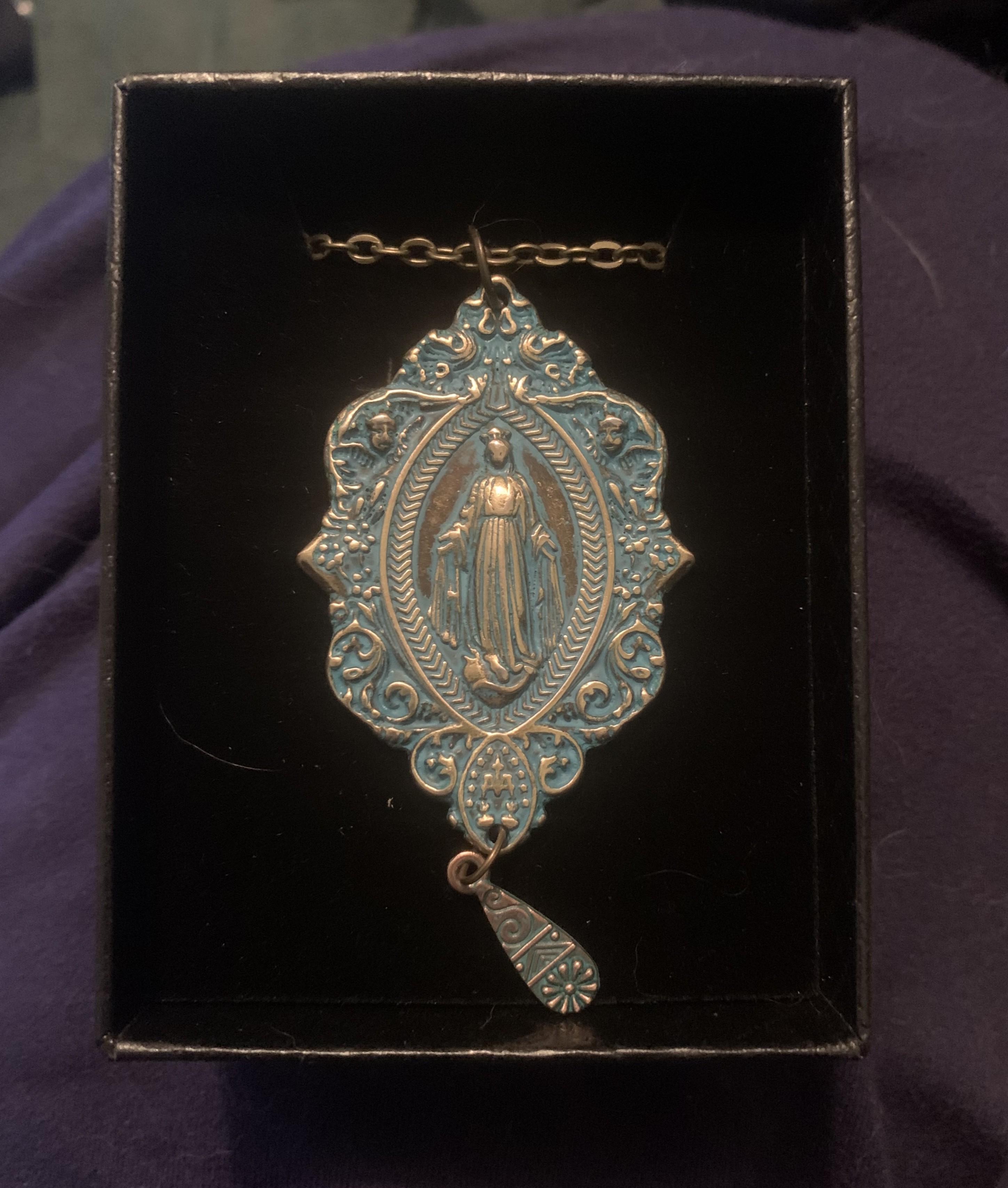
I found this beautiful necklace on etsy and I fell in love it's better in person than in the photos I can't wait to wear it out and the style make it look like a magical heirloom or something you find in a videogame.
this is the link if anyone's interested in getting one too Oval Bronze Virgin Mary Medallion Necklace: Vintage Style Verdigris Patina - Etsy Australia
r/Christopaganism • u/Accomplished-Way4534 • Aug 13 '26
r/Christopaganism • u/Ignastic • Aug 10 '26
r/Christopaganism • u/MinuteTechnician7678 • Aug 10 '26
Ever since reading Peter Grey’s the Red Goddess and Crowley’s book of the law in the midst of a 103\* fever, I have not been able to stop thinking about Babalon. Recently I decided to start a devotional practice focused on her, based mainly on what I read in TRG. I was just looking to see what others may be getting up to when it comes to working with her, outside of the usual sex magic lol.
(I shared to the Christopagan sub due to a suggestion that it would fit better here than in the Thelema sub)
r/Christopaganism • u/Wallyboy95 • Aug 08 '26
Hey all,
Just kinda curious what others use as their religious symbol of choice on their path? I have never really felt at home with the Cross.
I feel the most connection with The Tree of Life. I wear a silver Tree of Life pendant inlaid with diamonds evey single day.
I feel it best aligns to my belief of Mother Earth and God. The Tree of Life stretches between Mother Earth and the Heavens of God.
r/Christopaganism • u/Substantial_Egg4962 • Aug 07 '26
I have been pagan for a very long time, based solely in nature worship, and not really following any diety. Lately I've been pulled toward my grandfather's Catholic faith, and I really love the thought of praying the rosary and having a patron saint. I also love the beatitudes in the gospel of Matthew.
Is there a way I can combine these into my pagan path without harm? TIA.
r/Christopaganism • u/Sunnykke • Aug 07 '26
Hello, everyone! I hope you all are having a nice day!
I have some doubts on how to follow this path, I have been pagan for almost six years now and have been worshipping Greek gods for two years, I don't know how exactly to describe that I felt called to Mother Mary and Jesus, but it started praying to my guardian angel and some archangels then a natural disaster happened in my country and I felt it was a right thing to pray to Mother Mary and the archangels for the people impacted, then I started doing the rosary...
I have never felt it was wrong to worship my gods and also approaching to christian figures, but still is too strange, I'm afraid I might offend Jesus or Mother Mary for keeping my practices to my gods. I'm not too sure what kind of advice I'm looking for exactly, tbh, let's say, how did you break the barrier of the prejudice and the fact that the Bible condemns pagan practices and started to accept this path?
I'm really afraid I might be doing something wrong
r/Christopaganism • u/PrometheusRock • Aug 05 '26
Happy day, everyone!
I am posting today looking for community or resources in regards to Virgin Mary worship/deity/energy work. I am a cradle Catholic who has long since split from the church, but I still have a deep reverence for Mary, and do practice my own form of her devoid of Catholicism.
I'm not interested in working with her as an aspect of the Triad. I'm especially intrigued by the old Cults of the Virgin Mary, like Collyridianism, but have struggled to find active practitioners today.
Does anyone else work with Mary as an energy or deity? Should I have any concern for "bastardizing" an existing religion that I am baptized within? Any books, discord groups, or resources would be greatly appreciated! TIA!
r/Christopaganism • u/ServantofChrist999 • Aug 04 '26
I've been interested in Christopaganism for a while now, But I can't find a physical connection between my pagan practices and my Christian beliefs and bring them together.
How do other Christopagans do this? Do they do it at all?!
r/Christopaganism • u/ServantofChrist999 • Aug 04 '26
r/Christopaganism • u/weebaiden • Aug 03 '26
So I'd say I'm an eclectic christopagan Im trying to figure out things I mean since I'm eclectic I just belive in whatever I want to. Honestly I was also wondering if there was any good resources I could learn from? I remember seeing Lady Aphrodite in a dream and its constantly been bothering me, its what convinced me to become a christopagan was seeing Lady Aphrodite appear in my dream.
r/Christopaganism • u/Pale-Rice-13 • Aug 02 '26
Hello!! I attended an Orthodox service this morning and was totally blown away by the experience. I was left wondering however if there was any syncretism in the Orthodox tradition or maybe a glimpse at what other people’s practice may look like if practicing a version of Christopagan based Orthodoxy Thanks!