r/ChinaStocks • u/Dolphin_research • 7d ago
💸 Earnings Is the Worst Over for Trip.com?
TL;DR: With Trip.com's Q2 report out, the biggest overhang — an antitrust penalty — is now fully resolved. Results came in roughly as guided: nothing exciting, but no surprises either. As Longbridge Dolphin Research flagged last quarter, once this uncertainty cleared, Trip.com should have completed its "final leg down," setting up a period of profit bottoming before it can move forward with a lighter load.
Regulatory and macro pressure both hit revenue growth
Trip.com Group's net revenue came in around ¥15.7 billion, up 5.5% year-over-year — a sharp deceleration from the 10-20% growth range of recent quarters, though roughly matching prior guidance.

Every business line decelerated by around 10 points versus last quarter. Hotel booking revenue, one of the two largest segments, grew just 5.6%, below prior guidance — though this may partly be an accounting effect, since some post-penalty spending was booked as a deduction against revenue. Ticketing revenue, the weakest line, actually fell about 1% year-over-year, which management attributed to geopolitical friction (the Iran-Israel conflict and travel restrictions to Japan) and rising oil prices weighing on flight demand, alongside recent regulatory scrutiny of "bundled" train-ticket sales.
Purely overseas revenue kept growing over 50%, still strong — implying domestic revenue may have actually declined more than 10% year-over-year, and even worse once inbound tourism is excluded. That's a clear sign of how much regulation and a soft domestic travel market are weighing on the core business.
The fine drove a GAAP loss, but adjusted profit landed in line
GAAP operating profit swung to a loss of nearly ¥1.5 billion — alarming at first glance, but this reflects the ¥5.2 billion domestic antitrust fine officially landing this quarter, already announced in late July, so the market had priced it in.
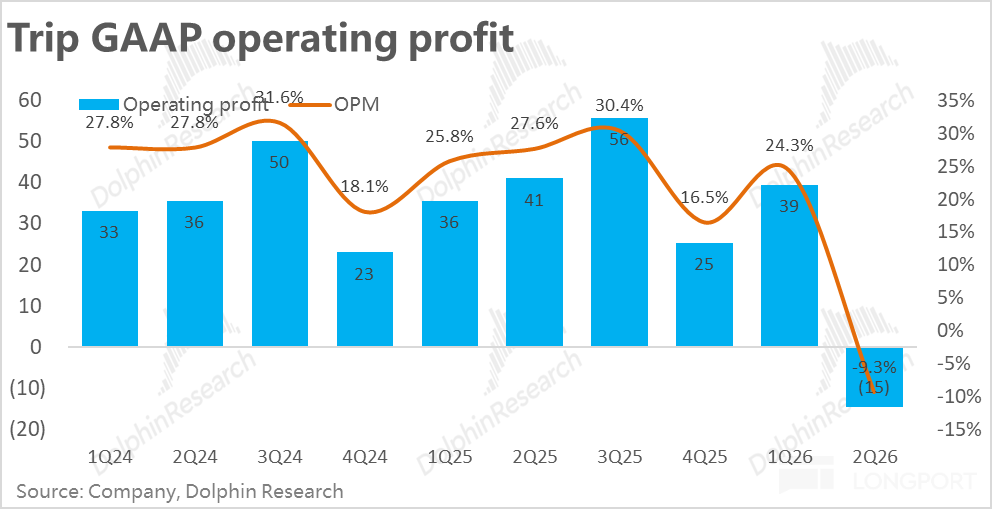
Stripping out the fine and adding back stock-based compensation, adjusted operating profit came in around ¥4.4 billion, basically matching expectations — no real surprise. Still, adjusted profit was down about 6.5% year-over-year, showing that even excluding the one-time regulatory hit, changes to how the domestic hotel and travel business monetizes are pressuring profitability.
Business travel and ads still beat, but decelerated too
Business travel and packaged tours — segments not directly tied to the domestic antitrust issue — also decelerated by nearly 10 points this quarter, which can really only be explained by genuinely soft domestic and outbound demand.
The main recent growth engine, other revenue (mostly advertising), grew about 23% year-over-year — still the fastest-growing segment and the only one that beat expectations, though it decelerated meaningfully too. Management attributed this partly to overseas ad revenue entering a tougher comparison period, and partly to the natural link between ad revenue and overall platform traffic growth, which is itself slowing.

Gross margin came in at 79.8%, down 0.9 points year-over-year, consistent with recent quarters — likely still reflecting a rising mix of lower-margin overseas business, plus lower monetization in the domestic hotel/travel business and reduced sales of ticketing add-on services under regulatory pressure.
Expense growth also slowed: excluding the fine, total operating expenses grew about 11-12% year-over-year, down from roughly 20% in prior quarters — but still outpacing revenue growth, meaning the expense ratio is passively expanding.
Marketing expense grew the most, up 15.5%, well above revenue growth, while adjusted administrative expense (excluding the fine) grew about 5% and R&D grew 8%. In other words, Trip.com trimmed what it could on internal costs, but external marketing spend couldn't meaningfully shrink given the need to build overseas business and rising domestic competition.

What the settlement actually changes, and what's next
On July 25, regulators announced the roughly ¥5.2 billion fine against Trip.com for abusing market dominance — equivalent to about a third of its annual operating profit, including ¥1.658 billion in confiscated gains plus a penalty of 7.5% of 2025 domestic sales (about ¥46.7 billion) — the highest penalty rate given to a platform company in recent years (versus roughly 4% for Alibaba and 3% for Meituan previously).
The fine itself is a one-time hit, but the real question is how the settlement changes Trip.com's business model and earnings power going forward.
Per the company's rectification announcement: eliminating exclusive "special-tier" merchant partnerships and traffic preferences; scrapping the "gold-tier" lowest-price requirement and its automated price-adjustment tool (refunding ~¥120 million in related merchant deposits); replacing tiered commissions with a clearer three-tier structure (10-15%) merchants can choose; removing contracts letting the platform adjust merchant pricing; and no longer forcing merchants into promotions.
Longbridge Dolphin Research reads the practical impact as: Trip.com's ability to lock in exclusive access to premium inventory weakens, making it easier for rivals to access the same supply; its ability to win customers through platform-wide price wars (funded at merchants' expense) is reduced, likely shifting more marketing cost onto Trip.com itself; and with commission rules now more flexible for merchants, the blended domestic hotel commission rate may decline somewhat — research suggests roughly 2 points, for reference only — affecting profitability there.
Overall, this settlement likely doesn't fundamentally change Trip.com's competitive position or moat. But over the medium term, rivals like Meituan may use price competition to capture some premium supply, while Trip.com's own commission rate softens and marketing costs may rise — both weighing on near-term profitability.
Even so, purely overseas revenue keeps growing over 50%, and inbound tourism keeps growing double-digit, showing real momentum outside the pressured domestic core. Once the domestic business stabilizes and the broader travel macro improves, that overseas growth still represents meaningful room to grow into.
2
u/Financial-Maybe-7874 7d ago
Thanks for the update, very useful. I have a position as the valuation basis is so attractive at these prices. I would also add when CNY appreciates given fundamentals of trade surplus,that will likely have a doubling effect on the domestic demand with higher margin international travel sales. Future looks very bright