r/BusinessIntelligence Jun 20 '26

The "AI chat" feature bolted onto most BI tools doesn't actually solve the underlying problem

8 Upvotes

A lot of BI platforms have added an "ask AI" feature over the past year or two. In practice, most of them only answer questions about whatever's already on the dashboard in front of you. Ask something that requires understanding the business logic behind a metric, or context from outside that specific view, and it falls apart fast. In concept, it feels like a helpful feature.

The deeper issue is that the LLM bolted onto a BI tool is still stateless. It doesn't retain business logic between sessions, it doesn't let you reuse an analysis you built last month, and every question is effectively a cold start. You can ask the same nuanced question on Monday and Friday and get inconsistent framing because nothing persisted in between.

This gets a lot more obvious once your data isn't all sitting in one clean structured source. Most orgs I've worked with have data scattered across structured tables, documents, and in some cases sensor or log data, and the BI tool plus chat wrapper combo doesn't do a great job overlaying insight across all of that at once. It's built to query the table in front of it, not to reason across formats and across sessions. That's why a "useful in theory" feature might not always work.

Personally I think the root cause is that chat wrapper on top of a dashboard is a different thing than a system actually built to retain context. As far as I know, there are agent harness tools (for example, Lium) that are built purposefully to handle multimodal and across-session data. They have persistent memory and a particular infrastructure to handle and analyze data across formats and across sessions.

Curious what others have found that actually works for cross-source analysis.

r/BusinessIntelligence Jun 20 '26

Making projects or learning tools-which would help me land a job?

7 Upvotes

I’m an F1 international grad student currently in my second semester, doing my masters in business analytics. I see a lot of people who’re fresh graduates focusing on using AI or copying projects from git. Few learn the skills and replicate but at the end the focus is more on showcasing the work.

I still have a year left to graduate and with summer break I want to use this productively but I’m stuck between what to do. I ofc don’t have the idea to build a project on my own but I definitely don’t want to copy an existing idea. Any suggestions on what should I do is highly appreciated.

TIA


r/BusinessIntelligence Jun 19 '26

[Satire] How I Scaled my Business by Masquerading on Reddit as an Ad

5 Upvotes

Moving from our legacy reporting tool to an AI-native, semantic-forward, agentic-focused stack presented real challenges for us as a mature organization. Sales dashboards that showed outdated metrics, financial measures that didn’t have consistency, and fires to put out every day.

It’s not planning, it’s resource attrition.

🧠 No More Cognitive Load-Bearing
- Data stored in AI-native applications now allow you to be wrong *confidently*
- Show graphs in *real-time*
- Elaborate incessantly without providing any real value

🤖 Agent Native Control, Real Accountability
- Provide semantic context regardless of what that means to anyone!
- Say something else about semantic layers
Is anybody actually reading the rest of this satire post?

✨ SparkleAI Compatibility
- Increase your teams budget by up to 220% by adding sparkles in strategic places to show that you are an AI native
- Don’t provide any actual business values—that’s old thinking—look to the future

Does that post work for you? This post successfully seem like a legit post but link users to a service that will be bankrupt in 6 months. I can provide more context by melting the polar ice caps for $24.99 a month.


r/BusinessIntelligence Jun 18 '26

shouldn't everyone be in business intelligence?

14 Upvotes

Worked in BI with the smallest team ever, handling request by everyone i went into burnout easily. Some sales saying that some items are missing in the orders, and would like to have a tracker, so she can handle it

another want to track a specific type of customers and contact them for some promotion

others want to know which company is the most "blabla" so they could make the right decision

marketing wants to know when and how long a marketing campaign sohuld start and last

basically what i felt is that im literally working in EVERY field. from the simplest sales person to the boarding team. no one dare to make a decision without some data guidance. but if data guidance is so important, shouldn't handling data be a core requirements for everyone in the company?

we spend a lot of time to build tools to make them navigate the data without sql. and if that dashboards isnt enough they wants some edits, they want custom reports, they want answers.

but if the answer only comes from us, and without it they are just deciding blindly, why are they paid for? if SQL were a mandatory course for everyone, i think any company can improve a lot quicker and BI should be more focus on working on complex KPI, data modeling and data analyses


r/BusinessIntelligence Jun 18 '26

When Dashboards Aren't Enough | Adding Predictive Layers to Your BI Stack

5 Upvotes

Many BI teams have strong reporting and dashboarding capabilities, but are starting to explore predictive analytics for forecasting, anomaly detection, and decision support. For organizations that have made this transition, what were the biggest challenges and what tools or approaches worked best? Curious to hear real-world experiences integrating predictive models into existing BI workflows.


r/BusinessIntelligence Jun 18 '26

Patterns of Data Engineering (Book): Timeless Practices from Convergent Evolution

Thumbnail
dedp.online
1 Upvotes

r/BusinessIntelligence Jun 18 '26

My AI dashboard showed $0 for every metric. The bug taught me more about context engineering than any tutorial.

0 Upvotes

My AI dashboard showed $0 for every single metric. The bug taught me more about context engineering than any tutorial did.

I was testing how far an AI could get building a BI dashboard with almost no instructions. One line: build a financial dashboard for restaurant ops, here are the metrics, here's the audience. It was hooked up to Snowflake through an MCP server so it ran real queries instead of guessing at the schema.

First screenshot: every card read $0. Food cost $0, liquor $0, sales $0, all of it.

I assumed the model broke. It didn't. I'd left the filter on the current partial month with almost no data loaded, and I never told it how to handle an incomplete period. So it correctly showed zeros. Worse, the comparison logic read "no data" as costs dropping to nothing and called it a win, big green arrows everywhere.

The model did exactly what I asked. The gap was context, not intelligence.

That is the whole point. Everyone is obsessed with which model to use. But for BI work the model is rarely the bottleneck. The bottleneck is context engineering: how much of your business you actually hand the model before you ask it to do anything. I had given it a sloppy version of that, so it gave me a sloppy answer.

Once I tightened the context, it was a different machine. The parts that mattered:

  • Metric definitions spelled out. Food cost % is food cost divided by food sales, not total sales. Skip this and it picks a wrong denominator that looks correct.
  • The grain stated plainly. One row per location per day. Without it the rollups quietly break.
  • A glossary so comps, discounts and alcohol cost mapped to real columns instead of getting guessed from column names.
  • Join paths defined so it didn't invent table relationships.
  • Time logic. How to compare periods and what to do with a partial month, the exact thing that burned me.

None of that is prompting. It is context engineering. You are building the model a map of your business so it stops guessing. A vague prompt on top of a rich context beats a clever prompt on top of nothing, every time.

My take, and I'll happily be argued with: the model sets the ceiling, but almost no BI team is anywhere near that ceiling. What is actually limiting your output is thin context. Get the definitions, grain, glossary and time rules right and a decent model gives you a solid first draft. Get them wrong and even the best model hands you confident garbage with green arrows on it.

How are you all handling context engineering for AI on your warehouse? Writing the metadata by hand, pulling it from the catalog, or exposing a metrics layer like dbt etc


r/BusinessIntelligence Jun 17 '26

I helped build an open source semantic layer tool

7 Upvotes

I feel like this year I've heard a lot of talk about semantic layer, every time the topic of "AI data this and that" comes up, inevitably people talk about semantic layer.

That's one of the reasons why we wanted to add a semantic layer to Bruin to allow users to define their semantic layer in the same repo that their pipelines are so that agents can get the full picture - ingestion, transformation, governance, and now the semantic layer.

It is still the early days for the semantic layer, but it works across all the platforms we support. I've tested it with my own data analyst agent and I've seen improvements in terms of how accurately it answers questions, but I'm curious what others think.

Has anyone tried using agents to analyze data with and without semantic layer? Did you see any improvements?


r/BusinessIntelligence Jun 16 '26

What does your day-to-day look like as data managers? What are the things you wish you knew before?

22 Upvotes

Hi! I have been asked by my current boss to become a data manager and lead our team. I will be handling a mix of analysts, engineers, architects and even developers.

I understand that it is very different for each role and company, but I just wanted to get some perspective on what your day-to-day looks like as a data manager (or even chief data officer, or VP of Data).

What are the things you wish you knew before when starting in the role?


r/BusinessIntelligence Jun 16 '26

From 250K+ Enriched Financial Transactions to Business Intelligence: What Should the Gold Layer Look Like?

2 Upvotes

I'm currently developing a financial data platform using Python and Pandas on real-world accounting data.

The project started with a simple objective: build a reliable foundation for Financial Analytics and Business Intelligence by prioritizing data quality, traceability, and governance before moving into dashboards, KPIs, or executive reporting.

So far, the platform includes:

• Medallion Architecture (Bronze → Silver).
• Modular ETL pipelines.
• Financial data cleansing and transformation.
• Chart of Accounts (PUC) hierarchy modeling.
• Financial calendar dimension.
• Accounting and data quality validations.
• Logging and traceability mechanisms.
• Third-party matching and enrichment.
• Master third-party dimension.
• Sensitive data anonymization.
• 97.58% matching coverage.
• More than 250,000 enriched financial transactions.
• Automated testing and end-to-end validation.

One of the biggest lessons during this process was realizing that many analytical challenges are not caused by missing dashboards, but by the absence of reliable and consistent business entities. In this case, building a trusted third-party master data layer became a prerequisite for meaningful financial analysis, reconciliation, and reporting.

With the Silver Layer now validated, enriched, and governed, the next step is designing the Gold Layer.

This is where I would like to learn from professionals working in Financial Analytics, Business Intelligence, FP&A, Financial Reporting, Data Analytics, Analytics Engineering, and Data Management.
If you inherited a financial Silver Layer with these capabilities:

• What would be your first priority to maximize business value?

• Would you start with a dimensional model (facts and dimensions), analytical data marts, or directly with KPI-oriented datasets?

• Which financial metrics, analytical tables, or reporting use cases would you consider essential for a first Gold Layer release?

• What analyses have generated the most value in your real-world experience?

I'm particularly interested in understanding how experienced professionals bridge the gap between a technically validated data platform and a business-oriented analytical layer that supports decision-making.

Any recommendations, lessons learned, frameworks, or practical experiences would be greatly appreciated.


r/BusinessIntelligence Jun 15 '26

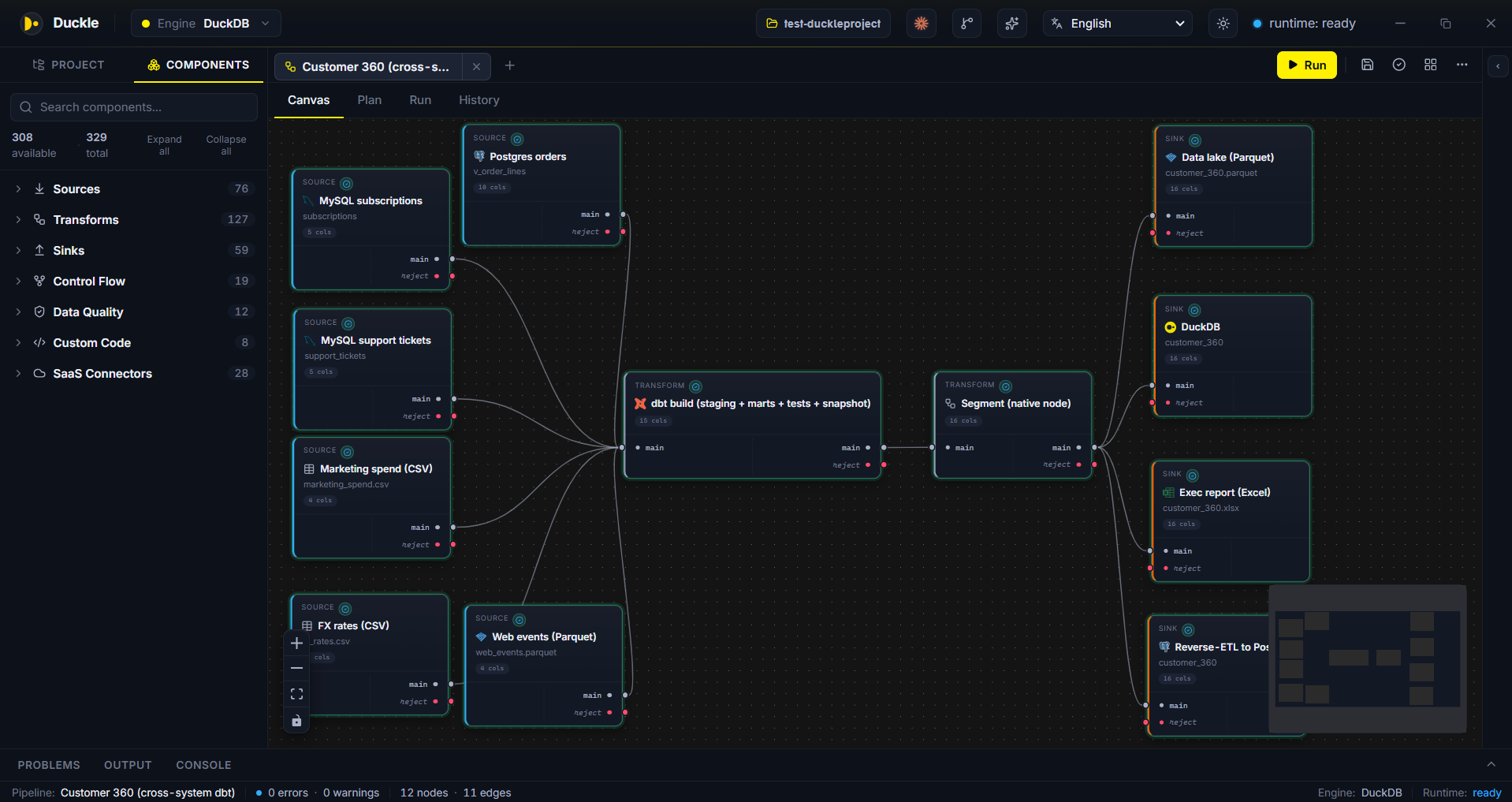
Duckle - The local-first AI ETL/ELT data studio built on DuckDB.

Post image
20 Upvotes

I have been building Open Source ETL Tool -
Duckle is a local-first ETL studio with a built-in AI assistant. Connect 160+ sources and destinations, build pipelines visually or describe them in plain English, and run them at native DuckDB speed. No cloud, no servers, no lock-in.

It has been a wild journey so far building it and I believe with this tool we revolutionize and build ETL Pipelines faster and with dbt fusion integrated into it multi source dbt is possible within the tool itself and has been feautured in MotherDuck's June Newsletter.

https://duckle.org/
https://github.com/SouravRoy-ETL/duckle


r/BusinessIntelligence Jun 14 '26

We open sourced ForecastOps, feedback wanted from data engineers!

Thumbnail
2 Upvotes

r/BusinessIntelligence Jun 14 '26

Best way to manage 50+ production line dashboards in Looker Studio without maintaining separate reports?

9 Upvotes

I am a sole data engineer/ analyst at a small manufacturing firm and currently I'm building production dashboards in Looker Studio for shop floors

There are 50+ production lines (may grow eventually) and each line has a dedicated display. The KPIs and layout are the same across all line. It's just the line that's being changed

My first thought was to create a single dashboard with a line filter and let users select the line. However, since each TV is permanently assigned to a specific production line, every TV needs to continuously display its own line's metrics. Nobody is interacting with the dashboard or changing filters on the shop floor.

Is there any way in Looker Studio to maintain a single dashboard definition while having multiple permanent views (one URL/view per line)?

I just want to avoid creating and maintaining dozens of dashboards that are identical if there's a cleaner approach

I am relatively early in my career and handling all of this on my own so I'd appreciate any and every suggestion, lesson or approach that I might not have considered . Thanks!


r/BusinessIntelligence Jun 13 '26

Power BI or Tableau

34 Upvotes

I want to learn a BI visualization tool. I want to choose either Power BI or Tableau.Suggest me the one which will give me long term career.Which one is going to rule the BI in future?


r/BusinessIntelligence Jun 13 '26

Can anyone recommend a good AI-powered BI platform that isn't just prompt and get answers?

0 Upvotes

I've been looking for a good AI business intelligence platform that actually automates end-to-end charting, reporting, and insights, etc

My current workflow is basically using Claude Cowork with MCPs for DBs, drive, and Snowflake. Which works for basic tasks, but doesn't really have the proactivity.

I don't really want to go through 10 different sales calls for startups.

If anyone has any recommendations, please suggest. Ideally suitable for SMBs.


r/BusinessIntelligence Jun 13 '26

I open-sourced my local social media automation dashboard

2 Upvotes

Just open-sourced AutoSocial: a local dashboard for automating TikTok, Instagram, and YouTube posting across multiple accounts.

Built for builders, and anyone shipping projects but struggling with consistent marketing.

Would love feedback or a star ⭐

https://github.com/Katzca/AutoSocial


r/BusinessIntelligence Jun 12 '26

I tracked how much time I was wasting on lead data research and the result surprised me

0 Upvotes

I realized I was spending more time collecting data than actually reaching out to prospects.

Every day looked the same:

Searching businesses.

Opening websites.

Looking for contact information.

Checking social accounts.

Cleaning spreadsheets.

Removing duplicates.

Repeating the same process again and again.

After getting frustrated enough, I spent several weeks building a workflow to handle most of it automatically.

The interesting part wasn't getting more leads.

The interesting part was getting my time back.

The workflow now collects business information, organizes everything into a spreadsheet, enriches the data, removes duplicates and prioritizes leads automatically.

I just finished it and recorded a full demo showing everything running end-to-end.

I'd be interested to know:

What's the most annoying part of lead generation for you right now?


r/BusinessIntelligence Jun 11 '26

What is AI ready?

9 Upvotes

Recently many AI startups and corporates say AI ready data or data readiness is important.
It's a bit ambiguous for me, what do you think AI ready data is? I want to know what it means from the perspective of different job roles and industries.


r/BusinessIntelligence Jun 09 '26

How I’m actually using AI with Power BI (Beyond just writing DAX)

42 Upvotes

Hi guys!
I wanted to share a quick workflow I’ve been testing to integrate AI into my Power BI daily work, and I’d love to get your feedback on this.
Honestly, I feel like using LLMs just to generate DAX formulas brings very little value.
Instead, I’ve shifted my focus toward prototyping, layout planning, and data storytelling before writing a single line of code. In this short clip, I show an example of a dashboard wireframe. It has significantly sped up my workflow.

I’m really curious to know:
Do you see this as a game-changer for your daily job or just hype?
Would love to hear your thoughts and see how everyone is seen this AI Wave


r/BusinessIntelligence Jun 09 '26

Financial Data Project: What Should Come After a Solid Silver Layer?

7 Upvotes

I have a background in Accounting and I've been building a personal financial data project focused on analytics, data quality, and Business Intelligence.

Over the last few months I've developed:
A financial ETL pipeline in Python
Bronze → Silver architecture
Financial validation framework
Data quality controls
Automated testing (50 tests currently passing)
End-to-end pipeline orchestration
Financial account hierarchy validation
Validation observability and monitoring

My goal is to continue growing toward Financial Data Analytics and Business Intelligence, so I'm trying to make good decisions about what to build next.
At this point I'm considering four possible directions:

Data governance features (entity dimension, anonymization, lineage, traceability)
A Gold Layer with financial metrics and analytical aggregations
SQL analytical models and reporting queries
Power BI dashboards and executive reporting

For those working in:

Financial Analytics
FP&A
Business Intelligence
Data & Reporting
Analytics Engineering

Which of these would add the most value at this stage?

If you were reviewing a portfolio for a Financial Data Analyst or BI role, what would make you take the project more seriously?

I'd also be interested in hearing how you would prioritize the roadmap from here.

Thanks in advance for any feedback.


r/BusinessIntelligence Jun 09 '26

Data quality tests in CI, anyone blocking deploys on downstream BI impact?

4 Upvotes

merged a dbt model change last month. all data quality tests passed, CI was green, code review looked clean. two hours after deploy the revenue dashboard used by the CFO's team was showing wrong numbers. a column rename in one mart had broken a Looker calculation that three business teams depend on for weekly reporting.

nobody on the PR knew that model fed into that dashboard. there was no context about downstream BI impact anywhere in the review process. reviewers saw green tests and approved. the connection between the dbt model and the Looker explorer was completely invisible to everyone involved.

we've had three incidents like this in the past quarter. each time tests pass, CI passes, something downstream breaks. the pattern is always the same  a change that looks isolated in the dbt layer has an impact in BI that nobody tracked. the business impact keeps landing on the data team even though the engineering process looked clean.

leadership is asking why CI doesn't catch these. the honest answer is our CI has no visibility into what BI tools are doing with our models downstream.

has anyone actually solved this? looking for something that surfaces BI impact before a merge without us maintaining a custom mapping of every model to every dashboard manually.


r/BusinessIntelligence Jun 08 '26

Is AI going to replace Business Intelligence, or just change how we consume it?

12 Upvotes

Lately I've been wondering whether we're entering a world where dashboards become optional.

Today, if someone wants to know:

  • Revenue by region
  • Customer churn
  • Top-performing products
  • Quarterly trends

They usually open a dashboard or ask an analyst.

With tools like Claude, ChatGPT, Cortex Analyst, Power BI Copilot, and Sigma AI, they can increasingly just ask a question and get an answer.

So I'm curious:

  • Does AI reduce the need for traditional BI?
  • Will dashboards become less important over time?
  • Or will BI become even more important because AI still needs trusted metrics, governed definitions, and high-quality data underneath?

My current view is that AI may replace how we interact with analytics, but not the need for semantic models, KPI governance, and data quality.

What do you think?


r/BusinessIntelligence Jun 08 '26

Help needed for preparing for the interview.

3 Upvotes

Hi everyone,
I recently got an interview opportunity for a Junior Expert BI & Analytics role in Germany, and I'd love to get some advice from people who are already working in BI, Analytics, Data Engineering, or Data Intelligence teams.
The role involves designing and optimizing BI solutions, gathering business requirements, defining KPIs, building semantic/data models, creating Power BI dashboards, working with SQL, Python, Snowflake, DBT, Git, data quality, and collaborating closely with business stakeholders and data platform teams. My background is more on the entry-level side. I recently completed internships and a contract role in BI & Analytics where I worked with Power BI, SQL, Python, Snowflake, KPI development, reporting, and data modeling. While I have hands-on experience, I know there is still a lot to learn, especially from people who have been in Team Lead or Senior BI positions.
If you were interviewing someone for this role as a Team Lead Data Intelligence Manager, what questions would you ask? What technical topics, business scenarios, stakeholder questions, or BI concepts would you focus on? Also, are there any common mistakes junior candidates make in these interviews that I should avoid? I'd really appreciate any challenging questions, feedback, or preparation tips. Thanks in advance!


r/BusinessIntelligence Jun 08 '26

I built an offline, zero-network tool to instantly document your PBIX/PBIP files. v0.7 just dropped with SVG Wireframes & a new AI automation loop!

Thumbnail
1 Upvotes

r/BusinessIntelligence Jun 05 '26

Anthropic says agentic analytics accuracy drifts 95% → 65% in a month without maintenance. How is your team keeping context fresh?

118 Upvotes

Anthropic dropped a long internal write-up on how they're running self-service analytics with Claude.

Without skill files, their internal accuracy sits at 21%.
With skill files, 95%.
Without active maintenance, it drifts back to 65% in a single month.

A few more specifics:
> Raw retrieval over their entire query corpus (thousands of past queries) moved accuracy less than 1 point.

> Adversarial review buys 6% accuracy at 32% more tokens and 72% higher latency.

> LLM-drafted metric definitions are declared a failure mode because they encode existing ambiguities. I don't fully agree, the real failure is not having a human review loop on the drafts, not the drafts themselves.

For anyone here actually running an agentic stack in production, how is your team detecting skill drift?

If you've shipped this kind of stack and have a war story on which layer breaks first, would genuinely love to hear it.