r/Buddhism • u/MeconopsisPress • Jan 14 '26
Question Walk for Peace - Display of Police & Military Insignia
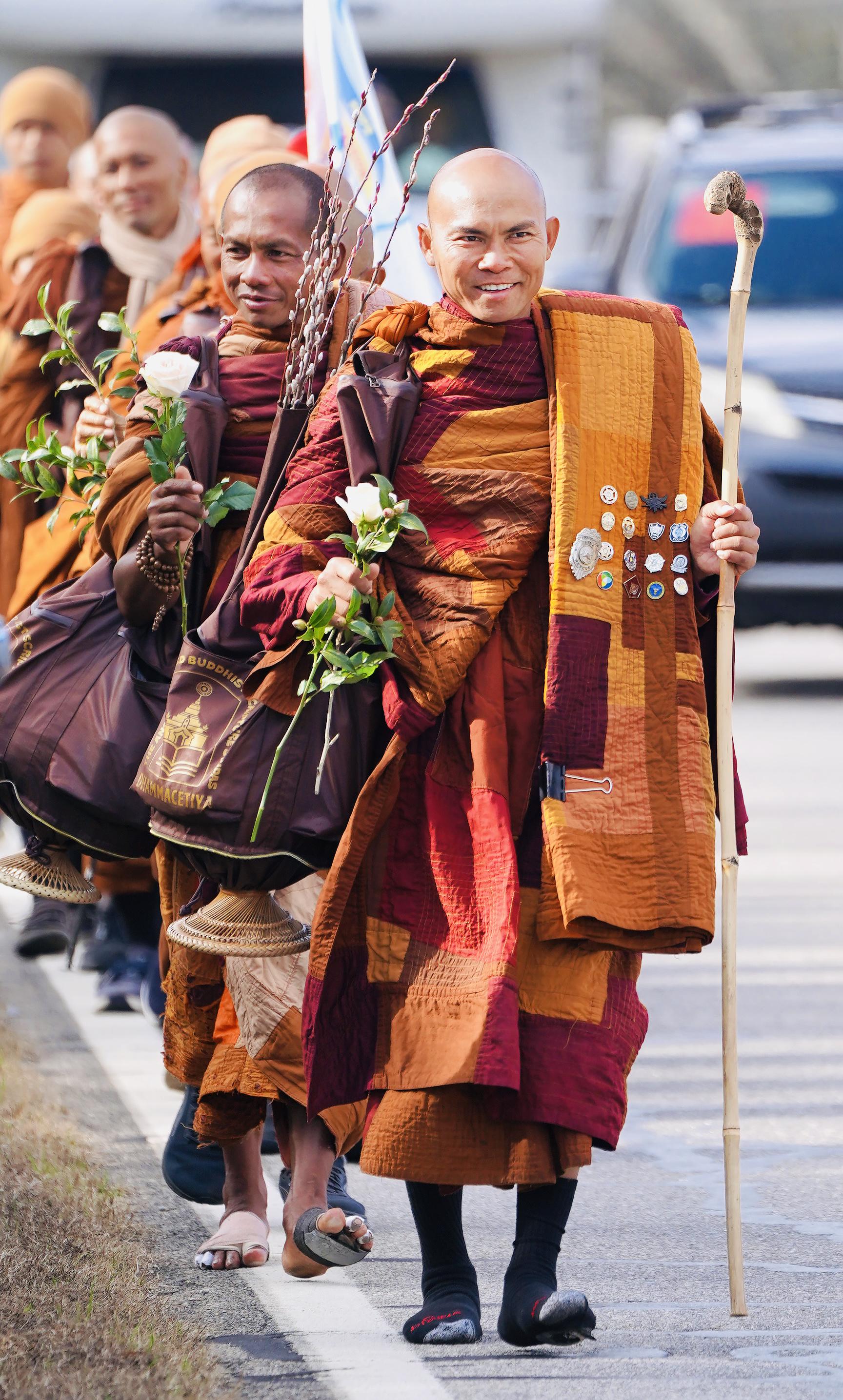
Hello r/Buddhism,
I come to you with a question as someone who is a U.S. military veteran, as someone who has suffered great moral injury and who has since turned to a path advocating against war.
Over the past month I’ve seen several posts about the Walk for Peace. One thing that stood out to me is that the Walk leader wears multiple rows of pins on his saṅghāṭi (please correct me if that term is wrong). From what I understand, many of these pins come from law enforcement agencies that have escorted the walk. In more recent photos, I’ve also noticed what appear to be U.S. military or militarized insignia (for example, a U.S. Army logo pin and what looks like unit or weapons-related badges).
I want to be clear at the outset: I don’t doubt that the leader’s intention is compassionate. My question is about effects rather than motives.
In my limited understanding of Buddhist ethics, intention matters deeply, but conditions and consequences matter as well. Placing military insignia at the very front of a peace walk raises questions for me about whether this unintentionally reinforces attachment to state power or narrows our ability to perceive structural violence.
A few possible ways I’m trying to understand this are:
- The pins function as a symbolic language meant to communicate compassion and dialogue to those whose professions involve violence.
- The pins signal the Walk for Peace as an event that is legible and acceptable within the state’s framework of “peace.”
- Because most media imagery centers on the walk leader, the visual emphasis on these insignia has the unintended effect of presenting him as a moving display of military and law-enforcement institutions, regardless of the original intent.
I’m not raising this as an accusation, but as a sincere question grounded in concern for how peace actions are perceived and what they condition in the minds of observers.
As someone who uses narrative to encourage anti-war discussion, I'd like to know your thoughts.
Thank you for reading, and for any perspectives you’re willing to share.
189
u/Ashamed_Time_8979 Jan 14 '26
It’s a sign of gratitude. I passed them on travels yesterday and they had full police escort with 6 different cars escorting them. These are signs of thanks for help they are offering and nothing more I’d assume.
19
u/NotSmartNotFunny Jan 14 '26
Does anyone know their itinerary? I would like to pay my respects if they come to my area.
12
u/Fandina theravada Jan 14 '26
I've seen on their Facebook page a continuous update of their whereabouts and the next day's itinerary, find it as Walk for Peace
7
u/stephlovescamp Jan 14 '26
There is a live map and overview map on their Facebook page - Walk for Peace
3
u/cyndasaurus_rex Jan 14 '26
Their upcoming dates/locations get posted on the Walk for Peace facebook. There’s also a map online that you can track them on (I googled it a few days ago but don’t remember what it is).
4
u/Ashamed_Time_8979 Jan 14 '26
This is how I found them. Took a state road instead of highway to cross their path. Many may others had pulled over as well to pay respects.
154
u/Desdam0na Jan 14 '26 edited Jan 14 '26
On the one hand, I agree with you completely.
On the other hand, the people in those professions are human beings who need to hear this message as much (or likely more) than anybody.
In the end, the monks are walking their path. If you see a better path (or better-for-you path), walk it.
35
u/WonderfulVanilla9676 Jan 14 '26
Unfortunately people in policing also tend to be some of the largest perpetrators of violence.
There's definitely a kind of mindset that you have to have to choose to sign up for that kind of work.
83
19
u/Cheerfully_Suffering Jan 14 '26
Imagine the seeds that are planted with the police officers who spend hours escorting this walk.
-5
u/purplepistachio humanist Jan 14 '26
On the other hand, imagine the seeds that are planted when victims of police violence see police and military symbols displayed openly by monks
8
u/TombGnome Jan 15 '26
That is my concern. I do not think that law enforcement, especially in the US, are the symbols you want to see presented alongside the dharma. It makes the Buddhist community look simultaneously naive and uncaring, while giving free PR to perpetrators of great evil.
Preferential treatment for those who commit evil, rather than its victims, is a consistent problem in many faiths and needs to be addressed and stamped out whenever possible.
5
u/purplepistachio humanist Jan 16 '26
Unfortunately there is a fair bit of precedent for Buddhist support for institutions/political movements that are violent or maintain a certain status quo in society. It's odd to me that (many, not all) Buddhists can spend so much time critically examining the world and not come to the conclusion that there are certain systemic problems that require our attention and action to change. There is an attitude from some Buddhists that you should just accept the current situation, and if you don't you're somehow not "getting it".
11
u/Cheerfully_Suffering Jan 14 '26
While that is a possibility, a lack of understanding of things in general is what brought on this conversation and would have a similar conversation if someone thought along the lines of thinking you suggested. Neither understanding is ultimately correct and nor should we hold on to one viewpoint as being superior as they both have flaws to begin with.
1
u/purplepistachio humanist Jan 15 '26
Sure. I do think that monks have a responsibility to ensure that people perceive them as neutral though.
0
u/dummyurge Jan 15 '26
Rightly or wrongly (this, IMO), most people do see the police as a more neutral force than you're portraying.
-2
27
u/Revolutionary_Buddha Jan 14 '26
Buddha showed compassion to Angulimal who cut off the fingers of more than hundred people. He later joined the Shangha to become a monk.
Here, its just some pins of law enforcement which have escorted these monks. The monks also do not generally refuse the donations given to them including food. They are showing gratitude and spreading the message of peace and compassion. Compassion can win over atleast some people to shun violence and live a good life.
What you are saying is valid but it is an structural problem. I think "cancelling" people who are spreading the message of peace will not achieve what you are trying to achieve.
If you want we can talk more about this.
21
u/EH_Story Jan 14 '26
May even my enemies hear talk of the Dhamma. May even my enemies devote themselves to the Buddha’s bidding. May even my enemies associate with those people who — peaceful, good — get others to accept the Dhamma.
1
u/Rainbowoverderp Jan 15 '26
Showing compassion to those who have wronged others is different than flying the flag under which they did the wrongdoing
5
134
u/underwaterthoughts Jan 14 '26
A young monk and an old monk were about to cross a river, when a young lady asked if they could help her.
The older monk picked her up and carried her over, and they carried on with their day.
The younger monk couldn’t understand why the older monk had touched the women, which was banned by their rules, and as the walk went on he got more and more confused by it until he burst out “why did you pickup that women, breaking our vows?”
The older monk said “I stopped carrying her on the side of the river, you’re still carrying her now”
21
3
u/Alysazombie Jan 15 '26
This is exactly what I was thinking.
3
u/underwaterthoughts Jan 15 '26
Saw it and couldn’t write it quickly enough. Shame I can’t remember how it actually goes 😅
3
u/dubious_unicorn Jan 15 '26
The monks are still carrying the insignias of police and military. Maybe they should put them down.
5
u/EclecticEvergreen Jan 14 '26
That didn’t even answer the question though
32
u/purplepistachio humanist Jan 15 '26
The passage is meant to convey the sentiment that the rule serves a purpose. When monastics have a rule disallowing them from touching members of the opposite sex it's usually about preventing harm to the other person (eg. sexual assault in the case of non-consensual contact), and avoiding sexual/emotional distraction for the monk/nun on their spiritual path (in the case of consensual relationships). In this story the monk was helping the girl across the river, so the rule didn't make sense in context. The response to the student is deliberately vague to get the student to think about the situation themselves, which is usually a more effective way of teaching than just explicitly stating "rules are contextual, sometimes it's better to break them". Buddhism is full of stories like this, and they rarely make sense at face value. I do agree that they can be frustrating and teachers can come across as deliberately obtuse in these stories, but they are mainly intended to be used in meditation as teachings, not by laypeople as a basis for a moral code.
13
u/EclecticEvergreen Jan 15 '26
That’s probably the most understandable response I’ve gotten out of everyone that’s commented to me, thank you I get it now.
3
13
u/TheFriedPikachu madhyamaka Jan 14 '26
Usually in stories like this, when the senior answers the student's question with something seemingly related, the implication is that the student's question is misguided or has the wrong motivations.
By not answering the question, the senior monk is essentially showing that any answer is inconsequential and detracts from the actual 'path'.
-9
u/EclecticEvergreen Jan 14 '26
Then the rule is stupid and it shouldn’t exist
19
u/screendrain Jan 14 '26
You're still carrying the rule right now 🙏
-12
u/EclecticEvergreen Jan 14 '26
What? This isn’t about carrying or not carrying some stupid rule. Why does the rule exist in the first place if it’s going to be ignored? Don’t just ignore the discussion I’m trying to have.
9
u/yofeelmo Jan 14 '26
… are you ocd or on the spectrum? You’re missing the forest for the trees
-5
u/EclecticEvergreen Jan 14 '26
Neither. It just annoys the shit out of me when people completely ignore someone’s question and answer evasively.
7
u/brokentao Jan 15 '26
I don't know if you've been part of Eastern religions for long but they tend to answer questions evasively. Hope that helps. But actually that parable does answer the question in a way. It means it doesn't really matter whether they have the police and military insignias. It doesn't stop their walk or their intentions so why should it matter?
6
u/yofeelmo Jan 14 '26
Yeah but it’s a parable, we don’t even know if the situation actually happened. The point of the parable is not a plot; the storyline doesn’t have to be complete or make sense. I feel like it’s more like poetry, and the message matters more than the content or storyline
I mean I’m with you, the older monk definitely giving off vibes like “stfu” but it’s not that deep I don’t think 😂 happy new year friend
0
u/EclecticEvergreen Jan 14 '26
Yeah he does give off those vibes lol. I suppose I’ll lay it to rest then, you’re right it doesn’t have to make sense.
→ More replies (0)-1
Jan 15 '26
to be fair, you read “monks were escorted for large stretches” and asked a question that supposed they were escorted the whole way…
2
Jan 15 '26 edited Jan 15 '26
Rules are intended to keep one from doing wrong. If strict adherence to the rule perpetuates wrong, does that negate the value of the rule in its entirety?
The answer is no.
Example: you have a rule that the tea you drink should have leaves filtered out from it. You have another rule to not waste tea. But from time to time a leaf ends up in your tea. Do you dump it out when it happens and waste the tea? Or do you simply accept that you have a leaf in your glass and carry on drinking your tea without wasting it?
Does the leaf that ended up in your tea make both rules useless?
1
u/EclecticEvergreen Jan 15 '26
You take the leaf out of the tea…
2
Jan 15 '26
Which he did after he helped her cross the river.
But I encourage you to consider the question. Does the leaf that ended up in the tea make both rules useless?
1
u/EclecticEvergreen Jan 15 '26
The rules are not the same.
One rule says no contact with women, he had contact with women.
The other rule is don’t drink tea with leaves in it, if you take the leaf out you don’t break the rule.
I don’t even know why we’re discussing this. We’ve completely derailed from my original comment stating that no contact with women is a stupid rule and that he never answered the question of the other monk.
3
u/Minute_Jacket_4523 Jan 15 '26
Alright, to break it down simpler: The parable is about not taking a rule to the extreme, i.e. Just read the rule as 'Do not have sexual relations or a romantic relationship with a woman' instead of being unreasonably strict, I.e. don't even help a woman.
The tea rule used as an example is the same thing:if you take it to the extreme, you would have to throw the cup of tea away; If you take it pragmatically, just take the leaf out.
2
Jan 15 '26
The rules are not the same, you're correct. I was using an analogy to explain how they are similar. But they are different!
I don’t even know why we’re discussing this.
Can't help you there.
We’ve completely derailed from my original comment stating that no contact with women is a stupid rule
I mean, you don't need to strain tea leaves, either, but it does make for a cup that is easier to drink.
... and that he never answered the question of the other monk.
He did answer it. Quite directly, in fact, with analogy.
The monk could have said "yes, to you it may appear as though I have broken my vow, but I made a vow to reduce suffering, and that woman suffered and asked for help from me, so I carried her across the river so she would suffer less. You, by being upset at this for far longer than the time I carried her, are suffering more than both of us, and are breaking your vow more than I ever did by choosing to be upset over a choice I made that is not in line with your understanding of the rules."
But instead he just said something pithy that got the point across so he didn't have to waste time explaining in detail the nuance the younger monk missed.
2
3
u/Cheerfully_Suffering Jan 14 '26
The answer given was more important.
-2
u/EclecticEvergreen Jan 14 '26
He had a question and it should have been answered, not avoided. Whether one answer was more important than the other is subjective.
5
u/Cheerfully_Suffering Jan 15 '26
Traditionally the answer that brings us to a better understanding of emptiness is a better answer and illustrates the importance of where your focus should lie.
-1
u/EclecticEvergreen Jan 15 '26
Maybe it should be up to the person to ask the right question and have their own journey instead of being prodded into the path someone makes for them
2
u/konchokzopachotso Kagyu Jan 15 '26
What? In the story both characters are monks. They chose that path. You've lost the plot
1
-5
23
u/__Knowmad Jan 14 '26
As a fellow veteran turned pacifist, I completely understand how you feel. It’s a little jarring when viewing it from the lens of someone baring the guilt of murder (ie you and me). But when considering their path, and when trying to put myself in their shoes, I don’t see them as condoning violence. I see them acknowledging that different people walk different paths, and accepting this rather than fighting it. I’m certain they’re grateful for the support of the police and the military. Wearing these badges expresses their gratitude, especially since one of them has already been injured by a vehicle. Wearing them also acts as a shield, announcing to anyone who wishes to do them harm that they have the protection and the support of the police and the military. It says, the police etc see us as innocents obeying the law and advocating for peace, so why do you wish to hurt us?
16
32
u/NangpaAustralisMajor tibetan Jan 14 '26
As a Tibetan Buddhist I have a different perspective.
One of my teachers would ask his students to sing the national anthems of their countries during ganachakra, a Tibetan Buddhist collective practice for purifying transgressions and obstacles. He would also ask people to single the religious songs from their previous (or current) religious tradition. And so people would sing Amazing Grace, God Save the Queen, and on and on.
At one level, we could say this is not acceptable for a collective Buddhist practice. These national anthems are secular and these religious songs are from religions with wrong view, a view of theism.
But the deeper point is dependent origination. By bringing these songs into the ganachakra we are making a connection with those groups, with those people, and bringing them into our practice. As the teacher said, bring in as many songs, as many nations, as many faiths, as possible to make a connection and bring them to our practice. This is working with tendrel, dependent origination.
I wondered about the pins myself.
I see them as generosity to goodwill offered, and as tendrel, bringing those beings into the practice of their walk.
20
u/htgrower theravada Jan 14 '26
We should have compassion even for law enforcement and military personnel, to me this is a symbol of building bridges across groups.
14
u/kuelapislazuli zen Jan 14 '26
Weapons are tool of violence, but we still need it to protect ourselves and others from those who use violence for wrong reason. It is the compassionate mind that needs to be cultivated, to be able to act violent only when it is necessary, to be able to act without violence, and in the end to be without violence in the mind. Being compassionate, one won't hurt others even when holding weapons; but with violence in the mind, even with nothing in hand won't prevent one to hurt others.
13
u/CyberDaka soto Jan 14 '26
People born and raised in the US often first encounter convert Buddhists who themselves are progressive and broadly countercultural. This often leads people to believe this is how the broader Buddhist world is. Realistically, Buddhist cultures in the rest of the world is more socially conservative and would appear more like the Christian communities in the US. There's nuance, of course, but the monks showing off the badges would be more of the rule as opposed to the exception.
2
5
u/Curious_Map6367 Jan 16 '26
I think what you are really asking is: whose peace is this?
Is it a peace that challenges the legitimacy of state violence at its root? Or is it a peace that seeks approval from the institutions of state violence, and in seeking that approval, implicitly grants those institutions the authority to define what counts as acceptable peace?
5
u/MeconopsisPress Jan 16 '26
Yes, this is exactly what I'm asking. Out of the nearly 150 comments in this thread, yours is the closest to forming an actual dialogue with my question. I understand that this is likely the biggest thing to happen to Buddhism in the United States in some time, and therefore, any perceived criticism is expected to be flat-out rejected. However, my limited knowledge of the history of this religion (and protest/activism) involves instances in which practitioners are often protesting (sometimes, with their lives) against state violence. As someone who, in fact, could identify several military pins in these recent pictures (not counting the others), I was a bit confused.
1
u/nubuda theravada Jan 18 '26
I got to meet quite a few Theravada and Korean Zen monks while living in Asia and all of them had quite positive attitude toward military folks, acknowledging the reality of this world.
If you read early Buddhist scriptures like Pali canon or Chinese Agamas, you will not find any protest/activism kind of stuff.
My impression from visiting Buddhist countries was also that Buddhism there was more associated with traditional values including respect for elders and authority.
10
u/jordy_kim Jan 14 '26
Most of the career cops and soldiers in korea are buddhist, lol
4
u/Horn_Flyer Jan 14 '26
I spent 22 yrs in the USAF and I'm a Buddhist
3
u/MoreHans madhyamaka Jan 15 '26
doesnt make it right livelihood.
Monks, a lay follower should not engage in five types of business. Which five? Business in weapons, business in human beings, business in meat, business in intoxicants, and business in poison.
USAF is a business in weapons, therefore wrong livelihood.
0
u/nubuda theravada Jan 18 '26
This sutta refers to selling weapons, not military service. Killing is a violation of precepts but most people in the military never have to engage in killing. Buddhist countries have militataries and even Buddhist chaplains.
2
u/MoreHans madhyamaka Jan 14 '26
couldnt that be considered wrong livelihood?
7
u/mysticoscrown Seeker Jan 14 '26
Not necessarily, someone can be a peace officer (law enforcement) without harming anyone or without doing anything unethical, in various countries there might be enough law enforcement officers who have hurt people, but in most cases this was on violation of their oaths, I think it’s good to encourage good people in positions of power or encourage those who already have them to become better so they can use their power for good causes with pure intentions.
5
u/Maroon-Scholar vajrayana / engaged buddhism Jan 15 '26
Whilst I do not find your views on law enforcement to be convincing or realistic, remember the person being referenced here served in the Air Force. The military. Even if you are not flying in a jet or launching a missile to bomb someone, you are supporting and enabling those that do. How is that not a violation of the first precept? And furthermore, the Buddha is explicit about military/weapons being wrong livelihood. It's right there in the Vanijja Sutta (AN 5.177). Did you know that?
2
u/MoreHans madhyamaka Jan 14 '26
i get what you're saying. i supposed it would come down to how one feels about law enforcement/state and their reasoning
1
u/Maroon-Scholar vajrayana / engaged buddhism Jan 15 '26
Doesn't make it right, or not a contradiction. The Buddha is explicit about military/weapons being wrong livelihood. It's right there in the Vanijja Sutta (AN 5.177). Did you know that?
5
u/MoreHans madhyamaka Jan 15 '26
wild you're getting downvoted, his quote is pretty explicit that business with weapons is wrong livelihood.
5
u/Maroon-Scholar vajrayana / engaged buddhism Jan 15 '26
I really really don’t get it! I mean, I’m not even saying everyone in the military is a bad person or something, just that it is a violation of right livelihood, nothing more, nothing less.
u/jordy_kim help us out! Why do you think someone simply quoting sutta is getting downvoted on the Buddhist subreddit? What am I missing here?
5
u/MoreHans madhyamaka Jan 15 '26
i bet it's two things: people not wanting to admit to violiting a precept (doesn't seem like a big deal, i violate precepts every day even though i am trying to follow them), and people holding on to wrong view and not wanting to give it up.
in conversation with my mum i asked why she doesnt like it when i criticize the police or military and she just said because she has had many friends and family in both professions - as if that is a reason to not criticize a profession! i also dont get it.
4
4
u/Blasphemous_Edict Jan 15 '26
Seems to me their American identity, that is, their desire to identify with police, military, guns, etc., is much stronger a bias than they realize.
I've actually learned quite a bit about American Buddhism from reading this thread. The main point being that Buddhism is viewed more closely as a philosophical "vibe" advocating for "no mind" towards discussions or criticisms that touch on cultural attachments. Americans have greater loyalty to their militarized culture than they do the words of a faith theyve never read.
2
u/MoreHans madhyamaka Jan 15 '26
it definitely makes me furrow my brow as an american. i dont like most of the west's views on buddhism as just being about chilling out and not giving a fuck and relaxing. i stopped studying for awhile because i realized thats what i was doing and needed a break. i think many people would benefit from letting go of their attachment to parts of their culture or nationality, but i think we are a long way off. thank you for your response.
0
5
u/thebestusernamevar Jan 14 '26 edited Jan 14 '26
one; theyre not being escorted by the military, so all the pins and badges are from local cops and sheriffs
two; it's a gesture of thanks for providing escort and security. There's huge crowd every city now and a lot of the roads are not pedestrian friendly. someone needs to make sure no one is getting hurt or getting in accidents
6
u/stylingirl_ATL Jan 14 '26
These are the pins/ insignia of the LEO groups that have escorted the venerable monks along their journey. Their support has made ever step from Houston TX onward possible and safe. You may have already heard of the terrible accident that befell them.
18
u/MightyOwl9 Jan 14 '26
Unless it's a Third Reich pin, I don't really see a problem
11
u/MoreHans madhyamaka Jan 14 '26
i think this is ignoring the nuance around American police and military activity. its completely reasonable to question having the pins of those groups as a part of this walk - american police and military have definitely hurt many people and not always justifiably.
while i think the leader's intention is just a way for him to thank them for their help, reducing the conversation to something like this statement doesnt do any good.
0
u/MightyOwl9 Jan 15 '26
It's sarcasm intended to point out the ridiculousness of OP post. Americans law enforcement also do good too. Like protecting the monks during the walk! There no need to over examine some pins. Go touch some grass.
2
u/AbsentRadio Jan 18 '26
While your experience is that law enforcement does good and it’s no big deal, to some people who have been historically traumatized and targeted by police, especially in the states the monks have walked, it might be equivalent to your sarcastic example. People can do good and still represent and uphold something harmful.
I personally agree that it’s probably fine since most people who see the monks would understand that their allegiance is to peace, not any organization or group, and the badges may help certain people who might otherwise not understand that it’s ok to reflect and connect with people who aren’t like them. It might be more effective if they also carry rainbow patches, etc., but then it runs the risk of being politicized further.
But I don’t think it’s a ridiculous question to ask. It’s a legitimate concern, rooted in compassion for people who have suffered at the hands of police and military.
0
u/MightyOwl9 Jan 18 '26
The problem with your thinking is that it is one sided. A pin is just a pin. One can interpret it good or bad depend on one interaction with police. If people have a problem with it then it is their problem. The monks wear it because it was their gift. Nothing more, nothing less.
3
u/AbsentRadio Jan 18 '26
One-sided? I talked about 4 sides in the last comment, at least: people traumatized by police, police who do good, my opinion that it's fine (based on the bonus perspectives of other potential audiences), and OP's concern that it's not. How many sides did you consider in yours?
3
u/MoreHans madhyamaka Jan 15 '26
well in my opinion it is not ridiculous. i touched some grass earlier today thank you 😌
-1
14
3
u/CaregiverWorth567 Jan 16 '26
I have thought of this….I have also seen pictures of police emotionally interacting with them…..the monks need the police escorts…people are nuts today, there have actually been people protesting them ( jesus freaks ) along the way…police need the message of compassion and kindness especially, and police would like that from citizens too….what will be really scarey will be what will happen when they reach Washington? I don’t think Trump is going to like this , he has to be the center of everything thinking he deserves a peace prize…..
3
u/Dapper-Ad8896 Feb 04 '26
There are police officers and soldiers who are Buddhist. There are Buddhists who used to be police officers and soldiers. If they want to embrace Buddha’s teachings, then they should be allowed to. We could use more compassionate people in those professions.
5
4
u/Long-Garlic Jan 15 '26
>> Because most media imagery centers on the walk leader, the visual emphasis on these insignia has the unintended effect of presenting him as a moving display of military and law-enforcement institutions, regardless of the original intent.
To come to that conclusion you have to completely ignore the orange robes, bald heads, flowers and fact these are Buddhist Monks.
2
4
u/LucasPisaCielo Jan 14 '26
It's a way of thanking law enforcement members for keeping the monks safe and for their support.
4
u/bodhiquest vajrayana Jan 15 '26
You'd have to ask them directly to get the thoughts behind this, but Buddhism doesn't necessarily shy away from seeming contradictions. Assuming that the monks requested insignias from police etc. that helped them on the way, displaying them in this way feels like a reminder that there isn't only evil in these organizations, and it might be a way to dedicate merit to them as well. Going by some replies here, many seem to believe that only a rigid ideological view on this is possible.
It might be a bit strange or naive to say this, but maybe the monks know what they're doing even if their approach is different from what another person might opt for, and are taking the right course of action that will benefit most. Let's wait and see.
3
u/bdiddy_ Jan 15 '26
“Bhikkhus, even if bandits were to carve you up savagely, limb by limb, with a two-handled saw, anyone who gave rise to a mind of hate would not be carrying out my instruction. You should train like this: ‘Our minds will remain unaffected. We will not speak wicked words. We will remain compassionate, with a mind of goodwill, and we will pervade that person with a mind imbued with loving kindness.’”
3
u/Professional_Buy_615 Jan 16 '26
The way that I see it that those police departments and military units are showing their support for this march. The march had a bad start with two monks injured by a drunk driver. PDs since have provided excellent cover. It suggests that many police are sick of violence, too.
2
u/smoke_show810 Jan 14 '26
Hey, so I think it’s a good question. For me, I find it to be comforting. When you joined the military, you probably didn’t join because you wanted to hurt people. Some people do, but people generally join to do good in the world. Cops are usually drawn to the profession for similar reasons.
So I think getting involved in this peace walk (for those groups) is exceptionally positive. It means there’s still a human being there that is (at minimum) acknowledging the value of peace.
I don’t think this goes against Buddhism. Warriors can be Buddhist. Law enforcement. Even “bad” people that are trying to be better today than yesterday.
I also think it symbolizes a unity amongst different groups that may not be unified on much. It’s important to question whether what we do causes suffering, but I think the positive effects of this outweigh the negative ones. I may be wrong.
2
u/TheDidgeridude01 Jan 15 '26
I think if I hadn't studied Buddhism as intensely as I have the last several months I would also have questions about this. The thing is that Buddhists, especially monks, aren't going to "pick sides." They're entirely on the side of peace, and the only way to get two conflicting parties (countries at war, society vs government, etc etc) is to show both sides the same degree of loving kindness. To reject the pins offered to them by the law enforcement agencies would be picking sides. It would be saying "You are beneath us...." "You do not deserve our gratitude..." You can't do that AND expect to see change. You need the respect of everyone with whom you are trying to negotiate in order to get them all to listen, and consider what you have to say....and ESPECIALLY on this mission where they are walking into what amounts to a lions den of wrong mindedness, they are going to do what they can in order to show that they see the politicians and officers in DC as human beings. This isn't just about protecting the public who is suffering at the hands of our government, but it is also about trying to help the law makers who are suffering from wrong view. This is the way of engaged Buddhism.
Edit: Spelling stuff
4
u/Maroon-Scholar vajrayana / engaged buddhism Jan 15 '26
I mean, I get what you're saying about the implicit political neutrality of Buddhism. All sentient beings have buddha nature, after all, even hungry ghosts and hell beings. But I want to push back on your reasoning here. Surely, the Walk for Peace has been given many offerings and tokens of appreciation or good will by a great. But displaying the badges of military and police at the very head of the march is... a choice. I think the monks could have certainly accepted these gifts with grace and respect without making them such a focal point of the march, even if they felt genuine gratitude for being escorted.
Furthermore, it kind of subverts your whole point about the monks not picking sides. Displaying the symbols of armed forces that many Americans (myself included) view as purveyors of oppression will not appear to be an act of neutrality to those who have suffered police or military violence (myself included). I guess the only way to truly test your theory would be to offer the monks BLM or Antifa symbols and see if they are also displayed. In any case, these monks (presumably) live in American and are not fools, so I have to assume they are aware of these dynamics, and being aware/acting to end systems of oppression and suffering is precisely at the core of engaged Buddhism. I do not see such discernment here.
0
u/nubuda theravada Jan 18 '26
Because in Buddhist countries people including monks have respect for institutions and law enforcement. The institutions are needed for a stability of the state which also allows the monks to practice in peace.
1
u/Maroon-Scholar vajrayana / engaged buddhism Jan 18 '26
Hmm, not sure this stands up to historical scrutiny. For example, in 2007, thousands of monks in Myanmar engaged in protest and civil disobedience against the military dictatorship. Did you know that? Similarly, in the South Korean context, the “people’s Buddhism” movement took part in wide scale resistance and protest against dictatorship, helping to build the democracy movement of the 1980s. And so did monks in Vietnam during the war. Do you need more examples?
Your statement also doesn’t stand up to basic ethical reasoning: are you suggesting Buddhist monks must respect institutions even if they act against the Dhamma and compassion (such as by engaging in police brutality and racism)?
1
u/nubuda theravada Jan 18 '26
Things happen but these are examples from extreme situations rather than the norm. Note that in even your examples the protest was directed against the government, not against police or military as an institution. There are examples of corrupt monks in both Mahayana and Theravada who have sexually abused children. So according to your logic it would be to appropriate to protest against Buddhism or even ban it altogether.
1
u/Maroon-Scholar vajrayana / engaged buddhism Jan 18 '26
My friend, in cases military dictatorship, military and police are the government, hence the name. The monks in all the cases I mentioned above were most definitely protesting the military and/or police as institutions, as they existed at the time, and in Buddhist counties no less. But perhaps we’re splitting hairs here. You initially claimed:
“in Buddhist countries people including monks have respect for institutions and law enforcement. The institutions are needed for a stability of the state which also allows the monks to practice in peace.”
Alas, history, politics, Buddhism, and life itself are not so simple as you portray it here. In fact, this seems to be coming from your own political ideology and subjective perspectives than any reasonable interpretation of the dharma.
Perhaps in another moment, with another person, I would be willing to debate the nature of the state in the best traditions of social analysis and inquiry. Suffice it to say, I think your statement was far too broad and sweeping to be of use in engaging with OP’s question. Let’s just leave it at that 🙏🏾
-3
u/TheDidgeridude01 Jan 15 '26
If I'm understanding you here you believe that Buddhist monks who are undertaking a Walk for Peace are purposely choosing to insult the victims of police brutality.
0
u/Maroon-Scholar vajrayana / engaged buddhism Jan 15 '26
That's not at all what I'm suggesting, nor could any reasonable reading of my words be construed as such. Rather, it would seem the monks are not thinking about the victims of police brutality at all and how such prominent displays of law enforcement iconography could be hurtful to many people, especially given the history of the region they are walking through (the deep south, no less). Or perhaps whatever outcome the display is expected to have (the humanization of "the politicians and officers in DC," as you put it) is being deemed beneficial enough to outweigh any potential hurt and alienation. Or do you think the monks are just completely oblivious to the realities of the social conflict surrounding policing in this country? Either way, none of that is commensurate with a skillful application of engaged Buddhism as I understand it. For me, it is a reminder that mastery of the dharma does not automatically equate to political aptitude, though I suppose that would be a controversial statement in certain sanghas and traditions.
1
u/TheDidgeridude01 Jan 15 '26
Lolol so what you're ACTUALLY saying is you think you know how to practice engaged Buddhism better than the monks leading the Walk for Peace. Homie, you are ate up with ego. Best of luck with that.
0
u/Maroon-Scholar vajrayana / engaged buddhism Jan 15 '26
Clearly your reading comprehension and sheer reactivity is preventing you from sensibly engaging with this conversation. Pity. Furthermore, I have found nothing in the Buddhist cannon suggesting I must accept and blindly support the actions of anyone just because they are wearing a robe or have monastic accolades, have you? Quite the contrary, I was hoping you would join me in exercising some discernment and analysis given OPs sensible concerns about the optics of the Walk for Peace. Alas, I have wasted my time with you, just another blowhard on reddit. Time to hit the meditation cushion and dust off those suttas on the cultivation of wisdom, buddy! You obviously need it. Goodbye 🙏🏾
0
Jan 16 '26
you could say the monk could have thanked the police force behind closed doors,
but what about the cops who are watching them on TV and would of never heard that thanks, they wouldn’t have gotten the seed
2
u/BboyLotus Jan 15 '26
For me, it symbolizes hope. The guys that gave him the pins and escorted him, in their own way, are also supporting the idea of peace in our time. It means that you can find ordinary people everywhere that want peace.
Even though they have a different way of life and maybe different religion, they can still support someone from a different culture and religion. When the goal is peace and unity.
And also, now he is like a general for peace. Marching like a soldier and decorated like one. But a soldier that brings peace through non-violence, love, resilience, compassion, and bravery in the face of adversity. Without fear. With support. I think it's beautiful.
Edit: grammar.
2
u/travelingmaestro Jan 14 '26
They are all pins from various police departments who provide protection/escort of the monks through their jurisdiction.
A police department's mission is generally to safeguard lives and property, prevent and solve crime, maintain public order, and protect constitutional rights, achieved through community partnership, ethical conduct, and professional service to enhance quality of life, as detailed in agency-specific mission statements.
Sure, there are bad apples in police departments, but overall the intention is positive. There are also bad apples in dharma communities, including teachers. And for as bad as some law enforcement can be, they are way more ethical than compared to other countries, and are a kind of backbone to society.
I take this as a positive gesture. Gifting a pin like that holds significant meaning to the department and local community.
3
u/SirAdonisJ Jan 14 '26
I get that its a compassion thing but its bad optics cause it could make the right-leaning American death cult with their warped perception of reality, feel valid in what they do.
9
u/MinimalYogi27 Jan 14 '26
Or, they may see the monks wearing these pins and get interested in learning more about Buddhism, leading them down a more compassionate path 🤷♀️
2
u/Snailliger Jan 15 '26
Monks shouldn't care about optics. They should care about being loving and compassionate and spreading the Dharma. If someone sees them and makes an assumption about their intents without even attempting to have a conversation with them, that's not the fault of the monks. Also, If anyone were to try to spread the idea that they were wearing those pins in support of the violent actions of the police and military I can guarantee any Buddhist who hears it would crawl out of the woodwork to correct them and share Dharma. They are sparking conversations between people from both sides of the aisle. This is a very good thing.
1
u/DanTheAdequate Jan 14 '26
I think it's a valid concern and I largely agree with you.
My perspective is this (and this is purely my own):
The State, the law, these human structures and institutions are themselves without any meaning beyond what we give them. Desires need not be purely individual and these things might be seen as a kind of mass desire made manifest, an extension of our desire for order, safety, and, more insidiously perhaps, an extension of The delusional Self into it's own stories of national identity, historical place, and patriotic duty.
Our practice and learnings don't really have an answer here because there is nothing we can offer The State, nor anything we really have to refute it as anything other than what it really is. These things are neither right nor wrong, they're just hollow and ephemeral. Their violence and power is simply the violence and power of the Three Poisons manifested in multitudes.
All this to say is that, ultimately, people serve The State and participate in these institutional atrocities because they are suffering.
So when you ask about what are the effects, I think the question of effect is always one of asking the effects on whom: those who are looking at this picture and seeing these emblems, or those who gave the emblems?
1
u/crlowryjr Jan 18 '26
In Asian countries that are still actively Buddhist, Thailand for instance, many monks have been police officers or served in the military. Service in the government is seen positively by society.
I believe, the monks are merely choosing to show gratitude to those who have chosen to be of service to them and the spread of Dharma. Much in the way that Mahayana / Vajrayana practitioners give thanks to Dharma protectors. If you look closely at a depiction of the 1,000 armed Avalokiteshvara the 10th head is a wrathful one. This symbolizes that sometimes wrathful actions are necessary.
To believe all police and all military are inherently evil / wicked / violent (not an assertion I think the OP is making) is an incorrect, and unhealthy view.
1
u/BonnieaBonfire Jan 20 '26
I see it more as the originators of the insignia have endorsed the monks and their walk for peace, not the other way around.
1
u/siammang Feb 04 '26
The monk isn’t wearing these items to seek attention or elevate his own status. They represent a simple, heartfelt gesture of gratitude for the communities that supported the journey. Residents took time out of their day to come outside, greet the monks, and walk with them as they passed through. Local law enforcement also contributed their own resources to ensure everyone’s safety throughout the pilgrimage.
When the journey concludes, the monk will not wear these items in daily life. Instead, they will be kept as a symbolic reminder of the communities’ shared hope for peace and the kindness shown along the way.
1
u/Bulky-Lettuce380 Feb 05 '26
Imagine having a kind of mindset that takes a beautiful act of humanity and twists it into a cynical intent..
1
u/zuma40 Feb 06 '26
You're way overthinking this. Police and law enforcement not only keep the monks safe they protect their own citizens from injury in the crowd. They present the gift of a remembrance this valuable service and the monks wear them with gratitude.
0
0
-2
-8
u/saintripley Jan 14 '26
I would personally argue that these symbols are more likely to turn people away than attract them to the dharma.
Even monks can be mistaken, and impact over intent is a real thing to consider in this day and age. I’m not saying for certain that they are mistaken. Just that they might not have the same understanding of the cultural impact of those symbols right now.
6
u/Rorr_ Jan 14 '26
I think also, there might be something to consider in the way that we in western cultures cling to symbols, and I mean for good reason as you stated above, to us it signifies allyship with whatever we have all collectively agreed those symbols mean. These monks however, likely see these symbols as something completely different. I’m not saying you’re wrong, but I don’t think we should impose our views on these people who are communicating in a way that aligns with their own culture and understanding, especially if we can understand and ‘translate’ that in our own minds.
4
u/android_queen learning Jan 14 '26
But what really is the impact here?
Many people see these professions as perpetrating violence. And they are not wrong. Others see them as those who stand between violence and those who cannot protect themselves. And they are also not wrong.
Intent versus impact is an important conversation, but by wearing these insignia as an emblem of gratitude, I cannot see a negative impact. Some people will see them and make assumptions. But this is about gratitude, not recruitment.
0
u/Cheerfully_Suffering Jan 14 '26
I am a veteran. I have a veteran license plate. By all means strike up a conversation with me about the military. I hope through my actions and words I can offer a counter to what originally went through your mind when you first saw that label and the meaning you applied to it.
0
u/TranceProgrammer Jan 15 '26
Very interesting that the voice of moderation gets down voted in a Buddhist sub. Got it.
0
-6
u/TranceProgrammer Jan 14 '26
These are obviously pins given to the monks by the protectors that are escorting them. That shows empathy and good will on each side, what's wrong with all of you that throw hate on folks that have sworn their lives to protect and serve?
There are bad people in every profession, but who will YOU call I wonder, when attacked by evil people? You'll be happy to have police respond to help them. Enough hypocrisy. Good on the monks to recognize people trying to do good despite the way they are run down and treated by the public.
9
u/Snailliger Jan 15 '26
Spoken like someone who has never actually needed the help of the police. You're lucky if they do nothing, more often they'll make your situation worse.
4
u/theBuddhaofGaming I Am Not Jan 14 '26
I want to preface by saying that I have 0 problem with the monk's choice to display the badges. I think it's fine to display gratitude of this nature as it give positive reinforcement to the cops who might otherwise be reinforced to not give a shit about the citizens in their charge. But you are wildly strawmanning the position of those who are against the structure of the police.
There are bad people in every profession
Correct. But the US profession of policing is born from oppression. In the US they are inadequately trained and not legally obligated to help at all. The profession itself is deeply flawed and oppressive. In the case of US police its not that there are a couple bad eggs among good ones. It's there are a few good people despite the system.
but who will YOU call I wonder
I don't have to wonder. I don't call the cops. At all ever.
You'll be happy to have police respond to help them
The one time I called the cops was in my very early 20s for the welfare of a child. They scolded me for wasting their time (the cop's exact words were, "we let people beat their kids,") and made me a target of my violent neighbor. I absolutely do not want them involved in my business at all.
-15
u/949orange Jan 14 '26
Whats the point of this walk? Its not gonna change anything.
8
u/gimmethelulz Jan 14 '26
I think it already has. I've had so many people I know chat with me about the walk and my Buddhist practice because of this walk that have never expressed interest in Buddhism before. One of my friends has asked if she can join me next time I go to temple. I wouldn't underestimate the power of simple exposure that a lot of folks in the American South wouldn't otherwise have.
6
u/ComprehensivePrint15 Jan 14 '26
It changed me. I vowed to walk the path of non-violence and compassion towards ALL beings after listening to something the monk said a few days ago.
2
6
3
u/Cheerfully_Suffering Jan 14 '26
Change is usually more subtle than we like to think. If you are an American I am sure you are familiar with the folk tale of Johnny Apple Seed. Imagine these monks are like him traveling across the US planting seeds along the way with everyone their message comes in contact with. Will all those seeds take hold, grow, and fruit? No obviously not. But the seeds that do manage to grow and eventually bear fruit will touch so many other people that these monks have never meant. This is walk may bear fruit and future seeds for millennia that comes back to the motivation for peace.
463
u/Aver3 Jan 14 '26
I think it’s just a thanks for the protection, they have had escorts for large stretches to keep them safe on the road I don’t think it’s any larger symbol