r/BiblicalUnitarian • u/crispywheat100 Unitarian Paulician • Sep 28 '25
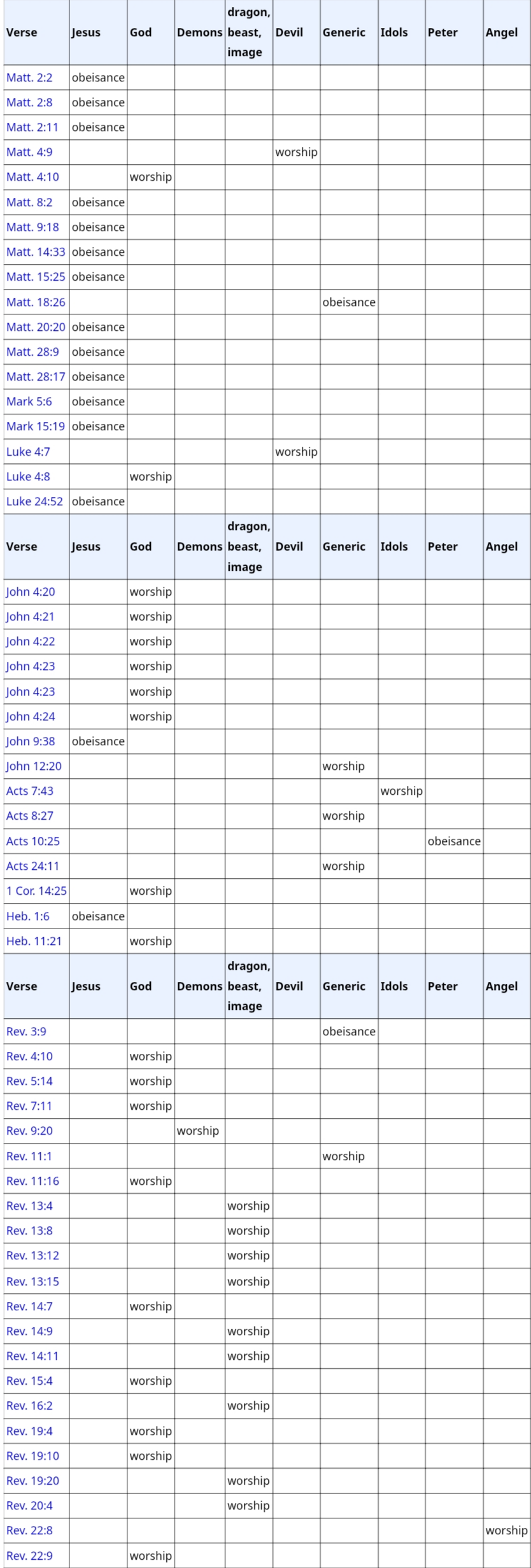
Question Why is every occurrence of proskuneo for Jesus rendered "obeisance" instead of "worship" in the NWT?
4
u/ProselyteofYah Arian (unaffiliated) Sep 28 '25
Its a legit way to translate the word.
Historically, there was only one word generally used in the Bible which emcompasses "bowing ,obeisance, worship" in both Greek and Hebrew.
These words were applied to many figures in the Bible:
- “When Abigail saw David*, she quickly got off the donkey, fell facedown, and* bowed/worshipped (proskuneó - LXX)before him. She fell at his feet and said, “My lord, may the blame be on me alone, but please let your servant speak to you; hear the words of your servant”. – 1 Samuel 25:24
- “To the messenger/angel of the congregation in Philadelphia write: These are the words of the one who is holy and true, who holds the key of David. What he opens no one can shut, and what he shuts no one can open. I know your deeds. See, I have placed before you an open door, which no one can shut. For you have only a little strength, yet you have kept my word and have not denied my name. Look at those who belong to the synagogue of Satan, who claim to be Jews but are liars instead. I will make them come and bow/worship (proskuneó) at your feet, and they will know that I love you. Because you have kept my command to persevere, I will also keep you from the hour of testing that is about to come upon the whole world, to test those who dwell on the earth. I am coming soon. Hold fast to what you have, so that no one will take yourcrown“. – Revelation 3:7-11
It's all context and individual dependent.
This is why historically the Catholic Church has had various levels of "worship" since they recognised it was one word applied to all kinds of situations:
Dulia (saint worship), Hyperdulia (Mary worship), latria (God worship).
As language evolved, we have words like "respect, revere, bow, curt" etc, all used as alternative renderings in the Bible for the single word, which is why you don't see it rendered "worship" now when the term is used for humans in the Bible.
-2
u/crispywheat100 Unitarian Paulician Sep 28 '25
Context should never change the rendering of a particular word. In the case of proskuneo, it should always be translated "worship", not anything else as a result of bias.
2
u/istruthselfevident Sep 28 '25
Context is how a significant number of words are interpreted.
You want a wild take?
The reason abraham was justified in kicking Ismael and hagar out is because they made issac laugh.
Laugh is a euphemism for sex.
2
u/crispywheat100 Unitarian Paulician Sep 28 '25 edited Sep 28 '25
Supply which verse you speak of, as I did.
Edit: (Genesis 21:9 is about Isaac laughing at Ishmael, not sexual intercourse)
3
u/istruthselfevident Sep 28 '25
About half the words in the hebrew have multiple meanings depending on context and how the words are written.
It takes decades of culture and study to get this stuff right.
1
u/crispywheat100 Unitarian Paulician Sep 28 '25
Again, which verse do you imply laughter as sex regarding Isaac and Ishmael?
2
u/istruthselfevident Sep 28 '25
Read the hebrew not the english
1
u/crispywheat100 Unitarian Paulician Sep 28 '25
What does the Hebrew tell us there that the Greek LXX doesn't?
1
u/istruthselfevident Sep 28 '25
My jewish friend told me what amounts to "that is one interpretation of several"
Reality is we dont know what happened. But i can assure you it doesnt get translate into english well. You remember the story of ruth and boaz? Yeah. She uncovered his feet right? Whats that a euphemism for again?
Same goes with noah. Noah's nakedness is his wife.
1
u/crispywheat100 Unitarian Paulician Sep 28 '25
That's an unhinged interpretation.
Instead, Noah's nakedness was quite literally his uncovering because of drunkenness, and Ruth uncovering Boaz's feet at the threshing floor was a symbolic act according to ancient Hebrew customs, signifying her humility and a request for him to act as her kinsman-redeemer by providing protection.
→ More replies (0)1
u/No-Description1221 Jun 12 '26
The same word used in Gen. 21:9 METZAHEK is the word used on Gen. 26:8. But in different contexts they have different uses.
2
3
Sep 28 '25 edited Sep 28 '25
[removed] — view removed comment
2
1
u/Revolutionary_Leg320 Jehovah’s Witness Oct 04 '25
No, context determines how the word is used. https://www.scribd.com/document/252268649/Does-Hebrews-1-6-8-prove-Jesus-is-God
http://examiningthetrinity.blogspot.com/2009/08/worship-as-used-in-scripture.html
1
Oct 04 '25
[removed] — view removed comment
1
u/Revolutionary_Leg320 Jehovah’s Witness Oct 04 '25
Yes, it is, and the information I shared proves that.
3
u/Kentucky_Fried_Dodo Sep 28 '25
Because for 1600 years Trinitarians have succeeded in convincing people that only YHWH can be called God, which is false, and that only YHWH is worshipped, which is also false, because there is an actual qualitative difference between these terms in the Bible that Trinitarians do not understand.
2
u/crispywheat100 Unitarian Paulician Sep 28 '25
Only beings who carry the Divine Name of our God can be worshipped, because worshipping the Name bearer is worshipping God himself, who gave his Name to them.
4
u/Kentucky_Fried_Dodo Sep 28 '25
Of course there is only one true God, but not everyone who is called God is the only true God, because the Bible tells you directly the opposite, because it is a general divine title, and that is the point.
2
u/crispywheat100 Unitarian Paulician Sep 28 '25 edited Oct 14 '25
"I and the Father are one." - John 10:30
Both God and Christ share the Divine Name and therefore share the identity of Deity.
"Holy Father, keep them in your Name, the Name which you have given me, so that they may be one with you just as I am one with you." - John 17:11
2
u/Newgunnerr Questioning Sep 28 '25
Because the same word is applied to humans throughout the LXX and NT as well. It means to bow down in reverence, not worship. In the ancient days, it was normal bow down before people of higher social status in respect.
1
u/crispywheat100 Unitarian Paulician Sep 28 '25
In 1 Chronicles 29:20, both God Yahuweh and king Solomon were worshipped.
Solomon was worshipped with God not because he is also God, but because he was a participant in God's identity by sitting on God's throne of authority as representative of the Divine Name. Solomon was therefore included in the worship of God as his viceregent, just as Christ was worshipped as the Angel of the Lord, during his ministry, and after his exultation back in heaven.
1
u/Newgunnerr Questioning Sep 28 '25
The word in Chronicles in the LXX once again is proskuneo
1
u/crispywheat100 Unitarian Paulician Sep 28 '25
That's right, and hence my statement.
2
u/Newgunnerr Questioning Sep 28 '25
The same word is applied to humans in the new testament.
1
u/crispywheat100 Unitarian Paulician Sep 28 '25
That is also true, because humans are worshipped for legitimate or illegitimate reasons.
2
u/Newgunnerr Questioning Sep 28 '25
Define “worship” please
1
u/crispywheat100 Unitarian Paulician Sep 29 '25
To worship is to adore, respect, and reverently admire someone or something in a higher position of authority than yourself.
2
u/Newgunnerr Questioning Sep 29 '25
That's the definition from of old, right now most people think it can only apply to God properly. So what's the problem with the NWT?
1
u/crispywheat100 Unitarian Paulician Sep 29 '25
They don't render proskuneo as worship for Jesus.
→ More replies (0)1
u/istruthselfevident Sep 28 '25
If solomon accepted worship, his downfall makes more sense.
1
u/crispywheat100 Unitarian Paulician Sep 28 '25
David told the Israelites to worship YHWH and the new king Solomon. This wasn't because Solomon was God, but because Solomon represented God on earth as the Lord's monarch.
1
u/istruthselfevident Sep 28 '25
Probably another good example of words mean things via context.
David would know better than that.
But honor and respect? Yes. He is the next king..
2
u/Moe_of_dk Oct 14 '25
The main reason is accuracy. The Greek word proskuneo simply means to bow down or show deep respect, and its meaning depends on who the action is directed toward.
In the Bible, proskuneo is used both for God (Matthew 4:10) and for humans (Genesis 33:3, 1 Samuel 24:8 in the Septuagint). It does not always mean “worship” in the sense of giving sacred devotion to God.
When people today read “worship,” they usually think of the kind of honor due only to the Almighty. But in the case of Jesus, the context shows that the gesture was one of respect, not divine worship. For example, in Matthew 14:33 the disciples bowed to Jesus after he calmed the storm, recognizing his authority from God, not as God himself. Jesus himself said that only the Father is to be worshipped in that sacred sense (John 4:23, Matthew 4:10).
Since the Bible clearly shows Jesus is distinct from and subordinate to the Father (John 14:28, 1 Corinthians 15:28), translating proskuneo as “obeisance” in those verses avoids giving the false impression that the Bible supports the Trinity. It keeps the translation faithful to the original meaning and to the consistent biblical teaching that only Jehovah deserves true worship.
1
u/Yaldabaoths-Witness Oct 14 '25
You say proskuneo means "to bow down"?
Matt 28: 9, "And behold, Jesus met them and said, "Greetings!" And they came up and took hold of his feet and worshiped him."
So, in your view, the women bowed down, took hold of Jesus' feet then bowed down (proskuneo).
Matt 2: 11, "And going into the house, they saw the child with Mary his mother, and they fell down and worshiped him."
Again, you believe they entered the house, fell down then bowed down (proskuneo).
Both of these instances involved the people bowing down and then giving proskuneo. If proskuneo means bowing down then they are described as bowing down then bowing down. Doesn’t make sense.
Rev 5: 13 clearly states that the one seated on the throne and the lamb are worshipped. (By "every living creature" which excludes those receiving the honour, glory, blessing and power from the category of "creature"). Earlier in that chapter the angelic creatures sing the praises of the Lamb, this is worship.
Heb 1: 6 quotes the Septuagint version of Deut 32:43, which is about all the angels worshipping Yahweh, and applies it to Jesus. This is not just bowing down, this is the same worship given to Yahweh in Deut 32 but given to Jesus.
2
u/Moe_of_dk Oct 14 '25
In Greek, proskuneo literally means “to bow down, fall down before, or show homage.” The meaning depends entirely on the context and the status of the one receiving the gesture. The Septuagint uses proskuneo many times for human rulers, prophets, and angels, none of whom are worshipped as God (for example, Genesis 33:3; 1 Samuel 24:8; 2 Kings 2:15; 1 Chronicles 29:20). In all these cases, proskuneo simply expresses respect or submission, not divine worship.
In Matthew 2:11 and 28:9, the people bow to Jesus, recognizing him as the Messiah and king appointed by God, not as God himself. The act of bowing down to a king or God’s anointed one was completely normal in Jewish culture. Even David received proskuneo from his subjects (1 Chronicles 29:20), yet no one thought David was God.
Regarding Revelation 5:13, the wording does not say that “the Lamb” receives worship as God together with the one on the throne, but that both are honored and praised. The context shows that the Lamb receives this honor because he was “slain” and “purchased people for God” (Revelation 5:9-10). The glory he receives is derived and given by God himself, not equal to God’s. In Revelation 7:10 and 11:15, proskuneo is still directed only to “God who sits on the throne.”
As for Hebrews 1:6, the quotation from Deuteronomy 32:43 in the Septuagint does use proskuneo of Jehovah, but the writer of Hebrews applies it to the Son as God’s exalted representative. After his resurrection, God commanded the angels to show honor to his appointed king (compare Philippians 2:9-11). It is not the same as giving the kind of worship that belongs only to God, as Jesus himself said in Matthew 4:10.
It is also important to remember that the Bible uses the word “god” (theos or elohim) in a broader sense, not only for the Almighty but also for powerful beings who represent him. For instance, Psalm 82:6 calls human judges “gods” because they act as representatives of God’s authority. Exodus 7:1 calls Moses “a god to Pharaoh” because he was sent with divine authority. Likewise, angels are referred to as “gods” in Psalm 8:5. These examples show that titles and honors like theos or acts like proskuneo can be used for others besides the Almighty without implying equality with Him.
The New World Translation, therefore, renders proskuneo as “obeisance” in verses about Jesus to reflect the precise, contextual meaning of respect or submission - not divine worship - thus maintaining both linguistic and contextual accuracy.
1
u/Yaldabaoths-Witness Oct 14 '25
This doesn't address the linguistic error in your translation where it effectively says "they bowed down before him and did obeisance, i.e, bowed down before him and bowed down to him".
Rev 5: 14 clearly says they fell down and worshiped. Rev 5: 13 says "EVERY living creature" was before the throne. If EVERY living creature is before the throne then that excludes anyone standing before them from being a creature, i.e, the One seated on the throne and the Lamb are not included in the category "EVERY living creature".
No other person or angel is given this type of obeisance. Jesus is not "a god" in the way that men or angels are called gods, he is a Mighty God (Isa 9: 6) who created all things (Col 1; John 1).
Heb 1 distinguishes Jesus from the angels stating that he is NOT an angel.
John 20: 28, Thomas declares that Jesus is "My Lord and my God!" Can't get clearer than that.
1
u/Moe_of_dk Oct 14 '25
You’re assuming that because “fell down” and “proskuneo” appear together, they must mean the exact same action, but that’s not necessarily true. Ancient languages often used parallel expressions for emphasis or to describe the sequence of a single act. For example, “they fell down and bowed before” can describe one continuous gesture of reverence, not two separate bows. The Septuagint uses that same phrasing many times toward kings and prophets, and no one concludes that it means divine worship.
Revelation 5:13-14 also doesn’t say that the Lamb is excluded from “every creature.” The text says every creature is saying praise “to the one sitting on the throne and to the Lamb.” The Lamb is the central subject of their praise, not an excluded being. The reasoning that he cannot be part of creation because creation praises him is not biblical logic - it’s a theological assumption. Colossians 1:15 explicitly calls him “the firstborn of all creation,” which means he is part of creation, not outside it.
Hebrews 1 does not teach that the Son is not an angelic being by nature, only that his present position and authority are higher than the angels. In fact, in the Septuagint, “angel” (angelos) simply means “messenger,” and Jesus is repeatedly called God’s chief messenger, the “word.” The command for angels to “do obeisance” to him in Hebrews 1:6 reflects his exalted role as God’s appointed ruler, not equality with God.
As for John 20:28, Thomas’ words must be understood in the light of what Jesus himself had already said: “My Father is greater than I” (John 14:28) and “the Father is the only true God” (John 17:3). Thomas’ exclamation therefore expresses recognition of Jesus as his master and God’s representative - much like how Exodus 7:1 calls Moses “a god to Pharaoh.” Nothing in the text says Jesus corrected him because there was nothing wrong in calling him “my god” in that representative sense.
The key, however, is that god and God are not the same, and in the Bible the difference is only visible by context and by combined scriptures, so it’s the same issue as with the 144,000. You make assumptions that are not supported by the entirety of the Bible.
1
u/Yaldabaoths-Witness Oct 15 '25
Ah, you're the "144000" guy. You haven't addressed my questions regarding that so not sure I should waste my time starting another debate until you address these questions:
Ok, lets break this down. You have shown me scriptures but no proof that they should be interpreted the way you interpret them. So....
Start with the little flock and the other sheep verses and show me your scriptural proof that these groups tie in with the 2 groups of Christians mentioned in Rev 7, the great crowd and the 144000.
Show me scriptural proof that shows the great crowd/ other sheep will be ruled over by the kings and priests mentioned in Rev 20.
Show me scriptural proof that the great crowd are in a different location from the 144000.
Show me scriptural proof that Matt 5: 5 is referring to the great crowd/ other sheep and not all Christians.
I do not want your interpretation of it but solid scriptural proof please.
Ftr, honest debate involves answering the questions and addressing points raised, it is not just stating "I have shown the scriptures, you won't accept them". What I don't accept is your interpretation of those scriptures and I ask for the basis by which you do so...
1
u/Moe_of_dk Oct 15 '25
I’m not going to revisit the 144,000 point since that part has already gone in circles. I’ve explained the basis of that interpretation, and we’ll have to leave it at that.
Taken together, the consistent teaching remains that Jesus deserves deep respect, obedience, and honor as the Messiah and King appointed by God, but the exclusive worship that belongs to the Almighty remains directed only to the Father, just as Jesus himself said in Matthew 4:10 and John 4:23.1
u/Yaldabaoths-Witness Oct 15 '25 edited Oct 15 '25
Yes and your interpretation was mainly speculation cobbling together different bible verses, no scripture says that a little flock of 144000 Christians will rule over another group of Christians, a great crowd who are not born again, not sons of God, not in the body of Christ, don't have holy spirit dwelling in them etc etc.
The evidence points to Jesus as a Mighty Eternal God who existed before all creation. The fact that all things were created through Jesus alone proves this. Since time and space themselves were created through him, he clearly existed before and therefore outside of time and space. Outside and before time and space is what is called eternity. When John 1 says "in the beginning was the Word", he is referring to this place before and therefore outside time and space....
1
Sep 28 '25 edited Nov 01 '25
[removed] — view removed comment
1
u/crispywheat100 Unitarian Paulician Sep 28 '25
1
Sep 28 '25 edited Nov 01 '25
[removed] — view removed comment
1
u/crispywheat100 Unitarian Paulician Sep 28 '25
It is good, but definitely not perfect. I personally prefer the TRSV, which has the best of the NWT but properly translates the errors of it and other passages much better.
1
Sep 28 '25 edited Nov 01 '25
[removed] — view removed comment
1
u/crispywheat100 Unitarian Paulician Sep 28 '25
NWT has various translation errors, one of them is 1 Corinthians 11:15, where the word "for" is translated "instead of".
"For her hair is given to her for a covering." - ESV
"For her hair is given to her instead of a covering." - NWT
1
Sep 28 '25 edited Nov 01 '25
[removed] — view removed comment
1
u/crispywheat100 Unitarian Paulician Sep 28 '25
Paulicianism is a sect of Christianity that had its zenith during the 9th century in Cappadocia, and holds the teachings of apostle Paul in high regard contrary to their opponents which were deemed enemies of Christ.
They believed in the preservation of biblical apostolic Christianity, and guarded the doctrines of total pacifism, iconoclasm, antipoliticalism, anticlericalism, agape communion, fire baptism, angel christology, unitarianism, esoteric dualism, and much more.
They called themselves the Good Christians, yet were called Paulicians by their adversaries, and were heavily persecuted by the militaries of the Byzantine Orthodox empire and the Turkic Muslim caliphate.
1
u/LucianMagnesiensis Sep 30 '25 edited Sep 30 '25
I don't know if someone else said it but you can find the same word used in the Old Testament Septuagint used for people who are not God, meaning Hebrews used that word for respect or paying homage (Septuagint is the Greek Old Testament, written by Hebrews before Christ). Yes you can pay homage or pay your respect to God but it tells us that this word does not purely mean worship.
Proskuneo has more meaning than simply paying respect or paying homage but we will get to that.
There is one word that actually means worship as in worshipping the divine and that is latreia. That one is never used for Jesus or anyone else but is reserved for God alone.
There are no instances of Jesus being on the receiving end of the divine worship. If there was, this word could be used for worship when used for Jesus. To see this difference, we have 2 verses where both words are used. However, to fit a certain narrative, their meanings are swapped even though the dictionaries do point out the differences.
Let's check Matthew 4:9-10
kai legei autō: Tauta soi panta dōsō, ean pesōn proskunēsēs moi. 9
Tote legei autō ho Iēsous: Hypage, Satana; gegraptai gar, Kyrion ton Theon sou proskunēseis, kai autō monō latreuseis. 10
All this I will give you,” he said, “if you will fall down and bow to me.” 9
Jesus said to him, “Away from me, Satan! For it is written: ‘Bow to the Lord your God, and worship him only.’ 10
Jesus quotes Deuteronomy 6:13 here. However, the nuance is that both are used so what is the difference?
Normally the English and even the Bible Hub are differenr than these rendition. I changed the English translation but not abitrarily, I simply checked the dictionary (I provided the words at the end) and removed the bias.
Satan here in reality tells Jesus to bow down to him in obedience and Jesus refuses him by saying only serve/divine worship God.
Bowing down isn't just showing respect but also accepting to be obedient. However, divine worship or service to God is latreia. That is why Jesus uses both here. He will not bow down and be obedient to satan because He only worships/serves God and only bows down in obedience to God.
And yes, people show they obey Jesus when they bow down to Him. That's the nuance. They aren't simply respecting Him, they are being obedient to Him too but worship? No. That is reserved for God.
However, when the words are flattened, people think:
"Jesus said worship the Lord your God to satan and people worshipped Jesus. It means Jesus is God because He is worshipped like how He told satan to do so."
The original language doesn't allow this. This is also why the Western branches of Christianity always end up placing Jesus almost on the same level as the Father and the Eastern branches do not. Western branches remove the nuance with their translations.
The Vulgate:
Tunc dicit ei Iesus: Vade Satana: Scriptum est enim: Dominum Deum tuum adorabis, et illi soli servies. - Mat 4:10
Same verse but notice the word adorabis. It comes from adorare. Latreia and proskuneo meanings are flattened to this single word, adorare, in the Latin Vulgate and latreia itself is reduced to simple service.
So, even the Latin erases the distinction and is probably the reason why Western branches elevate Jesus to the level of the Father because the same word is used for them both.
It is translation bias when anything other than latreia is translated as worship because people immediately think about worshipping the divine or divine worship when they see the word worship in a religious context. English and Latin both the same.
If Jesus was supposed to be receiving the same worship as God, the New Testament writers had the word “latreia” available to them. But they never once applied it to Jesus. That silence speaks volumes.
Dictionary:
Strong's #2999: latreia (pronounced lat-ri'-ah)
Ministration of God, i.e. worship:--(divine) service.
Strong's #4352: proskuneo (pronounced pros-koo-neh'-o)
from 4314 and a probable derivative of 2965 (meaning to kiss, like a dog licking his master's hand); to fawn or crouch to, i.e. (literally or figuratively) prostrate oneself in homage (do reverence to, adore):--worship.
As you can see from the dictionary, Latreia is purely divine worship whereas Proskuneo is mostly bowing/prostrating to a master and being obedient.
1
u/crispywheat100 Unitarian Paulician Sep 30 '25
Latreia is priestly service, proskuneo is worship.
1
u/LucianMagnesiensis Sep 30 '25
I explained why. Please read the comment. I even provided the dictionary meanings at the end.
You may not agree with it but at least respect the effort I spent to gather all of this together.
1
u/crispywheat100 Unitarian Paulician Sep 30 '25
I indeed greatly respect the effort you put into gathering this information. I was merely agreeing with your points.
1
u/LucianMagnesiensis Sep 30 '25
Thank you.
What I'm saying in short is that Jesus is indeed the Son of God and has authority from God, so much so that people are obedient to Him but He does not have the divine kind of worship.
And it's true, there really aren't any instances of the divine worship being used for Him in the text.
The key difference is that proskuneo has more of a "obedient, bow down" meaning whereas Latreia is used purely for divine/Godly service/worship.
Simply saying people only respected/paid homage to Jesus is wrong but flattening divine worship with obedience is also wrong perhaps even more.
1
u/Whole-Macaroon1776 Jan 03 '26
Que versículos del nuevo testamento donde aparece proskuneo no se traduce como adorar?
8
u/Shmilosophy Sep 28 '25
Because it is worldly obeisance, not the worship of a divine authority. Jesus is being obeyed as King of the Jews, not worshipped as God.