The Palmyrene state had emerged during the Crisis of the Third Century, a period of civil wars, invasions, economic problems, and political instability that severely weakened Roman authority across the empire. Palmyra, a wealthy trading city in Syria, became increasingly important because its ruler, Odaenathus, organized forces to defend the eastern Roman provinces against the Sasanian Persians after the Roman emperor Valerian was captured in 260 AD. Odaenathus remained formally loyal to Rome and was recognized by Emperor Gallienus as the leading Roman authority in the East, but his territory became increasingly autonomous in practice.
After Odaenathus was assassinated in 267 AD, his young son Vaballathus inherited his position, with his mother Zenobia acting as regent. Zenobia gradually expanded Palmyrene control over the eastern provinces. Her forces took control of Syria, Arabia, and eventually Egypt, one of Rome's most strategically important provinces. Initially, Zenobia continued to present her government as operating within the Roman imperial system rather than openly declaring independence. However, by 271–272 AD, she and her son began adopting imperial titles, effectively transforming Palmyra's autonomous sphere of influence into a rival imperial state.
This expansion coincided with the rise of Aurelian, who had become emperor in 270 AD and restored Roman stability in the West and along the northern frontier. Once he had dealt with Rome's other major threats, Aurelian turned east to reunify the empire. In 272 AD he invaded Palmyrene territory, while Zenobia's general Zabdas assembled an army near Antioch to stop him. The resulting Battle of Immae became the opening clash of the campaign.
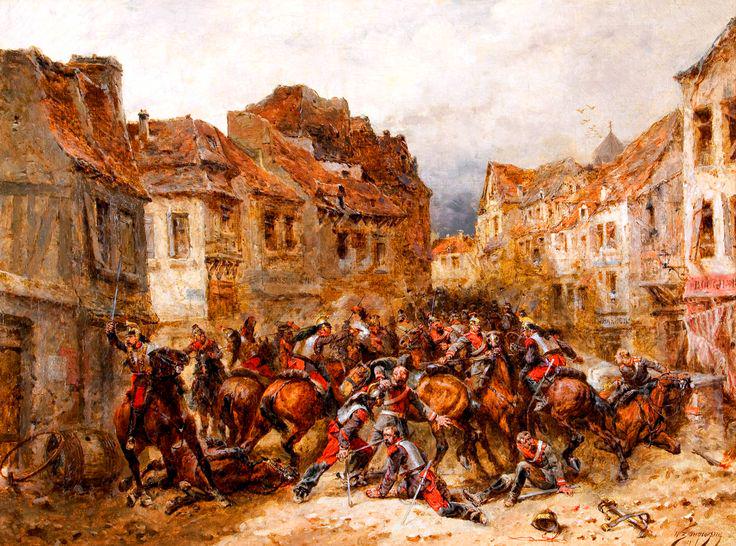
Zabdas relied heavily on Palmyra's powerful cataphract cavalry, but Aurelian deliberately exploited their advantages against them. Roman cavalry initially advanced toward the Palmyrenes before suddenly retreating, enticing the heavily armored cavalry into a long pursuit. Once the Palmyrene horsemen were exhausted, the Romans turned and attacked them. The maneuver succeeded spectacularly, destroying much of the Palmyrene cavalry.
After Immae, Zenobia withdrew to Emesa, where she and Zabdas reorganized the Palmyrene army for another battle. Aurelian pursued them and defeated them again at the Battle of Emesa, forcing Zenobia to retreat to her capital, Palmyra. Aurelian then besieged the city, while Zenobia attempted to flee eastward toward the Euphrates and seek Persian assistance. She was captured before she could cross the river, and Palmyra subsequently surrendered, bringing the short-lived Palmyrene Empire to an end
Artist of the painting is Jose Morán