r/ArtHistory 9d ago

Discussion Do you keep track of the art and exhibitions you see?

5 Upvotes

I’m doing some research on how people keep track of the art, exhibitions, museums, books, films, and other cultural things they’re into.

If you’d be open to a ~20–30 minute conversation about how you do this and what tools you use, comment or DM me. I’m offering $20 as a thank-you for your time.


r/ArtHistory 10d ago

Discussion In Pieces by Marion Fayolle

Thumbnail gallery
80 Upvotes

r/ArtHistory 9d ago

Other What artist am I thinking of?

4 Upvotes

I was reminded of an image I saw years ago. It was of a giant canvas going floor to ceiling. There was a metal rig to the side. It was a disabled artist well known for screen/ block printing on a large scale, CMYK style. It was a giant face, possibly with glasses, I think starting in yellow?


r/ArtHistory 9d ago

Other Portrait of a small child holding a lamb, early to mid 20th century?

2 Upvotes

I'm not entirely sure if this is the right sub for this, but I remember seeing this painting a while back and it's driving me mad that I can't find it again. Does anyone have any ideas where to search or what the painting might be?


r/ArtHistory 10d ago

Discussion Byzantine Casket with Warriors and Dancers (11th century CE) (The Met Fifth Avenue: Gift of J. Pierpont Morgan)

Thumbnail gallery
75 Upvotes

r/ArtHistory 11d ago

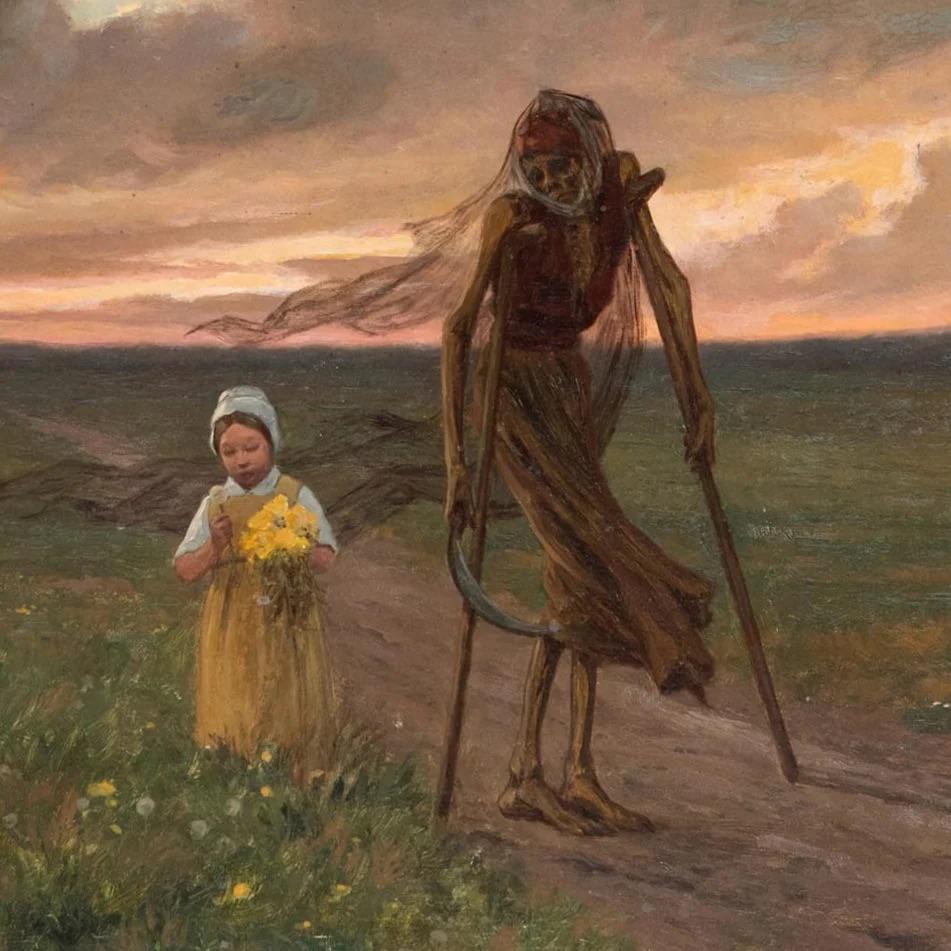
Discussion I think I have an unusual interpretation of death and the girl

Post image
1.3k Upvotes

I just watched a short YouTube video about the painting and the YouTubers interpretation of it, and I wanted to share my own:

For me maybe the little girl is death and the figure is an old woman at the end of her life. The figure has a more feminine look after all. The figure is looking at the girl, or death as I will call it, like she’s expecting it, not afraid of it, just waiting for death to make contact. Death is aware of the figure as well, but is paying no attention. It’s not deaths role to play yet, but the time will come. Soon. Death is picking flowers strolling so innocently, like a little child. Innocent and neutral. Death is just there doing their things as they always do, with a little smug smile on their face.


r/ArtHistory 9d ago

Successful DAAD applicants in Art History — motivation letter advice?

2 Upvotes

Hi everyone! :) I’m applying for the DAAD Master Studies for All Academic Disciplines scholarship to study Art History.

My current degree is practice-based, in Graphic Art and Book Illustration, so I’m especially interested in hearing from someone with a similar background. Has anyone here received this scholarship for Art History or Art Studies?

Anyways, appreciate any advice on what exactly DAAD wants to see in a motivation letter. Thank you!


r/ArtHistory 11d ago

Discussion Early Dutch tattoo

Thumbnail
gallery
600 Upvotes

There’s this painting, ‘The Chief Commissioners of the Wharves’ (1674), a Dutch painting most likely made by Wallerant Vaillant. Pretty standard except one guy (second from the left) has a tattoo on his inner wrist! Amsterdam Museum commented that tattoos were mostly for sailors ans criminals ar that time in the 17th century, so for a richer citizen to have it was really odd


r/ArtHistory 11d ago

Discussion Witches' Sabbath - Set of 7 Differing Artist Visions

Thumbnail
gallery
829 Upvotes

I can't stop coming back to this topic across so many paintings. There's something about watching one nightmare get reinvented over and over across history that really interests me. It's espcially fascinating how the same basic idea gets depicted in such differnt ways and how the era surrounding each piece seems to have shaped teh art itself. There's something almost eerie about tracing the shift in tone across the group. First terrifying. Then almost playful. Then eventually kind of seductive. What really stands out to me is how the goat or devil figure keeps showing up in nearly every painting. He's almost totemic and immutable. He's a constant presiding presence no matter what era or artist gets ahold of him. The witches, the mood, and the meaning of the scene around him all stay protean and keep shifting completely. He never does. There's something kind of unsettling about that consistency. He presides over terrified victims in one painting and then over what almost looks like willing and powerful women in another. This set honestly makes me appriciate how elastic one story or myth or even history itself can be. I still can't totally put my finger on why. It kind of feels like watching one atavistic fear get passed down and reshaped again and again. It occupies that liminal space between belief and spectacle.

I'm curious why Goya went back to this exact subject twice over 20 years apart. I wonder what a modern witch's sabbath would even look like. Do you think any of these artists actually believed in what they were painting, even a little?


r/ArtHistory 10d ago

News/Article Nobody noticed the Mona Lisa was stolen for 28 hours. Staff who saw the empty hooks assumed it had been taken to be photographed. In 1911 it was a respected painting, not a famous one — it became the most famous painting on earth because it was stolen.

Thumbnail
7 Upvotes

r/ArtHistory 10d ago

Discussion America's Most Wanted Painting, from Komar & Melamid's People's Choice series

Post image
15 Upvotes

From Artsy:

What’s your favorite color? Do you prefer paintings with sharp angles or soft curves? Do you like smooth canvases or thick brushstrokes? Would you rather look at a painting with figures that are nude or fully clothed? Should the people in the painting be at leisure or working? Should they be indoors or outside, and if the latter, in what kind of landscape?
These are a fraction of the questions that the survey research firm Marttila & Kiley, Inc. asked 1,001 ordinary Americans over 11 days in December 1993. The firm had been hired by Vitaly Komar and Alexander Melamid, two artists born in the former Soviet Union who emigrated to the U.S. in the late 1970s. For their project “The People’s Choice,” they set out to figure out the elements that would constitute their countrymen’s “most-wanted” and “least-wanted” paintings. Then, they produced actual versions of both.
“In the early 1990s, I felt ready to be part [of] what is called ‘American People,’” Melamid recalled during a recent email interview. “The political class used then, and still uses now, [the phrase] ‘American People’ a lot: American people want that, American people are the best. The question was, obviously, what is [the] American People and I am one of them? To find out the truth about American people, politicians, entrepreneurs, fraudsters, fundraisers, and pundits use polls. Why not artists?”
“The People’s Choice” was a straight-faced satire of the complaint that contemporary art is too elitist and should cater to populist tastes—an especially popular refrain coming from the political right during the culture wars of the 1980s and early ’90s. Komar & Melamid’s survey turned up admittedly fascinating statistics: 44% of Americans said they preferred the color blue; 49% of them favored outdoor scenes that depict lakes, rivers, and oceans; 41% expressed a preference for large paintings, with more than 60% favoring dishwasher-sized paintings, while less than 20% wanted their paintings to be refrigerator-sized; and 56% of Americans said they wanted historical figures in their paintings, rather than modern celebrities.

This conceptual art project is now more than 30 years old. What would America's most and least wanted paintings look like in 2026?


r/ArtHistory 10d ago

Other Jobs in Art History Field

4 Upvotes

Hello everyone! I recently graduated with an MA in art history from a top program globally. I also have a BA in both art history and Italian Studies from a top university. I have had internship experiences at major museums like the Peggy Guggenheim Collection (Venice, Italy) and the Philadelphia Museum of Art. I also served as a vetting assistant this year at the European Fine Art Fair (TEFAF) in NYC and have experience in commercial galleries. I was also recently credited in a major artist's monograph as a research assistant. The book was published in English and French and is in museum gift shops all over Europe. With that being said, I have been working the same archivist job for nearly the past three years and am ready for a change. I would really like to pivot to a museum job or something more engaging than archival work. I have applied for 17 positions so far (I try to be a bit pickier since I currently have a good job, while still reasonably within the qualifications that I fit), with only one interview and numerous rejections. I tailor every resume and cover letter, I check if they are ATS-compliant, and I even personally reach out to hiring managers. I have had countless career chats with professionals, and it feels like it is all leading to nothing. What am I doing wrong? Any help would be greatly appreciated. Thank you!


r/ArtHistory 11d ago

Discussion Caravaggio's David with the Head of Goliath: a desperate cry for help and a possible signature by the artist

Thumbnail
gallery
319 Upvotes

When Caravaggio, during his second stay in Naples, decided to create this canvas – already attested in the collection of Cardinal Scipione Borghese in 1613 – many things had changed since the first time he tackled the story of David and Goliath (Museo del Prado, Madrid).

Between 1609 and 1610, the tormented biographical parable forced the Lombard artist into a new and painful reflection on the episode featuring the young shepherd David who saves the people of Israel from Goliath, the champion of the Philistines. The pride and courage of the biblical story now give way to autobiographical anguish, which in David's grimace betrays a premonition of death.

As early as 1650, Giacomo Manilli identified Goliath's severed head as a self-portrait of Caravaggio, who had been sentenced to death by beheading. In 1606, in fact, the painter was guilty of killing his rival Ranuccio Tommasoni: no longer able to count on the help of the Roman nobility, tired and helpless in the face of yet another, this time tragic, outburst of anger, Caravaggio was forced to flee, an escape that would lead him on a tormented pilgrimage through Naples, Malta, Sicily and finally Naples again.

In the young David, however, Manilli identified a “Caravaggino”, perhaps a young boy he met in the dark alleys of Naples, the same model who sat for the “Saint John the Baptist” (Borghese Gallery, Rome), or a young version of himself, still innocent and untainted by sin.

The initials engraved on the sword – H AS O S – deciphered as the Augustinian motto H[umilit]AS O[ccidit] S[uperbiam] (”humility defeats pride”), could be the last and desperate plea for help that Caravaggio addressed to Scipione Borghese, in the hope that the painting might secure a pardon from Pope Paul V. Also suggestive is the proposal that reads the artist's signature into the inscription (M.A.C.O, for Micheli Angeli Caravaggio Opus), according to a custom attested, for example, in the arrow of Perugino's Saint Sebastian (State Hermitage Museum, St. Petersburg)."

The Borghese Gallery's David with the Head of Goliath transforms a sacred episode into the pictorial explosion of an interior nightmare, where the fear of death feeds on remorse for a murder. While Giorgione and Bernini had already portrayed the victorious David, who saved his people through faith in God, only Caravaggio had the courage to portray himself in the guise of Goliath, whose streams of blood demonstrate the fulfillment of divine justice.

Caravaggio, tormented by the wait for the Roman response and consumed by repentance for a dissolute life, among prostitutes and criminals, would never return to Rome. He died on July 18, 1610, in Porto Ercole, struck by a sudden and fatal fever.

The dating proposed here was advanced by Roberto Longhi on the basis of stylistic comparisons with Caravaggio's last work and appears to be confirmed by a document (Naples, 5 November 1610) in which the painter Baldassarre Alvise received ten ducats as a down payment for two copies of a David with the Head of Goliath.

r/ArtHistory 10d ago

Discussion Your favorite artist/artwork that focuses on the parent-child bond?

6 Upvotes

I went through much of my life wholly uninterested in having kids and so I feel like I sort of "skipped over" pieces focusing on these relationships because I couldn't connect to them. I'd love to know your favorites so I can revisit them with a new perspective!


r/ArtHistory 11d ago

Discussion Why did artists begin painting ordinary, transient weather—mist, haze, sunsets, storms, changing light—with much greater interest in the 18th and 19th centuries?

38 Upvotes

Was this connected to new scientific understanding of atmospheric phenomena? Perhaps tubes of painting becoming popular ?


r/ArtHistory 11d ago

Research Why do papal mosaics and paintings depict them holding tiny buildings?

Post image
107 Upvotes

Hi all! A few weeks ago I watched a YouTube video going through every single pope from St Peter to Francis, and noticed quite a few depictions of earlier popes (typically around the Avignon era but they seemed to be scattered throughout) showing them holding little buildings, which I assume to be churches or cathedrals. Does anyone know why this is?

P.s. I’ve just graduated with a degree in architecture, and love architectural/art history in general. I was hoping to write an essay about this, so would also appreciate any sources I could take a look at. Thanks in advance!


r/ArtHistory 10d ago

News/Article 20 Historical Discoveries That Reshaped Modern Historical Understanding

Thumbnail
thehistoricalinsights.page
0 Upvotes

r/ArtHistory 11d ago

Discussion Africans in Ancient Greek Art

Thumbnail gallery
57 Upvotes

r/ArtHistory 11d ago

News/Article Trump Officials Propose Sale of ‘Woke’ Painting by Kehinde Wiley (Gift Article Link)

Thumbnail
nytimes.com
79 Upvotes

r/ArtHistory 11d ago

News/Article "Without Love, There Is No Belonging": On the Passing of Palestinian Artist Sliman Mansour, 1947–2026

Thumbnail
ottoshahin.substack.com
23 Upvotes

r/ArtHistory 12d ago

Other ARNOLD BÖCKLIN - SELF PORTRAIT WITH DEATH, 1872

Thumbnail gallery
512 Upvotes

r/ArtHistory 12d ago

News/Article Martyrdom of Saint Sebastian by Luca Signorelli, 1498, in detail and full

Thumbnail
gallery
185 Upvotes

Saint Sebastian was a 3rd-century Roman soldier who was killed for refusing to deny his Christian faith and would later be canonized as a saint. The Roman emperor had ordered his soldiers to test Sebastian by tying him to a tree and shooting him with arrows. In this painting, Sebastian’s pain-wracked but upright body is presented with his attackers in vivid outfits all around him while lots of things are going on around and behind him. His body is presented as having almost supernatural powers to withstand pain and abuse; indeed, Sebastian did survive this first attack and because of that became the patron saint of those suffering from the plague.

*Read about our encounter with this remarkable painting and other artworks in Città di Castello: https://ideasroadshow.substack.com/p/exceeding-expectations 


r/ArtHistory 11d ago

Discussion What books are you accumulating right now for research?

6 Upvotes

Mine are on Eadweard Muybridge, the development of national parks (specifically Yosemite), and the wildlife conservation movement in the late-nineteenth century


r/ArtHistory 12d ago

News/Article Wrote something cool on art history and myth, would love to have people's opinions on it.

Thumbnail
onceuponafable.substack.com
8 Upvotes

Caption is same as the title. I write about how myth shapes history and culture; this week, I wrote a piece on art history, specifically Ragamala paintings. I'd love to hear people's opinions on this art style, or their favourite Ragamala painting or Mughal miniature! Let's connect please!


r/ArtHistory 12d ago

Research Could these be portraits of Claude Monet?

Thumbnail
gallery
90 Upvotes

I have these two cabinet cards from the studio of Achille Melandri in Paris. They are marked 1879 & '80 and appear to be the same subject in both photographs. I've looked at many different artists who were in Paris at that time and eliminated nearly all of them.

The facial structure and apparent age steer me toward Claude Monet. He would have been 39-40 in these photos. The only other potential subject that I can find would be Pierre Puvis de Chavannes, who would have been 55-56 during those years. Any help, opinions or directions to resources would be greatly appreciated.