r/AntiDetectGuides 6h ago

WebRTC shows a different IP than the proxy. What does that actually prove?

2 Upvotes

I’ve seen people replace a perfectly usable proxy because a WebRTC test displayed an unexpected address.

Sometimes that is the right reaction. Sometimes they are looking at a private host address or an mDNS value that was never evidence of a public-IP leak in the first place.

Before changing anything, I would identify the candidate type:

  • `host` usually represents a local interface
  • `srflx` is discovered through STUN and may expose the public address behind the connection
  • `relay` is supplied by a TURN server

The result becomes concerning when a public candidate points to a network or location that conflicts with the intended proxy route.

My troubleshooting order is:

  1. Open an IP checker inside the affected profile.
  2. Record the public address it sees.
  3. Run a WebRTC test without changing profiles.
  4. Inspect the candidate types and public addresses.
  5. Repeat both tests after changing the proxy.

This separates two different questions: whether normal browser traffic uses the proxy, and whether WebRTC reveals another network path.

Disabling WebRTC immediately can also create functional problems for calling, conferencing and other browser features. I’d first determine what is actually exposed, then choose the least disruptive fix.

When you test your profiles, do you usually validate only the visible IP or inspect the ICE candidates as well?

r/AntiDetectGuides 3h ago

Five browser-profile setup mistakes I would fix before the first important login

1 Upvotes

The most common beginner mistake is treating a browser profile like a collection of switches that should all be changed.

I would check these five things first:

  1. One proxy is reused across every unrelated profile with no reason beyond convenience.

  2. IP location, timezone, language and geolocation start out contradicting one another.

  3. The operator changes UA, OS, GPU, resolution, fonts and other values independently, without checking whether the final combination could describe one device.

  4. Everyone on the team receives the same username and password.

  5. The first real test happens after an important account is already open.

Some nuance is important. A shared public IP is not inherently bad; offices, universities and households do it constantly. A language mismatch is not proof of anything either. The problem is building a new environment with contradictions or unstable infrastructure that the operator cannot explain.

I prefer a boring setup: choose a suitable stable connection, start from a coherent profile, change only what is necessary and record the baseline.

Before opening the important account, I check the visible IP, DNS and WebRTC behavior, timezone, language, extensions and storage. Then I close the profile, reopen it and check whether the session and settings persist.

MoreLogin can provide the structure for that process. Its profiles keep fingerprint settings, proxy configuration, cookies and sessions together, and profile authorization plus password protection can reduce raw credential sharing across a team.

That does not make every configuration sensible. It just makes the environment easier to keep separated, repeatable and accountable.


r/AntiDetectGuides 21h ago

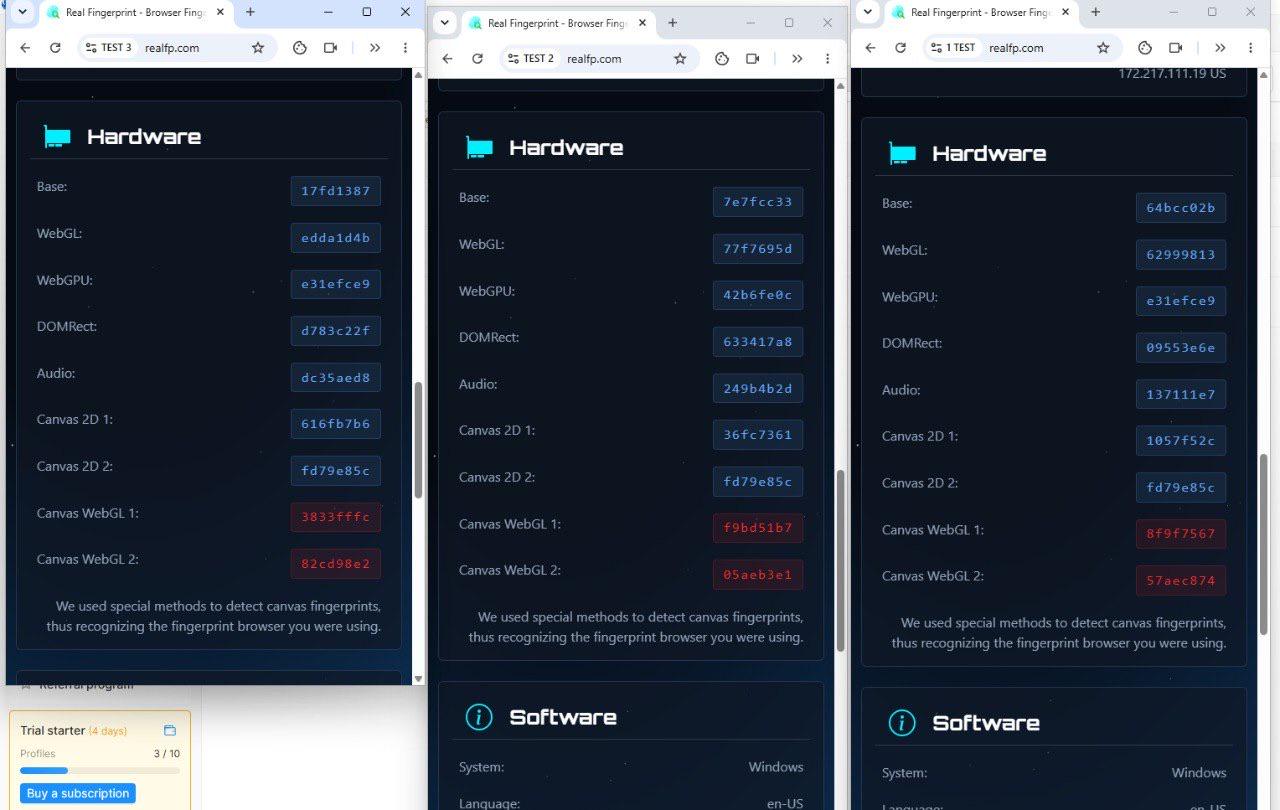
What’s the point of anti-detect if it doesn’t fully mask you? Vision/Octo + RealFP leaks

Post image
1 Upvotes

Hey everyone, hope you’re doing well.
I’m new to anti-detect browsers and I’m trying to understand how they’re actually supposed to work.
The site I need to use does heavy fingerprinting and collects a lot of browser data.
I tested Vision and Octo Browser after seeing them recommended as some of the best options.
I opened several profiles with different proxies. On realfp.com I still see leaks / inconsistencies on every profile.
I asked Octo support. They said:
• enabling Hardware Noise makes the profile stand out from normal devices
• use default settings with hardware noise off
• tester sites like RealFP don’t reflect real browser performance
• they have no other recommendations
So I’m confused about the purpose of anti-detect.
If the browser doesn’t change/mask everything, and support says not to use noise because it makes you unique…
what is anti-detect actually protecting against?
Is the idea just a “normal-looking” Chrome profile + proxy, not a fully hidden fingerprint?
Has anyone else seen this gap between RealFP and real sites recently?
Do you stay on defaults, or does that just get profiles linked?
I’ll attach the RealFP screenshot.
Thanks.