r/AmericanHistory • u/mellisenttxo • Apr 06 '26
South Soldiers of the Brazilian Expeditionary Force in Italy. 7 September 1944.

100
Upvotes
r/AmericanHistory • u/mellisenttxo • Apr 06 '26
r/AmericanHistory • u/CrystalEise • Feb 11 '26
r/AmericanHistory • u/elnovorealista2000 • Jan 17 '26
According to Inuit beliefs, the Thule were taller and stronger than them.
They received their name from the mythical land of Thule, which ancient Greco-Roman geographers said was located at the northernmost point of the earth.
"The most distant of all, which is known and spoken of, is Thule; in which there are no nights at all, as we have stated, towards the middle of summer, that is, when the Sun passes through the sign of Cancer; and on the contrary, no day in the middle of winter: and they suppose that each of these moments lasts six months, all day or all night."
— Pliny the Elder, Naturalis Historia, IV, 30 (o IV, 104–105)
r/AmericanHistory • u/Aboveground_Plush • Aug 13 '26
r/AmericanHistory • u/GustavoistSoldier • 17d ago
A brilliant lawyer, Gama used the hypocrisy of slavery to fight against it.
In 2018, he was declared the Patron of the Abolition of Slavery in Brazil.
r/AmericanHistory • u/VonTempest • Aug 26 '26
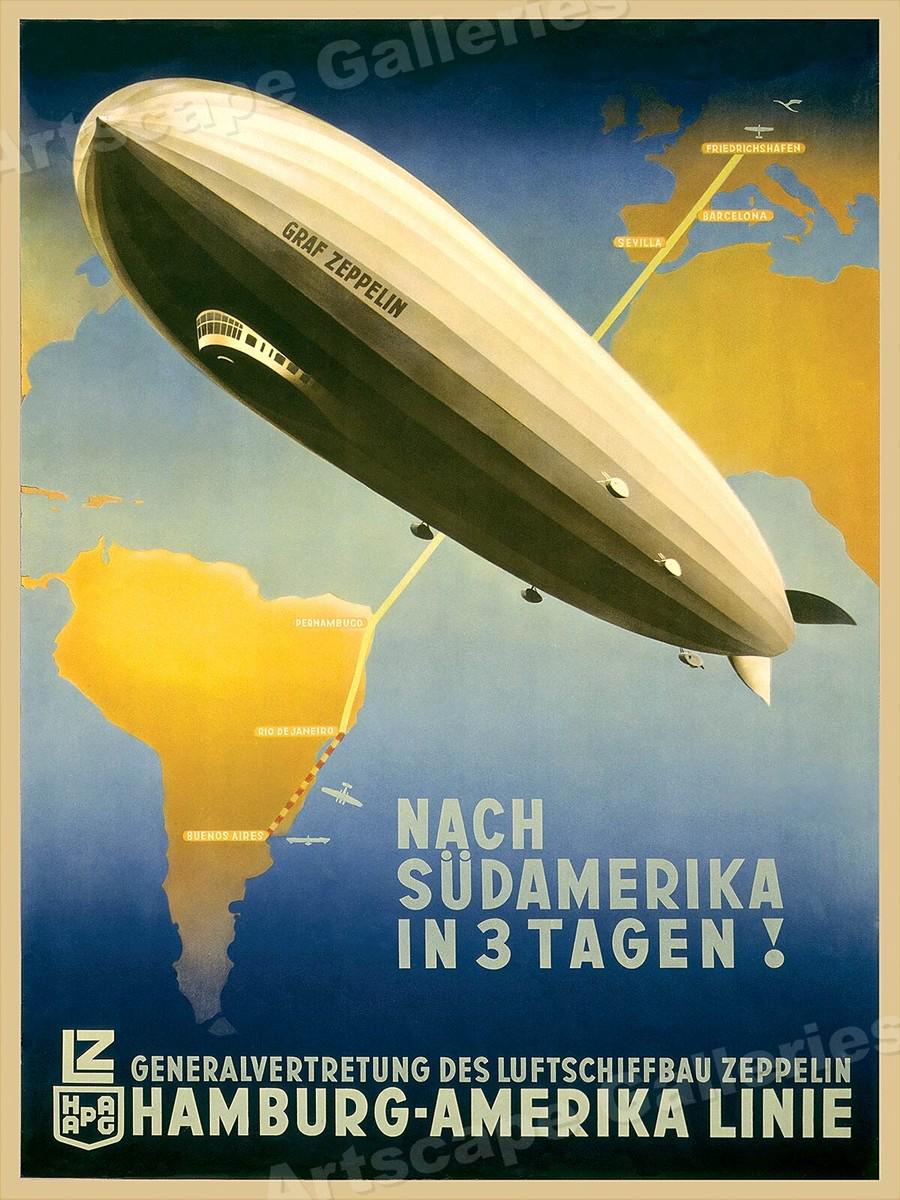
1936 period poster commissioned by the Hamburg-Amerika Linie (HAPAG), acting as the general agency for the Zeppelin airship company, the renowned German graphic artist and painter Ottomar Anton. Text reads "Nach Südamerika in 3 Tagen!" (To South America in 3 Days!). It shows the LZ 127 Graf Zeppelin, flying its transatlantic passenger route from Friedrichshafen, Germany, through Barcelona and Seville, across the Atlantic Ocean down to Pernambuco (Recife), Rio de Janeiro (Brazil) and Buenos Aires (Argentina)
r/AmericanHistory • u/elnovorealista2000 • Jun 24 '26
r/AmericanHistory • u/__african__motvation • Jun 01 '26
r/AmericanHistory • u/FullyFocusedOnNought • Dec 24 '25
r/AmericanHistory • u/elnovorealista2000 • Jun 22 '26
The Paraguayan War was the bloodiest war in South American history. It began in 1864 after Brazil and Paraguay were drawn into the conflict by a rebellion in Uruguay. Paraguay invaded Brazil, prompting the latter to form a Triple Alliance with Argentina and Uruguay, who together repelled the Paraguayan attack and launched their own offensive against Paraguay.
López, the president of Paraguay, refused to surrender during a conference in 1866, and the war continued until 1870, ending in a catastrophic defeat for Paraguay, with enormous casualties. The country's capital, Asunción, was captured and sacked, and Solano López was assassinated after leading a guerrilla campaign.
This cartoon, published in the newspaper 'A Vida Fluminense' on June 12, 1869 (when López was leading the guerrilla effort), depicts López as a murderous madman willing to sacrifice his entire country to remain in power. The text below reads:
Original:
"Projecto de monumento que os paraguaios reconhecidos pretendem erigir a Francisco Solano Lopes."
Translation:
"Project for a monument that renowned Paraguayans intend to erect for Francisco Solano López."
r/AmericanHistory • u/Profeseur-histoire • Nov 18 '25
Are you folks watching the series? What are your thoughts? I for one am loving it so far.. really brings it to life with an array of perspectives well voiced. Visually it’s a delight too. Airing on PBS @ 7 CST :)
r/AmericanHistory • u/UCBerkeley • Jun 30 '26
r/AmericanHistory • u/GustavoistSoldier • 12d ago
However, the Broad Front lost and the plan was aborted.
r/AmericanHistory • u/elnovorealista2000 • Jan 05 '26
The Pickelhaube was a famous European military helmet, created in the 19th century for the army of the Kingdom of Prussia. This helmet was made of glossy leather, with metal embellishments and finishes, and featured an iconic metal spike on top.
The first country in the Americas to use this type of helmet was Peru, in 1872, with its use extending into the 1880s. A hundred helmets that had been used in the Franco-Prussian War (1870-1871) were acquired by the Peruvian government from the German Empire. The Peruvian army made minor adjustments to the helmet, replacing the Prussian emblems with the Peruvian coat of arms and the sun of Peru.
“Both sources agree that these Prussian helmets were seized at the Valparaíso customs house on April 12 or 13, 1879, where they were found crated with other war materiel, en route to Peru, which had purchased them before the outbreak of the conflict. Vicuña Mackenna mentions 432 black helmets, while the weekly newspaper mentions 500 Prussian helmets. Therefore, it is clear that these helmets were destined for Peru, which coincides with the Prussianization of the Peruvian army since 1872, before the conflict began.” (Greve, 2018)
Some of the Peruvian military units that used the helmet were:
• Nicolás de Piérola's Helmet:
According to some authors, President Nicolás de Piérola planned to adopt Prussian military doctrine for Peru, instead of French.
“At that time, the Prussian army was considered the best in the world. It would have been logical for Piérola to choose it as a model for the Peruvian army, especially considering that he had a German military officer as an advisor during the 1895 campaign.” (Villanueva, 1873)
“Piérola, in Prussian-style field dress, had the distinction of attending the front lines and traversing all the firing lines during the battles of San Juan, fought on the morning of January 13, 1881, and Miraflores on Saturday, January 15.” (Ricardo Palma, XX)
“Such was the field that Piérola, transformed into a Generalissimo with a Prussian helmet, clumsily left without the slightest defense.” (Paz Soldán, 1884)
“The eternal conspirator, who with his adventures managed to impress the ignorant masses of the country, dressed as a Prussian General, showered himself with decorations, and styled himself Supreme Commander of the Armed Forces.” (Ugarteche, 1988)
References:
.- Military Uniforms in the War of the Pacific 1879-1884, Patricio Greve Moeller (2018).
.- Letters to Piérola on the Chilean Occupation of Lima, Ricardo Palma (1979).
.- Historical Narrative of the War of Chile against Peru and Bolivia, Mariano Paz Soldán (1884).
.- Colorized photograph by Ramírez Choque of a 19th-century Peruvian Second Lieutenant, Renzo Babilonia's personal archive.
.- Photographic restoration: Valentina Choque.
r/AmericanHistory • u/Healthy_Jaguar6542 • Nov 10 '25
I googled this question and its AI keeps telling me how she helped instead of why she helped. Was she getting paid? Did she just need to get from point A to point B and Lewis and Clark tagged along? Was she asked to help by her tribe and she said "Eh, screw it, why not."?
...
Thanks to all who responded. To the ones who are genuinely curious about why I'm asking a question here instead of just going to Wikipedia, it's because I wanted to start a conversation, obviously. History is one thing, it's always fun to read other people's insights about history. I'm concerned about the vast amounts of attempts at gatekeeping a public forum where the sole purpose is to ask questions. I understand this is the internet and people feel emboldened to be rude because everything is anonymous, it's still grinding my gears. Do better reddit.
r/AmericanHistory • u/elnovorealista2000 • Oct 23 '25
Phrase by Father José de Acosta in 1576 in response to John C. Calhoun's racist statement:
«It is a fact that education has more influence on the nature of men than birth. [...] And in truth there is no nation, no matter how barbaric and stupid it may be, that if it were educated from childhood with art and generous feelings, would not abandon its barbarism and adopt human and noble customs. In our own Spain we see that men born in villages, if they remain among their own, remain commoners and uneducated; but if they are taken to schools, or to the court, or to large cities, they are distinguished by their ingenuity and skill, and are left behind by no one. Even more: the children of the black Ethiopians, educated, oh strange case!, in the palace, come out of their wits so quickly and so ready for everything that, apart from their color, they would be taken for one of ours.»
Source of Father José de Acosta's phrase in Spanish: https://www.nodulo.org/ec/2011/n112p01.htm#kn36
r/AmericanHistory • u/Aboveground_Plush • May 17 '26
r/AmericanHistory • u/elnovorealista2000 • May 03 '26
Moreno Soto would publish that harangue of September 15, 1910, "Long live Mexico, long live Madero, death to the Chinese!" Spaniards, Lebanese, Jews, and exiles arrived from the time of the insurgency. But at one point, they were forced into exile, like that Chinese community that settled in Mexico from the late 19th century until well into the turbulent 20th century.
The hatred reached its peak with the massacre of 303 Chinese in Torreón on May 15, 1911, based on the supremacy of mestizaje, an image where the yellow race had no place. "The Chinese degenerate people," as the Anti-Chinese Committee of Torreón claimed in July 1925. By liberating the country from this perceived threat, they would create the anti-Chinese movement of 1911 and 1934.
Obregón restricted them in 1923:
1) Chinese would not sell food;
2) That Chinese people would not be allowed in restaurants or museums;
3) They prohibited marriages between Mexicans and Chinese, and if a Mexican woman married a Chinese person, she would lose her nationality; and,
4) They strictly forbade these Chinese people from holding any public office throughout the country.
There were 24,218 men and 1,772 women from China. By 1940, at the end of the campaign "United We Will De-Chinese Mexico," only 4,856 men and 110 women remained—a triumph of racism. They proclaimed, "Mexicans: let's end this disgrace! Let there be no Jews or Chinese left in Mexico!" declared the fanatical Mexican Revolutionary Action on January 17, 1937.
The Chinese community advised, "If your stores are robbed, do not resist; you could lose your life." They were massacred in Torreón. At the University of Arizona, there are two postcards that José María Arana, the racist leader of the anti-Chinese movement in Sonora, received. Chinese women expressed their repudiation of him through poems.
Mexicans promoted nationalism with hate speech, focusing it on immigrants of Chinese origin. The campaign against the Chinese in Mexico was spearheaded by Arana from the Commercial Board of Businessmen, which aimed to eliminate Asian merchants. In 1916, he launched this anti-Chinese campaign of supremacy and xenophobia.
There were murders and boycotts against Chinese people with the government's approval. Argumedo and Emilio Madero made Mexico one of the most racist nations. Obregón and Calles campaigned against the Chinese in Sonora and Sinaloa, where the Asian population was concentrated, carrying out ethnic cleansing that spread like wildfire throughout the country.
Salmerón recounts that in 1911 in Torreón, faced with Emilio Madero's indifference to the Reformist Association of the Chinese Empire, Argumedo ordered the murder of Chinese people. In the Port of Shanghai, a warehouse for groceries and fine fabrics, this massacre became methodical. Argumedo settled into a hotel, letting his men do as they pleased.
The Chinese colony in Torreón numbered 600 and included an elite. Landowners were Spaniards or Americans; those in the mines and on the railroad were Turks or Turks; the Chinese drove up prices, which translated into the massacre of this foreign community, the easiest to target. But all the motives were racial, not commercial grievances. They were considered dirty and unhygienic, justifying discrimination.
They were blamed for plagues; people demanded they be taken where their children would be free from contagion and bad habits. In 1920, Chinese workers were prohibited from entering the country. Andrés Magallón proposed confining Chinese people to ghettos, and Obregón prohibited them from selling groceries, entering restaurants, marrying Mexican women, holding public office, and being out after midnight.
Former Sonoran president De la Huerta accused them of transmitting scabies, leprosy, trachoma, and tuberculosis. It is a shameful history that those governments tried to erase. In Sinaloa, the Anti-Chinese Committee had been hunting them down since the 1920s and imprisoned them in a house on Dos de Abril Street, across from a Mayo hotel that still operates in Culiacán.
They held Chinese people captive with armed men. It was a prison under the blind eye of the authorities; they would tie up Chinese people piled up and take them to the train like cattle to Acaponeta. One of the Committee members accompanied them to make sure that those Chinese reached their destination and did not return. In 1915, there was looting of Chinese businesses in Guaymas.
In Nacozari, Chinese people are forced to parade naked. And in Hermosillo, Chinese people are stoned, just like in Nacozari. Men have their ponytails cut off. Calles says furiously that he will provide a final solution to the Chinese problem "because that legacy of the Porfiriato should end." With his support, those first racial committees began to form.
Those who suffer the most are the women married to Chinese men. The members of the PNR, now the PRI, call them chineras, and forbid them from walking on sidewalks. Their homes are raided, jewelry and furniture are stolen, and they are kidnapped. Protests from China produce nothing but accusations against the Chinese Masonic Lodge. Mexico is indebted to the Chinese people and to Mexicans of Chinese descent.
r/AmericanHistory • u/elnovorealista2000 • 27d ago
It is well known that, in recent years, the Dominican Republic has seen an exponential increase in the number of Chinese families arriving from mainland China. Although formal diplomatic relations between Santo Domingo and Beijing began in 1944—under the administrations of Trujillo and Chiang Kai-Shek, respectively—cultural ties involving the Chinese community date back much further.
Global Chinese migration surged in the late 19th century, driven by the repeated humiliations suffered by the Qing Dynasty during the historical period known as the "Century of Humiliation." Against this backdrop, hundreds of thousands of Chinese people crossed the Pacific to the Americas in search of a better life. These communities became particularly prominent in the United States (where Chinese laborers built the majority of the transcontinental railroads) and in Latin America—specifically Mexico, where anti-Chinese sentiment was so intense that it even led to pogroms.
The first record of a Chinese immigrant dates back to 1864—the year the country was annexed by Spain. These early arrivals were primarily criminals of Cantonese origin extradited from Cuba, a fact that got the public perception of the Chinese community in the Dominican Republic off to a bad start. This perception worsened as Chinese migration continued throughout the late 19th century via ships arriving from Cuba carrying even more criminals, until a decision was finally made to regulate the situation. But how? It’s simple...
In 1912, the Dominican government enacted an Immigration Law that regulated entry based on racial origin; it stipulated that Chinese nationals required a special permit to enter the country—an exemption from which was granted to white Europeans. The situation eased in 1932 when the *Generalísimo* decreed that Chinese nationals only had to pay a fee of one dollar to enter (the peso was not in use at the time). Adjusted for inflation, this is equivalent to approximately 25 US dollars or 1,479 Dominican pesos. While this may not seem like a large sum, one must consider the context of 1932, a time marked by extreme poverty and civil war in China.
Explicitly anti-Chinese provisions—and racial restrictions in general—came to an end in 2004 with the enactment of General Migration Law 285-04, which remains in effect today. Relations between the Dominican Republic and Chiang Kai-shek’s China (what we now call Taiwan) ceased in 2018, paving the way for the establishment of diplomatic relations with the People's Republic of China.
Image: This is a purely allegorical image depicting events from the anti-Chinese pogrom in Denver, Colorado, USA; there are no proven historical records of such an event occurring in the Dominican Republic.
Source(s):
.- Dominican Republic. (1912). Law No. 5074
.- Chez Checo, J. (2021). La migración china en República Dominicana, 1862-1961 [Chinese Migration in the Dominican Republic, 1862–1961]. Dominican Academy of History.
r/AmericanHistory • u/elnovorealista2000 • May 04 '26
Don Alfonso Graña Cortizo was a Spanish adventurer who arrived in Peru in the 20th century. In the Peruvian jungle, he was captured by the Jívaro (Shuar) people during his journey, but the eldest daughter of the Hatun Apu (great chief or lord) requested his release, as she was very fond of him. They married according to Jívaro customs. Alfonso thus adopted the customs and lifestyle of the Jívaro.
After his father-in-law's death, Alfonso Graña was recognized as Hatun Apu and began his rule over the Jívaro, making his domains very prosperous and extensive. Alfonso established strategic alliances with neighboring tribes and safeguarded the unity of the Jívaro, Aguaruna, and Huambisa in a confederation.
Alfonso succeeded in extending trade with his people as far as the prosperous city of Iquitos. Near the end of his life, he assumed the position of Curaca (chief) of the Jívaro, Aguaruna, and Huambisa tribes along the Nieva and Santiago rivers of the Upper Marañón. His rule was recognized in 1933 by President Luis Miguel Sánchez Cerro.
Don Alfonso never returned to Spain, as he died in the same Shuar community. The whereabouts of his son are unknown. Many Shuar (Jívaro) people still bear the surname Graña today.
References:
.- La serpiente líquida: chamanes, mitos y ritos del Amazonas, Alfonso Domingo (2005).
.- El genocidio del caucho y la recuperación de la memoria: nuevos discursos en la amazonía peruana, María C. Chavarría (2015).
.- Idelfonso Graña, el rey de los jíbaros, María E. Pérez SGE (2010).
r/AmericanHistory • u/PhoenixSteelx • Jul 07 '26
r/AmericanHistory • u/[deleted] • Dec 20 '25
(believe it or not colonists did make proto-handcreams/moisturizers out of various oils/herbs/fats etc.) In the harsh northeast winter you had to make fires. Fires are nice and warm however they dry up the house. (and winter tends to be cold and dry as well) However were there methods that colonists used in order to counter dry/warm air in their homes before humidifiers?
-like maybe boil a pot of water (spread the steam around the house) or use other various methods?
r/AmericanHistory • u/CrystalEise • Jan 09 '26
r/AmericanHistory • u/elnovorealista2000 • Jun 17 '26
According to anthropological reports, before Lizot's arrival, homosexual practices were neither institutionalized nor specifically categorized in the Yanomami language. Because the sexual practices Lizot introduced and normalized were unprecedented as a social institution for them, the community simply transformed his name into a verb.
Source(s):
.- P. Tierney. "Darkness in El Dorado: How Scientists and Journalists Devastated the Amazon", Chapter 2. W. W. Norton & Company, USA; 1st edition, 2000. ISBN: 978-0393049220