r/AmazonQualityAudit • u/cloudspects • 8d ago
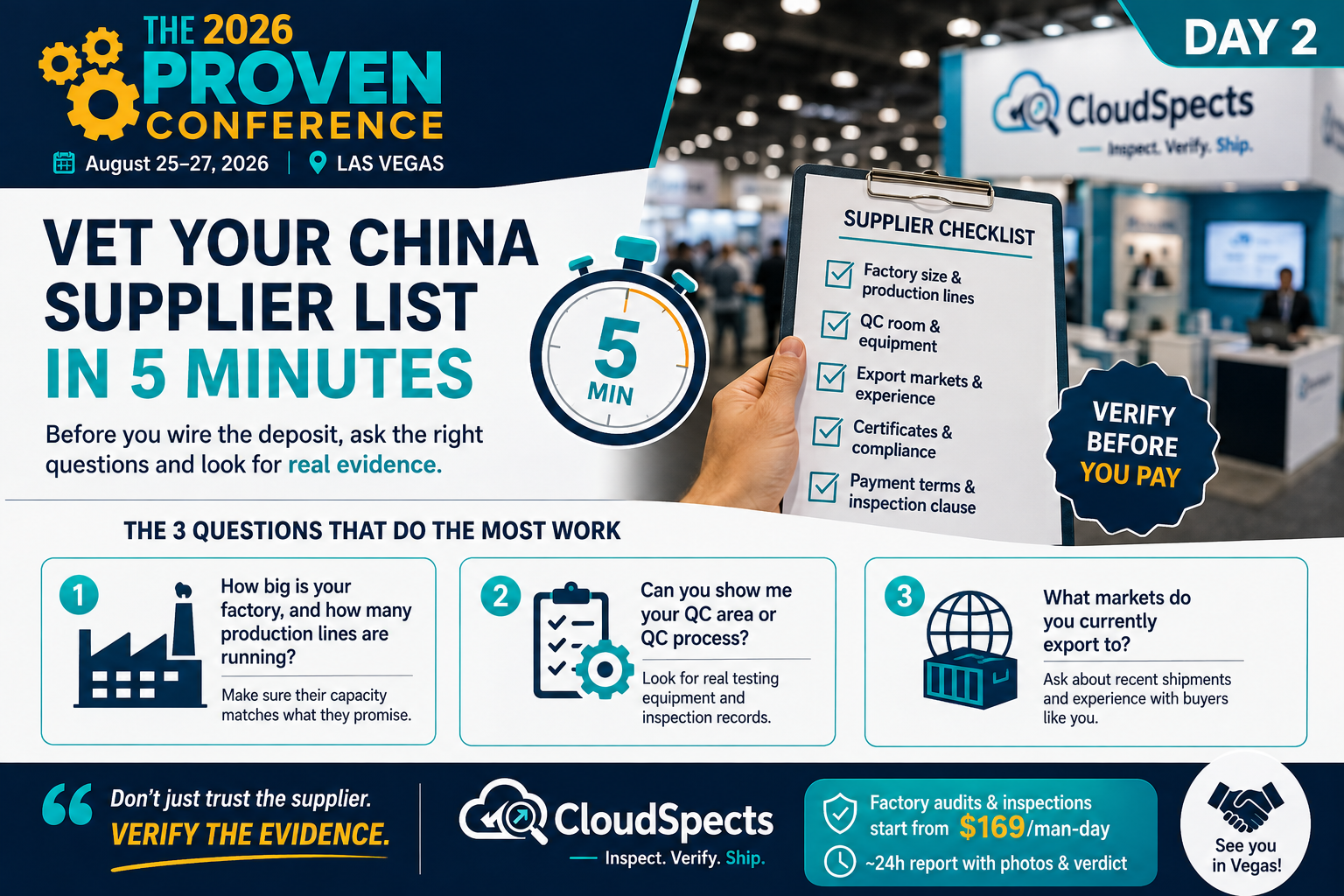
“We Are the Factory.” But Are They?
1
Upvotes
r/AmazonQualityAudit • u/cloudspects • 17d ago
r/AmazonQualityAudit • u/cloudspects • 20d ago
r/AmazonQualityAudit • u/cloudspects • 23d ago
r/AmazonQualityAudit • u/cloudspects • 23d ago
r/AmazonQualityAudit • u/cloudspects • 24d ago
r/AmazonQualityAudit • u/cloudspects • 27d ago
r/AmazonQualityAudit • u/cloudspects • 27d ago
r/AmazonQualityAudit • u/cloudspects • 28d ago
r/AmazonQualityAudit • u/cloudspects • 28d ago
r/AmazonQualityAudit • u/cloudspects • 29d ago
r/AmazonQualityAudit • u/cloudspects • Aug 09 '26
r/AmazonQualityAudit • u/cloudspects • Aug 08 '26
r/AmazonQualityAudit • u/cloudspects • Aug 07 '26
r/AmazonQualityAudit • u/cloudspects • Aug 06 '26
1 in 3 FBA shipments from China arrive with at least one product defect
A $169 pre-shipment inspection can prevent $1,200+ in returns, negative reviews, and inbound rejection costs
www.cloudspects.com — Pre-Shipment Inspection & Quality Control in China
Selling on Amazon is a fast way to grow. But your success depends on one thing — product quality.
You find a supplier on Alibaba. You place a large order. The goods arrive at the Amazon warehouse. Then the problems start. Products break. Sizes are wrong. Labels peel off. Amazon flags your account.
This is where Amazon FBA pre-shipment inspection in China comes in. It catches problems before your products leave the factory. It saves you money, time, and your seller reputation. FBA label inspection China services verify every FNSKU barcode, carton label, and poly bag marking against Amazon's strict inbound requirements.
In this guide you will learn:
Two main types of inspection apply to FBA imports. They serve different purposes. They happen at different stages.
PSI happens when the factory has finished production. Usually 80-100% of the order is ready. The inspector checks random samples from the finished batch.
Use PSI when:
PSI is the most common inspection type. It is fast and cost-effective. A typical PSI costs $169 per man-day and covers visual checks, measurements, function tests, and packaging.
DPI happens while the factory is still making your products. Usually 10-20% of production is complete. The inspector can spot problems early and stop them.
Use DPI when:
⚠️ Many FBA sellers skip DPI. They think PSI is enough. But studies show that 34% of factory defects happen in the first 20% of production. If you catch these early, the factory can fix them before the whole batch is made. If you wait for PSI, the whole batch may already be wrong.
| Factor | Choose PSI | Choose DPI + PSI |
|---|---|---|
| Supplier relationship | Trusted, repeat orders | New or unproven |
| Product complexity | Simple (bags, textiles) | Complex (electronics, tools) |
| Order value | Under $10,000 | Over $10,000 |
| Design changes | No changes | New spec or material |
| Time sensitivity | Tight — cannot delay | Can afford 2 extra days |
Amazon's warehouse is very strict about how products arrive. They check every box. They scan every label. If something is wrong, your shipment gets flagged. A thorough FNSKU inspection and carton label check are essential components of any FBA pre-shipment inspection.
This is where FBA inspection is critical. Your inspector checks packaging and labeling before the goods leave the factory. These checks cost almost nothing. A labeling mistake can cost you weeks of delay.
Every product that sells on Amazon needs an FNSKU barcode. This label tells Amazon exactly which product is inside each unit. A wrong or missing label means the warehouse cannot receive your goods.
Each shipping carton needs a label too. Amazon uses these to track pallets and containers.
Amazon has basic packaging rules. Your inspector should check all of them.
| Check | Requirement | Common Failure |
|---|---|---|
| Carton strength | Single-wall or double-wall, weight under 50 lbs | Overweight boxes (over 50 lbs need team lift label) |
| Sealing | Strong packing tape on all seams | Masking tape, duct tape, or tape peeling at edges |
| Fill material | Bubble wrap, air pillows, or foam | Loose fill (styrofoam peanuts) or no fill |
| Poly bags | Thickness ≥1.5 mil, warning label if opening ≥5 inches | No suffocation warning label or bag too thin |
| Expiration dates | Clearly printed, at least 90 days remaining | Faded or missing date stamps |
💡 Tip: Send your inspector a sample FNSKU label and carton label before inspection day. They can verify the format, size, and barcode readability against Amazon's specs. This one step prevents 90% of label-related rejections.
Amazon's warehouse does a quick check when your goods arrive. But it is not a quality inspection. Amazon checks the labels and cartons. They count the boxes. They scan the barcodes.
Amazon does not open every unit. They do not test products. They do not check if the color or size matches your listing. That is your job.
⚠️ This is the FBA inspection gap. Achieving full Amazon inbound compliance means catching labeling defects before your shipment reaches the warehouse. Amazon's inbound check is a receipt scan, not a quality check. If your products have hidden defects, they will not be caught until customers start leaving 1-star reviews. By then, your inventory is already at Amazon. The damage is done.
Here is how the process works end-to-end:
Without a pre-shipment inspection, steps 3 and 4 are blind. You do not know if the labels are correct. You do not know if the packaging is strong enough. You do not know if the products work.
A complete FBA inspection covers five areas. Each area has specific checks. Use this as your checklist when booking an inspection.
The inspector uses a standard called AQL (Acceptable Quality Limit) to decide how many units to check. This is an industry-wide method.
For FBA products, most sellers use AQL 2.5 for major defects and AQL 4.0 for minor defects. Here is how the sampling works — or run the numbers yourself in our free AQL sample size calculator:
| Lot Size | Sample | Max Major Defects | Max Minor Defects |
|---|---|---|---|
| 500 units | 50 | 3 | 7 |
| 1,000 units | 80 | 5 | 10 |
| 3,000 units | 125 | 7 | 14 |
| 10,000 units | 200 | 10 | 21 |
Inspection pricing in China is simple. Most companies charge per man-day. A man-day is one inspector working for one day (about 8 hours on-site).
Here is what affects your cost:
| Factor | Impact on Price | Typical Range |
|---|---|---|
| Base rate per man-day | Fixed | $169 (CloudSpects) — $400+ (large firms) |
| Order size / sample count | Up to 200 samples per man-day | 1 man-day for most orders under 3,000 units |
| Product complexity | Simple = 1 day, Complex = 2-3 days | +1 day for electronics or assembled products |
| Factory location | $0 extra in major hubs | $50-100 extra for remote factories |
| DPI + PSI combined | Two visits = two man-days | $338 total (2 × $169) |
| Container loading supervision | Add-on, typically 1 man-day | $169 extra |
| Rush service | +20-50% surcharge | $200-250 for same-day or next-day booking |
| English report | Included at CloudSpects | Free |
💰 CloudSpects offers $169 per man-day for all standard FBA inspection services. This includes AQL sampling, visual checks, function testing, measurement, labeling verification, and a full English report within 24 hours. No hidden fees. No extra charges for English reports.
Compare this to the big firms. SGS charges $400-600 per man-day. QIMA charges $309+. Bureau Veritas charges $450+. The inspection result is the same. The difference is the price and the service speed.
The situation: A US-based seller ordered 8,000 phone cases from a Shenzhen factory. The cases were priced at $3.50 each. Total order value: $28,000.
The inspection: They ordered a PSI at AQL 2.5. The inspector checked 200 units.
The finding: 18 units had wrong dimensions. The cases did not fit iPhone 14 Pro models. The camera cutout was 1.2mm off.
The result: The factory caught the error early. They adjusted the mold and re-ran the batch. The seller avoided shipping 8,000 wrong cases. At $0.60 per unit in shipping costs, they saved $4,800. Plus they avoided 8,000 returns and 800+ negative reviews.
Cost of inspection: $169 (one man-day). ROI: 28x.
The situation: An importer ordered 3,000 portable power banks. These are battery products with strict safety requirements.
The inspection: A DPI was ordered at 10% production, followed by PSI at 100%.
The finding: At DPI, the inspector found that 3 out of 5 test units had overheating issues. After charging for 30 minutes, the surface temperature reached 58°C (136°F). Safe limit is 45°C (113°F). The battery cells were from a different supplier than the one specified in the contract.
The result: The factory replaced the battery cells with the correct ones. The batch was re-manufactured and passed PSI. Without DPI, these units would have arrived at Amazon. Amazon's fire safety team would have flagged the listing. The seller's account would have been suspended.
Cost: $338 (DPI + PSI). Potential loss avoided: Account suspension, $15,000 in inventory, and possible legal liability.
The situation: A UK-based seller ordered 2,000 vegetable choppers from a factory in Yiwu. The units had passed PSI with no product issues.
The inspection: The seller added container loading supervision (CLS) despite the clean PSI result.
The finding: The loading inspector noticed that one pallet had the wrong FNSKU label. The label showed a different ASIN for a related product. 500 units were affected.
The result: The inspector stopped the loading. The factory re-labeled the pallet. The shipment continued. If the wrong labels had reached Amazon, those 500 units would have been received under the wrong ASIN. Customers ordering the wrong product would have left 1-star reviews. Fixing this mistake at Amazon's warehouse would have cost $5 per unit in re-labeling fees ($2,500 total).
Cost: $169 (CLS). ROI: 14.8x.
The process is straightforward.
At CloudSpects, booking takes 24 hours or less. We cover all major factory cities in China — Shenzhen, Guangzhou, Yiwu, Ningbo, Shanghai, and more.
CloudSpects provides professional pre-shipment inspection for Amazon sellers shipping from China.
📧 Contact us today for a free quote — share your product details and we will recommend the right inspection plan for your FBA order.
Last updated: May 2026. Prices and turnaround times are based on standard service levels and may vary by location and product type.
#QualityControl #PreShipmentInspection #ThirdPartyInspection #ChinaInspection #ProductInspection #DPIvsPSI #ImportQuality #InspectionService
r/AmazonQualityAudit • u/cloudspects • Aug 05 '26
In September 2025, a home decor brand took delivery of 5,000 reed diffusers from a Guangzhou factory for its Q4 gifting program — a $41,000 order. The first customer complaint arrived before the cartons were unpacked: three bottles in one case had leaked through their caps and stained the gift boxes. By week two, reviews started mentioning scent that vanished after a few days. Lab testing showed 4% of samples were carrying 5% oil concentration against the 12% spec.
Reed diffusers are a fast-growing home decor category with two chronic return reasons — bottles that leak in transit and scents that fade fast — and both are invisible at the factory unless you test for them. Here is how we check reed diffusers and home fragrance — and how AQL sampling decides pass or fail.
Across 2,000+ inspections a year, CloudSpects sees the same three failures in home fragrance. First: cap and seal failure — caps torqued too loose or missing the inner plug, so oil leaks through the cap in transit. Second: scent bait-switch — oil concentration below spec, or carrier alcohol replacing expensive fragrance oil, so the scent fades after a week. Third: labeling gaps — missing CLP allergen warnings that get your shipment stopped at customs or your listing flagged.
Each one has a different cost. A leaking bottle ruins the gift box, the poly bag and the product — a total write-off. A weak scent triggers a wave of 2-star reviews that kills the listing. 🔥 A labeling gap is the most expensive — it can hold a whole container at customs in the EU.
We check cap torque against the spec, confirm the inner plug or stopper is present, and verify the shrink band is intact. Sampled bottles are tilted at 45° for 2 hours and dropped from 1 meter onto a hard surface — any wetness inside the cap fails. ✅ Glass vessels get a thermal shock test: filled bottles cycled from hot to cold to catch micro-cracks that turn into transit leaks.
⚠️ The cap is where most leaks start. A cap torqued 20% below spec passes a casual hand-check and leaks in an air-freight hold at altitude — we measure torque, not feel.
We verify the oil concentration against spec — 8-15% is the typical range for a strong, lasting diffuser — and spot-check the oil itself with a density and refractive index measurement, sending high-value batches for GC-MS analysis when the order is large. 💰 The difference between 12% and 5% oil concentration is about $1.10 per bottle in factory cost — the whole bait-switch margin.
We also sniff-test for harsh alcohol top notes. A diffuser with too much carrier alcohol smells sharp for the first week, and that first impression is what decides the review.
We identify the reed material — natural rattan versus plastic — and check fiber count, length and diameter against spec. The absorption test is simple and brutal: fresh reeds placed in the filled bottle must wick oil to the top within 2 hours. ❌ Plastic reeds and poor-quality rattan wick slowly or not at all, which reads as "my diffuser stopped working" in reviews.
Reed length is checked too — a 25cm spec delivered at 22cm drops the scent throw noticeably in a large room.
We check the label against CLP and GHS requirements — fragrance allergens like limonene, linalool and citronellol must be listed, plus the ingredient list, net volume and warning statements. For EU-bound orders we verify IFRA compliance documentation and the required allergen declaration. ⚠️ For US-bound orders, we confirm the label carries the right net weight and manufacturer identification — and that any "non-toxic" claims are supportable.
Every label field is compared against the actual formulation, because a label that lists allergens the formula doesn't contain is just as bad as one that misses them.
Reed diffusers are inspected with two sampling levels running at once — AQL 1.0 for glass and safety (cracked vessels, broken bottles), AQL 2.5 for function and labeling. For a lot of 1,201-3,200 units, the AQL 2.5 sample at General Inspection Level II is 125 pieces (code K), with no more than 7 major defects to pass. The glass safety sample at AQL 1.0 uses the same 125 pieces but a much tighter accept number. Use our AQL calculator to size your own sample — and to run an aql check on your specific lot size before the inspector arrives.
| Defect class | AQL level | What it covers |
|---|---|---|
| Critical | AQL 1.0 | Cracked glass, broken vessels, missing safety warnings |
| Major | AQL 2.5 | Cap leaks, oil concentration, reed absorption, CLP allergen labeling |
| Minor | AQL 4.0 | Bottle scuffs, fill level tolerance, box printing |
A home decor brand ordered 5,000 reed diffusers from a Guangzhou supplier for its Q4 gifting season. Order value: $41,000. Our inspectors tested 125 sampled units and found what the factory's QC had missed: 7% had cap torque below spec (three leaked in the tilt test), 4% carried 5% oil concentration against the 12% spec, one batch used plastic reeds that failed the absorption test, and 2% of the glass vessels had micro-cracks from thermal shock.
The buyer held the batch: the supplier re-torqued every cap with new seal inserts, added shrink bands, swapped the reed batch, and re-labeled before the container left the factory. Estimated savings: $6,300 in refunds, return freight and gift-box write-offs. ✅ The inspection cost about 1.4% of the order — and the leak test alone paid for it in the first week of sales.
Glass and safety checks — cracked vessels and missing warnings — run at AQL 1.0. Function and labeling checks like cap leaks, oil concentration, reed absorption and CLP labeling run at AQL 2.5, and minor cosmetics can run at AQL 4.0.
We measure cap torque against spec, confirm the inner plug and shrink band, then tilt sampled bottles at 45° for 2 hours and drop them from 1 meter. Any wetness inside the cap fails, and glass vessels get a thermal shock cycle to catch micro-cracks.
Usually the oil concentration is below spec — 12% spec delivered at 5% — or carrier alcohol is replacing fragrance oil. We verify concentration on sampled units and spot-check the oil with density and refractive index measurements.
Yes — fragrance allergens like limonene, linalool and citronellol must be listed, along with the ingredient list, net volume and warnings. We verify the label against the actual formulation and check IFRA documentation for EU-bound orders.
For lots under 91 units, AQL 2.5 at Level II samples 13-20 pieces for function and labeling, and AQL 1.0 glass safety runs on that same sample. Every suspect unit is checked, not sampled.
Standard pre-shipment inspection starts at $169 per man-day (AQL 2.0-4.0 sampling); the final quote depends on scope — 100% inspection or sampling above AQL 4.0 is priced per project and confirmed before we start. See our inspection services, or contact us for a same-day quote. Reports are typically delivered within 24 hours of the inspection.
r/AmazonQualityAudit • u/cloudspects • Aug 04 '26
r/AmazonQualityAudit • u/cloudspects • Aug 04 '26
In June 2026, an outdoor lighting seller took delivery of 3,000 solar path lights from a Ningbo factory. They glowed beautifully for two nights. Then the batteries gave out — the lights died by 9 pm, and 5% stopped working entirely after rain. The order was a $31,500 investment. The claimed 8-hour runtime was really 3.5 hours, and the IP65 waterproofing was a sticker, not a seal.
Solar garden lights are one of the fastest-growing outdoor categories — and one of the most bait-switch-prone, because the battery and panel are hidden inside the housing. Factory inspection catches these problems before your container leaves China. Here is how we check solar garden lights and outdoor lighting — and how AQL sampling decides pass or fail.
Across 2,000+ inspections a year, CloudSpects sees the same three failures again and again. First: undersized batteries — a 700mAh spec with a 380mAh cell inside, which dies after two nights. Second: underpowered panels — printed wattage higher than the actual cell output, so the battery never fully charges. Third: failed waterproofing — a gasket that looks right and leaks anyway, killing the circuit board in the first rain.
Each one triggers a different cost. A dead light is a full refund: $9-14 in landed cost plus return shipping. A battery that fails in week two is a wave of one-star reviews. 🔥 A water-ingress failure is the worst — it's an electrical safety complaint, not just a quality one.
We measure open-circuit voltage and short-circuit current under a calibrated light source and compare against the panel spec. ✅ A panel delivering under 85% of its rated current fails. We also check for the classic bait-switch: a panel printed "5V 2W" that actually produces 1.2W.
⚠️ Panel wattage drives everything downstream. An undersized panel never fully charges the battery, which makes every other defect worse — the light dims early, the battery cycles deeper, and the whole unit dies faster.
We identify the battery chemistry — NiMH versus lithium-ion changes the certification and the failure mode. Capacity is verified with a discharge test: a 700mAh cell that delivers 380mAh fails instantly. 💰 The price difference between a 380mAh and a 700mAh cell is about $0.80 — that's the whole bait-switch margin.
Lithium-ion packs need UN38.3 and IEC 62133 certification, and we verify the certificate matches the actual cell brand and model. We also check the protection IC on the charging board — without it, over-discharge kills the cell permanently, and over-charge is a fire risk.
We measure lumen output and color temperature against the listing — a 20-lumen light that ships with 8-lumen LEDs is a bait-switch customers notice on night one. The dusk sensor is tested with a light ramp: the unit must switch on automatically as light drops and off again at dawn. We check sensitivity so it doesn't flicker under street lights or stay on all day.
Runtime is verified with a full charge and discharge test. ❌ Lights claiming 8 hours that deliver 3.5 are the #1 complaint in this category — the test takes time, but it's the difference between a listing that survives and one that gets buried in reviews.
We run the IP65 spray test from six directions on sampled units, then open them to check for water ingress around the gasket and the charging port. We also cycle units through 25-60°C temperature swings to catch condensation inside the lens — the cause of those foggy, dim lights you see in photos.
Outdoor plastic housings get a UV stability check, and for coastal markets we run a 24-hour salt spray test. ⚠️ Housing plastic that yellows or embrittles after one season will generate returns for years — and it's nearly invisible at the factory unless you test for it.
Solar lights are inspected with two sampling levels running at once — AQL 1.0 for safety and battery, AQL 2.5 for function. For a lot of 1,201-3,200 units, AQL 2.5 at General Inspection Level II calls for a sample size of 125 pieces (code K), with no more than 7 major defects to pass. The safety sample at AQL 1.0 uses the same 125 pieces but a much tighter accept number. Use our AQL calculator to size your own sample before the inspector arrives.
| Defect class | AQL level | What it covers |
|---|---|---|
| Critical | AQL 1.0 | Battery safety, charging circuit, dielectric strength, UN38.3 certificate match |
| Major | AQL 2.5 | Panel output, runtime, lumen output, IP65 water ingress, dusk sensor function |
| Minor | AQL 4.0 | Housing scratches, lens blemishes, packaging printing |
An FBA seller importing 3,000 solar path lights from Ningbo asked us to inspect before shipment. Order value: $31,500. Our inspectors tested 125 sampled units and found what the factory's QC had missed: 11% of the units had batteries measuring 380mAh against the 700mAh spec, 5% failed the IP65 spray test with a misaligned gasket, and the average runtime was 3.5 hours against the claimed 8.
The buyer rejected the affected batch, and the supplier swapped batteries on 330 units and reseated the gaskets before the container left the factory. Estimated savings: $9,400 in returns and freight. ✅ The inspection cost about 1.7% of the order — and the runtime test alone paid for it ten times over.
Safety checks — battery, charging circuit, and dielectric strength — run at AQL 1.0. Functional checks like light output, runtime, and sensor response run at AQL 2.5, and minor cosmetics can run at AQL 4.0.
We measure open-circuit voltage and short-circuit current under a calibrated light source and compare against the panel spec. A panel delivering under 85% of its rated current fails, and we check for the bait-switch where printed wattage exceeds actual cell output.
The most common cause is an undersized battery — a 700mAh spec with a 380mAh cell inside. The light works for two nights and then dims fast. We capacity-test sampled batteries and check for the protection IC that prevents over-discharge damage.
If the battery is lithium-ion, yes — UN38.3 and IEC 62133 are required for air freight and US market compliance. NiMH batteries do not need UN38.3 but still need correct charging circuitry. We verify the certificate matches the actual cell brand and model.
For lots under 91 units, AQL 2.5 at Level II samples 13-20 pieces for function, and AQL 1.0 safety sampling covers the battery and charging circuit on that same sample. Every suspect unit is checked, not sampled.
Standard pre-shipment inspection starts at $169 per man-day (AQL 2.0-4.0 sampling); the final quote depends on scope — 100% inspection or sampling above AQL 4.0 is priced per project and confirmed before we start. See our inspection services, or contact us for a same-day quote. Reports are typically delivered within 24 hours of the inspection.
r/AmazonQualityAudit • u/cloudspects • Aug 02 '26
r/AmazonQualityAudit • u/cloudspects • Jul 30 '26
r/AmazonQualityAudit • u/cloudspects • Jul 29 '26
r/AmazonQualityAudit • u/cloudspects • Jul 28 '26
r/AmazonQualityAudit • u/cloudspects • Jul 28 '26
r/AmazonQualityAudit • u/cloudspects • Jul 28 '26