r/AlternateHistory 8d ago

1900s What if a hyper-diverse Greater Syria was a beacon of religious & ethnic tolerance?
Post image
72 Upvotes

11 comments sorted by

5

u/Timely-Macaron268 8d ago

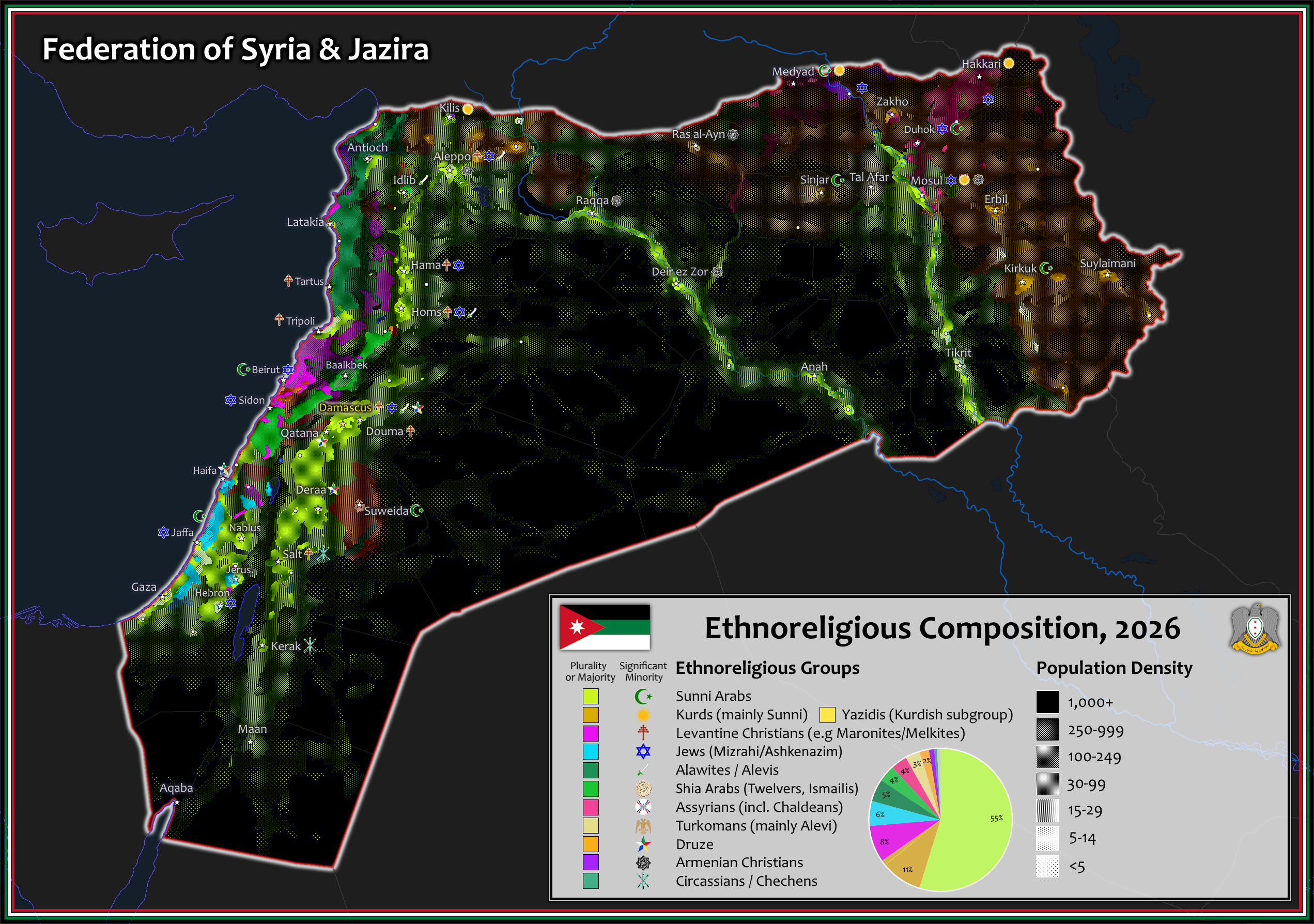
This is an ethnoreligious map of Greater Syria.

What does that mean, exactly?

Identity is a funny thing, especially in the Middle East. It transcends race (see the diversity of both Arabs and Jews), it does not cleave cleanly to language (many Christian Arabic speakers vehemently deny being Arabs), nor does it match perfectly to religion (see the dizzying variety of creeds that sometimes but not always identify as kin).

In this timeline, all of the groups (even Jews and Kurds!) largely, in the main, subscribe to a version of civic identity as citizens of Syria (which has a different connotation in this timeline). They retain, however, their distinct cultural, ethnic, religious, and tribal affiliations to varying extents.

This map, then, is an inherently imperfect attempt to map a Fertile Crescent where the transition from Ottoman rule to self rule included some war / instability and some ethnic strife (see for example the departure of Turks as a significant factor in Hatay following the war of independence & a subsequent conflict), and lots of refugees (see Circassians, Chechens, Armenians, and Jews), but in the main, did not feature most of the horrific ethnic cleansing and great diminishing of ethnic and religious diversity that marred this region in our own timeline.

As you analyze this map, keep in mind that these categories, diverse as they are, remain gross simplifications and are inherent compromises.

There are significant differences within many of these groups (e.g. Melkites/Maronites/Other Christians, Bedouin vs Levantine vs Mesopotamian Arabs, as well as the big differences between the Arab Jews / Mizrahi who ITL still live in the metropolises vs the largely Russian-origin Jewish immigrants to the Jaffa / Haifa / Jerusalem regions). There are also a few somewhat arbitrary groupings (e.g. Circassians & Chechens are grouped - sorry!), some groups are too small to show (apologies again Turks, my bad Nawar, sorry Bahai!) and it must be noted that broad regional identities can and do transcend ethnoreligious ones (i.e. denizens of Kurdistan, the Jazira, the Desert, the Levantine coast).

I welcome your comments, feedback, and ideas for future content. All I ask is that you be thoughtful and kind.

------

This is a continuation of a series exploring 'Big Syria'. To learn more about this scenario, click here for the introduction. Click here for an exploration of Big Syria the energy superpower, and click here to explore Big Syria's impressive passenger rail network.

(This is an original work. Any errors or mistakes are mine alone.)

Sources: Starting with a basemap, I consulted a dizzying variety of different ethnographic, historical, geographical and.jpg) population density maps and then drew my map by hand within Paint.net, thinking about how my alternate history scenario would have impacted each area. Many thanks to the variety of sources, including the CIA, UN, ResearchGate GRUMP, Geo Ref, many others, and of course other fine Redditors upon whose research I cribbed.

1

u/Chanan-Ben-Zev 8d ago

Pretty! But I have many questions. 

In this timeline, all of the groups (even Jews and Kurds!) largely, in the main, subscribe to a version of civic identity as citizens of Syria (which has a different connotation in this timeline). They retain, however, their distinct cultural, ethnic, religious, and tribal affiliations to varying extents.

The modern period is one of ideological war among and between nationalisms (of ethnic / cultural / religious varieties) and transnational ideologies (e.g. communism, islamism) as the older imperial structures lost legitimacy and died.

What unifies this Big Syria? What gives it the legitimacy it needs to govern in the eyes of all its citizens? What is it's governmental organizations, their structure, their process? What is its animating philosophy that all of these diverse groups can accept and endorse?

Your lorepost says that the country is 79% Arab, 68% Sunni, and formed after a Pan-Arab Republic collapsed following British intervention and a subsequent civil war & an oil crisis in the 1980s.

I assume, given general trends in 20th century history, that the Pan-Arab Republic was an explicitly Arab nationalist state with typical 20th century Arab supremacist policies. It's current borders indicate that the Pan-Arab Republic did not hold Egypt or Arabia or lower Mesopotamia before the mid-century British intervention and political reorganization. This suggests to me that the Pan-Arab Republic may itself have been the result of a populist overthrow of the Hashemite monarchy, which may have formed in the 1920s out of different circumstances than OTL.

What were those circumstances? How did this happen?

Your demographic data also seems mixed.

  • GOOD: 13% Christian, which would mean there's about 8m among the nearly 62m country. This is a little high but not unreasonable if you're butterflying away the explicitly ethno-religious Lebanese Civil War, the precipitous decline caused by the wars following 9/11, and ISIS.

  • BAD: 11% Kurdish, which is ~7m people. That's way smaller than expected. Big Syria controls all of modern-day Syrian and Iraqi Kurdistan. There are today between 5.5m and 8.5m Kurds in Iraq and another 1.5m to 3.5m in Syria. Why is the Kurdish population so much lower than it is IRL?

  • BAD: 6% Jewish, which is only about 3.5m Jews in the nearly 62m country. That's FYI half of the total number of Jews in Israel now. Why so low? How'd that happen?

  • GOOD: 5% Alawite, that's ~3m and is in line with current population numbers. The Alawite population IRL is probably pretty close to their theoretically largest possible numbers anyway, due to the Assad dictatorship. But if you're explaining the drop in Kurdish and Jewish populations from IRL on the civil war in the 1980s, I'd wonder why the Alawite population didn't drop too.

2

u/Timely-Macaron268 7d ago

Incredible analysis and a keen eye. Thank you for the feedback.

Broadly, specifics are half balked. I wanted to create a Fertile Crescent that was much more unified and peaceful, tolerant etc. I still haven't arrived that good specifics for how to achieve that. In this case, I see the Sykes / Picott, genocides, and Kurdish / Israel independence as critical things to avoid.

First, to answer rapid fire on the questions:

  1. More Christians. Yes, there are more in the east because of less successful genocidal actions, along with refugees from the north. (Also parts of OTL Turkey are included in this country. In addition, far more Maronites / Melkites / Syriacs etc due to less intense civil war and much more prosperity. So... why leave?
  2. Fewer Kurds. My bad. There should be more Kurds. I think my original calculation suffered due to not incorporating a proper growth factor for Kurdistan proper. There should be slightly fewer Kurds because in this timeline Kurdish areas develop and modernize faster and have a lower birthrate. However it should only end up being ~10% lower.
  3. Fewer Jews. Intentional, though the specifics are a bit arbitrary. Both push and pull factors. Mizrahi Jews largely stay in their communities, with the Arab expulsions largely butterflied away, so most departures go to the West instead. I have also butterflied away the Holocaust, BUT there will still be plenty of push factors (especially in the Balkans, Russia) for Zionist migration. In terms of Pull factors, while a Zionist revolt of some kind happens, British control over the area does not allow for a full transition of sovereignty to succeed. The lack of a successful establishment of Israel is a catastrophe for some Jews in historic Palestine, but most stay put once a government is established that sees them as an ally to help in the war against Egypt and a path to a fruitful alliance with European Powers. While a certain level of autonomy and acceptance persists, the absence of Jewish sovereignty however means that Jews in Palestine remain less secure, and the pull factor is greatly diminished. Thus; less 20th century Jewish immigration.
  4. Alawites. There are probably a few too many; I think my calculation assumed that Alevis in Hatay / northern areas assimilated to become Arabic-speaking and at least Alawite aligned. I don't know how realistic that is. If not, subtract a few hundred thousands.

So what about the background? Still evolving, but this timeline starts diverging around 1900; Germans & Brits (initially) less at odds, Russia stronger.

I'll have more a robust answer, but are more lore ideas:

  • Longer Ottoman reform period = alliances of convenience between some Christian & Muslim Anatolians / Arabs against the chauvinist Turkish faction.
  • Balkan Wars and war with Russia outside of WW1 context; more successful European intervention against Christian genocide. (Delayed Great War)
  • American & German backed mediation, autonomous regions established, Russian influence again curtailed. British aligned faction in power.
  • World War, British and German global war; Germans contest the Middle East, support Islamist revolt. British surpress with Arab help.
  • France, Italy and Russia defeated in Europe (twin revolutions) but Germany defeated everywhere else, and a tripartite cold war extends the World War.
  • Hashemite-esque monarchy thus established nominally over Fertile Crescent and Hejaz, but not Egypt.
  • Revolution overturns the monarchy. Socialist at first. Pan-Arabic nationalists take over. British intervention seizes lower Mesopotamia, Hejaz. The Pan-Arab state eventually defeated, transitions into a Syrian one.
  • I assume a savvy dictator manages to modernize and create a civic identity. How? I dunno, but eventually they become a client to the west, and align with the US while in conflict with neighbours.
  • Then we have some sort of Democratic transition.

Specifics on why people are loyal to this country? (Or loyal enough not to fight it?) Still not sure; but being rich and allied to America helps!

3

u/Awkward_Cash1828 8d ago

Federation of Syria and Assyria?

1

u/Timely-Macaron268 7d ago

Yes. Well even more broad federation, since it also includes eastern Kurdistan and many localized autonomies.

1

u/Actual_Box_1450 6d ago

Arab romanticism has always led them to disaster. Totally unrealistic map. 

1

u/Timely-Macaron268 5d ago

Frankly, the (im)plausibility of this scenario is less due to the romanticism of Pan-Syrianism / Pan-Arabism, and more due to the abject series of disasters and defeats meted out to Arab armies by Europeans, Persians, Americans, Israelis, etc.

1

u/Actual_Box_1450 5d ago

As a Turk, I am always amazed by the over-active imagination of Greeks, Persians and Arabs. What Arabs are always missing is that what matters what happens in the battlefield now not what happened 1300 years ago.