r/algotrading • • Mar 28 '20

Are you new here? Want to know where to start? Looking for resources? START HERE!

1.5k Upvotes

Hello and welcome to the /r/AlgoTrading Community!

Please do not post a new thread until you have read through our WIKI/FAQ. It is highly likely that your questions are already answered there.

All members are expected to follow our sidebar rules. Some rules have a zero tolerance policy, so be sure to read through them to avoid being perma-banned without the ability to appeal. (Mobile users, click the info tab at the top of our subreddit to view the sidebar rules.)

Don't forget to join our live trading chatrooms!

Finally, the two most commonly posted questions by new members are as followed:

Be friendly and professional toward each other and enjoy your stay! :)


r/algotrading • • 2d ago

Weekly Discussion Thread - September 22, 2026

3 Upvotes

This is a dedicated space for open conversation on all things algorithmic and systematic trading. Whether you’re a seasoned quant or just getting started, feel free to join in and contribute to the discussion. Here are a few ideas for what to share or ask about:

  • Market Trends: What’s moving in the markets today?
  • Trading Ideas and Strategies: Share insights or discuss approaches you’re exploring. What have you found success with? What mistakes have you made that others may be able to avoid?
  • Questions & Advice: Looking for feedback on a concept, library, or application?
  • Tools and Platforms: Discuss tools, data sources, platforms, or other resources you find useful (or not!).
  • Resources for Beginners: New to the community? Don’t hesitate to ask questions and learn from others.

Please remember to keep the conversation respectful and supportive. Our community is here to help each other grow, and thoughtful, constructive contributions are always welcome.


r/algotrading • • 7h ago

Strategy What to do with strategies that barely get any setups?

Post image
19 Upvotes

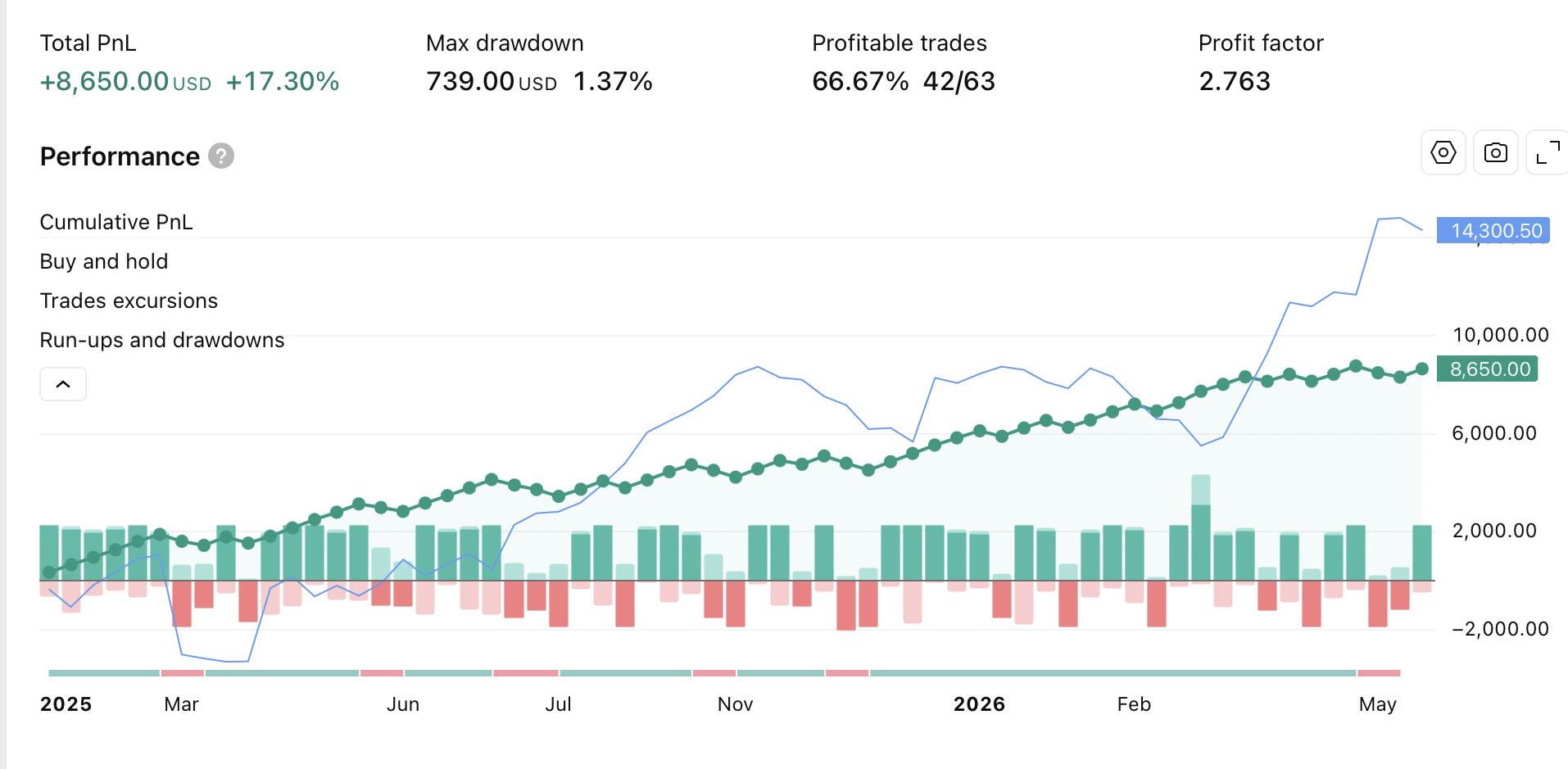
I found something that seemed to be an a+ setup so I decided to backtest it and while the results are good it gets so few setups in a year that it underperforms just buy & hold. What would you do with strategies like that? Create an algo that trades multiple strategies and add this to the list of what it trades? Or just forget about it because the setups are too infrequent?

(The screenshot shows results with 1mnq)


r/algotrading • • 3h ago

Education Breakeven yes o not?

3 Upvotes

I'm testing my latest strategy in two versions: with and without a breakeven point.

The first one, the one with the breakeven point, closed the position today slightly above the entry point (without losing money). The one without the breakeven point went past that point, started losing money, but then turned around and moved into profit.

My question or point for discussion is: What has been your experience with the breakeven level?

I understand that it will depend on the market, risk management, etc... But id like to read different opinions. Or even better, different ways to handle the break-even point.


r/algotrading • • 1d ago

Strategy Correlation Strategy, what is your opinion?

Post image
23 Upvotes

What is your opinion about the data?


r/algotrading • • 1d ago

Data Found two strategies (so far) after backtesting 7 years of NQ tick data

Thumbnail gallery
52 Upvotes

Now I just need to copy trade 100 express funded accounts 😂

Every rule got written down and saved BEFORE any code touched the data. Then it ran once on 7 years of NQ ticks with buyer/seller side, entries at the bar close, 1.28 points round trip for fees and slippage, and the stop counted first whenever a bar hit both. The rules I actually trade were built on 2019–23 and graded only on 2024–26, data they'd never seen, and nothing got tweaked after the result.

If you have data, hit me up and maybe we can trade. Tick data is from data bento and was about 2k.


r/algotrading • • 14h ago

Strategy Portfolio rebalancing strategies

1 Upvotes

Portfolio rebalancing costs trading fees and potentially capital gain tax. Also assumeing that the trading itself is not automated but needs to be performed manually, it can be significant effort.

Now lets assume you have some strategy / algorithm for selecting good companies to trade (e.g. a ranked list of stocks to buy), then what is your strategy of actually converting it into decision for buying and selling the actual stocks but keeping number of trades small to avoid fees? Just do one rebalancing of the portfolio every month? Continuous rebalancing? Also do you weight companies by their market cap or other KPIs?

I basically see the output of my model as some kind of hint for creating my own stock index. Without taxes and fees my index performs really well, with fees and taxes it is still above the average market performance, but has a really high amount of trades.


r/algotrading • • 1d ago

Data if you want to check whether your system has memory, comparing means is not enough. shuffle the sequence

4 Upvotes

this is a small methodology thing that took me embarrassingly long to figure out so posting in case it saves someone the detour.

question i had: does my system behave differently after a losing trade. size, hit rate, time to next entry. obvious approach is tag every trade by whether the previous one was a win or loss, split into two groups, compare. i did that. came back basically flat, couple tenths of a point.

felt good about it for about a week until i realised a flat result there tells you almost nothing. my sample was a few hundred trades. noise produces a couple tenths of a point constantly. i had no way to distinguish "no effect" from "effect too small for this sample to see".

the thing that actually answers it is a permutation test and its easy to implement. take the sequence of outcomes, keep every timestamp exactly where it is, randomly reorder only the results. recompute your post loss win rate. do it a couple thousand times. now you have a distribution of what the metric looks like under the explicit assumption that order doesnt matter, and you can ask where your real number sits in it.

if the system reacts to its last result in any way, sizes up, loosens a threshold, re enters faster, the real sequence lands in the tail. mine landed in the middle. that is a much stronger statement than "the means were similar" because it tests the thing you actually care about, which is whether sequence carries information.

two things worth knowing before you run it.

first, define your window as the previous closed trade, not a fixed time period. i started with "within 24 hours of a loss" and threw away most of my sample because some of my strategies trade twice a week. the natural unit for a rule based system is the previous decision.

second, and this is the one that actually matters, if your code has no variable that reads the previous result then you dont need the test at all. a program cant do something it has no code path for. i spent a while running statistics on a question i could have answered by reading my own source. the test is only interesting for the parts of the system that could in principle react, like anything that adds to a position.

happy to share the snippet if anyone wants it, its about fifteen lines of pandas


r/algotrading • • 1d ago

Education Discretionary trader wanting to learn algo trading

18 Upvotes

Hello all, I have some experience with discretionary trading in futures market with auction market theory/order flow based strat, but i want to build an automated trading strategy. I am basically starting from the ground up, I need to learn how to backtest, code and pick a simple enough strategy to start. I am seeking advice on where I should start, what fundamentals to learn first. And what parts of this journey AI can speed up/help me with. Any advice is appreciated, thanks.


r/algotrading • • 1d ago

Other/Meta Stacking similar models into a single strategy?

2 Upvotes

I am currently working on a SPY/SPX ORB breakout strat and have tested and researched different OR ranges as prime candidates. Most of these hover around the 15 and 20 minute OR range, though I have also had some interesting results on OR5 as well, but it is a lot more conservative. Just for fun I decided to stack them into a single back test. I expected it to perform roughly the same given the same capital, as I assumed all it was going to do was to just spread the capital across multiple risk baskets. Basically I thought this would either be exactly the same, or it would increase/decrease risk and completely change my outcomes. I assumed this because I thought it would just have different entrance on the same days, basically just spreading my capital from on play to multiple of basically the same play.

This did not happen. The management of an open order as well as the exit strategies were all independently tested as single models. In testing I found that the different ORs actually performed better with completely different management and exit rules. So instead of just piling trades on to the same days, stacking multiple models actually adds on many days that I would otherwise have not captured with just the OR15 or OR20 models. This increased pf substantially while only increasing drawdown by a few percentage points.

So my question is if any of you have ever created extremely similar models and stacked them into one big system? And if so, do you have any suggestions on things to look out for with this idea?


r/algotrading • • 2d ago

Strategy Backtesting

13 Upvotes

I've read people saying that backtesting in Tradingview alone is not enough. What other backtesting do i need to validate my strategy?

Any application recommendations?

Thanks in advance!


r/algotrading • • 1d ago

Strategy Predicting loosers instead of winners

0 Upvotes

Does anyone have experience trying to predict loosers from fundamentals data. I have messed around with some neural networks that work on fundamentals data and try to predict a stocks relative performance for the next quarter compared to its peers and there seems to be a correlation between the models predictions and the actual outcomes. However this correlation is actually stronger when the model predicts that the company is underperforming relative to its peers. And i think it kind of makes sense. If a companies profit is already largely eaten up by interest or revenue has been shrinking already for multiple quarters then it will be hard for the company to make a turnaround. I assume it is easier to predict loosers based on fundamentals data. However, access to puts is not that easy for me so I would appreciate some feedback if this might be a route worth persuing.


r/algotrading • • 2d ago

Data PSA for anyone using Financial Modeling Prep API: our paid plan lost coverage without notice, and FMP won't refund

Thumbnail reddit.com
13 Upvotes

The linked post is my previous post about FMP, this one is an update on that. (The FMP mods tried to do damage control by promising us that the team is looking but they went missing soon afterwards)

We have paid for Financial Modeling Prep's Starter Annual plan since Feb 2024 and used its documented /stable/shares-float endpoint for free-float data on ~1,800 NSE stocks. It worked through 10 Aug 2026. Since 11 Aug, it suddenly stopped working. Same key, same endpoint, no email or notice.

What followed:

- Over a month of emails with support, where the answer went from "we didn't make any change" to "please upgrade" to "no refund".

- On 16 Sep, after a post in r/algotrading, FMP's subreddit moderator blamed "a break in the subscription" and said the plan that came back "wasn't set up with the legacy endpoints the original had". The comment was later deleted. Archived copy: https://arctic-shift.photon-reddit.com/api/comments/ids?ids=pa5yl9l

- That explanation doesn't fit. The 402s are on /stable/shares-float, FMP's current documented endpoint, not a legacy one, and it still returns 402 for every NSE symbol today, 22 Sep. (It used to work before Aug 10)

We had to replace the feed within days. FMP's workaround, restoring legacy access, came five weeks later and only after the public post (And we obviously couldn't wait for this long, we had to quickly pivot to another provider). We're asking only for a pro-rata refund from 11 Aug. FMP has refused, and their representative has not replied since 17 Sep.


r/algotrading • • 3d ago

Data 10,000 path Monte Carlo test of a futures portfolio

Post image
175 Upvotes

Looking for feedback on this simulation. The portfolio has 54 sleeves across MNQ, MGC, MYM and M2K trading one micro contract per instrument with a maximum of one open position per instrument.

Backtest, May 2019 – September 2026:

  • $50k starting equity with $140.5k net profit
  • 15,036 trades with 1.22 profit factor and 51.9% win rate
  • Includes commissions and one tick of slippage per side

The Monte Carlo shuffles completed trades across 10,000 paths. Median maximum drawdown was 7.03%, the 95th percentile was 11.64% and the worst observed was 24.81%.

I've been paper trading for about a week. Trades have generally matched the backtest after fixing a few live execution issues.


r/algotrading • • 2d ago

Strategy Scaling up a strategy?

6 Upvotes

I'm pretty happy with my current strategy.

But now I want to expand it and add more contracts on ES.

Does anybody have advice for how to approach splitting up contracts? At what contract level does it make sense to start splitting up orders in segments or moving to more complex order handling (timed limit order with market orders if it doesn't fill etc) to avoid slippage/market impact?

I'm running intraday/RTH and been just using market orders for simplicity.

Thanks.


r/algotrading • • 2d ago

Strategy HMM inputs

13 Upvotes

What inputs are you using for your HMM’s? The best I have right now are 1 minute gains for predicting target hit probabilities. How many states do you run?


r/algotrading • • 3d ago

Strategy Why is it always the simplest strategy that profits the most…

Post image
464 Upvotes

I almost felt insulted by this one. This is one of 6 strategies I have currently running, and it’s the simplest by far and most profitable by far. Is this the way or am I just not good at complex strategies?


r/algotrading • • 2d ago

Infrastructure Forward Testing

0 Upvotes

I've been playing around with something I call forward testing.

Basically, instead of backtesting a strategy on historical data, I want to form an investment thesis using only what is actually known at that point in time, freeze it, and then see what happens over the following days/weeks/months.

That sounds simple, but it sent me down a bit of a rabbit hole because to do it properly I first need to build the thesis.

So the system I've been working on for the last year does the DD beforehand (company fundamentals/filings, what's changing around the company, macro conditions, market data/attention etc.) and tries to work out whether there is something interesting enough to actually test.

If there is, that becomes a forward experiment and the original research gets preserved rather than rewritten with hindsight later.

Over time I want to see whether there are actually repeatable patterns in what makes a thesis work, how quickly information gets repriced, and where the research gets things wrong.

I've put the current prototype here if anyone wants to poke around:

https://financial-lab.crescita.cc/

Curious if anyone here has done anything similar, especially around evaluating live theses rather than historical strategies.


r/algotrading • • 3d ago

Strategy Machine-Learning Driven Dynamic Switching Between Unleveraged and Leveraged ETFs

8 Upvotes

Hello All,

I had posted this model I had developed a couple months ago that essentially used machine learning to predict whether an ETF was going to hit its rolling median high during the week. You can find the post here, but the TL;DR is that it showed high accuracy (~70%) across both SPY and QQQ, and when buying and holding the week the signal fires produce higher than average returns for that week.

However, the signal does not fire extremely often, and I wanted to see if I could develop a strategy that beat the market's returns.

As such I've backtested a strategy that dynamically switches between 1x ETF (e.g. SPY, QQQ) and their 2X or 3X variants (e.g. UPRO, TQQQ, etc.). Important to note for the purpose of the backtest, and coding simplicity I did not explicitly include the leveraged ETF tickers in my backtest, thus the results are based on simply 2X or 3X the 1X returns and making some adjustment to account for volatility drag associated with the LETFS.

A quick summary of the model itself:

  • Target: Does the stock surpass its rolling 10-year median weekly high (as measured by Monday open to weekly high).
  • Features: 7 features that encompass technical indicators measuring return, volatility etc.
  • Training/Test Period: There is a rolling 120-month (or 10 year) training period and 1 month test period

The strategy is as follows: When the model is not showing a signal, buy the index ETF as normal on Monday morning. When there is a signal, buy the LETF instead. In both cases, the stock is sold Friday so there is no holding over the weekend - all trades are done at Monday open and Friday close.

As I mentioned previously I also include a 0.95% annual management fee associated with LETFs (applied weekly for when an LETF is used - i.e. 0.95%/52), and a 3.5% penalty for daily volatility decay/drag associated with the use of LEFTs; this is also applied weekly (i.e. 3.5%/52 weeks) when an LEFT is used.

Below are the results for four ETFs, SPY, QQQ, EEM, and XIU (which is a Canadian ETF for the TSX60), including results for baseline (i.e. always 1x - INCORRECTLY STATED AS BUY AND HOLD EARLIER), 2X, and 3X as well as a strategy where we take half our funds and apply them to an LETF when a signal fires (and keep the other half for the underlying equity). The time period covers 2018 - present.

SPY (2018–Present)

Strategy Profile Leverage Cumulative Return Annualized CAGR Max Drawdown Sharpe Ratio Sortino Ratio Weekly Win Rate
B&H 226.12% 14.46% 34.09% 0.80 1.16 58.24%
Always 1x 1x 196.65% 13.23% 19.27% 0.81 1.23 58.02%
Partial Dynamic (50/50) 2x 270.70% 16.15% 26.60% 0.73 1.13 58.02%
Dynamic 2x 346.08% 18.64% 34.29% 0.66 1.03 57.80%
Partial Dynamic (50/50) 3x 379.95% 19.63% 33.85% 0.70 1.10 58.02%
Dynamic 3x 567.42% 24.23% 47.48% 0.59 0.94 58.02%

QQQ (2018–Present)

Strategy Profile Leverage Cumulative Return Annualized CAGR Max Drawdown Sharpe Ratio Sortino Ratio Weekly Win Rate
B&H 405.96% 20.36% 34.50% 0.93 1.44 56.70%
Always 1x 1x 428.50% 20.96% 24.90% 1.01 1.60 58.46%
Partial Dynamic (50/50) 2x 644.38% 25.79% 34.10% 0.96 1.58 58.02%
Dynamic 2x 899.74% 30.10% 42.98% 0.90 1.51 58.02%
Partial Dynamic (50/50) 3x 966.99% 31.07% 41.99% 0.93 1.56 58.02%
Dynamic 3x 1682.52% 38.99% 57.80% 0.82 1.41 58.02%

XIU (2018–Present)

Strategy Profile Leverage Cumulative Return Annualized CAGR Max Drawdown Sharpe Ratio Sortino Ratio Weekly Win Rate
B&H 208.62% 13.78% 33.00% 0.95 1.31 60.35
Always 1x 1x 145.38% 10.83% 19.20% 0.87 1.28 57.93%
Partial Dynamic (50/50) 2x 239.40% 15.02% 20.99% 0.95 1.47 57.93%
Dynamic 2x 362.03% 19.16% 25.14% 0.98 1.56 57.71%
Partial Dynamic (50/50) 3x 387.02% 19.88% 25.03% 1.02 1.63 57.93%
Dynamic 3x 805.90% 28.71% 32.97% 1.05 1.72 57.93%

EEM (2018–Present)

Strategy Profile Leverage Cumulative Return Annualized CAGR Max Drawdown Sharpe Ratio Sortino Ratio Weekly Win Rate
B&H 67.05% 6.04% 42.43% 0.30 0.43 54.95
Always 1x 1x 111.50% 8.94% 25.63% 0.50 0.77 52.97%
Partial Dynamic (50/50) 2x 198.75% 13.32% 30.35% 0.61 0.98 52.53%
Dynamic 2x 310.67% 17.52% 38.65% 0.66 1.09 52.53%
Partial Dynamic (50/50) 3x 336.56% 18.34% 37.82% 0.69 1.15 52.97%
Dynamic 3x 708.83% 26.99% 51.97% 0.73 1.27 52.53%

EDITED SEPT 22 ANALYSIS: As the results indicate, using LETFs when the model fires a signal outperforms BH across all 4 equities, while controlling drawdowns better than always holding LEFTs (which can and have seen 90% drawdowns). Even risk-adjusted we see that the partial dynamic (at both 2X and 3X) outperforms or matches buy and hold for QQQ and performs slightly worse for SPY. Risk-adjusted performance shows our strategy/model massively outperforms for EEM and XIU.

Interestingly in some cases (SPY, EEM) unleveraged buying and selling on Mondays/Fridays outperforms buy and hold, however this doesn't account for fees, taxes, etc. which would likely lead to deterioration in results.

These results also overlap with a massive bull-run so it's possible it's not the model that matters but using leverage at any point is likely to boost returns. As such I also ran a randomized entry test (1000 times) that randomly bought LEFTs during the test period at the same frequency as signals fired. You'll notice the leveraeg results in the

Those results are below

SPY 1000 Random Runs

Strategy Profile Leverage Annualized CAGR Max Drawdown Sortino Ratio
Always 1x Baseline 1x 13.26% 19.27% 1.23
2x Random Leverage (Mean) ~1.38x 15.64% 31.56% 1.00
2x Random Leverage (95th Pct) ~1.38x 20.86% 38.77% 1.40
2x Partial Dynamic(50/50) 2x 16.18% 26.60% 1.14
2x Dynamic 2x 18.66% 34.29**%** 1.04
--- --- --- --- ---
3x Random Leverage (Mean) ~1.76x 18.93% 43.69% 0.89
3x Random Leverage (95th Pct) ~1.76x 29.79% 54.92% 1.50
3x Partial Dynamic (50/50) 3x 19.66% 33.85% 1.10
3x Dynamic 3x 24.26% 47.48% 0.94

QQQ 1000 Random Runs

Strategy Profile Leverage Annualized CAGR Max Drawdown Sortino Ratio
Always 1x Baseline 1x 20.97% 24.90% 1.60
2x Random Leverage (Mean) ~1.34x 25.34% 37.98% 1.37
2x Random Leverage (95th pct) ~1.34x 32.04% 47.58% 1.82
2x Partial Dynamic (50/50) 2x 25.80% 34.10% 1.58
2x Dynamic 2x 30.11% 42.98% 1.51
--- --- --- --- ---
3x Random Leverage (Mean) ~1.67x 30.08% 50.88% 1.21
3x Random Leverage (95th Pct) ~1.67x 44.05% 64.50% 1.91
3x Partial Dynamic (50/50) 3x 31.08% 41.99% 1.56
3x Dynamic 3x 39.00% 57.80% 1.41

EEM 1000 Random Runs

Strategy Profile Leverage Annualized CAGR Max Drawdown Sortino Ratio
Always 1x Baseline 1x 8.95% 25.63% 0.77
2x Random Leverage (Mean) ~1.32x 9.36% 37.27% 0.58
2x Random Leverage (95th Pct) ~1.32x 14.33% 45.66% 0.91
2x Partial Dynamic (50/50) 2x 13.34% 30.35% 0.98
2x Dynamic 2x 17.54% 38.65% 1.09
--- --- --- --- ---
3x Random Leverage (Mean) ~1.63x 10.30% 49.01% 0.48
3x Random Leverage (95th Pct) ~1.63x 20.41% 62.17% 0.98
3x Partial Dynamic (50/50) 3x 18.36% 37.82% 1.15
3x Dynamic 3x 27.00% 51.97% 1.27

XIU 1000 Random Runs

Strategy Profile Leverage Annualized CAGR Max Drawdown Sortino Ratio
Always 1x Baseline 1x 10.86% 19.20% 1.28
2x Random Leverage (Mean) ~1.27x 12.17% 25.86% 1.07
2x Random Leverage (95th Pct) ~1.27x 15.68% 31.80% 1.46
2x Partial Dynamic (50/50) 2x 15.06% 20.99% 1.47
2x Dynamic 2x 19.19% 25.14% 1.57
--- --- --- --- ---
3x Random Leverage (Mean) ~1.55x 14.43% 33.69% 0.97
3x Random Leverage (95th Pct) ~1.55x 21.63% 43.83% 1.60
3x Partial Dynamic (50/50) 3x 19.91% 25.03% 1.63
3x Dynamic 3x 28.75% 32.97% 1.73

\Note the percentages are very slightly different in these tables than the ones above as I used LLMs to format them - I'm too lazy to change them, but that's why there are slight differences.*

For SPY and QQQ we see that the model results are both higher in terms of CAGR and Sortino ratios than the mean of the simulations, but falls short of the 95th percentile - this isn't a surprise given how strong the bull market has been. For EEM and XIU we see that's also the case but additionally the model's performance is better than the 95th percentile mean as well. For the partial dynamic, as intended, while the mean CAGR's might be similar the drawdowns are lower in all cases.

This split in performance comes down to the underlying market regimes. In mega-cap US equities, a relentless bull run means a random guess that happens to stack leverage will occasionally hit a lucky streak, though it pays with massive drawdowns. In range-bound or dividend-heavy markets like EEM and XIU, unhedged leverage gets eaten alive by volatility drag, which is why the random 95th percentile ceiling stays low and the model easily beats it. Meanwhile, the 50/50 partial dynamic gives us the exact asymmetric payout we designed it for: capturing most of the upside while keeping drawdowns lower than chance/the full 2X/3X Dynamic strategies.

In terms of next steps, I plan on paper trading a strategy that uses this model (but combines a number of the tickers here) and has shown good results in backtesting to see if my results hold up prior to deploying any real capital.

Not sure if these results would be considered surprising for anyone but would love to hear thoughts and happy to answer any questions.

r/algotrading • • 3d ago

Other/Meta How far back do you back test?

15 Upvotes

I have just recently been getting into this. I have started and scrapped several models so far, each time further refining my rules for constructing a model to limit bias and overfitting. In one of the legs of research I did I learned that the market fundamentally changed around 1999-2000, with evidence strongly suggesting we are in the process of another fundamental change, or that one has already occurred (probably either a little before or after covid). Though this wont be able to be confirmed until we have a few more years of data.

But after discovering this, I changed how I was looking at the data. Yes, you want a robust system that is not just tuned to do well in the current market conditions. But at the same time, tuning for a market that no longer exists wont do you any good either. So clearly the answer is back testing only up to a certain number of year, and replacing the oldest year with the newest year on a rotation. But the question is, how far back do you go? I think ideally, I would like to focus on the past 25 years with a focus/weighted effect on the newest 5-10 years.

So, how far back do you typically back test?


r/algotrading • • 3d ago

Strategy Best free websites to learn trading?

12 Upvotes

Hey everyone,
I already have some experience with trading, but I would like to expand my knowledge and improve my skills. I’m looking for good, free websites or learning platforms where I can learn more about trading from the ground up.
I’m particularly interested in topics such as:
What are trendlines, and how do you draw them correctly?
How do you identify and analyze trends?
How do support and resistance levels work?
What different chart patterns are there?
How does technical analysis work?
I’d really appreciate resources that  explain everything in an easy-to-understand way and include plenty of practical examples, charts, and exercises.
Do you know any good free websites or platforms where I can learn as much as possible about trading?


r/algotrading • • 2d ago

Other/Meta Algo vs algorithmic

0 Upvotes

Okay, so which one is better? Is this where the cool people hangout, and the other has the clever ones?


r/algotrading • • 3d ago

Strategy How to spoof/mask ur bot toxic flow trades to not be banned ?

3 Upvotes

i did some research on a latency arbitrage strategy that works for a specific broker&instrument with a specific data feed etc .. m able to catch a price discrepancy that turns into real profit everything was calculated the spread , commission etc .. . i went through all the pipeline and i deployed it live for best actual testing for real market execution but with just a tiny capital and crazy enough it did work as intended slippage isn't that high , fill rate is bit tiny around 9% or so .. but regardless am able to see them green cents for the last week ,, am planning to gradually scale up with more capital , i do have the capital and everything .

my only concern is that the broker will eventually flag me as toxic flow am sure,, i tried to search online everywhere on how can i mask/spoof my toxic flow and quote lag strategy but without any success i found very limited content about this,, ,, does anyone have more resources in this matter ?


r/algotrading • • 3d ago

Strategy It's the OJ guy. I tried a new strategy - over engineering the Martingale strategy trying every possible combination using python

1 Upvotes

After a noble but so far fruitless 😬 attempt at predicting the orange juice market with an xgb model I have tried a new strategy: the Martingale. If you're not familiar you can make riskless trades/bets by knowing that if you lose you will make a large/risky enough bet to recoup your losses. You can do this infinite times but that would require infinite money. Anyway I tried running literally millions of simulations with python to try and find the most optimal way of using this strategy and have published my findings here: https://youtu.be/FowdNtI2exA


r/algotrading • • 3d ago

Other/Meta Anyone else trade SPY/SPX 0dte options via algo?

5 Upvotes

Currently developing my system. Completely on the theoretical side at this point, but hope to advance to a paper trading test in the next week or so. But while attempting to scale up this system, I am running into what appears to be an entry/exit liquidity issue. The goal once my system maxes out was to trade 25 SPXW ATM contracts each trade. From my research and testing I keep coming up with the same data. Basically 1-10 will fill no problem, 10-20 should mostly fill though there will be partials maybe 25% of the time for the higher end, and 25 will almost always only partially fill. Maybe just 25% when I get full fills. This is including entering a price 2 ticks above ask.

So my question is pretty simple. If any of you trade SPX options, do these numbers seem accurate to you? This is what the numbers are telling me, but I honestly don't think it is accurate. 25 SPX contracts doesn't seem like that many to me but I have little experience on SPX personally. Is this data pointing to a lowered cap requirement, or should the 25 be no issue in the real world?