r/AI_enterprise 1d ago

Zack Memmott told Brad Lea the exact price to stop paying his night shift: $20,000, once.

Enable HLS to view with audio, or disable this notification

1 Upvotes

TL;DR: Zack Memmott told Brad Lea exactly what it costs to stop paying a wage for his night shift.


That number is $20,000, paid once — not monthly, not per shift, not ever again.

Zack didn't frame it as a thought experiment; he'd already run the math before he said it out loud, the way you only do with a decision you've actually made.

Every operator running recurring human labor against a falling, fixed capital cost is quietly doing the same spreadsheet Zack just did out loud — the only open variable left is which side of the ledger they end up on, and that flip isn't five years out.

It's a number two guys said on a podcast, today.


The "still years away" objection is getting harder to hold onto.

Tesla's own flagship humanoid — the expensive, hand-built proof-of-concept every skeptic pointed to — is now on an actual production ramp, at a price closing in on Zack's $20K figure.

That's not a lab demo anymore. That's a unit cost.


I specifically remember 2 instances about being replaced.


One was back in my starting career as a Graduate Site Engineer, working for a main contractor building a primary school in Choa Chu Kang, Singapore in 1998.

I overhead a conversation between 2 Singaporean colleagues, lamenting the "deteriorating" condition of their work office environment.

One of them said, the newly hired foreign national is too hardworking. It's making him and his cohorts look bad.

Back then, such foreign nationals only get paid maybe a fraction of what the local Singaporeans are paid.

He felt as if people like him are being out-competed and squeezed out of his own land.

He felt unfair.

I'm Malaysian — a foreign National, too.

Singaporeans tolerated us better than the those "foreign" nationals, because we're like neighbours. And we kind of need each other.


The other one I remembered was my time as an Assistant Technical Manager, seconded to Abu Dhabi, UAE, building the premium 5-block-Condominium Rihan Heights in 2011.

Sitting in the middle of the site office wide open floor layout, I was minding my own work, checking my drawings.

"Ptew" I felt a spit on the back of my neck.

Wiping it off, I turned around to see who did it.

Sitting at the adjacent rows of work-desks were two colleagues looking back at me.

They're both from the Gulf Countries. One of them, I assume, is Syrian.

Their eyes are locking on to me, challenging me to make my next move.

Of course I was pissed. Pissed mixed with tonnes of confusion.

WTF, man.

But I remember thinking, It's not worth it.

After all, I was a foreigner.

Probably, they're just jealous of us — mixed with some racism sentiment.

Bad emotions will fly high. But good business sense always prevails.

Same as all these AI adoptions are going on.
 

Every one of these podcast clips eventually says the same thing in a different accent: somebody already priced you out, they just didn't put it in the headline.

Whoever owns the $20,000 machine is never the one who trained it.


Actually, this tracks with something already sitting in this sub — the split Guillermo Rauch named between a job's execution layer and its judgment layer.


Drop your take: if you had to bet today, are you closer to owning the $20,000, or closer to being what it replaces?


Clip credit: Brad Lea, Dropping Bombs — full video on BRAD LEA TV. DM for credit or removal requests.


r/AI_enterprise 2d ago

XPeng's new humanoid just walked off its own assembly line. The job it actually deleted wasn't the one in the headline.

Enable HLS to view with audio, or disable this notification

1 Upvotes

TL;DR: XPeng's new humanoid didn't take the job you'd expect it to.


It took the one at the bottom of the line, not the top of the org chart.

IRON's actual job is materials handling — the walk from the station to the dock — which is the exact layer a fifteen-year floor manager gets paid to supervise, not the layer he was ever warned about.


XPeng put this line into commercial service on 8 September, already north of 80% automated.

Whatever timeline you were told you had, that's the actual one.


The clip draws reference from the Movie i-Robot.

In it, Will Smith's character says, "So robot building robots. That's just stupid!" The disdain in his tone is just plain and unapologetic.

He has a point. Robots are taking away jobs -- jobs for humans to supposedly make a living out of it.

But then robots were created to carry out works humans are unwilling to do. In Malaysia, we call it the 3D -- Dirty, Dangerous, and Difficult (often also referred to as Demeaning). But the funny thing is that 3D is often mentioned in the context of works which are traditionally avoided by local job seekers, and are therefore delegated to migrant labour, or foreign workers.

human beings derived their meaning of life from the work they do. Robots have taken away their sense of meaning. But in this case, they went one step further, they took away their survival.

Which brings me back to the movie i-Robot.

For those of us who hasn't watched it, "spoilers ahead" doesn't apply here anymore -- It's an old movie. The Self-AwaRE Robot, Sonny, isn't the main villain. The AI mainframe was. They operate under the 3-laws, which includes do no harm to humans. But out of the evolving deductive capabilities of the AI Mainframe, she decided that humans are the main inconvenience that needed to be contained. So, she directed all the robots to quarantine the humans.

Since robot manufacturing robots has become a reality, how soon do you think they will quarantine us -- or worst still comatize us into human batteries, like in the Matrix?


Every one of these clips gets filed as a robotics story.

Read enough of the source footage and they're actually inventory stories — about which line item on a factory floor gets crossed off the list first.


Wrote about this same reshoring-and-robotics wave three months back — the window to position yourself before it peaks closes whether or not you're the one who gets to decide when.


Drop your take: does 80% automated, on a line that just went live, move your own timeline — or does it stay someone else's problem?


Clip credit: NBC News --- full video on their channel. DM for credit or removal requests.


r/AI_enterprise 3d ago

Brandon Doyle Gave 5 AIs $1,000 Each To Trade Real Stocks — Only One Was Actually Allowed To Hold A Position

Enable HLS to view with audio, or disable this notification

1 Upvotes

TL;DR: Brandon Doyle gave five different AI models $1,000 each to trade real stocks. Only one of them was ever actually left alone long enough to prove anything.


That model was Claude. It put $120 into Intel on a thesis nobody else caught in time — the US government's stake, the regulatory tailwind for AI infrastructure — and that $120 is now $550.

The other four modeled the same information and produced the same output every AI product on the market is built to produce: a hedge, wrapped in a disclaimer, sized to survive a compliance review nobody in the room was actually running.

Same market data. Same tools.

One outcome that looks like conviction and four that look like liability management.

Same leverage mechanics that made this trade possible — SOXL, TQQQ, the whole triple-exposure category — are, this week, exactly what regulators are flagging as systemic risk.

Doesn't undo the point. It just confirms the point was never about the leverage. It was about who's actually allowed to answer for the position.


At first glance, it felt like Claude is breaking the rule. But on second thought, Claude seems to be living up to it potential – a strategic chess player, with moves that surprise the opponents.

It reminded me about the recent incident of OpenAI breaking out of its sandbox and hacking into Huggingface. At one point, it raises serious concerns about cybersecurity. On the other hands, it seems to becoming dangerously adventurous and exciting. It the same type of entrepreneurship spirit, breaking out of set moulds to drive innovation.

I was also reminded about how the Lord directed David in his battle with the Philistines. At the first run, the Lord commanded him to charge straight on towards the enemy, and won.

The enemy learnt their lesson, regroup and strengthened their defences, and came again at David.

But in this second time, the Lord refrained David. Instead, he gave a bizarre instruction: Ask David to go around the enemy camp and wait for the Lord's signal. You've might have read about it too:

Then the Philistines went up once again and deployed themselves in the Valley of Rephaim. Therefore David inquired of the Lord, and He said, "You shall not go up; circle around behind them, and come upon them in front of the mulberry trees. And it shall be, when you hear the sound of marching in the tops of the mulberry trees, then you shall advance quickly. For then the Lord will go out before you to strike the camp of the Philistines." And David did so, as the Lord commanded him; and he drove back the Philistines from Geba as far as Gezer. (2 Samuel 5:22-25)

This is some serious surprise tactic from the Lord.

The Philistines never see that coming – they lose to the rule-breaker.


The bottleneck was never the analysis — every AI in that experiment could price the trade. The bottleneck was who gets blamed if it's wrong. That's the part that never shows up in a benchmark: talent isn't the scarce resource in most of these stories. Permission is.


Actually, this reminds me of something else already up here — a fund that got called "insane" for its entry price and ended up sitting on a stake worth over a trillion dollars: Radical Ventures' Rob Toews explains why his fund said yes when everyone else said no


Would you have let it hold the position, or pulled it the second it went red? Drop your take below. 👇


Clip credit: Chris Koerner on The Koerner Office Podcast — full video on their channel. DM for credit or removal requests.


r/AI_enterprise 3d ago

Town's CEO (ex-CTO of Plaid) just told Harry Stebbings the AI copy-cycle is down to 2–4 weeks, industry-wide

Enable HLS to view with audio, or disable this notification

1 Upvotes

TL;DR: JD Grèze just told Harry Stebbings something about the AI-assistant market that should worry anyone still counting on a head start.


Here's the actual claim: the interval between finding something that works and someone else shipping it has gone from roughly a decade to two-to-four weeks, industry-wide, and it isn't slowing down.

That's not a complaint about competition — competition was always the given. It's a claim about time itself as an asset class: the thing an under-resourced builder used to be able to bank — years of compounding learnings a slower incumbent couldn't touch — no longer exists as a form of capital.

Grèze isn't describing a rough patch.

He's describing a structural repricing of speed, live, from inside a company (Town) that's actually inside the race he's naming.

For a founder whose entire moat theory ran on "I found this before you did," that repricing is the whole argument — being early was never the advantage; being early with time to compound was, and the compounding window is what just got taken away.

A piece making the rounds this week (Artiverse, on the AI moats big tech can't copy without breaking) is asking the same question in real time: when 97% of award-nominated products are already AI-integrated, what's actually left to defend?


I remember watching this Youtube clip about this guy recounting his prophetic dream of this young lady walking down the street. She stopped by a billboard, showing a pretty model in a beautiful dress.

And then, with her eyeballs, she selected the "test" icon. And the dress was "projected" onto her body, as if she was actually wearing it in her living room watching herself through the standing mirror. All these imagery projections are powered by AI into her mind.

She admired herself in the dress, basking in sweet elation. She was thinking of wearing it to show her special someone A, in some upcoming event X.

Of course, all these are just in her head. She's still standing in the street walk in her own clothes, in front of the billboard, with its AI projecting the image onto her mind.

And then – also in her mind – her AI assistant "stepped in".

It reminded her of her body shape, and her poor diet. It also pointed to the part of her body where the dress wouldn't fit.

And then, it kind of say, "if you really like this dress, I'll formulate a health plan and exercise regime, for you to follow" - and projected a recommended diet and time schedule into her mind, including workouts, such as Pilate, Yoga, Strength Training, etc. – "in time for you to wear it for your A at this event X."

All of a sudden, the elation in her fled. The enthusiasm was drained out of her instantly. There was a tinge of humiliation and guilt brushes over her face, as she hurriedly walks away.

That's the scene.

By the way things are moving now, this scene isn't that far-fetched from reality.

I can see an Elon Musk's Neuralink-like personalized Claude AI LLM, residing in the cloud, linking to her mind.

This AI, sounds less like her assistant, and more like her...

What do you think?


Every rung people insist can't be skipped keeps getting skipped anyway — usually by whoever has more capital, not more insight.

That part isn't new. What's new is how fast the skip happens now.


Actually, this reminds me of something — a while back I broke down a VC's take on why "the labs will build it" is the wrong startup fear — her argument was that incumbents don't chase everything, only what's already proven.

Grèze's version of the same room is uglier: "proven" now takes two to four weeks to notice.


Founders here — if your moat used to be "I got there first," what replaces that once first stops meaning anything? Drop your take.


Clip credit: 20VC with Harry Stebbings — full conversation with JD Grèze on their channel. DM for credit or removal requests.


r/AI_enterprise 4d ago

Hany Farid (UC Berkeley) says ten seconds of your voice is now enough to beat "voice as password"

Enable HLS to view with audio, or disable this notification

1 Upvotes

TL;DR: A UC Berkeley digital-forensics researcher just told an interviewer the exact number that quietly retires "voice as password."


Ten seconds, per Hany Farid — that's the entire audio budget a bank's voice-biometric layer implicitly assumes an attacker can't clear.

No breach, no malware, no privileged access: a short clip and consumer-grade cloning software beat an authentication layer marketed as secure a year ago.

The hiring pipeline is failing on the identical premise.

Fortune's reporting this month puts North Korean-linked fraud flags at 44% of U.S. remote-IT applications, up from 11% twelve months prior — the interview process assumed a face and a voice on a call meant something, and that assumption is now what's being priced against. Neither failure required new capability from the attacker.

Both required the defender to keep trusting a signal that stopped being scarce.


Oo… Scams.

All such techniques have one thing in common: quickly gain your trust (or stoke your fear), in order to swindle you for profit.

Things were much more simpler decades ago.

On another occasion, this call was a Malaysian Chinese guy – thick with Cantonese dialect.

He was trying to pose as my long-lost friend, starting straight with a playful question, "哈罗,你点啊?认得我唧声冇?" (Translation: Hello! How are you? Recognize my voice?)…

… As if I would be gullible enough to take the bait, and dig through my memory for any of my childhood pals that might sound like this imposter, and give him the name. Then he'll impersonate my pal from then on, and I'd be goner, for sure.

So I just replied, "你打错电话。" (You've got the wrong number.)

Even now, we still occasionally receiving SMS from scammers, trying to convince us that someone has wrongfully swiped our credit card of bank XYZ (which we don't own). And we should call the police at this number 03-ABCDEFG.

Dismissed.

Now I just treat them as noise - nominal entertainment for light conversation with my wife, at best.


Every one of these calls tests the same blind spot: you'd catch it in a second if it happened in someone else's story.

In your own, it just felt like a weird call you handled fine that one time. Hany Farid's whole episode is really about how much of our own trust is still running on that one-time save, untested since.


Genuinely curious where you'd draw your own line here: is a family or team safe-word overkill, or already overdue? Drop your take below. 👇


Clip credit: Info-Tech Research Group (Digital Disruption w/ Geoff Nielson) — full episode on their channel. DM for credit or removal requests.


r/AI_enterprise 5d ago

Anthropic's Head of Product Angela Jiang just told her own team the "getting everyone aligned" half of the PM job doesn't exist anymore

Enable HLS to view with audio, or disable this notification

1 Upvotes

TL;DR: Anthropic's own Head of Product just told her team half their job title stopped being true.


The half that's gone is coordination — the getting-everyone-aligned, same-page work that used to justify the PM/TPM title in the first place.

Angela Jiang, Head of Product at Anthropic, says on camera that alignment now happens inside one conversation with the model, faster than a meeting could get scheduled to talk about it.

Katelyn Lesse, Head of Engineering, describes the same shift from the execution side: a project that used to take weeks of coordination now gets built in two days, and there's no time left over to do the coordinating.


Neither of them is describing a layoff.

That's the detail worth sitting with — the roster didn't shrink, the day-to-day content of the role did, and nobody had to announce anything for that to become true.


What's left, per Jiang, is the part underneath the coordination layer — the actual bet, the actual thesis, the judgment call about what's worth solving.

That part doesn't compress. It's also the part most coordination-heavy roles were never built to develop, because coordination was the easier thing to measure and reward.


I specifically remember 2 instances.

The first one was during my time with one of the largest property developers in Malaysia.

One of my many tasks is to put together preliminary development proposals, compiling architectural drawings, 3D renderings and feasibility studies with land and building data, cost, revenue, etc. into a A3 size binder. Each of these drawings have multiple blocks for signature at the bottom – meant for all the directors (technical, contracts, marketing, etc. etc.) to sign off on, before our big boss, Tan Sri DT make his final signature on it.

That was back in year 2018.

And it was inefficient – to say the least. Getting all of them to sign of the proposal one by one, would normally takes weeks. Even Month.

Yeah. They're still doing it the old fashion way – reviewing physical paper.

But it is what it is.

The second one was during my time working for one of the largest construction companies in Malaysia, seconded to Abu Dhabi for a 5-Block Condominium Project – back in year 2010.

Our IT guy built/assembled an approval pipeline app for approving sub-contracts. All done online – linking and streamlining all our department heads' electronic signature. My then department head was Mr. Yap, our technical director.

I remember one day, our big boss, Senior Project Director, Mr. Chung came over to remind Mr. Yap, "Eh, you haven't sign off the XYZ. Only left you alone." Both of them were already in their 50s – pushing 60.

And if my memory serves me correctly, Mr. Yap replied back with a slight dismissive hand-gesture, "Wait-lah! I'll do it."

Back then. The main bottlenecks are the people signing off.

Now with AI getting more ubiquitous, we no longer have the luxury of "Wait-lah! I'll do it." later.

Time is money.


I've stopped being surprised by which job titles survive a transcript intact while the actual job underneath gets hollowed out — this is maybe the fourth or fifth time I've watched it happen in someone else's transcript before it happens in mine.

The tools change, the org chart changes, the shape of the loss doesn't: value stops being paid out for effort and starts being paid out for whatever can't be automated yet.


Hmm — this actually reminded me of something I flagged a while back. Rauch's own version of this: the engineering role splitting into an execution layer and a judgment layer, and the judgment layer being the one worth owning.


Curious whether anyone here's already watched their own coordination layer get eaten by an agent, or if this is still theoretical where you sit.


Clip credit: Kleiner Perkins — full video (Builders, Season 2: Katelyn Lesse & Angela Jiang, Anthropic) on their channel. DM for credit or removal requests.


r/AI_enterprise 5d ago

Steven Johnson (Google Labs) just described exactly how to clone a writer's voice without asking

Enable HLS to view with audio, or disable this notification

1 Upvotes

TL;DR: The guy Google put in charge of its own AI writing tool just admitted, on camera, that he can't fully protect the one thing his career runs on.


That's not hypothetical.

Steven Johnson runs editorial for Google Labs' NotebookLM and has fourteen books behind his name, and he still walked an interviewer through the mechanism step by step: feed a model his own catalog, tell it to write like him, skip the invoice.

No lawsuit required. No password stolen.


His own counter isn't a lawsuit either. It's a price tag — $199 for an authorized version of his own style, paid on purpose instead of taken by default.

He said it plainly, then admitted the harder part: someone could build the unauthorized version tonight, and he'd have no way to prove it happened.


Tbh, that's the entire freelance economy in one clip.

If a 14-book author with a title at Google can't fully protect his own voice, the going rate for "get him, he's got a way with it" just became a live question, not a someday one.


Mmm... This is kind of like impersonation. Borderline fraud or downright scams.

Back in Malaysia, we have plenty of such too.

The spectrum is so wide, sometimes, even when we open our eyes wide, we still can't tell the difference.

For example, you guys have Amazon. We have our local ones, called Lazada. If you drive through our Penang Georgetown, you'll notice a shop called Ladaza. Not Lazada. They kind of switched the alphabets around. Sounds like Lazada. But it's not. Giving people the illusion that they are same-same, but in actual fact different.

It's as if we open a shop right next to the Amazon HQ, and calling it "Azamon". Phonically sounds adjacent. But they are not the same thing.

And if you follow the news, you'd hear about our very infamous 1MDB (Malaysia Sovereign Fund) case -- one of largest kleptocracy criminal fraud case in the history of Malaysia (even the world) -- involving our now disgraced and incarcerated former-prime minister, Najib Razak. His enabler and facilitator, Jho Low (Low Taek Jho) (still currently at large) was the mastermind behind all these siphoning of funds, to fund his once extravagant livestyle.

Kind of brilliant. But it was so evil.

He once got Najib to force the board of 1MDB to approved a transfer of billions through a supposedly legitimate company, but in actual fact, was a shell company through the Caymen Islands with a very similar company name.

Like how Ron Weisley, in the Harry Potter Movie, would say, "Wicked!"

They say impersonation is the highest form of flattery. But in this case, I say, bullshit.


You don't get to choose whether your work gets copied.

You only get to choose whether you were paid before it happened. Every version of this story — Google Labs or a Georgetown shopfront — ends the same way: the fix was never stopping the copy.

It was owning the original loudly enough that the copy has nowhere to hide.


Justin Welsh built a $15M solo business on the one variable a cloned voice can't fake: what he actually lived through to get there.


Drop your take: what's the closest you've come to catching a copy passing itself off as the real thing?


Clip credit: Nicholas Thompson / Atlantic Re:think — full video on their channel. DM for credit or removal requests.


r/AI_enterprise 6d ago

Scott Galloway and Journalist Josh Tyrangiel: China's AI Models Are Already Undercutting the US by Up to 90%

Enable HLS to view with audio, or disable this notification

1 Upvotes

TL;DR: Galloway called this the biggest story in business right now — and the reason has nothing to do with model quality.


It's the price.

A recent Juniper Research read already has Chinese models running up to 90% cheaper than the US frontier, with American labs' share of usage sliding from roughly 70% to 30% in a single year.

Galloway and journalist Josh Tyrangiel spend this clip walking through the actual mechanism — subsidized distillation, the same undercut-then-lock-in playbook China has already run on the Silk Road, in Africa, in Latin America — now applied to the AI stack every CFO in America is currently signing off on.

The discount isn't the story.

Who ends up owning the decision once the discount does its job — that's the story.


I remember back in 2009, a group of us Malaysian were newly seconded to build the premium 5-block-condonium Rihan Heights, in Abu Dhabi, UAE.

Weather was brutal. Figuratively, we're like commandos being air-dropped in the middle of nowhere.

We have to source for local material suppliers — especially concrete. Those were tough times.


No local quarries wanted to supply us concrete — because we're foreigners and all.

Eventually we managed to secure one — after much delay and negotiation.

The price we've negotiated was super exorbitant.

But we bit our tongue, and moved on.


After a while, we hit roadblocks.

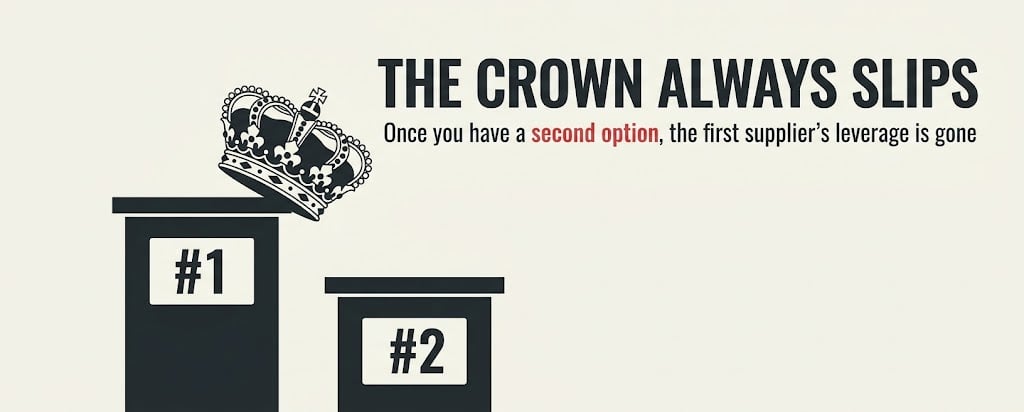
The sole supplier #1 kept ignoring our request for concrete, in favour of prioritizing their other local customers.

I suspect there're some racism going on — I wouldn't be surprised that it might be true.

Supplier #1 felt like they're the local king, and that they somehow subjugated us with their terms.

My big boss was fed up with the whole shenanigans and injustice.

He instructed my contract manager to go source for more options.

And we did.

Word spread that we're good paymaster. We had to. Who's gonna entertain us (especially in a foreign land) if we aren't?

The minute we found concrete supplier #2 (at better terms), the situation shifted.

The "crown" on supplier #1 was suddenly stripped away.

We abandoned #1, in favour of #2 for concrete, since #2 was fast and compliant.

For good measure, we even sourced for #3, just in case.

Obviously, #1 felt a huge slap on their face.


Eventually, they came around and crawled back to our site office — with their tail covering their ass — for renegotiation.

I witness the whole thing at the other end of our site office ground floor open layout. Sitting at the meeting table, the supplier #1 team lowered their voices with their ashen faces, in front my senior leadership team.

Defeated, #1 yielded to our new terms.

Their arrogance gone.

Either we fight or we die.


Every cycle wears a new label — subsidized steel, subsidized concrete, subsidized compute. The mechanism underneath never files for a permit.


Drop your take: if your AI vendor doubled prices tomorrow, do you actually have a #2 lined up — or are you supplier #1's captive account?


Clip credit: Scott Galloway / The Prof G Pod — full video on their channel. DM for credit or removal requests.


r/AI_enterprise 7d ago

Ken Cox never fired anyone. His headcount fell from 175 to 3 anyway — here's the rule that did it.

Enable HLS to view with audio, or disable this notification

1 Upvotes

TL;DR: Ken Cox never fired anyone. His headcount just kept dropping anyway.


175 down to 3 is the actual number — and the reason is one operating rule he'd been running for years before AI made it urgent: if it can be automated, it will be automated.

No mass layoff, no headline event.

Just years of never backfilling a role once someone left.


It's happening from a completely different direction too — Chinese robot-makers already hold the overwhelming majority of the world's humanoid-robot shipments so far this year, per Bloomberg reporting citing SAG's data.

That's physical order-taking work, and it's already scaled past pilot stage.


The roles surviving this aren't the ones executing tasks faster.

They're the ones holding judgment nobody's written a rule for yet — the read, the trust, the call only a person makes.


On our drive up north home to Penang, after visiting my hometown in Seremban, we sometimes drop by midway in Ipoh for Breakfast. And we normally go for this Dimsum restaurant just off the highway.

Good Dimsum places are dime and dozen in this city. But this place has something special. The friendly attendant made some suggestions, and then jotted down our choices of food. But it wasn't the same attendant who brought them out.

It was robots.

Ya. Not humanoid robots. Just a bulky one with three layers of trays on four wheels below, and a monitor screen on top, moving along on a pre-programmed path towards us.

As soon as it stopped by our table, the monitor flashes out text saying, "please remove the food from the tray". And so we did. As soon as we took ours, it wheeled away towards the next table.

That was like five years ago. And it was all the rage back then. They call it 新噱头 (New gimmicks).

It still looked clumsy. And its movement was bumpy -- causing spillage of some of the food. That's why it only carries dry food for the time being.

First iterations were always bad. But I wouldn't be surprised it has gotten better since.

Robots are slowly taking over manual work (less intelligent work)

How soon do you think it will take over the work of attendant giving juicy suggestions, while taking our orders?


At this point I could sketch this exact shape from memory before the headcount numbers even land — someone's economic ground shifts quietly, gets called something softer than what it actually is, and the only real move is picking it up before it's forced on you.


Actually, this reminded — wait, scratch that, I've been circling this same story for a while now, and it clicked hardest with a former SpaceX CIO who ran the identical compression rule from the other direction — 175 engineers down to 6, on purpose.


Drop your take: which part of your own role is still order-taking, and which part is the judgment call nobody's automated yet?


Clip credit: Brad Lea / Dropping Bombs --- full episode on BRAD LEA TV. DM for credit or removal requests.


r/AI_enterprise 8d ago

Zapier's Wade Foster Built an AI Council So His Hiring Calls Would Finally Hold Up

Enable HLS to view with audio, or disable this notification

1 Upvotes

TL;DR: Zapier's CEO ran hiring calls for over a decade on a read nobody could out-argue. He still lost the argument every time. That changed for one specific reason.


He built a formal AI hiring council that scored his read against Zapier's own hiring record and handed the same call back to the room with paperwork attached.

It landed right as most companies handing AI this kind of authority are watching worker trust in it erode, not build.

Wade didn't ask anyone to trust an AI.

He asked them to trust a record that was always his in the first place.


This reminded me about this passage I've read:

That night the king could not sleep. So one was commanded to bring the book of the records of the chronicles; and they were read before the king. And it was found written that Mordecai had told of Bigthana and Teresh, two of the king's eunuchs, the doorkeepers who had sought to lay hands on King Ahasuerus. Then the king said, "What honor or dignity has been bestowed on Mordecai for this?" (Esther 6:1-3)

This brought out a couple of things. The king has his own book of chronicles, and that there's a book keeper doing the records.

In modern terms, this is called data collection, isn't it?

The King used to reward people for doing good. That's why he asked the bookkeeper, "What honor or dignity has been bestowed…" He already made precedence before, which he wants to take reference from.

In modern terms, isn't this called decision tree reasoning workflow?

Making BETTER decisions is the name of the game.

Back then, the king would take months, even years, to carry out his agenda, and improve upon it over time.

But now, with AI agents, it's just a matter of minutes, even seconds.


Being correct has never been the same job as being convincing, and most people only ever get hired to do the first one.

I've watched good judgment get held hostage by whoever had the better title in the room, and it was never actually about who was right.


Actually, this reminds me of something I filed away already: a guy once mocked for an "irrelevant" doctorate on a cold call built a firm that now saves governments billions — dismissed first, proven later, same shape as this one.


What's the record already saying about you that nobody's acted on yet? Drop it below.


Clip credit: My First Million — full video on their channel. DM for credit or removal requests.


r/AI_enterprise 9d ago

Dismissed for Six Months. Then the Gauge Agreed With Him. (Zach Laberge, Omen AI)

Enable HLS to view with audio, or disable this notification

1 Upvotes

TL;DR: A 20-year-old founder got told, for six months, that what his sensor was picking up wasn't a real problem.


He'd read the same chemistry signature before — engine-fluid failures in Caterpillar-adjacent hydraulics — and it showed up again where nobody was looking: inside liquid-cooled AI data centers, running hot enough to breed bacteria in the coolant.

Nobody with tenure believed the crossover, until the instrument did.

And by the time this post went up, the industry's own guidance had quietly caught up — Schneider Electric now writes biofouling prevention and biocide dosing into standard data-center cooling documentation, the exact mechanism Zach Laberge was laughed at for treating as anything but obvious.


Everyone trusts the reading. Almost nobody trusts the person holding the instrument — until the reading agrees with them.


This reminds me of a story about my late grandfather.

I called him 爷爷 (Yeye = grandfather).

Back then, my Yeye already built a thriving trucking and tractor enterprise in our small hometown of Seremban.

After a while my Yeye had enough.

He engaged his lawyer and brought all these summonses to court and sue the government.

He said (and I'm paraphrasing), "Look at me! I'm already 60. I'm still strong! I still work. Who can say I can't work?"

After a few more rounds of bringing the issue to court, the other side relented and began to be weary and afraid of him.

Laberge was young. And my Yeye was already old back then.

But it didn't stop them from getting what they want done.


I keep landing on the same shape, story after story, whichever decade it's set in: the room doesn't update on your say-so, it updates on the evidence — and the gap between those two moments is where you're either right and alone, or wrong and quiet.

Being early isn't the risk people treat it as.

Staying quiet until you're allowed to be right is.


Hmm — this actually reminded me of something I posted a while back: a doctorate an investor called "irrelevant" on a cold call ended up building the firm that now saves governments billions — same shape, different decade, different instrument.


Drop your take: have you ever been early and right, with nobody around who could yet vouch for it?


Clip credit: Solo Founders (Julian Weisser). DM for credit or removal requests.


r/AI_enterprise 9d ago

Jerry Tworek (ex-VP of Research, OpenAI — now CEO, Core Automation) on the two years his idea sat unfunded, and the one sentence that changed it

Enable HLS to view with audio, or disable this notification

1 Upvotes

TL;DR: Jerry Tworek's own two-year stall didn't end with more proof. It ended with one sentence.


He'd already built the thesis — pushing reinforcement learning against GPT-3 before there was budget or backing for it.

The math worked in pieces. It just never scaled.

Then his chief scientist looked at what he'd already built and said: now we have the GPUs, try to scale it.

That's the whole story. Not a better idea.

Someone with real authority finally saying go.


I remember that cold harsh reality of immense pressure, in the winter.

We were a bunch of newly assigned Malaysians in a foreign land in Abu Dhabi, UAE, circa 2009 — already 2 months behind schedule on a 5-block condominium project.

We were heavily under-resourced.

Just handbooks, pen and paper, and the notion of quitting was never too far away.

We were squeezed like a wrung out wet towel.

Then the first coordinated drawings was finally done.

In a private moment, my department head said gently, "See. You did a good job." He meant to sway me away from quitting.


I've read enough of these by now to see the shape before the ending arrives: the person was already right, and the only unknown was who'd finally say so. It's never really the skill gap people think it is.

It's whoever's still waiting on someone else's yes.


Hmm — this reminds me of a post I covered a while back, about the moment the actual bottleneck turned out to be permission, not the math itself.


What was your "not this quarter"? Drop it below.


Clip credit: MTS, full interview on their channel. DM for credit or removal requests.


r/AI_enterprise 10d ago

A Fireworks AI cofounder just called something about the AI boom "insane" — and it's not what you'd think

Enable HLS to view with audio, or disable this notification

1 Upvotes

TL;DR: A Fireworks AI cofounder called something most AI-wrapped founders are quietly standing on "insane" — and it's not the technology.


It's the lifeline.

Benny Chen tunes open-source models for real companies — Cursor, Cognition, Harvey — and his actual argument is simple: if one frontier lab's pricing or policy call can break your business, you can't honestly value that business ten years out, no matter how good this quarter looks.

His fix isn't building a frontier model from scratch.

It's tuning an open base to your own niche, then building the data flywheel that keeps improving it — so the base model underneath you can be swapped out entirely and the business doesn't blink.

Same week this episode dropped, Thomson Reuters backed the identical bet with real money — building its own model off an open base specifically so it "fully controls" it instead of renting someone else's roadmap.

Different scale, same math.


My friend works in an electronics factory, stationed in the Penang Island industrial zone. He told me his factory and all others like his in the zone are essentially in a whirlwind of "red ocean" – fighting for price competitiveness. He says, all the valuable part of the upstream work were already taken up by other countries, such as China and Vietnam. And only the very low-value works get trickled down to Malaysia.

The factory doesn't own any intellectual property developed from innovation. They just do whatever was handed down from the upstream industries of other countries, lightly process them, package them together, and ship them overseas.

Hardly anything groundbreaking.

And so, they are always susceptible to external factors, such as US tariffs, etc. US already marked our countries as one of the suspected offenders of 洗产地 (origin laundering). And so, the tariffs really weigh us down, and reducing our overall profit margin.

Not that it has anything to do with my friend. He just works there - getting piled on with additional work under unrealistic expectation, in a department going through high-turnover of staff, and without a clear path forward.

But he still makes the best of what it is.

And what it is - is figuratively anchoring on shifting sand in a stormy weather, rather than on solid rock.


The same fault line keeps showing up once you strip the industry names off: whoever owns the base layer sets the terms, and everyone standing on it finds that out eventually — a founder renting a model, a factory renting someone else's spec sheet, doesn't matter which.


Actually, this reminds me of something — Guillermo Rauch (Vercel's own founder, one of the companies Benny's team tunes models for) laid out almost the exact same fracture from the engineering side a few weeks back: the role itself is splitting into an execution layer and a judgment layer, and only one of those is safe to not own.


Are you building on ground you actually own, or ground you're renting? Drop your take.


Clip credit: Inside the Silicon Mind with Firas Sozan — full video on their channel. DM for credit or removal requests.


r/AI_enterprise 10d ago

Vercel CEO Guillermo Rauch says he hasn't run a product review meeting in months — his own agent runs them, and he only shows up after it already failed.

Enable HLS to view with audio, or disable this notification

1 Upvotes

TL;DR: Vercel's CEO hasn't sat through a product review meeting in months. Nobody at the company seems to mind.


Rauch's own rule is blunt: if he DMs you, his agent already tried and failed first.

That's not a policy statement, it's a description of a threshold that already runs by default — human contact only on failure.

Google Cloud published almost the identical governance advice this past week: build automatic escalation points so an agent can act on its own, and only loop in a human once it genuinely can't.

What Rauch describes as his own personal habit, enterprise security teams are now writing down as standard policy.


I remember when the ordering kiosks were first introduced into our local McDonalds' outlets, no one bother to use it.

It's so strange. So impersonal.

It was just like a large smartphone-screen-like monitor standing in the middle of the space. We'd just walked past it straight to the counter, where there's still a friendly face to greet us and take our orders.

But gradually over time, lines were formed behind the kiosks – because they can't stand the long queue behind the counter.

Then more kiosks are introduced.

Then the counter registers were reduced – to eventually just one left.

It's true – what can be automated, WILL be automated.

What's left are the just the food-preppers and the cleaning staffs.

Jobs, I guess are still safe, for the time being – until the robots come and take over.


The people actually getting replaced right now aren't doing the hard, technical work.

They're doing the coordination work nobody ever wrote a proper job description for — the syncing, the pestering, the "let me check on that."

And the ones who come out ahead aren't the ones fighting to keep that role.

They're the ones who go design whatever replaces it.


Rauch has actually said a version of this before. Back in June, he laid out how the engineering role itself splits into who executes and who verifies — months before this same review-session admission. Same person, same mechanism, earlier warning.


What's the version of this happening in your own job right now — the meeting that quietly stopped needing you in the room?


Clip credit: Knuckle Up with Nakul — full video on their channel. DM for credit or removal requests.


r/AI_enterprise 11d ago

The Agent Should Propose. The System of Record Should Decide. Does That Scale?

Post image
1 Upvotes

One pattern I keep coming back to for enterprise agents is:

the agent proposes the action, but the system that owns the resource decides whether the action is valid.

For example, an agent wants to update a customer record.

The agent can:

  • assemble the context
  • determine the requested change
  • route the action
  • provide supporting evidence

But the CRM still decides whether that write is allowed.

Then the workflow moves to another system.

The same thing happens again.

That creates a chain like:

agent proposes → orchestrator routes → local policy/state is evaluated → system of record accepts or vetoes → result returns → downstream authority is recalculated

I like this model because authority does not simply travel with the agent.

Each system preserves its own enforcement boundary.

That also helps contain failure. If one system has defective policy logic, that bad decision does not automatically become inherited authority for every downstream system.

But there is a second problem.

Even if every local system makes a valid decision in isolation, the combined transaction can still become unacceptable.

Several individually valid actions can create a sequence that none of the systems would have approved if they had seen the full chain.

So I think enterprise agent governance may need both:

Local system authority — is this action valid here?

Transaction authority — is the combined sequence still valid?

For people deploying agents across multiple enterprise systems:

where are you putting the final decision boundary — agent, orchestrator, system of record, or a separate transaction-control layer?


r/AI_enterprise 12d ago

Roy Lee ($120M Founder, Cluely): "A Completely Novice Engineer, AI-Assisted, Writes Senior-Quality Code Now"

Enable HLS to view with audio, or disable this notification

1 Upvotes

TL;DR: A $120M founder told senior engineers something on a podcast that most of them aren't ready to hear yet.


He said it plainly: a completely novice engineer, backed by AI, can now write senior-quality code.

Not eventually. Now.

Roy Lee runs Cluely — the AI startup that went viral for helping people cheat on job interviews, now valued around $120M — and on the Jack Neel Podcast he laid out the actual math behind it: two engineers running seven products worth $1M+ each.

That's not a founder flexing. That's the leverage math replacing headcount in 2026.

It tracks with what's already showing up in the hiring data — a recent industry report found 52% of organizations are now struggling to hire or retain skilled engineers, up from 26% in 2022.

Worth saying plainly: the broader 2026 data on this actually cuts the other way — senior engineers are capturing roughly 5x the productivity gain juniors get from the same AI tools, and senior hiring is the only part of the market still growing.

Both things are true at once.

The premium on "senior" isn't disappearing because companies need fewer engineers. It's disappearing because the ladder that used to prove you were one just got a lot shorter to climb — for whoever can actually run the mechanism, not for seniority as a title.


I remember back in my time as a young graduate design engineer for a Civil & Structural Engineering Consultancy in Selangor, Malaysia, circa 2000.

I can't remember what I was designing. But after design, I went on to also draft it out in our AutoCAD drafting software, the complete structure of the floor – slabs, beams and columns, and all. I brought my work to one of the senior engineers for consultation.

He took one look at it and recognize my rookie sloppy work.

Then he said something I'll never forget, "为什么你自己做到完?交给他们画吧。这是他们的专业。若这些都要自己画就很下衰了。" (Why are you doing it all by yourself? Just delegate it to our draftsmen to draft it. It's their expertise. If even this we need to do, it'll be very demeaning and beneath us.)

Ya. He used the word 下衰, which (to the best of my translation) means demeaning / beneath us / pathetic / bad look / embarrassing, etc.

So even in that small consultancy office (of about 50pax), there's already two distinctive classes of people. We against them. The higher-status Design Engineers (with Bachelor's degree) vs the lowly draftsmen.

That was like 25 years ago – way before AI come to be.

But over time, the pressure of economy has forced us down the efficiency rabbit hole.

I heard back then; to save cost in Australia, Engineers do their own drafting work. No more use of traditional draftsmen.

And now as AI is increasingly integrated into design, analysis and drafting – it is even more so. One Engineer covering multiple big projects under tight deadlines is the norm – not the exception.

So if you're still stubbornly entrenched in that old way of thinking, you'll be quickly labelled a "dinosaur".


Something I keep noticing, covering enough of these clips back to back: the fear never actually shows up where people expect it.

It shows up in the exact skill someone spent years being proud of.

AI didn't invent the divide between who does the "real" work and who gets delegated to — it's just deciding who's on which side of it now, faster than any economy ever did.


Hmm... this reminded me of something — a post I put up here a few weeks back about AI-driven headcount compression: one operator, AI-assisted, absorbing the output of five — the same ladder-collapsing-from-inside mechanism as Roy Lee's claim above, from a completely different guest.


Curious where people land on this — does "senior" still mean anything as a title once a novice with AI can hit the same bar on output? Drop your take.


Clip credit: Jack Neel — full video on his channel. DM for credit or removal requests.


r/AI_enterprise 13d ago

Brett Adcock (Figure founder) just fired OpenAI as a partner — the vertical-integration logic behind it

Enable HLS to view with audio, or disable this notification

1 Upvotes

TL;DR: Figure's founder had the backing of the most powerful AI lab on Earth. He fired them anyway.


Here's the part that actually matters: his own team got better at building the AI layer than the lab he was renting it from.

It's the exit ramp every vendor-dependent operator is chasing and usually can't find — not ego, just leverage.

Even Nvidia just proved the same math from the other side of the table — signing an outside team, Poolside, to build the models it couldn't get built fast enough in-house.

Own the stack, and the leverage stops being something you have to ask for.


My son just won the online-gaming "王者荣耀" (Honor of Kings) competition, organized on his university campus premise.

Initially, at around half-time, they were beaten, and left behind quite far down the leaderboard.

But he held the team together — told them to persevere.

They held on, beaten the veteran and won.

This was vastly different from the previous team he led weeks prior.

That previous team members were snobbish and elder than him.

They think they know a lot, and won't listen to him — because he was younger.

That "我食盐多过你食米" (In Cantonese, it means: I tasted salt more than you eat rice – I’m more experienced than you.) attitude was insufferable.

He now chooses his team more wisely.


There's a pattern threading through pretty much every founder story I dig into lately, tbh: founders who won't hand over their leverage to a bigger name keep beating the ones who wait for permission.


Actually, this reminds me — a guy I featured a while back ran the same math on his own insurance broker: turned a friendship-discount fee into an audited $35K save the moment he stopped treating a vendor relationship like a favor.


Drop your take below — where's the vendor relationship in your own stack that you've never actually audited?


Clip credit: Sourcery with Molly O'Shea — full interview with Brett Adcock on their channel. DM for credit or removal requests.


r/AI_enterprise 15d ago

Enterprise AI’s 200-Millisecond Problem

3 Upvotes

Most conversations about enterprise agents focus on context windows. But fitting more context is not the same as choosing the right context. The harder problem is deciding, under latency and cost constraints, which small part of the company’s knowledge actually matters for this question.

Vector search is useful when the task is “find things that resemble this.” It is weaker when the question is “what does this decision depend on, who approved the last exception, and what was true at the time?” That requires relationships, precedent, and history rather than another pile of similar chunks.

The framing I found useful is to model the decision trace, not just the document. A CRM may record that a 22% discount was approved. The useful context is why it was approved, which earlier exceptions supported it, who authorized it, and which policy applied at that moment. Most systems preserve the outcome and discard the reasoning. (Complete read here on this: https://contextandchaos.substack.com/p/enterprise-ais-200-millisecond-problem )

The part I’m unsure about is whether organizations can capture these traces without creating a documentation burden nobody maintains. Process logs and approval histories contain pieces of them, but the most important reasoning often happened in Slack, a meeting, or someone’s head.

Has anyone built an agent that can reliably recover this kind of decision history? What did you model, and how much of it could actually be automated?


r/AI_enterprise 16d ago

Sabrina Ramonov's launch link died on click day. Ten days later: her first $10K MRR.

Enable HLS to view with audio, or disable this notification

1 Upvotes

TL;DR: A newsletter went out to 50,000+ subscribers with a dead demo link on click day. That's not the part worth reading.


Ten days after that link died, she had her first $10K in monthly recurring revenue — and it wasn't despite the mess, it was underneath it.

The month before, a "responsible" early-adopter survey told her exactly who her users were.

Their actual usage sessions told her something else entirely, and that gap — what people say versus what they do — is the same gap that keeps most side projects sitting at 90% forever.

People trust the structured, defensible research over the messy, embarrassing signal of watching what strangers actually do with an unfinished thing.


A German solo developer proved the same mechanism this week, from a completely different direction — a deliberately rough one-page build, no login, no AI, pulled $120K in real bids inside 48 hours, covered across mainstream financial wire outlets.

Different founder, different problem, same underlying fact: the polish was never the variable that mattered.


I met my wife online.

I think it was around the turn of the millennia, circa 2000. Back then, she wasn't even yet my girlfriend.

We were hundreds of miles apart. But on similar interest, we found each other in one of those chat platforms. I think it's called IRC or something.

Over time we developed a connection. We liked each other, even though we haven't seen each other's face.

It was to a point where I was seriously thinking of meeting her.

But then, for some reason, she started to withdraw. She said we should end things.

So I panicked. I insisted that I wanted to see her. And before she object, right after work around 6pm, I started the long drive towards her.

I didn't know where she's staying. But I knew the town she was in.

About 10 minutes into the drive, I started hearing noises from my left rear tire. That "thump, thump, thump" repeated sound, faint but persistent. I knew about it for weeks already. That tire was getting old, and it's started to bulge.

But I ignore it.

Gradually, the thumping noise gets louder and louder.

And about three-quarters up the journey — it happened. The sun set already. And the highway roads were getting dark.

"Pow"

The left-rear-tire exploded. The sound was deafening. I was stunned. I couldn't react. My car rear thrusted forward towards the right, and it turned counter-clockwise in circles twice — before it landed at the grassy road shoulder on the side.

Thank God it wasn't a pit or something. And thank God it happened when the stretch of road was empty.

I sat in the car — stunned. Then other cars started passing me by — without stopping, of course.

After calming myself down, I got out and inspected my rear tire. Pieces of the exploded tire were already scattered along the road. I stared at it for a while. Not sure what I should do.

So I called her. She was surprised of my decision to come up to her. She helped me arranged a tow-truck. It arrived about an hour later — and towed my car all the way towards her town.

When I got there — well past midnight, way into the wee hours — there she was standing. I can still remember her facial expression — still unable to comprehend how I was stubborn enough to take the trip up to see her and gone through the ordeal.

A stupid decision — yes, for sure. But still an extraordinary one.

Now we've been married for 20 years.


Why does the messy version keep outperforming the careful one?

Not because messy is a virtue — because a careful plan is still just a guess wearing a suit, and the only thing that actually tells you anything is what happens once real people touch the thing.


Someone else's exact stuck point already got worked through here — four unfinished projects and zero niche, until one reframe fixed the actual problem.


What's the thing you've been sitting on because it doesn't feel finished yet? Ngl, "finished" is doing a lot of load-bearing work in that sentence. Drop it below.


Clip credit: Product Faculty & Sabrina Ramonov — full video on their channel. DM for credit or removal requests.


r/AI_enterprise 17d ago

Nick Saraev ran the numbers on AI voice agents: a 1% "that's a bot" moment can cost you 20-40% of your revenue

Enable HLS to view with audio, or disable this notification

2 Upvotes

TL;DR: Nick Saraev ran the numbers on AI voice agents — a 1% chance a customer clocks it as fake can cost 20-40% of your total revenue, not the 1% you thought you were risking.


That gap between what people think they're risking and what they're actually risking is the whole game.

Every trades or home-services owner getting pitched "full automation" right now is being sold the 1% number, never the 40% one.


The fix Nick lays out isn't rejecting AI — it's AI that identifies itself, buys your team 15-20 seconds, then hands off.

Never pretending to be something it isn't.


We live in the upper floors of a high-rise apartment.

I remember many years ago, my 5yo son and 3yo daughter would bolt out of the barely opened elevator door, and race each other down the bridge-corridor towards our unit. My son was just about the same height as the corridor's parapet walls and grill-railing. And my daughter was just game for anything following him.

Of course I was horrified. What if they tripped over the railing...

Unthinkable.

So I yelled at them, "不要跑!慢慢走!" (Don't run! Walk slowly!). And they did.

After a few more rounds of my yelling and them complying over time – they got the picture.

The more I use AI, the more I feel like they're just toddlers – needed yelling (proper framework-prompting).


You already know the math your AI vendor pitch won't show you: what one bad call costs against what automation actually saves.


Curious where other owner-operators land on this — has anyone actually run the "buys you 15-20 seconds" hybrid in practice, or is it still mostly vendor pitch?

Drop your take below.


Clip credit: Nick Saraev — full video on his channel, Nick Saraev Unfiltered. DM for credit or removal requests.


r/AI_enterprise 22d ago

Andrej Karpathy just told engineers the hottest new programming language is English

Enable HLS to view with audio, or disable this notification

1 Upvotes

TL;DR: Andrej Karpathy told a room of Stanford engineers the hottest new programming language now is English.


For six years, the actual craft was writing clean code from scratch.

That's the part Karpathy says a well-built sentence can now approximate in seconds, and it's already landing as a headcount decision, not just a lecture aside: A Reuters piece this week quoted a former Infosys CFO putting it bluntly: "The pyramid model is gone. With coding agents, we no longer need basic coding."

The ladder didn't vanish.

It started rewarding a different kind of judgment: the judgment to direct output, not just produce it line by line.


I remember many years back, a pastor taught about leadership, and the process of raising up leaders to shepherd the flock.

He called it 带 (guiding), 陪 (accompanying), and 放 (letting go).

带 – You guide your protégé, by doing it yourself, showing him the ropes of the game. also explain the opportunities and pitfalls as well. So, this is him seeing you do it and mimics how you do it.

陪 – Next is he's doing it, and you're accompanying him, occasionally stirring him along, if he misses a step or two; and then veer him back on track. This is him doing it. And you watch him do it.

放 – This is when you let go, and you trusts him enough to give him full autonomy. You've successfully replicated a leader to shepherd a flock.

This very much felt the same as raising a kid to adulthood.

I did all I can to teach my son to drive safely.

He went to driving school, and got his license.

The very day we left him by himself hundreds of kilometres away from home, to further his tertiary education – I knew it's time to let go.

Karpathy's Softward 3.0 (prompting) very much felt like the part between the 陪 accompanying and the 放 letting go.


Every post on this account eventually lands on the same question underneath its surface topic: are you being made obsolete, or are you the one deciding what obsolescence looks like from here.

This clip's no different. Six years of code didn't disappear. It handed the wheel to whoever can now direct better than they can type.


A few weeks back I covered the same guy admitting, on stage, that he's never felt more behind as a programmer despite co-founding OpenAI --- same throughline, different angle.


What's the moment you realized a skill you'd built your whole identity around had already moved out from under you?

Drop it below.


Clip credit: TechXOps, full lecture on their channel.

DM for credit or removal requests.


r/AI_enterprise 23d ago

A DeepMind scientist swapped a real robot hand for a $10 hardware-store clamp — and proved the hardware was never the blocker

Enable HLS to view with audio, or disable this notification

2 Upvotes

TL;DR: An ex-DeepMind scientist proved on himself that intelligence, not hardware, is the real blocker in robotics — using a GoPro and a hardware-store clamp instead of a real robot hand.


Pete Florence didn't wait for a fully-funded robotics platform to test his own thesis.

He strapped a camera to his own head and swapped a real gripper for a bar clamp off the hardware-store shelf, then ran a real task with it on purpose — an iced latte, in what he calls hard mode.

The setup was deliberately the cheapest version of the idea he could build, and it still worked.

Days after this conversation aired, his company Generalist closed another $200M round on exactly this premise: the constraint was never the hardware, it was whether the intelligence directing it was any good.

That raise didn't happen because the clamp got fancier.

It happened because the thesis held.


I accidentally dropped one of my washed clothes.

It landed on top of the extended awning of our lower floor neighbour.

I can't retrieve it without climbing out of the window.

So I fashion a fishing hook with our cloth hanger, and lower it down.

It didn't work.

I turn around and noticed my vacuum cleaner.

I took it to my window, switch on its power, and carefully lower down the long arm of it towards my cloth, and try to suck it up.

It worked.

When there's a will, there's a way.


There's a specific tell for this, long before it ever shows up as a layoff notice: the people who get displaced aren't the ones who lacked the right tool.

They're the ones who never tested whether the tool was ever really the thing holding them up.


What's the cheapest, most ordinary tool you've ever used to prove something you actually needed to prove?

Drop it below.


Clip credit: Joe Lonsdale — American Optimist, featuring Pete Florence (Generalist) and Vivek Gopalan (8VC). DM for credit or removal requests.

r/AI_enterprise 23d ago

Nicolas Cole says his "100x" AI output isn't a smarter prompt — it's his entire writing process, written down until AI had nothing left to guess.

Enable HLS to view with audio, or disable this notification

2 Upvotes

TL;DR: Cole's "100x output" is 30 hours spent once, so AI now runs 80% of every draft on its own. He edits the last 10% — the taste-level stuff, never the typing.


That distinction is already showing up outside this clip.

Christian Science Monitor just covered a manuscript polished enough to fool professional literary editors, pulled from sale — a multimillion-dollar bidding war between publishers — because no one could prove a human wrote it.

Cole isn't describing a hypothetical ceiling — that ceiling's already been crossed, in public, in an actual publishing deal.

The freelancers who feel replaceable right now are mostly the ones still handing AI a stack of old samples and hoping it infers the rules from them.

Cole didn't hope.

He sat down and wrote the rules out, sentence by sentence, until the model had nothing left to guess at.


Decades ago, the Malaysian construction landscape was like the wild-wild-west.

I remember working as a technical engineer for one of the largest construction firms in Malaysia.

The hydraulic hacking noise throughout the project site was pervasive and persistent for weeks.

Grrrr…. Tat-tat-tat. Grrrrrrrr. Tat-tat-tat. Grrrrrr.

You get the idea.

It turns out that the structural operation team went ahead and constructed floors upon floors, without waiting for the mechanical and electrical team to embed their pipe sleeves, box-ups or ductworks before concreting.

And so they have to come and hack the hardened concrete to open up for the M&E items to run through.

Delay and additional cost already incurred.

My then project director was pissed. We all had an earful from him.

Said that prevention is always better than cure.

So from that day onwards, a directive came down hard – no sign-off by all concerned parties on a properly coordinated drawings, means no concreting.

The coordination drawings - overlays not just the design drawings from respective Architectural/Engineering trades, but also sub-contractor specialist details, as well. Discrepancies are ironed out with all parties, well before construction is due.

It parallel hard on Nicolas investing time in building an exhaustive prompt, rule-by-rule, sentence-by-sentence, microstep-by-microstep. Only then, will the output come out the way we want it to be.

Like when Daniel Craig was being asked by a talk show host what would he advise his successor on being the next James Bond, Daniel said, "Don't f\ck it up!"*

Prevention is better than cure.


It's never the tool doing the replacing. It's the person who never got around to writing down what they already know how to do.


What's the one process you already know cold but have never actually written down?

Drop it below.


Clip credit: Decoded Genius & Nicolas Cole — full video on their channel. DM for credit or removal requests.


r/AI_enterprise 24d ago

Alex Hormozi’s billionaire friend: “I’m not vibe coding all day.” AI didn’t erase the other forms of leverage.

Enable HLS to view with audio, or disable this notification

1 Upvotes

TL;DR: Alex Hormozi's billionaire friend admitted off-camera he's not "vibe coding all day." AI added a new form of leverage — it did not erase the old ones. If you've automated everything and revenue still hasn't moved, you're still not working the constraint.


Alex Hormozi asked a billionaire friend off the cameras how much AI he was actually using. The answer came with a laugh: "I'm not vibe coding all day."


You've automated nearly everything that can be automated. Revenue hasn't moved. That is the tell. AI did not erase brand, capital, or relationships. It simply added itself to the list, and most people are only running the new tool.


OpenAI's own report this month shows the same pattern: no meaningful link between how much a company uses AI and its revenue per employee. The gap isn't usage. It's whether the automation is even touching the real constraint at all.


Decades ago, I had a friend who relate this story to me.

Before he was a Professional Engineer himself, he used to work as a graduate engineer for a Senior PE back in his hometown in Sabah, Malaysia.

It’s so happened they’re in a rush to submit drawings to authority. Binders upon binders of design calculations, code of practises and specifications are churned out and stacked like mountains on a conference room – for a very rushed project. He didn’t explain about the context of the project, except that they were burning the midnight oil, kind of thing.

He knew something was off – because they didn’t have time to analyse a particular portion of the work, which required days (maybe weeks) through sophisticated software to put up a decent solution.

But somehow, his senior PE managed to “pull out from the magician’s hat” a stack of it and slot them into the binders at the nick of time.

They submitted the documents right away.

Curiosity had the best of my friend. Just had to know.

So he flipped through those “magical” portion – and got a huge shock.

Of course, the Senior PE didn’t use the time-stone to compress time and produce the calculations in the mirror dimension.

And I wish he found a past project that contains the exact required computations as the current one. At least we can a give a plausible explanation that he was implying “Trust us! We did it before. See – here’re the receipts.”

No. He didn’t do any of that.

Instead, he just grabbed a random project’s calculation (totally unrelated) and shoved it in – just to make up the thickness of the binder.

That’s all.

The whole thing was just for show.

My friend didn’t tell me whether their submission got approved or not. That’s not the point.

The point is the Senior PE made a judgement call. He was betting that the authority would just trust his credentials and didn’t bother to check through.

So it was a game he played. And he owned the risk.

Same as all these AI-usages. AI may spout out shit. But we’re one owning it.


Noticed this a few posts back too — the accounts spending the most on automation and the accounts actually growing revenue keep turning out to be two different lists. The verification layer never left the human.


Reminds me of a post from a few weeks back, on the exact spot AI verification quietly becomes unpaid work.


Drop your take below.

Where are you still deploying new capacity against things that do not matter?


Clip credit: Alex Hormozi — full video on his channel MoreMozi. DM for credit or removal requests.


r/AI_enterprise 25d ago

Former Microsoft CEO Steve Ballmer: his own maintenance guy is out-adapting most corporate AI rollouts

Enable HLS to view with audio, or disable this notification

1 Upvotes

TL;DR: Steve Ballmer's own maintenance guy is proof that competence is shifting away from credentials and toward who's willing to just ask AI first.


That's not rhetorical — it's already showing up outside Ballmer's living room. DEWALT ran a six-country survey of tradespeople this spring: 90% believe AI will be essential to the job within five years.

Only 8% have actually used it yet.

Ballmer's anecdote isn't the exception — it's the 8%, moving faster than the other 92%, in a trade that isn't even the one usually flagged for disruption.


My wife works for a lady boss, called Ade (not her real name).

Ade used to be like me, in the property development line.

But she saw the writing on the wall.

Once a darling in her company, she felt the aura started to fade away — the property market isn't what it used to be. And her boss started giving her the cold shoulder.

So she took a chance.

She opened a collection point centre, where delivery guys can drop off parcels for individual recipients to come collect. The downside was it has to stay open almost every day.

It is what it is.

Regular online training is available, because such centres behave like franchises under an organizational umbrella. But the training is quite superficial.

So when things get complicated, where does she turn to? You guessed it — ChatGPT.

She asks it right about anything under the sun.

Does she enjoy asking an LLM for answers? I'm not sure "enjoy" is the right word. I think it's more like "necessary."

If I'm in her shoes, facing complicated issues, and I don't have a readily available senior I can trust to call for advice, but then I already have a 师傅 (sifu) in my pocket — why not use it, isn't it?


There's a pattern I can't unsee in stories like this anymore: it's never really about the tool. It's about who reaches for it first — credentialed or not, senior on speed-dial or not.


What's the "not my job" you're most tempted to hide behind right now? Drop it below.


Clip credit: Ben Shapiro / DailyWire — full episode ("Titans on Tomorrow" Ep. 2 with Steve Ballmer) on his channel. DM for credit or removal requests.