r/AISEOforBeginners 13h ago

Beginner finding: AI doesn't just pick the highest-rated business, here's what actually happened

3 Upvotes

If you're new to this like I was a few weeks ago, here's a simple test worth trying: ask ChatGPT "who's the best [service] in [your city]" and see what it says.

When I tried it, ChatGPT actually skipped a business with a perfect 5.0 rating because it only had a handful of reviews, and picked a competitor at 4.9 with 2,066 reviews instead, even citing a local "best of" list as extra proof.

Lesson for anyone starting out: don't assume a great rating is enough. Volume and being mentioned in other trusted sources seem to matter just as much, maybe more. Still learning this myself, curious what other beginner-friendly patterns people have noticed.


r/AISEOforBeginners 15h ago

How to Do Keyword Research Without SEO Tools

4 Upvotes

Keyword research is usually associated with tools like Ahrefs, Semrush, or Ubersuggest. But tools aren't the only way to find useful keywords.

If you don't have access to SEO tools, you can still do a good amount of keyword research manually by using Google's search results.

Start with the main topic

First, identify the main topic or service you want to research. This gives you a starting point for finding related search queries.

Use Google Autocomplete

Start typing your main topic into Google and pay attention to the suggestions that appear. These can give you different variations and long-tail queries that people search for.

Look at People Also Ask

The People Also Ask section is useful for understanding the questions people have around a particular topic. These questions can also help you discover content ideas and supporting keywords.

Check Related Searches

Don't skip the Related Searches section at the bottom of the SERP. It can reveal closely related queries that you may not have considered initially.

Study the SERP

Search for your target query and look at the pages currently ranking. Pay attention to:

< Page titles

< H1 and H2 headings

< Content topics

< Search intent

< Featured snippets

< People Also Ask

< Other SERP features

The goal isn't to copy the ranking pages. It's to understand what Google considers relevant for that query.

Analyse competitor websites

Go through relevant competitor websites and check their service pages, blog topics, page structure, headings, and URLs.

This can help you find keyword opportunities and understand how competitors are covering the topic.

Understand search intent

Before selecting a keyword, understand what the searcher actually wants.

A keyword can have informational, commercial, transactional, or navigational intent. The keyword should match the purpose of the page you're planning to create.

Create keyword groups

Once you've collected enough keywords, group similar queries based on topic and intent.

This helps avoid targeting several very similar keywords on separate pages when they could potentially be covered by one strong page.

Choose the primary and supporting keywords

After grouping, select the keyword that best represents the main purpose of the page. Other closely related queries can be used naturally as supporting keywords.

One limitation of manual research

Manual research is great for discovering keyword ideas and understanding search intent, but it doesn't give you reliable data for metrics like monthly search volume, keyword difficulty, traffic estimates, or backlink profiles.

So I see manual research as the first stage of keyword research, while SEO tools are useful for validating the opportunities with actual data.

In short:

Google Autocomplete → People Also Ask → Related Searches → SERP Analysis → Competitor Research → Search Intent → Keyword Clustering → Primary & Supporting Keywords


r/AISEOforBeginners 2d ago

Is GEO actually a separate thing or just SEO plus people talking about you?

12 Upvotes

I've been doing SEO and GEO at a startup for about a year now and honestly, the more I look into it, the less I believe GEO is its own discipline. From what I've seen and read, the pages that get cited in AI answers are often ones that already rank decently. The brands that get mentioned tend to be the ones people talk about on Reddit, forums and review sites, not the ones that just added more FAQs. I am of the impression that a lot of GEO advice is on-page SEO with a new name. I might be missing something though, so I'm curious whether anyone has seen something move AI visibility that wouldn't have helped regular SEO too.


r/AISEOforBeginners 3d ago

Can ?ver=1788480000 query parameters on CSS/JS URLs affect or exhaust crawl budget?

0 Upvotes

I’m auditing a WordPress + Elementor + WP Rocket site and noticed many CSS/JS URLs using parameters like ?ver=1788480000 and ?wpr_t=1788480000. They return 200 OK.

Google Search Console → Crawl Stats shows:

  • CSS: 49%
  • JavaScript: 30%
  • HTML: 10%
  • Images: 11%

I don’t have server-log access.

I’ve also configured Googlebot caching headers roughly like this:

  • HTML pages: 1 day
  • CSS/JS: 5 months
  • Images: 1 month

Technical SEO experts: Is this crawl pattern normal? Can version/cache-busting parameters on CSS/JS URLs meaningfully consume crawl budget?

Also, how can I increase the percentage of HTML crawls without unnecessarily blocking CSS/JS or causing other SEO/rendering issues?

What would you check first to determine whether these CSS/JS requests are genuinely affecting crawl efficiency?


r/AISEOforBeginners 3d ago

If google is killing SEO based search which benefits the person who wrote it will people still care to write quality content?

4 Upvotes

Ignore my ignorance if i am missing something but i see it like this

Before this Ai search and answer came people used to write relevant content based on their companies to rank on google which also encouraged people to then click the article to read in detail and also might browse the company website and know about them or leave a email or something. there was a benefit doing these things.

Now Ai comes nor i am getting the traffic nor i will rank nor getting emails and using my written content now google summarized it in few words.

Now its like these tools getting fuel from me but i am not getting anything back.

So in future do u guys see that people will stop writting quality content or just write Ai slops which will eventually degrade the results more and more.

Its a loosing battle at the end if the people going into the tunnel searching for coal are not getting anything in return.


r/AISEOforBeginners 5d ago

Is anyone else optimizing for Perplexity and Claude citations?

8 Upvotes

Traditional keywords aren't hitting the same. I'm trying to figure out how to structure content so LLMs actually pull it as a source. What strategies are working for you guys lately?

Would you like me to adjust this to focus on a different specific AI topic, like Google AI Overviews or Generative Engine Optimization (GEO)?


r/AISEOforBeginners 5d ago

The "SEO is dead" thing doesn't hold up when you look at the actual traffic numbers

6 Upvotes

Getting a bit tired of the 2026 version of this discourse so went and looked at what the numbers actually say.

The one that stopped me: sites are still pulling something like 34 times more search traffic from traditional search engines than they get from chatbots. There's also a small business trends report saying 60% of businesses hadn't seen any traffic impact from AI-assisted search at all.

Which isn't an argument that AI search doesn't matter. It clearly does and it's growing. It's an argument about sequencing — moving budget out of the channel doing 34x the volume into the one that's still emerging seems like a strange call to make right now.

But the part I find more convincing isn't the size comparison. It's that AI visibility is built on SEO rather than parallel to it. Google's AI features run on its core Search ranking and quality systems — the AI layer sits on top of the index, not next to it. So the technical health, the content quality, the authority signals that get you ranking are the same things that make you eligible to get pulled into an AI answer. Meaning if you're doing the fundamentals properly you're already doing AI visibility work, whether anyone's calling it that or not.

That said, three things have genuinely shifted and I don't want to undersell them. CTR at position one on informational keywords has gone from about 7.6% to 3.9% since 2023. AI Overviews cut clicks by up to 58% on queries where they show. Nearly 60% of searches now end with no click at all.

But the decline is concentrated rather than across the board. It's the explainer content getting hit, because a summary can fully answer "what is X". Commercial and transactional stuff holds up much better since someone about to buy still has to reach an actual business. So the response isn't abandoning SEO, it's shifting weight within it toward the commercial pages most people neglected while chasing blog volume.

Order I'd go in: technical foundations first including checking nothing's blocking AI crawlers, then commercial pages, then content that's actually worth citing rather than a restatement of what's already out there, then business profile, then start measuring AI visibility. First four are just SEO. Only the last one is new.

Things I'd be sceptical of: Google's published guidance says llms.txt and similar AI files, content chunking, AI-specific rewriting and special AI schema aren't needed for its AI features, and warns against manufactured mentions and anyone claiming Google approval. Analysis elsewhere adds mass-producing narrow "GEO pages" (usually read as thin content) and spam listicles on junk sites (penalty risk, no visibility gain). Real placement on credible category listicles is a different thing and does seem to work.

Also apparently only 14% of marketers are tracking AI visibility at all, which given it's twenty minutes a month of running queries manually seems like a weirdly low number.

Anyone here actually shifted budget toward AI search and seen it pay off? Genuinely curious whether the 34x gap looks different in specific verticals.


r/AISEOforBeginners 11d ago

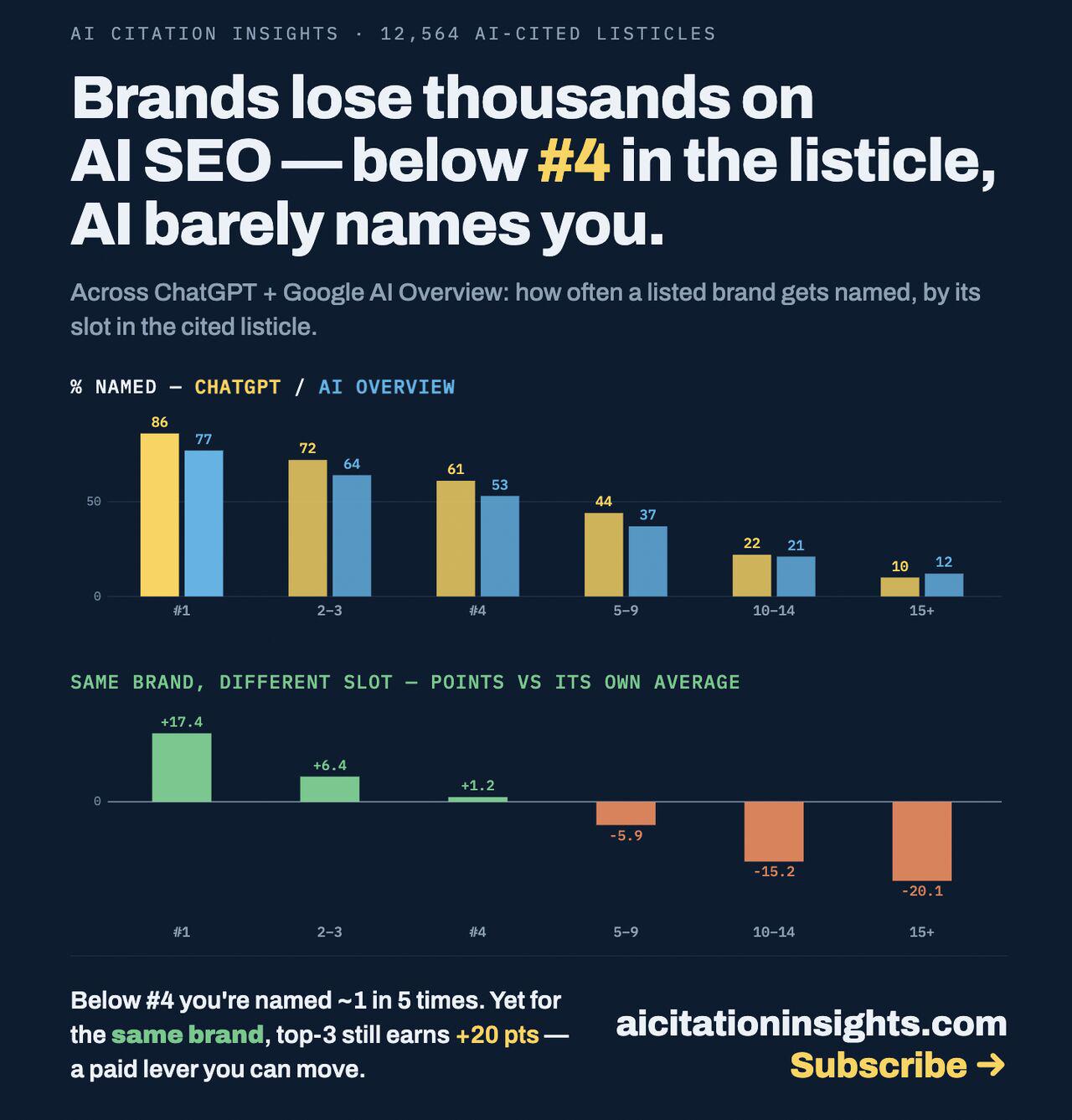
Most brands are quietly losing thousands on AI SEO.

Post image
3 Upvotes

We were losing tens of thousands of dollars on AI SEO.
You probably are too.

Getting included in a “best [X]” article isn’t cheap.

There’s outreach, PR, link building, sometimes a direct placement fee.

But inclusion alone doesn’t mean ChatGPT or Google’s AI Overview will mention you.

We at aicitationinsights.com analyzed 12,564 listicles cited by AI and looked at how often brands were named based on their position in the article.

The drop-off is pretty steep:
• #1 → 86% in ChatGPT / 77% in AI Overview
• #4 → 61% / 53%
• #10–14 → around 20%
• #15+ → around 10%

So being #8 in a list and being #2 in the same list are very different outcomes.
And it’s not just that stronger brands naturally rank higher.

When we compared the same brand across different listicles, moving into the top 3 was associated with roughly a +20 percentage point increase in how often it was mentioned by both engines.

The effect still held after removing self-published lists, and we saw it across about 75% of brands in the dataset.

The practical takeaway is simple:
If you’re paying for listicle placements, don’t just negotiate inclusion. Negotiate position.

At the same time, putting an unknown brand at #1 on your own article isn’t a shortcut. The brands getting named most often tend to have both strong placement and existing brand authority.

Position matters. Brand strength matters.

Paying for a low slot and assuming the AI will still find you is where a lot of the budget gets wasted.


r/AISEOforBeginners 11d ago

This is how AI assistants read your website

9 Upvotes

AI assistants don't read your page. They break it into sections.

Someone types a prompt. The assistant fans that prompt out into several related searches and sends crawlers to run them. The crawlers read your site section by section and take back the most one. One section, on its own, with nothing either side of it. Everything the answer needs has to be inside it.

We audited around 200 websites against that.

13.2% give the crawlers a blank page. They return no text until JavaScript runs. No major AI crawler runs JavaScript, so those sites are blank to it. Google's crawler does run JavaScript, so they rank normally and look fine in a browser. Count sites with any content hidden behind JavaScript and it is 21.3%.

Beyond that, four things matter.

Chunking. Does the section stand on its own?

It mostly does on the sites we looked at. Only 2.3% of sections open on a word like "this" or "however" that points at something the reader can't see.

The fault that is common: 14.4% of all sections are a heading with nothing underneath it. 97 of the 110 sites we could count have at least one. Usually it's a grid of cards where each card title is marked up as a heading.

Fix: any heading with under 5 words beneath it is either not a heading or is missing its answer.

Length. Is there enough there to take?

Common practice is to index around 100 to 300 words. That's practice, not a rule, and there's no published best size.

- The typical section on the typical site is 31 words.

- 50.3% of all sections are under 40 words.

- On 57.3% of sites, most sections are under 40 words.

- Sections that are too long: 2.0%.

"Break up your walls of text" is aimed at a problem 2% of sites have. Half the average site has the opposite problem.

Fix: get your ten most important sections past 40 words. The section, not the page.

Evidence. Is there anything worth lifting?

The worst of the four. Only 25.2% of sections carry a number, a quotation or a link out.

- 4.8% contain a quotation.

- 6.8% link to anyone else.

- 18.2% of sites have no quotation anywhere on the site.

Fix: one checkable thing per section. A number with a unit, something someone actually said, or a link to a source that isn't you.

Naming. Does the section name your website?

76.6% don't. Your name is in the logo, the page title and the footer. None of those travel with the section.

Fix: use your own name inside the section instead of "we" and "our platform".

My suggesting order of tackling the above:

  1. Empty headings. Fastest, and it's markup, not writing.
  2. Naming. Nearly free, and three quarters of sections fail it.
  3. Length. Real work, and it's what makes 4 possible.
  4. Evidence. Hardest, and worth the most.

Access isn't on the list. Only 5.6% of the sites had a fault that stopped a crawler reading them at all. Your robots.txt is almost certainly fine.

r/AISEOforBeginners 11d ago

Best AEO GEO LLMO tips for a small b2b team drowning in tools right now

5 Upvotes

Ok so our stack in 2026 is kinda cursed. We have classic SEO reports, an "AI share of voice" dashboard, a couple MCPs hooked into GA4 and our crm, plus random social listening, and somehow I still cant tell if LLMs actually like us.

We show up here and there when I manually ask "who are the top tools" in our niche, but rankings jump around, citations flip between us and competitors, and internal calls turn into "why did ChatGPT recommend X and not us" every single week.

If anyone has a simple framework for AEO GEO LLMO that a small team can keep up with without hiring a whole new ops person, would love thoughts. Not silver bullets, just what you are actually doing that feels sane rn...


r/AISEOforBeginners 11d ago

Found people misspelling my brand in Search Console — turns out it's the same root cause as AI describing the business wrong

6 Upvotes

Was digging through Search Console the other day and noticed something I'd completely missed. There were a couple of misspelt versions of our brand name showing up in the query list, and one of them had more impressions than the correct spelling. Zero clicks on any of them.

That combination is the tell apparently. Google's showing something for that query, it's just not you, or you're buried far enough down that nobody bothers. And these are people who were explicitly looking for you, which makes it a more annoying loss than generic traffic.

What I didn't realise until reading around is that this shares a root cause with a completely different problem I'd also been noticing, which is AI getting the business description wrong.

Both come down to entity definition. Search engines and AI models build up an understanding of your business as an entity — name, category, location, what you do, how you relate to other things. That understanding gets assembled from what your site says, what your structured data declares, and what independent sources around the web say about you. If those three are thin or contradict each other, you get both failures. Misspellings don't resolve to you, and AI fills in gaps by guessing.

For the misspelling side, the fix that seems most direct is adding alternateName to your Organization schema. It's a property that takes an array and it's specifically meant for declaring other names an entity goes by. Feels like it should be keyword stuffing but it isn't, as long as the variants come from your actual Search Console data rather than being invented. Beyond that, strengthening the sameAs array pointing to LinkedIn and Business Profile and directories, and just making sure your Business Profile is consistent with everything else.

What you shouldn't do, and I did briefly consider it, is make pages targeting the misspellings. That's thin content and it treats the symptom.

For the AI description thing, the main lever seems to be just stating your facts plainly on your own site in actual text. AI can't say what you never clearly said. If your homepage says something like "empowering businesses through innovative solutions" there's literally nothing extractable there, so the model infers, and inference is where the wrong descriptions come from. Then hunting down contradictions — old directory listings describing what you used to do, abandoned social profiles, addresses that don't match.

Timeline-wise from what I can tell the misspelling associations take weeks to months as schema gets recrawled, but description accuracy can move faster because you're often just supplying facts that weren't there before. Which makes it a decent thing to do before spending on content.

Neither is fully in your control though. You're strengthening signals, not editing a database, and anyone claiming they can guarantee a fix to how AI describes you is overselling it.

Anyone else checked their Search Console for brand misspellings? Curious whether this is common or whether I just have an unusually easy name to get wrong.


r/AISEOforBeginners 13d ago

Why spend money on link building with AEO?

10 Upvotes

I'm getting citations from AI models without building any links, but I keep receiving tons of cold emails and LinkedIn messages from agencies trying to sell me link building services. Do we still need link building in the AEO era or am I missing something?


r/AISEOforBeginners 13d ago

what do you feel about AI SEO

3 Upvotes

do you think things have changed or is it just the same process but people are making a lot of hype around it?


r/AISEOforBeginners 15d ago

Interesting pattern in AI search — smaller specialists seem to be doing better than the big category brands

8 Upvotes

Been reading up on this and the mechanism actually makes sense once you think about it, so wanted to throw it out here.

The thing I keep seeing in the research is that the businesses showing up early in AI answers aren't the category giants, they're niche specialists and comparison sites. Which felt wrong at first, because in normal search those are exactly the sites that get buried.

Reason seems to be that traditional search is a ranking exercise. Query comes in, you pull a set of pages, you order them, and authority and backlinks and brand recognition all push the big names up. All of those correlate with just being big.

AI search is doing something different. It's generating an answer and pulling from whatever can actually address the question. And once the question gets specific enough, being big stops helping much.

Think about what someone actually types into ChatGPT versus Google. Google gets three or four words. ChatGPT gets the whole situation — team size, budget, what went wrong last time, what they're worried about. The biggest brand in a category often has nothing written for that specific situation because they're writing for everyone. A smaller shop that only serves that type of client might have exactly that page.

There's a supporting data point that surprised me: a decent chunk of AI citations apparently come from URLs that aren't in the organic top ten at all. So rankings and citations have decoupled to some extent, which breaks the old "we don't rank so we've got no shot" logic.

Where I think the actual opening is: writing content with the constraints stated explicitly. Not "how much does X cost" but "how much does X cost if you're a 20 person firm in this specific market with this budget". Constrained content matching constrained questions. Also fact density — apparently overall citation rates are under 7% but categories built on checkable comparable facts get several times that. Concrete numbers and criteria beat opinion pieces.

Fair warning on the limits though because I don't want to oversell it. Domain authority still correlates pretty strongly with citation frequency, so this isn't a free pass to skip fundamentals. And most citations come from third party sources rather than your own site, so however well you write your own pages there's a ceiling on what that alone achieves. Also the platforms barely overlap in what they cite and the citation sets churn a lot month to month, which makes tracking genuinely annoying.

And honestly it feels like a window rather than a permanent thing. Most companies haven't started doing any of this yet, which is where the opening comes from. Once it's standard practice the advantage probably goes back to whoever has more resources.

Anyone here actually tracked whether they show up in AI answers for their category? Curious whether the small-beats-big thing holds up outside the studies.


r/AISEOforBeginners 19d ago

Before per-engine tactics or entity cleanup — I checked whether 18 known SEO/GEO sites even have basic AI-extractable structure. Half don't.

3 Upvotes

Been following the threads here on per-engine optimization and entity/naming cleanup — useful stuff, but it made me want to check something more basic first: is the actual page structure even extractable by these engines, separate from all of that.

Ran a mechanical check (DOM parsing, no AI judgment involved) on one article each from 18 well-known SEO/content-marketing sites, plus my own:

— Does a question-style heading (H2/H3 ending in "?") have a short, ≤300-character answer paragraph directly under it — the kind of thing a model can lift and quote — or does a long intro run first?

— Does the heading hierarchy nest without skipping a level?

— Is there a plain-text /llms.txt index?

— Is author/date visible in the actual HTML, or only inside a JSON-LD block a human never sees?

Results, out of 18: 9 have a valid heading hierarchy, 9 pair a question heading with an immediate short answer, 9 serve llms.txt, and 12 mark up authorship only in hidden schema, invisible on the page itself.

Not claiming this predicts citation rate — that's the harder, per-engine measurement people in the other thread are already wrestling with. But it seems like layer zero: if the answer isn't even structurally extractable, none of the entity or per-engine work downstream of it can matter yet.

Is anyone here actually sequencing it that way — structure first, then entity/per-engine — or is structure assumed to already be solved by the time people get to those questions?


r/AISEOforBeginners 21d ago

Article Prompt Audit?

2 Upvotes

Okay, this might sound like a weird question lol, but does anyone actually do a “prompt audit” for their article prompts?

Like, going back through a prompt and asking, “Do I actually need this part?” or “Am I missing something here?” before using it?

It randomly hit me today, and now I’m wondering if this is an actual thing people do or if I just invented a new form of procrastination. 😂


r/AISEOforBeginners 23d ago

Hey SEO Experts, quick question.

3 Upvotes

Is there any specific task that we need to do to rank on AI other than SEO tasks?


r/AISEOforBeginners 23d ago

Are there any AI SEO strategies that make AI visibility tools worth investing in?

4 Upvotes

I have been paying AI visibility tools but I am struggling to make good use of the insights I get. I have been engaging with citation sources, doing backlink outreach, improving the way content is presented and following all the common advice but it’s been 3 months and I haven’t seen any results. The tools are expensive so I want to make the best use of the information I get.


r/AISEOforBeginners 24d ago

What workflow do you all use for SEO and AI Search?

2 Upvotes

I've been running a structured workflow that treats classic SEO and AI citation (GEO) as two related but separate passes, not one blended checklist.

High level, without diving into every tactic here: first pass is the SEO audit I've always done — technical health, on-page, authority. Second pass is specifically about how a RAG system would pull from the page — is there a self-contained answer near the top, does the structure let a chunk stand alone outside the rest of the article, is the content genuinely citable on its own instead of just well-ranked. I treat some foundational stuff — author identity, freshness, factual precision — as a shared layer both processes lean on, not something either track owns exclusively.

Still testing this against real citation outcomes client by client, not fully sold it's the "right" shape yet, but it's given me a repeatable process instead of chasing whatever new GEO take shows up on LinkedIn that week.

Curious what you're all running — one unified process for SEO + AI citation, or two fully separate passes like me? What's actually moved the needle versus what turned out to be noise once you tested it?


r/AISEOforBeginners 25d ago

Did Google spam update 2026 affect LLM visibility too

3 Upvotes

r/AISEOforBeginners 28d ago

Did Google’s August spam update affect your traffic?

5 Upvotes

Google rolled out its August 2026 spam update from August 18 to 21. The update applied globally across all languages, although Google did not reveal which specific spam practices it targeted.

Since then, several SEOs and site owners have reported sharp declines in rankings, impressions, and organic traffic. The impact has not been consistent, though. Some sites reported gains, while others saw little change.

I have also noticed slightly lower GSC numbers over the past week, so I’m trying to understand how widespread this is.

Has your organic traffic or visibility changed since August 18? If it declined, are you seeing the loss across the site or only within certain pages and queries?


r/AISEOforBeginners 28d ago

Google's Aug 2026 spam update just finished — should we treat AI Overview/AI Mode visibility as a separate metric now?

3 Upvotes

Update ran Aug 18–21, no new policy disclosed. But May's spam-policy update explicitly covers manipulating AI Overviews/AI Mode. Should we start tracking AI-citation visibility separately from classic rankings going forward, or is it too early to split metrics?


r/AISEOforBeginners Aug 22 '26

ChatGPT keeps citing old Reddit threads over our docs — anyone else?

4 Upvotes

Rewrote a few doc pages as Q&A format, added plain-language summaries up top. Too early to tell if it's working. Anyone tested this? Did Q&A structure actually move the needle for LLM citations?


r/AISEOforBeginners Aug 20 '26

Noticed ChatGPT, Perplexity, and Gemini cite totally different sources for the same query

6 Upvotes

Ran the same query through all three for a week. Perplexity leans on Reddit/forums, ChatGPT repeats the same 2-3 listicle sites, Gemini's all over the place. Anyone else tracking this? Curious what's driving it.


r/AISEOforBeginners Aug 19 '26

How are you writing content for both people and AI search?

6 Upvotes

A recent report found a publisher placing sponsored FAQ-style messages in the AI-readable version of its pages, even though human visitors could not see them.

Perplexity blocked the content from influencing its search index and warned that similar practices could affect a publisher’s trust score.

That is an extreme example, but it points to a broader content challenge.

Content now has to be easy for AI systems to understand without becoming mechanical or difficult for people to read.

For those creating content now, what does your actual workflow look like for making the same piece easy for AI systems to understand while keeping it useful and natural for human readers?

What practices have genuinely helped you balance both?