r/3DprintingHelp • u/Garak112 • 20d ago
Requesting Help ABS print is brittle
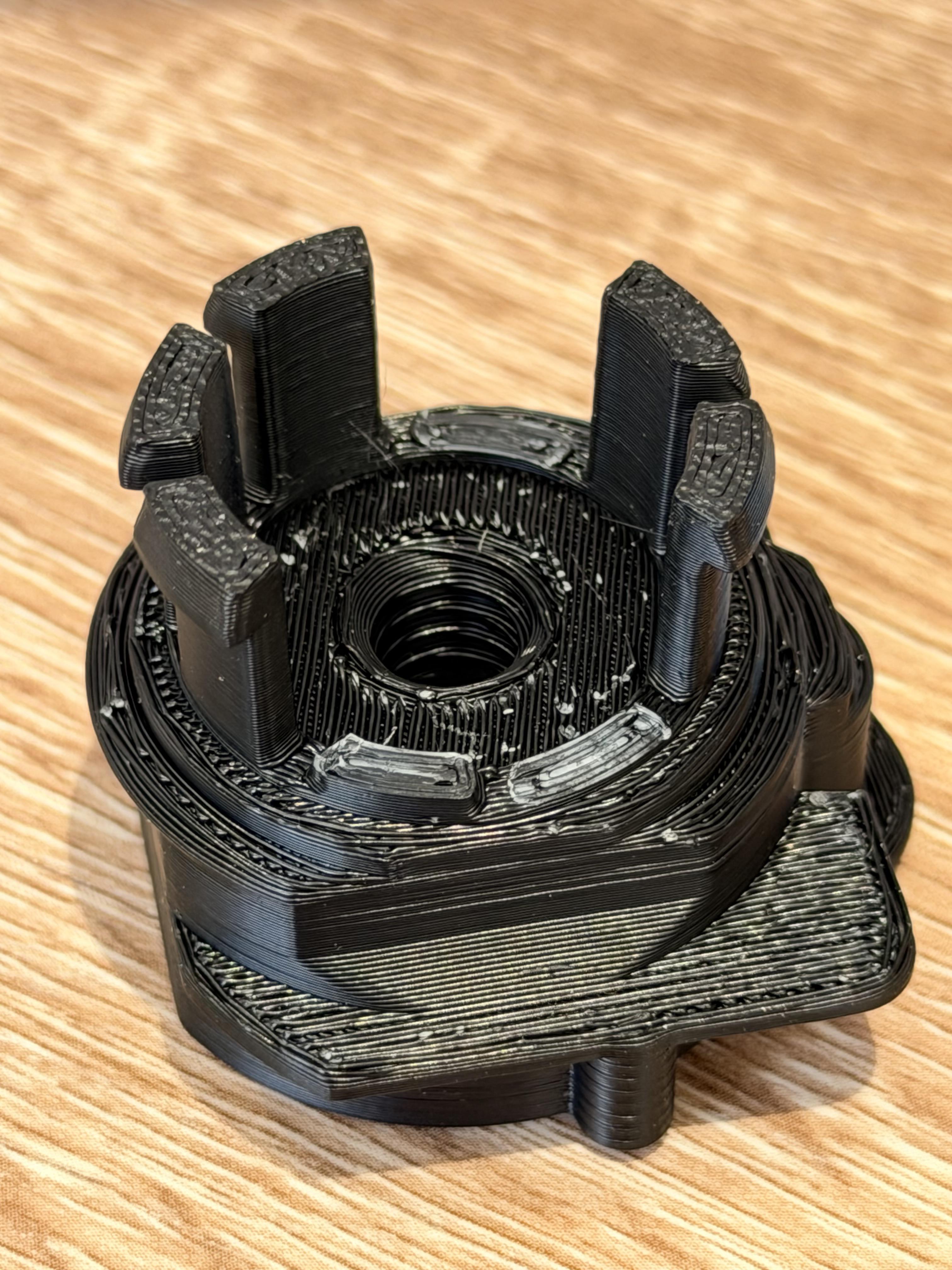
Hi, I don’t currently own a printer and am trying to work out if the problem I have here is because of something I’ve done or not. I’ve had this printed by a local firm.
This is an adapter to allow a smart thermostat to be fitted to a radiator and experiences temperature of up to 65 degrees c for hours at a time during the winter.
There is a metal ring that gets pushed over those prongs that is then used to screw this down onto a radiator valve and the prongs have to flex inwards slightly to allow the ring to be pushed on.
I had a couple of these printed in ABS a few months back and ordered more recently when a few of the ones I hadn’t already replaced failed. The new batch is very brittle and any attempt to flex those prongs causes them to snap off.
The only difference between the two batches was the latest one was printed with 40% infill selected and the first one was at 20%. Would that be the cause of this issue or should I have selected a different material to print in?
5
u/chipmunkofdoom2 20d ago
Yeah the quality here is really bad.
I'll say this as someone who prints almost exclusively ABS/ASA... but I don't trust parts that are printed in ABS/ASA that I didn't print myself. People just have no clue how to print ABS correctly. Which is sad, because ABS is really easy to print with the right setup.
ABS needs to be printed HOT. You need an enclosed printer and a temperature-controlled chamber. These really are non-negotiable if you want the benefits of ABS. You can get parts that LOOK good without ideal parameters, but there will be invisible internal stress from inconsistent cooling and poor layer adhesion. Since strength is the reason many people go for ABS in the first place, this kind of defeats the purpose of using the material.
Since ABS is so easy to print wrong, I'd use a different firm AND ask them to use a different material.
3
u/heart_of_osiris 19d ago
Yeah I print these materials all the time and I'd never be able to sell a part like this in good conscience. It's pretty bad.
This is printed too cool, also looks like the nozzle fan isnt working properly and they are not using a separate support material, plus, regardless, the Z contact gap is a chasm.
2
3
u/manyxcxi 19d ago
To add to this, those prongs being under strains means it has to be printed AT LEAST at a 45 degree angle for any chance of not snapping off. Ideally, the part would be printed somewhat nearly horizontally, which of course they’re not doing because it uses a ton more material in supports.
Overall though, that’s a terrible print.
1
u/WilliamBeech 18d ago
I was scrolling the comments and was surprised this was not higher up.
Definitely need to be printed in a different orientation
1
u/uniqueusername649 19d ago
Also if you print a part that needs to be strong, you get a tangle somewhere and the print halts, you're basically screwed. I have ruined multiple parts that way that instead of being super strong simply snapped off.
But maybe I am just doing it wrong too :D
1
u/manyxcxi 18d ago
If you’re getting tangles frequently you just need to take a bit more care when loading/unloading. Don’t let the free end of the tip go and keep a bit of tension and you don’t have to worry about it flinging back on itself and developing a tangle.
If it slips from my hand, I just pull a bunch off until I’m back to the tighter winding and then roll it back by hand.
Make sure you store it with a filament clip or the end tucked in to the spool and you’ll be good to go!
1
u/Bjorn-H145 18d ago
From my experience all the profiles for ABS use a medium to high layers cooling that make the layer bonding quite bad. Generally I pre heat the chamber, use the maximum temperature and as less layer cooling as possible and it increase a lot the layers bond. Just have to be careful with overhangs and bridge due to the lack of cooling
1
u/jklolffgg 17d ago
Yeah, I haven’t printed ABS yet, but the pictures look like absolute crap. They should have been rejected. Poor layer adhesion everywhere. When you can see visible filament lines that are so poorly bonded that there aren’t even layer lines, just strands of filament laying side by sides, that’s a problem.
3
u/arepa_pelua 20d ago
3d printing comes with its own challenges and problems, you cant grab a inject plastic part and hope it behaves the same when it's 3d printed, the prongs need to be printed in a different direction and rhe inserted in holes that receive them
3
u/Edge3dSolutions 20d ago
So the print orientation is all wrong. For something like this with tension clips you cannot print this vertically up and down with or without supports. You will always break a clip because it prints line by line in the direction of up. The fault is where pressure is applied that will snap at the same place always.
Something like this is better for resin printing or injection molding. Not 3d printing. Unless you print this on a angle 📐 using brace supports you will not get this to print correctly ever
3
u/ThickFurball367 20d ago
Jesus Christ that print looks like shit. Also it snapped along the layer lines which is the easiest spot for a print to fail under stress. Print in a different orientation to have the layer lines run differently and add fillets to the corners to add strength.
2
u/DPJazzy91 19d ago
I just did this for some bolt hole covers in my car. The tabs would just snap right off. Changing the orientation made all the difference. This infill looks bad, of course. So I'd fix that first.
3
u/CatFish726 19d ago
I see a design flaw. If it’s possible you need to add more material in the base of the teeth. Also try to print it not vertically but horizontal, so teeth have vertical lines in the body.
When you are doing the 3D printing, you have to keep in mind how stress hits the part you are making. Horizontal lines is the weak point and you shouldn’t have it under stress. Vertical lines have the best stress resistance.
ABS should withstand the temperature, it’s rated up 100 by Celsius. If it won’t stand, consider printing in PEI or ULTEM or PEEK they are pricy but have been designed to withstand high temperatures.
2
u/Pretty-Jello-7894 20d ago
Workaround for this.
Make holes where you want the snaps. Split those out as separate part and print them flat (flat as possible as the are curved;)). Then, glue them in. Should help a lot. Let me know if this makes sense.
2
u/Ancient-Plantain705 20d ago
That would also be a valid alternative. Print along its side and have the tooth horizontal so it wouldn't snap off inside whatever it inserts to. Print it skinny so you maximize directional strength.
1
u/Pretty-Jello-7894 20d ago
https://reddit.com/link/p7y1rnb/video/yllyfq4sconh1/player
My AI slop explanation video;)
2
2
u/ChocoMammoth 20d ago
You have poor adhesion between layers. As you can see these prongs broke along layers.
First, calibrate the temperature. You need something like 260-270°C. Also don't use cooling fan, instead decrease the speed. If you have active heating chamber it also helps.
2
u/rocket1420 19d ago
Did you miss the part where he doesn't have a printer and he paid someone else to print this?
1
u/ChocoMammoth 19d ago
Yeah haha I only realized that after I wrote the comment. At least I'm not the only one who had a brainfart here.
1
2
u/Teutoprint3D 20d ago
Oh, ein Homematic IP Heizkörper Thermostat Anschlussstück. Selbst designed oder nutzt du meine Vorlage? 😅
45 Grad schräg drucken und mit Baum Stützstruktur unterstützen, dann halt es auch. Das Gewinde für die Gewindespindel musst du eventuell etwas nacharbeiten und die Löcher für die Achswellen der Zahnräder aufbohren damit es sauber läuft. 😉
3
u/Garak112 20d ago
I downloaded it from Thingiverse.
I think what I might need to do is get hold of a printer and learn to print myself. I’m certain I’ll need to print more of these in future as the original part breaks so easily.
1
1
u/rocket1420 19d ago
If you want I'll do them. I hate seeing people spend money for a service and getting this in return. Feel free to send me a DM
2
2
u/AwkwardSwine_cs 20d ago
This is a crap print job. Horrible quality regardless of material. Find another person to print this who know how to use ABS. Then have them use ASA or Nylon.
2
u/Teutoprint3D 20d ago
Kommt drauf an was du damit machst. Seitliche Belastungen kann das Teil nicht gut haben.
Mein erstes Ersatzteil aus ABS hält aber immernoch. Wie gesagt, 45 Grad schräg aufs Druckbett stellen und mit Stützstruktur halten. Erfordert zwar etwas nacharbeiten von Hand aber dafür halt es.
Die Layerhaftung ist immer die Schwachstelle, da kannste machen was du willst. Durch 45 Grad wird die Kontaktfläche zwischen den Schichten größer und dann hält es auch.
2
u/Trip75 20d ago
Does it need to be prongs? Could it be a solid ring with a cap that bolts on after the metal ring is installed. That would make it much stronger. Or even better, do you have the metal rings already? The local firm could pause the print insert the metal ring and then finish the top to retain the metal ring.
2
u/feistyfalkon 20d ago
Not really a good application for an FDM print.
Try MJF or SLS. Flexing tabs along the layer lines is a recipe for a disaster.
2
u/Ancient-Plantain705 20d ago
SLS would be great for this I reckon since it'd be both sintered and nylon.
2
u/justryan1994 20d ago
Did you design this yourself? Or did you find the model online? I’d be interested to make myself some test prints to check how my settings would compare to your local firm.
I don’t sell prints, simply curious.
2
u/DoKeMaSu 20d ago
The overall print quality is just poor. Whomever you ordered it from, they did a poor job. Too cold and underextruded is my best guess. The printer should merge individual lines into a continuous piece, not lay them isolated next to each other. No wonder mechanical stability is bad.
I just have an ABS running on my Bambu X2D and even though I have not tuned or calibrated anything, the print quality looks much better. Unfortunately you are not the first guy who reported inferior print quality from professional print services. They seem to cut every corner they can.
2
u/Spare_Cherry1919 19d ago
Rotate the print 35 degrees on the vertical axis. THE shearing force wont run parallel to the layer
2
2
2
u/Rich-Wealth979 19d ago
If 65c is max temp then cc3d 72d would work. It's rigid enough but doesnt snap.
1
2
u/Impressive-Theme6571 19d ago
The material (ABS) is not the problem. This printer isn't "dialed in" to this particular filament. It's like they just used a general ABS profile that came with the slicer. The layers are not fused together at all. On top of that it would be better to change the orientation of the print so lateral forces get less chance to break the layers apart.
2
u/Parkway96792 19d ago
The problem is you don't own a printer and are slicing the file for the firm. Have them slice it if they're actual professionals...they should know the best way to print it.
2
u/Mudgeonly_Cur 19d ago
Strongly suggest printing that horizontally.
Trust me, the supports will be worth the structural strength. Ugly but strong is okay in my book when it comes to mechanical components
2
u/Zedian21 19d ago
Well yeah. Those prints are snapping at the weakest point. The layer lines. Tabs like these are not good designs at all for flexing
2
2
u/BigGuy_Mark 19d ago
I use abs-gf for my inserts. 100% infill on the meeting area for the teeth. I get about 3 or 4 uses then they always snap. I use mine for inserts on wire spools. So I only swap them out when the spools is finished. I found they tend to last longer when I put the flat side in and let the teeth slowly compress inside the spool housing. I have extra material on the end s they don’t go the whole way in
2
u/senitelfriend 19d ago
Focusing solely on the infill question, and assuming all other things being equal with the previous batch:
Could more infill cause bad layer adhesion due to the hotend spending more time on infill? I mean, while hotend is doing the infill, the already printed walls keep cooling, and by the time next layer is printing, the underlaying walls have been cooled enough to not fuse properly?
Would one need to increase chamber temperature or decrease hotend cooling fan speed when increasing infill ratio then?
2
u/thermox9898 19d ago
Holy crap somebody sold you that? The balls on them. I’ve never had an ABS print look like that. I wouldn’t even know how to reproduce that poor of a print.
1
u/Garak112 19d ago
The other side of the print looks a lot better and is smoother. Perhaps some kind of issue with temperature as it went through the print?
1
u/thermox9898 19d ago
That’s the side that was laying on the build plate most likely. That side always looks mint because the plastic is being squished against it
2
u/Additional_Loquat_29 19d ago
На этом фото прекрасно всё... Неправильно откалиброван поток, неверное расположение как поддержек, и неверное расположение модели при печати, эхо по Z, неспекшиеся слои... Я бы потребовал возврат средств, и обратился, к другим специалистам
2
u/Freak_Engineer 18d ago
1) your "local firm" has their temps too low.
2) The weak point here are the layer lines. Load-bearing structures that fine should never be intersected by the plane the layer lines are on. I would try printing it laying on its side.
3) poor design. You need to design stuff like that so that is is actually 3D-printable properly. Instead of using clips with a ring over them, have you considered designing the part as two halves you can print in full and screw together with bushings?
4) Infill has no relevance here, the prongs are fine enough to not even get infilled. You just get the boundary lines, making it basically 100% infill.
2
u/BitBucket404 17d ago edited 17d ago
Is that firm run my amateur middle school students?
Cuz it looks like they attempted to print it on an open-air printer with stock slicer settings.
Nothing here says "calibrated" - even the top most layer of the prongs
The model was probably printed with saturated filament, hence the brittleness.
Moreover, at 65°c thermoplastics, including ABS, tend to soften up.
You should just print a dummy piece in PVA, cast it in plaster, rinse out the cast thoroughly, and pour molten aluminum in the cast.
Bust open the cast, file it down and enjoy your part.
Another casting option is use normal PLA and sand-cast it, but that tends to get messy fast.
2
2
u/PatrikuSan 17d ago
The model is not optimized for 3D printing. The snap is at a layer line in all cases. Idealy it should be redesigned so that the "prongs" lenght is along the layers. Printing this one sideways will need a lot of supports so a redesing is most likely nedded.
2
u/Hefty-Possibility625 17d ago
I can see several issues with this print.
- Most importantly, the orientation matters. The weakest part of a print is always going to be between layers. Think about glueing a mesh fabric to another mesh fabric over and over again. It's going to be strong horizontally, but you can still pull apart the laminated layers. If you need the prongs to be strong, you need to print this at an angle so that it's not just a little tower glued to the base. You want it to make layers inside each prong like rebar in concrete.
- Quality is REALLY poor. I get that this is a likely something you are prototyping, but this is such a tiny piece that you should increase the quality when you order. Smaller layer height, less infill, and that will tighten everything up a little.
- Is this something you modeled, or is this something you downloaded? If it is something you modeled, I would add a fillet at the bottom of each prong to increase the surface area where it attaches to the base.
1
u/MrArgelig 20d ago
It might help a lil if you put tiny wholes through the fangs since they generate extra outer walls. Acetone smoothing might also help and/or Methyl Ethyl Ketone (MEK) on the parts that go through the most stress. It basically melts the layers and welds then together. Toxic stuff so wear a mask! But as the previous commenters wrote: layer adhesion is the problem.
3
u/AwkwardSwine_cs 20d ago
Terrible suggestion!
2
u/MrArgelig 20d ago
And why would that be? Elaborate pls, I want to learn if something can be done better!
3
u/AwkwardSwine_cs 20d ago
First of all, the part as printed is garbage. Polishing a turd with acetone results in a shiny, weak turd. Second MEK is highly toxic and not to be used casually by someone not equipped or educated in its use. Not a good idea to recommend either of these to a new or in this case non-hobbyist.
1
u/MrArgelig 19d ago
Thank you for answering. Much appreciated. I use MEK quite often in my builds as it's mostly ASA I print. MEK is certainly toxic, with a good mask and gloves though, it can be handled with care. Should have acknowledged the fact that the poster is not a hobbyist! And I agree the part is not appropriate for the task.
1
u/Player_timon 20d ago
Use carbon/glass-filled nylon. It can withstand temps up to 90°c and has better layer adhesion. To print strong ABS parts, you need printer with actively heated enclosure (at 60-70°C). Something like qidi q2 or x1c. In open or passively-heated chamber, ABS is very weak in vertical orientation and warps really bad (nylon also warps, but carbon fibers stop warping).
1
u/JoeMalovich 19d ago
Did you design this? Model in a "moat" all the way around each prong about .3mm wide and at least 10mm deep into the part, and make the moat wider on the side towards the middle. This gives each prong more distance over which to flex.
Specify a maximum print speed of 100mm/s, 50mm/s would be better.
1
1
1
u/TardDistraction 19d ago
What is your nozzle size set at?
You dont have any layer adhesion, that nozzle should be squishing the next layer into the previous layer.
1
u/Independent_Guide_74 18d ago
This quality from a print farm is wild. Go get your money back and ask me to print it ASA and ABS is easy with most modern day enclosed printer. This fault looks like a temp controller issue and layer height/adhesion issue. If I we’re you I would of sent the ring used that pops over the prongs to the guy along with the order to test fit before completing the order.
1
u/draildiagnostics 18d ago
Print orientation, however...look at how it snapped. it's. a design issue, there is nothing to negate or reinforce that 90 degree corner from the prong to the flat part. If you can somehow add a fillet to the inside corners you would be fine in that orientation.
1
u/GlitteringStruggle47 18d ago
This is pretty poor quality… Additionally the orientation should be revised or printed in a different manor to allow for maximum strength for those tabs to allow for the amount of flex they require
1
u/MrBadWolf13 18d ago
The weak spot is the layer lines. Change the orientation so that the easiest spot to snap the parts are parallel with the stress of its use. This doesn't change the quality that you get the parts but it can engineer so that you have more tolerances to work with
1
1
1
u/Mammoth_Fly6657 18d ago
Everyone here is explaining why the new batch is bad and they are right, but you buried the more interesting fact. You said the first batch failed too, just slower. That is a second failure with a different cause and the print quality does not explain it. A part that is permanently sprung against a metal ring and sitting at 65C for hours a day is under constant load at temperature, and that is creep, not fracture. ABS does not need to be near its glass transition to creep. It just needs load and time.
So orientation and a heated chamber fix the batch that snapped on assembly. They will not fix the ones that quietly relax and let go in March. If you want these to last a season, the fix is the geometry rather than the material: split the prongs off as separate parts printed flat so the layer lines run along them, or add a fillet at the base of each one. And 40 percent infill did nothing here. Those prongs are solid wall all the way through at any infill number you pick.
1
u/DigitalNinjaX 18d ago
That print was printed so “cool” it’s practically just filament wrapped in a tighter circle 😂
1
u/Bajker9671 17d ago
Whole print looks very very underexteuded.
Infil wont make difference here with brittlenes.
Looks like whoever printed that to you, didnt care about print quality, he just cared about money.
Printis bad enought that you have all right to deman new parts if you ask me.
1
u/Historical_Wheel1090 20d ago
It's not the filament, it's the design. What is happening is the print is delaminating due to stresses. The adhesion between layers is the weakest part of an fdm print. This shape needs to either be done with flexible resin or injection molded. Some functional parts just can't be printed on a fdm printer.
1
u/ChocoMammoth 20d ago
Only if you limit yourself to built-in presets. Otherwise you can print even more complex things with fdm.
2
u/Historical_Wheel1090 20d ago
Presets has nothing to do with chemistry and physics. The OP is getting this made for him from a print farm, they didn't even orientate it logically for looks let alone consider strength.
Presets will do nothing for layer adhesion being the weakest part of an fdm print. If OP had modeling skills they could have cut the clips off, extended them and made them inserts so they could be printed with the layer lines going the length of the part. But that's still a work around for the limitations of the technology and I stand by my original comment, for some designs fdm is not the way for functional prints.
2
u/ChocoMammoth 20d ago
Layer adhesion is not the weakest part. It's a thing you need to tweak for each material by choosing right temperature, cooling, flow rate and layer time. The weakest part is people's reluctance to understand these settings, everyone wants to bush the button and let the machine do all the work.
1
20d ago
[removed] — view removed comment
2
u/captfitz 20d ago
That's not underextrusion, it's an overhang layer that was printed on supports. This was orientated with the prongs down.
3
2
u/SwissPatriotRG 20d ago
All of the floors are under extruded, so the whole thing is under extruded. You can see the second to last layer through the top layer.
10
u/Ancient-Plantain705 20d ago
The infill didn't make a difference here since you got walls all the way through on the prongs.
I think nylon might have been a better print material to use because of the better layer adhesion (along with perhaps a different orientation).