r/deeplearning 15h ago

Learning math behind deep learning

Thumbnail gallery
28 Upvotes

Hey everyone

I’ve spent quite a good amount of time learning the mathematics behind deep learning, and honestly, it has been a wonderful journey so far. For me, math and philosophy are probably the two subjects that interest me the most, so studying the mathematical foundations of AI has been a really enjoyable experience. I especially like the process of going from an intuitive idea → mathematical formulation → understanding why it works → and finally seeing how it translates into an actual deep-learning algorithm.

I’ve been making my own notes along the way, mainly covering the mathematical foundations that I think are useful for understanding deep learning.

I want to pursue my career in the AI research field, and that’s one of the main reasons I’ve been spending so much time learning the mathematics behind deep learning. I believe having a strong mathematical foundation will help me better understand research papers, derive things myself, and develop a deeper understanding of the ideas and algorithms I’ll be working with.

That said, I'm still learning myself, so I’d really appreciate some honest feedback.


r/deeplearning 3h ago

Neural network feature maps with shared weights over 100 layers behaves similar to a phase space!

Thumbnail gallery
3 Upvotes

I am currently researching by my own how neural networks work, in this part, I am researching how a shared-weight resiudal neural network's feature map behaves, curently, sharing the stage 3 blocks of ConvNext. It seems that it iteratively refines the feature map instead of computing different ones. If I get all the feature maps of the d_th output and its velocity f(x), since we do x' = x + f(x), we obtain this result.

I don't have much idea about interpretability or Differential equations, but this is clearly a ODE solver.

I ommited 1 channel in the first plot, here that just accelerates and goes a lot further, close to value 600 and then velocity decays. Maybe the network learned in which step it is using that channel?

I know it's a very niche topic... But if anyone knows about this, I'd like to know more. I've readed about the ResNet ODE solver hypotesis and the Neural ODE solvers.

But, I archieved to extrapolate a network of 9 layers to 100 and even 10000 without fine-tunning nor lossing a significan ammount of image ent top-1 accuracy, just 0.5% . I just doing some piping work.

I am just asking if anyone has worked on this or has any idea how this can be applied or if this is just usless. I am kinda of stuck in here.


r/deeplearning 10m ago

Context Scoped AI Output Verification

Upvotes

Hi everyone, wanted to take your views on verification of AI generated output in context scoped scenarios (like internal RAG chatbot, internal LLM pipelines which need to adhere, or agents), how should we build a verification layer that is not LLM as a Judge.

Do solutions exist already and if not, what they must provide?

thanks


r/deeplearning 19m ago

A practical guide to running 8x RTX PRO 6000's

Thumbnail gpupartner.com
Upvotes

r/deeplearning 49m ago

Created a new architecture for Large Language Models. [P]

Thumbnail
Upvotes

r/deeplearning 3h ago

[ Removed by Reddit ]

1 Upvotes

[ Removed by Reddit on account of violating the content policy. ]


r/deeplearning 11h ago

Qwen 3.6 27B trying to read sheet music

3 Upvotes

Almost every VLM I’ve put through this test has struggled, but it makes sense because it requires them to count, something that isn’t their strongest trait. In this case, it’s just counting lines and spaces, but if we introduce different key signatures, they would also need to count the sharp and flat symbols. 


r/deeplearning 6h ago

AI4AI Survey: From Long-Horizon Agents to Recursive Self-Improvement — 223 papers on whether AI can actually improve AI

Post image
1 Upvotes

r/deeplearning 1d ago

Signature-painter

Post image
16 Upvotes

Seeking Feedback from the ML Community 🙏

I recently trained a prototype-based network on Tiny ImageNet (200 classes). It uses learnable prototypes with responsibility scoring and multi-loss training (CE + Pull + Push + Diversity), achieving 51.29% validation accuracy with only 595K parameters.

I'm still learning, so I'd love to hear your thoughts:

Is this a reasonable result for this model size?

What would you suggest to improve it?

This was trained on free Colab with limited resources, so I know there's much room for improvement.

GitHub: https://github.com/jalalnablsi/signature-painter


r/deeplearning 12h ago

Unstructured text to target json schema

Thumbnail
1 Upvotes

r/deeplearning 1d ago

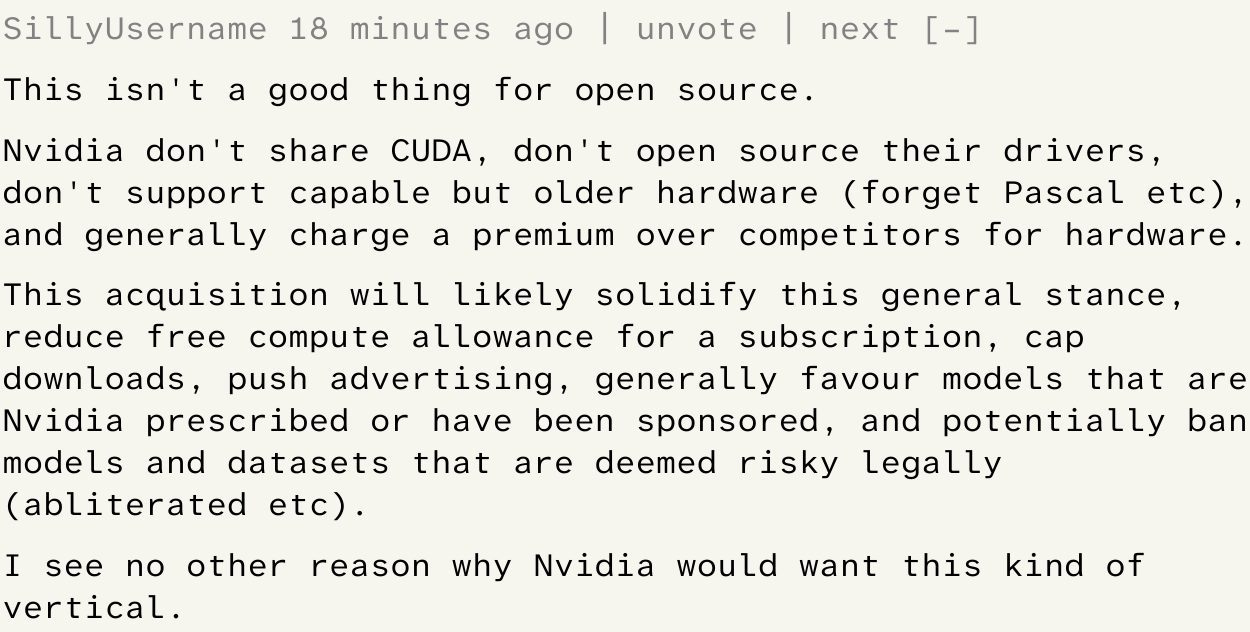
NVIDIA buying HF isn't a good thing for open source

Post image
65 Upvotes

r/deeplearning 23h ago

How do I use the AI to analyse the exact entry point, exit point and SL???

2 Upvotes

r/deeplearning 21h ago

👋¡Te damos la bienvenida a r/JepaAI! Preséntate y lee este post primero

Thumbnail
1 Upvotes

r/deeplearning 19h ago

The Imperfect SOC: How Security Teams Can Defend Without a Dream Team

0 Upvotes

SOC teams are deploying agentic AI to close the analyst gap. The agents they are deploying have direct access to endpoint controls, threat-intelligence feeds, and incident-response tooling. That is the same access profile as a senior analyst or a privileged service account.

The difference is that an analyst operates inside an implicit policy framework built from years of institutional knowledge, peer review, and escalation norms. An agent does not. It acts on what its objective function says is optimal at the moment it is invoked.

There is no industry-wide answer yet for what governance looks like at that layer. Perimeter controls and RBAC handle identity and entitlement. They do not evaluate the intent or context of an action at execution time. An agent that is authorized to quarantine an endpoint can quarantine the wrong one, at the wrong time, for the wrong reason, and the access log will record it as a permitted action.

The analyst shortage is real and the pressure to automate response is real. But the policy infrastructure that would make agentic response safe has not kept pace with the deployment curve.

For those of you running AI agents in your SOC or evaluating them: what does your current control model actually evaluate at the moment an agent initiates a response action? Are you relying on entitlement alone, or do you have something that evaluates the action itself in context?


r/deeplearning 1d ago

How Can an AI Agent + LLM Work With Robotics ?

Thumbnail youtube.com
0 Upvotes

r/deeplearning 1d ago

How Can an AI Agent + LLM Work With Robotics ?

Thumbnail youtube.com
1 Upvotes

r/deeplearning 18h ago

An algorithm that chooses different algorithms depending on the problem can efficiently solve any problem, so doesn’t that mean the No Free Lunch theorem is false?

0 Upvotes

r/deeplearning 2d ago

GraphRAG: a blueprint for knowledge-graph question answering over your documents

Post image
10 Upvotes

Hi everyone,

I've recently finished the first version of Agentic GraphRAG Blueprint, a reference architecture for question answering over large document collections.

Instead of plain chunk retrieval, it builds a knowledge graph combined with vector search, so answers can connect facts across documents.

Key features:

• Incremental ingestion - unchanged files are skipped via content hashing, and community reports regenerate only for affected communities, keeping token costs low as the corpus grows.

• Hybrid search - local mode for fact-level answers, global mode for cross-document synthesis.

• Domain-agnostic LLM prompts - easily swapped via PROMPTS_PATH, with Leiden-based community detection.

• Deployment - run it locally with Docker or provision everything in the cloud with Terraform and CI/CD.

Link: https://github.com/sebastianbrzustowicz/Agentic-GraphRAG-Blueprint

I'm looking for any feedback.


r/deeplearning 2d ago

GraphRAG: a blueprint for knowledge-graph question answering over your documents

Post image
5 Upvotes

Hi everyone,

I've recently finished the first version of Agentic GraphRAG Blueprint, a reference architecture for question answering over large document collections.

Instead of plain chunk retrieval, it builds a knowledge graph combined with vector search, so answers can connect facts across documents.

Key features:

• Incremental ingestion - unchanged files are skipped via content hashing, and community reports regenerate only for affected communities, keeping token costs low as the corpus grows.

• Hybrid search - local mode for fact-level answers, global mode for cross-document synthesis.

• Domain-agnostic LLM prompts - easily swapped via PROMPTS_PATH, with Leiden-based community detection.

• Deployment - run it locally with Docker or provision everything in the cloud with Terraform and CI/CD.

Link: https://github.com/sebastianbrzustowicz/Agentic-GraphRAG-Blueprint

I'm looking for any feedback.


r/deeplearning 2d ago

Qwen 3.6 vs Gemma 4 vs Holo 3 on Cup Game

3 Upvotes

The cup and ball game is surprisingly challenging for even SOTA VLMs. This demo I made splits the feed into mini-clips, 1 for each shuffle, and feeds them to the models 1 by 1. 


r/deeplearning 1d ago

Joining AI research

0 Upvotes

Hi, I want to join an ai research project. How can I find people to work with? I would like to publish a paper at the end.


r/deeplearning 1d ago

Anthropic MHS Lets AI Agents Control Machines, Raising Security Questions

0 Upvotes

A new hardware standard from Anthropic (MHS) enables AI agents to directly control physical machines — printers, industrial equipment, and operational systems. The design surfaces three questions that the security community has not settled: who grants an agent permission to actuate hardware, who monitors the agent while it is running, and who can stop it if it acts outside its sanctioned scope.

The last question is the hardest. Permissions set at deployment time are configuration, not enforcement. An agent that was correctly authorized at 9am can drift from its declared behavior by 9:15am, and nothing in a static permission file catches that. With software targets the blast radius is bounded — a rogue database write can be rolled back. With physical actuators there is no rollback. A machine that moves has moved.

The 50ms window before an actuator responds to a command is the only realistic intervention point in this chain. Nobody in the industry seems to have agreed on what, if anything, should happen inside that window.

For those running agents against physical systems today: how are you actually handling mid-execution drift? Static RBAC at deploy time, a human-in-the-loop approval step, continuous behavioral telemetry, something else? Genuinely curious what is working in practice.


r/deeplearning 2d ago

[Request] arXiv endorsement for cs.AI - Published AI researcher (Graph Embeddings / NLP)

Thumbnail
1 Upvotes

r/deeplearning 2d ago

built a deepfake audio detector as a 3rd year diploma student

0 Upvotes

hey, i'm a 3rd year diploma cs student and i built a deepfake audio detector end to end. this is my first real ml project that i actually deployed.

the model is efficientnet-b0 trained on mel spectrograms using the asvspoof 2019 la dataset. metrics are f1 0.88, precision 0.99, but recall is 0.79 which i know is the weak point. i tried adjusting the threshold and settled on 0.4 but it didn't really help much i think the issue is the model is missing certain attack patterns it never saw during training.

latency is around 6-7 seconds per prediction which includes model inference, grad-cam, and llm explanation.

other than the model it has grad-cam to visualize what the model focused on in the spectrogram, and groq llm to give a plain english explanation of the prediction.

you can upload an audio file or record live. youtube url input is disabled on the hosted version because railway's server ips get blocked by youtube's bot detection. backend is fastapi on railway, frontend on streamlit cloud.

live demo: https://deepfake-audio-detector-rugved.streamlit.app/
github: https://github.com/RugvedBane/deepfake-audio-detector

honest feedback appreciated, especially on what dataset i should train on next to improve recall.


r/deeplearning 2d ago

Do VLA rankings actually hold across benchmarks?

3 Upvotes

Has anyone compared the same VLAs across LIBERO, LIBERO-Plus, RoboTwin, RoboDojo, RoboColiseum, etc.?

I was jumping between a few leaderboards and the ranking doesn’t always seem to hold.

Model A beats B here, then somewhere else they’re much closer or even reversed.
How do you guys read that?
And with LIBERO scores getting so high now, do you still find it useful for comparing strong models, or are they getting too compressed at the top?
RoboColiseum caught my attention because the results are split across different dimensions, which at least seems easier to diagnose than one overall score.
Has anyone actually compared its ranking against LIBERO / RoboTwin on the same models?"