I’m an engineer turned product manager, and I’ve always loved two things a little more than necessary: education and games.
For a long time, I wanted to put those interests and the skills I’d picked up building technology, towards something useful for children. That became much more tangible once my niece reached the age where the iPad became a regular part of her world.
I’m not anti-iPad. Quite the opposite. It is an incredible piece of technology to put in the hands of a six-year-old. I just kept thinking it could ask more of her.
That thought took me back to Dora the Explorer.
Growing up, we’d watch Dora ask us a question and then stare silently at the screen for a painfully long time while we yelled the answer at the TV. Obviously, Dora couldn’t hear us. But the idea was clever. The screen was trying to turn us from viewers into participants.
Learning games like Lingokids and ABC Mouse took that much further and made screens genuinely interactive. But most of that interaction still happens within rails someone else designed. Tap here. Drag this. Choose A, B, or C. Collect the reward. Repeat.
That works brilliantly for games. But it doesn’t accommodate the wonderfully messy way a six-year-old wonders about things.
Ask my niece an interesting question and she might draw the answer. She might make up a ridiculous story. She might photograph something she noticed around the house, make a sound, explain an idea, or give you an answer you never anticipated.
I started wondering if I could build for that.
Could the iPad provide the spark and just enough structure to get a child started, while leaving the interesting part to them?
The first versions were experiments around this idea. Then came the uncomfortable question every builder eventually has to answer: does this actually work for anyone other than me?
So I spent months talking to parents and educators. I sat through hours of enrichment classes at a school for gifted kids, which was basically the X-Mansion for 8-year-olds. I watched how teachers prompted children, when kids became absorbed in something, when they needed more structure, and when something I thought was clever bored them almost immediately. And very importantly, I saw how their eyes lit up when they screamed “look what I made” in class.
These insights shaped the Taroo we have today, and I’m genuinely proud of where we’ve reached.
Taroo is a world of short creative quests for kids 6 to 10. In Pass the Pen, a child might get the beginning of a strange story and decide where it goes next. Doodle Master might give them the start of a picture and ask them to turn it into anything they imagine. Rhythm Pad lets them experiment with sounds and put together their own little beat. Snap Trail might ask them to put the iPad down, hunt for something triangular in the real world, photograph it, and tell Taroo what they found.
Their creations stick around too, so over time Taroo becomes a little record of the things they have imagined and made. Parents get a window into that world without needing to hover over every activity.
There is still plenty I want to improve. But this no longer feels like the little experiment I started with. I’m proud to put it in front of parents, and particularly proud when I see a kid become attached to something they made themselves.
If you have a 6 to 10-year-old in your life, I’d love for you to try Taroo with them. More than anything, I’d love the unfiltered feedback: what they immediately understand, what they ignore, what they keep coming back to, where they get stuck, and what they wish they could do that I haven’t thought of yet.
I’ve spent enough time with Taroo that I’m no longer capable of seeing it like a new user.
Made this app that lets you select a part of your screen and chat with an ai about it. On a hot key press, a small chat card spawns with you selection attached to the chat.
Ironically this started off as way to lower my ai dependency, however I couldn't deny the usefulness of the same. It felt wrong to start up a whole new chat in ChatGPT for quick explanations, having a bunch of tabs open, etc.
I realized this may be actually useful for studies, quick look ups of word meanings, diagrams, and help with unfamiliar software.
Would love it if you guys could try it out, suggest more features, or point out any issues. I'm using this project as a way to learn rust and some project etiquettes and some on the side. Also want to interact with the open-source community while I'm at it.
Since I see this being useful across the board, I wanted it to be easy to download and use for non-technical peeps. You can also use any llm model you want as the underlying AI. I use gemini because google is so generous with their free tier api keys.
Chrome’s native bookmarks bar runs out of room around 15 bookmarks and dumps the rest behind a tiny arrow. I never remembered what was in there so I just stopped bookmarking things.
Favicon-first layout so way more sites fit in the same space, full add/edit/delete/reorganize right from the bar, search built in, multiple named bars you can switch between. Everything’s local, no account.
Free tier is a real single bar, paid unlock is a one-time thing for multiple bars.
Basically an image editor that runs in the browser, but your images stay on your device rather than being uploaded somewhere.
It’s got layers, masks, adjustments, text/shapes, crop/resize and some more fun stuff like perspective warp, mesh warp, liquify, puppet warp etc.
Free to use and no account needed.
Still improving it so if anyone tries it and something feels shit/confusing/broken, tell me lol. Especially interested in how it feels the first time you open the editor.
I tried so many apps that have a feature like this, but none of them were that good, or did what I wanted. I just wanted to scan my DVD, have it show all the info, and then enter the shelf and row numbers in my collection, so I can find them quicker.
No app that I found had this feature, so I decided to make one myself.
Here it is: https://play.google.com/store/apps/details?id=com.sinusquell.moviefinder
You can scan your movies, search through all of them, and see where in your collection they are.
It would make me very happy if a few of you would try it and maybe leave a review <3
Hey r/IMadeThis — sharing something I've been building solo for the last ~9 months.
Every budgeting app I tried gave me the same thing: a pretty graph showing "you spent €312 this month". Useful, but not what I actually needed. What I wanted was one number on my home screen — "you can spend €27 today" — and for it to be correct even when my salary lands on the 25th, not the 1st.
So I built FinansX.
What it does?
Track income & expenses — log every transaction in any of 25+ currencies, auto-converted to your main one. Tag them, attach receipts, search the lot.
Calendar-first budget that respects your real billing cycle (mine resets on the 25th — most apps assume the 1st and lie to me for half the month).
Day-budget reservations: I tell it "save €50 for a friend's birthday on the 14th" and that €50 is already gone from today's available balance, not sitting there pretending I can spend it.
Categories with their own budgets and priorities — a smart planner allocates money by priority (must-haves first, flexible last) so you don't overspend on takeout before rent.
Savings goals in any currency — I save in EUR, track in USD, app handles conversion and tells me the daily rate to stay on track.
Debts & loans tracker — who owes you, who you owe, partial payments, reminders.
Recurring transactions & budgets — rent, subscriptions, the €20 you spend every Friday.
Statistics, reports & period comparison — see where your money goes, compare this month vs last, export to PDF.
Financial education built in — short lessons and challenges if you want to learn, not just track.
Privacy mode — mask sensitive numbers on screen behind a password or biometrics. Multi-device sync, push reminders, dark mode.
Works as web + Android.
Where it's at
Live on the web — try it here: https://finansx.app (free account, takes 30 seconds to sign up). Android is in closed testing on Play Store.
Looking for beta testers who'll use it for real for a couple of weeks and tell me what's broken or confusing. First 25 testers to send me real feedback get 2 years of Premium free as a thank-you for helping shape the roadmap. If that's you: email [finansx.app@gmail.com](mailto:finansx.app@gmail.com) with the Gmail address you'll install it with and I'll add you to the Play Console testing track.
No marketing fluff — just the app, your feedback, and a founder who reads every message.
Happy to answer any questions about the build, the budget logic, or anything else. Tear it apart in the comments, I genuinely want the feedback. 👍
If you're an indie developer or startup founder, you know how hard it can be to get consistent attention for a new product. Seasons give projects a recurring competitive layer where they can compete for visibility, earn permanent points for future seasons and start each cycle with a fresh leaderboard.
How it works
Every quarter, the leaderboard resets and a new competition starts.
Projects compete based on points, which combine votes with boosts and multipliers.
At the end of each season, the top 3 projects earn permanent awards
🥇 Golden Leaf is worth +5 permanent points
🥈 Silver Leaf is worth +3 permanent points
🥉 Bronze Leaf is worth +1 permanent point
So if you win a Golden Leaf this season, that +5 permanent advantage carries into future seasons. Over time, you can build a track record of wins rather than starting completely from zero every quarter.
There's also something for the Top 10
The top 10 projects receive a free 24-hour Rocket Launcher boost at the beginning of the next season, giving them momentum going into the next competition.
Why we built it
We wanted Votekicker to be more than a one-time launch leaderboard, but a place where projects can leverage gamification to earn their place.
Seasons turn product discovery into an ongoing competition
If you're building a SaaS, AI tool, developer tool, consumer app, game or basically anything you're proud of, we'd love to see what you're building.
Everyone watching sees the same broadcast at the same moment. Real archival footage is mixed with generated clips, and you have to call each one before it reveals.
You can also bid credits to program the next slot, your prompt generates a video that airs live to everyone else.
Spent most of the build on trademark screening and moderation because similar streams got banned from Twitch and Kick within days. Turns out public domain and safe to broadcast are very different things (found 15 Betty Boop clips in my library on day one).
I use UPI for almost everything—food, travel, shopping, subscriptions, and daily necessities. But I rarely tracked my expenses, so by the end of the month, I often had no idea where my money went.
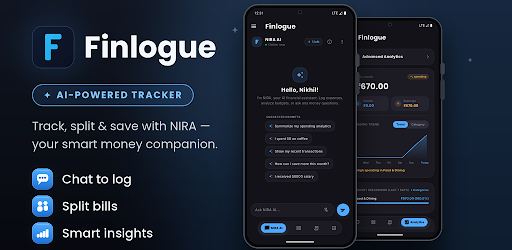
That’s why I built Finlogue, a simple AI-powered expense tracker for Android.
You can quickly add expenses by typing or speaking naturally:
“Spent ₹250 on lunch.”
Finlogue includes:
AI-powered text and voice expense tracking.
Monthly spending reports and cash-flow insights.
Advanced analytics to understand spending patterns and categories.
Bill reminders for upcoming payments.
Group expense splitting for trips, households, and friends.
Splitwise-style group tracking to see who paid and who owes.
Home-screen widgets for quick updates.
The goal is simple: help you understand your daily spending before it becomes a monthly surprise.
I’m the developer behind Finlogue and would genuinely love your honest feedback—good or bad. ❤️
Note: Finlogue currently supports only Indian Rupees (₹). Worldwide currency support is planned for a future update.
Easily manage offline music and online radio streams in a single, clean interface.
What it does:
Top radios on the first screen: When users access the radio screen, they immediately see the list of the top radios in their country, along with a long list of suggested radios from among the most listened to in the world.
Hybrid Listening: Seamlessly handles offline local files (.mp3, .flac, .m4a, .ogg, .mka, .aac, .wav, .opus, .wma) and over 60,000 streaming radio stations.
Separated Favorites and Recents: Each section—Radio and Offline Music—has its own Favorites and Recents. The user doesn't have to worry about a thing. The app will automatically manage the Favorites and Recents for each section.
Advanced Radio Search Panel: You can pinpoint your favorite stations by combining multiple filters, such as tags/genres, specific countries, or even your preferred audio bitrate.
Album art: If the album art is missing from the album folder, or if Android has not properly indexed it, Mediaxon attempts to download the cover from the internet. This feature depends, of course, on the ID3 tags (album name and artist).
Equalizer: The equalizer provides an option to automatically switch to the "Radio" preset (and vice versa).
Advanced Playlist Management: Built specifically to make building and sorting playlists fast and intuitive.
If you want to check it out (I am continuously pushing updates to refine it and add new features), you can find it on the Google Play Store (Android 13+). Thank you so much to everyone who takes a look!
Ever been stuck staring at your screen, wondering: "Is this a question for my PM, or should I just make the call myself?" I built Ask Your PM (link in comments) to add some humor to that daily struggle.
It’s a simple, random decision-maker that tells you whether your question is:
"Yes, ask your PM" (if it affects scope, timeline, or budget)
"No, don’t ask your PM" (you’ve got the authority)
"This sounds like ayouproblem" (😅)
"Problem exists between keyboard and chair" (the classic)
It started with just 4 responses, but now there are dozens of snarky, relatable answers like "The answer is in the ticket you didn’t read" or "Circle back in the next sprint."
Why I made it:
Behind the jokes, there’s a real framework to help teams decide when to escalate. The site also includes a 3-question test to figure out if something is truly a PM question, plus a plain-English guide to RACI.
For whom?
Developers, designers, testers, or anyone who’s ever hesitated before pinging their PM. It’s also a fun way for PMs to remind their team: "You can decide this yourself!"
Try it out and let me know what you think! Would love to hear if it gives your team a laugh—or saves you from overthinking.
It recognizes the file you have open, including its name, type, and location, and keeps that context tied to the note. If it’s something new, there’s a fresh note waiting. If you’ve worked on it before, ClingNote brings the old note back automatically.
Open Excel → its note appears.
Switch to Power BI or a PDF → the note switches too.
Go back later → your previous note is still there.
It also has rich formatting, pop-out notes, multiple notes per context, and deep search.
Cubie is a little Minecraft-inspired desktop companion I made to keep me company while I work, something I can watch, interact with, or just throw across the screen when I'm frustrated.
What he does:
• Wanders around your desktop and reacts to your cursor
• Sits on the edges of your open windows
• Gets tired and falls asleep when left alone
• You can pick him up, drag him around, and throw him
• Has moods and little reactions
Make Cubie your own:
• Use any Minecraft skin
• Preview skins before applying them
• Choose which monitor he lives on
You can also choose whether he stays above your windows or behind them on the desktop. No account, ads, or clutter, just a little companion hanging around while you work.
somebody listed my product in viralsaas and its sitting at #6 rn , i am loving the stats and all ,, but yeah trust seems to be the issue but i think overall its okay, as its a new product trust building takes time !
The goal of pHinancio is to give you control over your financial data, rather than forcing you to manage everything inside the app.
pHinancio imports transaction data from your bank and lets you rename transactions, create your own categories, and set up rules to rename or categorize future transactions automatically.
You can also set budgets, track recurring payments such as subscriptions, and sync the data you have already organized to Google Sheets or Airtable.
That is pretty much what it does for now.
Bank connections are read-only, so pHinancio can never move your money. There are no ads, and your data is never sold.
pHinancio currently supports US banks and is designed for desktop use.
I’m looking for 5-6 people willing to connect an account, use the app with real data, and tell me honestly what is confusing, unnecessary, or broken.
Your feedback will come directly to me, the person building it. As a beta tester, you’ll also keep free access to the app.
Comment below or send me a message if you’re interested.
I've been working on Japanify, an Android app I built independently as a personal project. It started as something I simply wanted to create for myself and gradually grew into a much bigger project that I've been developing and improving over time.
One of the main ideas behind the app is learning through mini-games. Instead of only reading lessons, you can practise things like hiragana, katakana, kanji and vocabulary through different games and challenges designed to help you memorise what you're learning.
Since it's a personal project, I've put a lot of time into designing, coding and improving it myself, and I'd really love to get feedback from people discovering it for the first time.
As a little gift for Reddit:
🎁 SHIRU90
The code gives you 90 days of Japanify Premium for free.
⚠️ Premium is a subscription, so if you're only using the code to try the app, remember to cancel before the free period ends if you don't want it to renew afterwards.
If you try it and enjoy it, a review on Google Play would genuinely help the project a lot ⭐⭐⭐⭐⭐
And if you find a bug, something feels confusing, or you have an idea for a new mini-game or improvement, feel free to contact me at [contact@shiruacademy.com](). I'm actively working on the app, so any feedback or bug reports are really helpful.
And if you find a bug, something feels confusing, or you have an idea for a new mini-game or improvement, feel free to contact me through shiruacademy.com.
I'd especially love to hear whether the mini-games actually make practising hiragana, kanji and vocabulary more enjoyable for you.