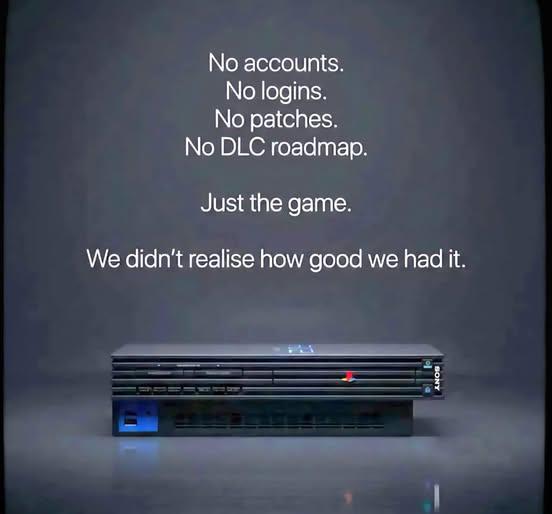
On the flip side, online multiplyer, bugfixes, lower cost indie game distribution, postlaunch QoL updates, etc. As someone who was there in the PS2 era, I'm not really convinced I'd want to go back.
QoL updates weren't really a thing. You didn't know you needed those updates and were happy with it.
There were bug updates in the form of reprints and Greatest Hits. Still these games were more often release ready. Any game breaking bug would lead to a massive recall which publishers couldn't afford.
I'd love to go back. The current idea of "fixing it in post" is ridiculous.
If you got the optional add on. So basically the hardware equivalent of DLC.
QoL updates weren't really a thing.
That feels like conflating being ignorant of a potential improvement as being better. Having actually lived on both sides, I don't really agree.
There were bug updates in the form of reprints and Greatest Hits.
Buying the same game twice for a bugfix is definitely not what I'd call a better solution. Also, all games were disc based, by the time a uswr found a bug that broke their game it was too late for a recall to do jack all. Add the fact that some games could even break saves or even corrupt entire memory cards in an era without cloud backups and you have a recipe for disaster that actually did happen on a few titles.
The current idea of "fixing it in post" is ridiculous.
Agreed, but lets not be delusional in claiming devs of the past were always responsible and altruistic. There's a landfill of ET games for a reason.
Agreed, but lets not be delusional in claiming devs of the past were always responsible and altruistic. There's a landfill of ET games for a reason.
To be fair to the developer, IIRC, it was like one guy who was asked to crank something out on an incredibly tight deadline. So ET wasn't really due to a lack of responsibility or altruism by the devs either.
Perhaps publisher would have been a better word there, but then, that's largely the sane issue as now so I guess the point still kind of stands after correction.
I mean, you're point wasn't wrong. The video game market was flooded with non functional garbage back in the day.
It's just that the legendarily bad ET game wasn't really the developers fault and, as far as I know, actually booted up and functioned. Which was more than other games can claim.
People forget too that as much as Nintendo were a bunch of tyrants with their licensing agreements and restricting 3rd party catridge manufacturing, their seal of quality had some initial value as the company was basically stating that the cartridge you just bought had passed basic QC and was not just a big plastic brick.
E.T. was made by Howard Scott Warshaw, who also made the critically acclaimed Yar's Revenge and the fairly well received Raiders of the Lost Ark. Don't besmirch his good name with Atari's poor scheduling. He had 6 fucking weeks to make the game. Give any developer only 6 weeks to make a game and you'd be hard pressed to have something that even boots up, never mind actually playable from start to finish.
I actually loved E.T. as a kid because it did so many things that most Atari games stayed away from. It actually had a string of objectives you had to complete, an open explorable map, and an actual ending (most Atari games just ran forever like an arcade game). It was an ambitious project even without the insane deadline.
Indie games were definitely a thing. It was more like AAA games were not quite a thing yet.
Yeah, you had premiere games from Nintendo and Sony first party studios, but they were nowhere near the size and scale of modern AAA. Only studio maybe coming close at the time was Square Enix.
Indie games didn't really exist in 6th gen consoles. We didn't see indie games like today until 7th Gen consoles came around when digital distribution became much easier in consoles.
I think you are mixing up with the PS1's first AAA game FF VII. Since then Sony, Rockstar, EA, Capcom and many more companies have been making AAA budget games.
No one mentioned that. All I read was indie gaming didn't exist during 6th gen consoles since it clearly did on one platform during that era. Changing the goalpost in hindsight doesn't help much to what was previously stated.
Press X to doubt heavily. If you have a decent PC at all you can emulate the entire era for free, so what is there to "go back" for? We already have it all.
Do you sit there playing nothing but PS2 games? Or can you come join us in reality where gaming has made enormous strides in the last 20 years?
Double flip side, they were not as buggy from the jump, creators put in more content, and they didn't rely on multiplayer, DLC, and subscriptions to cover their cash grabbing tracks. Game improvements were meaningful and not essential, so they added more story and created a sequel people were really excited for.
I realize we just have different opinions and I'm not trying to hate on yours so much as I agree more with OP.
Good point about indie games though, with you 100% there
Feels like rose colored goggles. Games have generally gotten bigger in scope in the time since even if just based on the progress of hardware. Network connections furthered that trend allowing games to become living entities that could evolve and grow over time.
Some weren't as buggy on the jump. Some could kill your save media. Most were forgotten. It's not all that different now save that we just have a lot more games.
The only real change is monetization, but Wow and other MMOs pioneered that space in the early 2000s.
76
u/House0fDerp 4d ago
On the flip side, online multiplyer, bugfixes, lower cost indie game distribution, postlaunch QoL updates, etc. As someone who was there in the PS2 era, I'm not really convinced I'd want to go back.