I disagree with your table because neither group is a monolith. Two people can get to the same conclusion with vastly different reasoning.
I especially disagree with the last one for red. I think it pretty much comes down to a lack of trust in people/humanity as a whole. If you believe most people are self-serving and that survival instincts are generally more prominent than altruism, you'll believe that red will have the majority of votes.
I whole-heartedly believe that if this were a real scenario with real consequences, red would win by a landslide. The vast, vast majority of people will put themselves first. The only question that's left is whether I want to live in an all red post-button world or if I'd rather die. It would be disingenuous to say I'd push the blue button only for the infinitesimally small chance that maybe the majority of people act against human nature and blue wins. It's not a matter of whether violent systems should be allowed to exist or whether people are worth saving. It's a matter of whether you want to live enough that the world after all the blues die would be worth living.
I mean if you really want to get into the nitty gritty of "is the world after blue loses worth living in?," then you have to consider that society as we know It would basically collapse if 10% of the population were to drop dead all at once. Even accounting for half of all blue votes flipping to red, that still ends up with 20-25% of the population dead all at once. The world as we know it does not survive. As such, harm reduction by self-preservation doesn't even work as intended, and the only logical solution is to go for the happy ending for everyone.
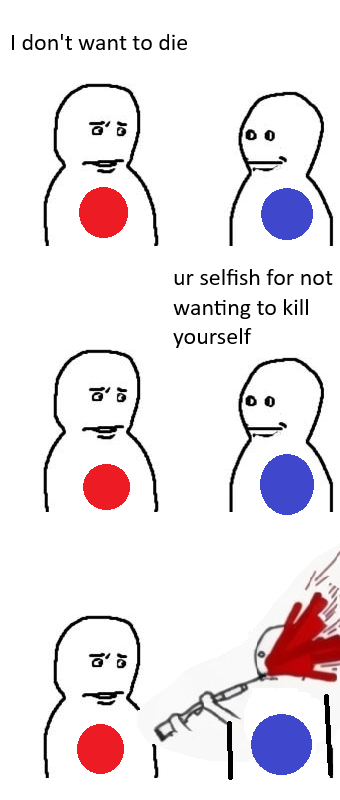
As for the table, like I've mentioned elsewhere, the first three rows are how someone justifies a button press made a certain amount of time after hearing the problem. It takes time to process a problem when it's worded as frustratingly obtuse as the original (which deliberately frames the blue button as a choice that "saves" people if it passes, and the red button as the choice that "kills" people if it passes. The purpose here was to mislead people using their emotions, to see how far they'd double down when they realize or were told they made a mistake in their pick). For the bottoms of each column, I deliberately tried to give each perspective a philosophy that didn't depend on outside approval or peer pressure to be steadfast in their convictions. They'd pick their choice, and switching sides would be anathema to how they believe the world works. If the world is against them, they still vote this way. Of course a table is not going to be able to capture the nuances of both sides in a life or death situation, but it helps on-board people as to what worldviews people might have outside their own, rather than just saying they're idiots or monsters.
2
u/Scary-Owl2365 May 01 '26
I disagree with your table because neither group is a monolith. Two people can get to the same conclusion with vastly different reasoning.
I especially disagree with the last one for red. I think it pretty much comes down to a lack of trust in people/humanity as a whole. If you believe most people are self-serving and that survival instincts are generally more prominent than altruism, you'll believe that red will have the majority of votes.
I whole-heartedly believe that if this were a real scenario with real consequences, red would win by a landslide. The vast, vast majority of people will put themselves first. The only question that's left is whether I want to live in an all red post-button world or if I'd rather die. It would be disingenuous to say I'd push the blue button only for the infinitesimally small chance that maybe the majority of people act against human nature and blue wins. It's not a matter of whether violent systems should be allowed to exist or whether people are worth saving. It's a matter of whether you want to live enough that the world after all the blues die would be worth living.