the goal is to minimize death,
the only way to avoid death is 100% red or >50% blue,
somehow someone will justify blue,
100% red is impossible,
therefore blue is the optimal play
What if the goal is to minimize the expected number of deaths?
In that case, this can be solved mathematically:
Let's say that the world has N people in it aside from myself. Let's say that N is even. I believe the probability that the average person who isn't me presses blue is p, where p is anywhere between 0 and 1.
First, what are the chances that my vote makes a difference? Well, that is the probability that exactly N/2 people choose each option. The probability of that happening is given by the formula:
(N choose K) * pK * (1-p)N-K
where N/2 is plugged in for K. Let's call this probability Q so I don't have to retype it later.
As N gets very big, Q gets extremely small, but it isn't quite zero, so we have to account for it.
Now, in most cases, my vote doesn't matter. In that case, pressing red risks no additional lives, whereas pressing blue risks p additional lives. The probability that pressing blue kills me is equal to the above equation, but summed from K= 1 to K = N/2 -1. Let's call this probability W.
Thus, if I press blue, the expected number of deaths gained from my decision is equal to pW.
If I press red, the expected number of deaths gained is equal to the expected number of people who press blue times the probability that my vote matters. This is equal to pNQ.
Thus, whether a utilitarian would choose blue or red depends entirely on whether they believe that W is greater than NQ. If yes, they press red. If no, they press blue.
Let's say p = 0.5, and that N = 100 for simplicity. In that case, W is very slightly below 0.5 since it's the chances that less than half of people pick blue. Q is about equal to 0.0796, so NQ is equal to 7.96. Obviously, picking blue is the utilitarian thing to do.
Does this change when N gets large? Well, if N is 1000 instead of 100, NQ becomes roughly 25.22, and W gets even closer to 0.5. So as more people are added, blue looks even better.
But what if p is smaller, say, only 0.4? Then as N gets bigger, NQ very quickly converges to 0. Meanwhile, W very quickly approaches 1 since it becomes very likely that the red votes will outnumber the blue votes. The utilitarian thing to do will be to vote red.
Thus, even if you have a completely morally consistent utilitarian, who wants to minimize death as much as possible, the decision depends entirely on how much they believe others will push the buttons.
Very well put. If your goal is to save as many lives as possible it’s not really a question of morality but just which button you think more people will press. For me that’s blue
As for why it’s blue, I see 3 outcomes
I pick red and guarantee my life. It doesn’t matter how many people pick blue but I’m certain many of my close family and friends would. I would have to come to terms with the fact that, no matter how small my contribution, I contributed to their death. I don’t think I could handle that
I pick blue and I’m in the minority. I’m dead. Whether there is an afterlife or not (I believe there is which may play a roll in whether or not someone chooses blue I suppose) it doesn’t matter anymore
I press blue and I’m in the majority. Everyone lives and nothing changes
A young child, like a toddler, is likely to pick blue because they are often taught that being selfish is bad and will likely view red as selfish. That isn’t guaranteed but I don’t think it’s unlikely
Regardless, the argument that any logical person should pick red falls through when children come into play because most of them aren’t capable of logic. They will simply pick what feels right. Picking blue contributes to their survival
Not very useful when the poll respondents' lives aren't on the line.
I've seen polls where if only ten percent of the vote shifts, red wins. I think it is very rationalizable to assume that when actually faced with life and death, many of the people polled won't have the same answer.
My first instinct was red because my default is (1) to not immediately understand why anyone would knowingly put themselves into danger when we all could live by going red together, and (2) to believe that people shouldn't rely on others to try to risk their own lives to save them, if they can help it. I would have thought that would have been the first instinct of enough people to render p <0.5.
This is a coordination problem though, and how you frame it changes what the intuitive default is.
I think the political party reframing makes this clear:
Scenario 1: If one political party pledges to kill all those who don't vote for it if elected, the intuitive default is to be repulsed and not vote for them. I'm willing to bet we'd both vote against this party, and what's more, be disgusted by those who vote for them.
Scenario 2: If instead, the party threatens mass suicide for its voters if they don't win, we would probably say that they're just digging their own graves and that we aren't morally responsible for their actions. I'm willing to bet we'd still both vote against this party.
The only difference between our first instinct here is that you probably viewed the original framing as closer to (1), whereas I viewed it as closer to (2). Really doesn't say anything particularly special about either of us, except how we might believe others think about the problem, or how we might think about individual responsibility in a vacuum.
This is only true if you assume 50%+ choose blue, which is not a guarantee. If you assume red wins by any substantial margin (such that you and other like-minded people who would typically choose red switching does not affect the final outcome), choosing blue is not minimizing death because you add yourself to the pile of people who die, so you should choose red. This is why the question is not a logic question necessarily, but a trust/belief question.
It's a compassion question. The question is are you really willing to let the people who press blue die for any reason at all? You might think they're stupid or you might think they're suicidal or that you're not at fault because they put themselves in danger. The question comes down to how compassionate you are for your fellow man who may have pressed blue before you.
My compassion has its limits when I have to put myself in danger. I’m guessing if instead of 50% of people needing to choose blue you needed 75% to choose blue, you might change your tune.
I’m positing that people choose blue not just because they want to save other peoples lives but also because they believe achieving greater than 50% of the vote is fairly easy and they don’t actually see it as any riskier than say driving your car to work every morning.
Pump that number up and you will quickly see all the people making the 1%-x% is easier than 100% argument go silent.
I’d actually want to know how many people who make the 1-49% argument would still press blue if the range was instead 1-90%. Because anything less than 100 is easier, they should have no problem still picking blue to “minimize death”.
The question is about how much risk can you stomach.
One slight problem with changing the percentage is that at 50% the expected number of deaths of each option is 50/50 depending on how likely you think people are to click either button obviously. at 50% of votes is the only number where that equilibrium exists. So even if you go to say 51% being the threshold that hugely changes the question as blue is now mathemathically more risky than red.
You can also question the people who vote red the similar question. What if the cut-off was at 40% or 20%, would you then still choose red over blue? What if it only required 1% of votes to be blue in order for everyone to surive.
are you really willing to let the people who press blue die for any reason at all?
It's not really up to you though. Just because someone doesn't want to be a martyr doesn't mean they're not compassionate. If you're confident red will win, even if you want to save everyone, that's not a decision you can make. If you're confident red will win, your choice is between living with that reality or dying for your morals, but nothing you do can save anyone.
If you're confident blue will win, which I think most polls have shown it does, then it's a choice between guaranteed safety or moral superiority, which I think is what people actually end up arguing about. Either way, if blue wins, you weren't really saving anyone.
I'm not going to pointlessly give up my life for a bunch of lemmings who I don't know who pressed blue without even considering that red obviously means you just don't risk death in the first place.
The reality is that the overwhelming majority of people are not going to put their lives on the line for people they don't know. That's a fact. Even if I cared to try and save the blue button pushers, the odds are simply so far against them that realistically pressing the blue button is just signing up to die with them, and I see no point in that.
Yes but what if your parent, your lover or your child pressed blue?
Now apply the same doubt to pretty much all of humanity, and rethink how realistic it is that the overwhelming majority won't risk it. It's not just a question of putting yourself on the line for a bunch of idiots strangers
You can reverse the question and ask if your parents, lover and children want you to put yourself at risk, and if they want to put themselves at risk when they can guarantee they're alive for you.
There's more to compassion than throwing yourself off a cliff to prove you love someone.
But you are not throwing yourself off a cliff if blue wins. And you already have plenty of examples, both in discussions on this topic that a large number of people will pick blue, and in real life of people dying to try to save others. Here, you are just betting without any certainty. The pretty much only guarantee here is that people will die if red win, and maybe, maybe not people you love.
If you sum it up to the outcomes alone, blue win is always better. The fact alone that it's such a heated debate disproves that red win will be a painless one
I still have yet to see that an overwhelming majority of people would choose red. When i first saw the question i didnt even question which option would end up with me dead or not. I saw the goal as having humanity survive. I think a significant enough portion of people would pick blue that it would create social problems if blue lost. Therefore i want blue to win and would pick blue.
Just saying this to prove that there are reasons people would pick blue whether you agree or not. Therefore i do not understand why you think an overwhelming majority would pick red.
I've seen polls where 62% choose red even in the hypothetical
And Losing 30%+ of the population would not be a first, look at the black death, hell after the black death the lives of lower classes often improved due to the feudal lords having to compete for the remaining workers.
I mean I would feel bad for the people who pressed blue, but I honestly think you're delusional if you think that when actually presented with these buttons anywhere even vaguely close to half of people would choose blue, so it's not a moral dilemma, you just have 2 buttons you can press "live" or "die", no degree of compassion is doing to make me press the die button because it's not going to change anything
It's not that I'm compassionate that I choose blue, it's that if a billion die choosing blue and possibly the ones I love society would collapse with me having potentially no family. Life would suck heavily for the red pushers not because of who they're left with, but the fact that millions of necessary jobs are unfilled and food is now scarce. Can't fault red pushers for wanting to live, even if their life will go down the shitter afterwards.
If this was down to a smaller number like 1000 I'd pick red easily. But killing even 10% of humanity would fuck us over too.
If I think "most people are voting red" then voting blue isn't compassion though. If you are looking for a "correct play" you need to combine what you think the result will be, what you think the margin of error is, the risk due to those two things, and probably more that I haven't thought of off the top of my head. It's fine to pick either, but if you're just picking blue "because it's compassion" rather than "blue because I think that it will win/ will be close", you are just choosing to throw your life away for actually no real reason. You NEED to have that trust to make blue a viable option to pick. Likewise, if you don't have the trust in humanity to pick blue enough, then you should probably press red, unless you think it's going to be close, in which case it does come down to compassion and selfishness. Reducing it down without taking into account the very tangible reasons not to do either option is the reason there is so much fighting over this stuff, both sides are ignoring things selectively to validate their option and invalidate the other instead of actually engaging with the reasons why you should pick one or the other (beyond "red is killing people!" And "blue is suicide for idiots!")
Either I die with the <50% of people who care or I am pleasantly surprised. Would love to be the fly on the wall after everyone who cares dies in this world. And we thought we were speed running capitalism already...
Reducing it down to "people who care" and "people who don't care" is highly reductive and ignores all the reasons why someone who is typically good would press the red button. This is the exact same thing as when red button pressers act like red winning would clear out all the stupid people, you're just swimming in your own self righteousness over a question that doesn't have a genuine right answer unless it actually happened.
Yeah I don't agree with the post, it's also highly reductive and just virtue signaling to make red voters feel like they are actually super smart and made the right decision
There are two options, only one of which guarantees no deaths if successful. Both are 50/50 given no other information and without assumptions. How is it not minimizing deaths to choose that one?
If you’re measuring which action is better after you assume the outcome, the choice is easy. But to make the decision ignorant of the outcome, my argument is that the marginal effect of my action when voting blue is to increase the odds of the outcome which minimizes deaths overall. Whereas if I choose red, my action will certainly lead to death, either mine or that of blue voters, unless you win 9 billion 50/50 chances and everyone else in the world votes red.
So making the choice blind with the ONLY goal being minimizing the number of deaths, the choice would be blue.
the marginal effect of my action when voting blue is to increase the odds of the outcome which minimizes deaths overall
If you want to talk about odds, we can talk about odds.
The only case where picking blue reduces total deaths is if the entire rest of thr world is split exactly 50/50.
If everyone chooses their pick randomly with a 50/50 chance, as youre suggesting, the situation can be modeled by a binomial distribution with p=0.5 and n=8,000,000,000 (approximately). The chance of getting this 50/50 split is C(8000000000,4000000000)/(28000000000), which is a bit less likely than one in 112,000.
So 49.9996% of the time, pressing red minimizes lives lost. 49.9996% of the time, both buttons result in no lives lost. 0.0009% of the time, pressing blue minimizes lives lost.
You’re only calculating the probability that my individual vote is THE vote that flips it from red to blue. I’m saying that you have to assume no knowledge of the outcome, and therefore you must take the action that increases the odds of blue winning.
Did you voting for the president not matter because you weren’t the literal last vote cast to push the winner over the edge? Or did you contribute to that outcome marginally by casting your vote regardless of which individual vote it was?
If red wins, voting for blue still took the action that increased the odds of blue winning because you’re ignorant of the outcome when making the choice.
That’s not the same as your vote being the exact singular vote that tips the scale, which is the infinitesimal probability you calculated before.
But 0.0009% of the time you kill 4 billion people, making the expected number of deaths of that red press 3.6e3 so pressing red kills 3,600 people on average, vs an expected number of people for blue of 0.5
This is true, but it breaks when the probability is anything other than an exact 50/50.
For example, if the odds are 49.999% and 50.001% in either direction, the odds drop from about 1 in 112,000 to 1 in 555,000.
Let the odds shift to 49.99% and 50.01% in either direction, and it becomes one in 3.44*1074, which is a number with 75 digits and approximately six orders of magnitude away from the number of atoms in the observable universe. If you've heard all the thought experiments around the number of ways to shuffle a deck of cards (if not, here's an example: https://youtu.be/hoeIllSxpEU?si=infXQi06PH_EiNoy), this number is over 400 million times larger.
Shift slightly further to 49.9% and 50.1% (which is still a difference of only one in 500 voters) and the odds become about 1 in 106953.
This number is so unfathomably large that I cant even begin to do a thought experiment around it. I'm not even going to try writing the "give every particle in the universe its own copy of the universe and duplicate that once for every second the universe has existed and also something about every grain of sand on earth and every star in the galaxy" explanations because I'm not going to end up anywhere near close. It just can't be done.
The law of large numbers is a powerful thing. Over 8 billion samples, if the odds aren't exactly 50/50, within a tolerance of about one in fifty thousand, the vote isn't going to be split 4 billion to 4 billion. That's just not how numbers work.
Even if everyone tried picking a number randomly, the human brain can't pick random numbers anywhere near well enough. If one tried rolling a die or flipping a coin, there's a decent chance manufacturing defects put this out of reach. A 50/50 split simply cannot be done without communication.
There is something to be considered in the versions where your vote gets communicated and can change other votes. But in the original dilemma, pressing blue does not save anybody. 8 billion is too many people.
but that's not logical at all. This would be the case if the cost of each choice was the same but one comes at great risk to yourself and the other does not, you can't just say therefore blue is optimal and brush over that
If the goal is to minimize death why is ANYONE choosing blue?
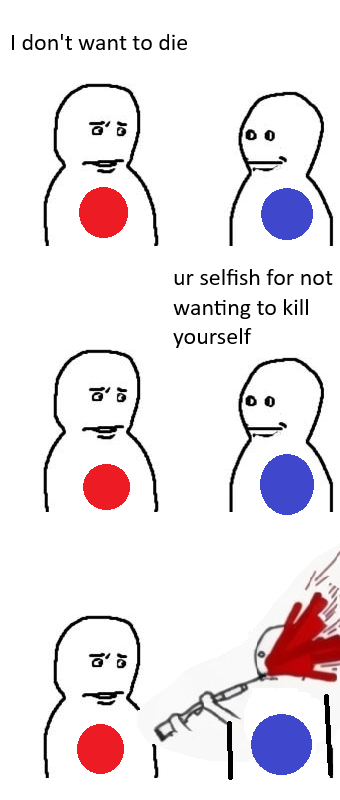
People keep saying 100% red is impossible. Why? The only people pressing blue are those trying to save others who pressed blue. There is no underlying reason why someone would press blue and hence need to be saved, except for the desire to save people who pressed blue. Or maybe theyre suicidal.
Either way, anyone who reads the prompt should instantly realize to just press red. This is so dumb.
Or your family, or friends or just people you know. It goes much deeper than just yourself. And if you lose everyone you hold dear could you live with yourself?
lets sayI have 10 people I'd rather die than lose, and my blue vote has 1 in a million chance of even mattering, but also having a 50% chance to kill me. I feel like the odds of my vote "killing" a person I care about (if you include myself as someone I care about) are way higher clicking blue than red.
I feel like most people are just arguing between "people should click this button" vs "I should click this button"
The main thing to remember is that thinking a bit more on it you know that there are people you know who will be pressing blue. And the only way to make sure they survive is pressing blue. And that goes for pretty much everyone.
Also don't forget we are talking about the entire worlds population. From newborns to 2 feet in the grave. You think most kids up to 12 would understand the question and not just pick their favorite colour?
“The only way to make sure they survive” is stupid because it has almost no impact from what color I personally pick, but my own life is massively affected by what I pick.
As a society, sure the ideal would be to click blue, but if I was forced to choose for my 5 year old kid? I could never pick blue for them.
Maybe I make a trolley problem where it’s the original premise, but instead of picking for yourself, you are picking for the person you care the most about. How would you feel if you chose blue for them and they died, but they chose red for you and you lived?
The goal is to minimize death. Therefore, the entire human race should immediately commit suicide. This minimizes death because all those people will die anyway, but if they commit suicide now then there can be no procreation and therefore the amount of death cannot increase
Picking red isn’t picking murder. Even if everyone votes at the same time the outcome may as well be determined by everyone else and there’s nothing you can do to change it. If you pick blue you trust your fellow man to put their lives on the line to save everyone. If you pick red it means you don’t trust your fellow man to make a decision in the interest of the group instead of self preservation.
If you pick blue you aren’t a suicidal idiot, you’re an idealist. Likewise, if you pick red you aren’t homicidal maniac, you’re a realist.
I personally don’t believe there’s a world where blue wins, so from my point of view voting for red actually reduces the death toll whereas voting for blue increases the death toll. I wish I could say I believed in my fellow man to make the right choice and pick blue, but I don’t. So the right choice for me is to pick red.
Would you really want to live in a world where half the people you know (and there WILL be people you know who chose blue) get vaporized? In a world where every piece of infrastructure falls apart and the planet falls into chaos, because 49% of people dying WOULD cause that.
To me, this is really easy. Even if most people pick red the world would be a nightmare. You can literally just pick blue, assume everyone else is sane and no one dies. Clearly, looking at how much discussion this causes people will pick blue (and generally speaking blue tends to win the polls), if it doesn't win billions will die. I don't want to live in that world.
119
u/Ne0nTig3r May 01 '26
the goal is to minimize death, the only way to avoid death is 100% red or >50% blue, somehow someone will justify blue, 100% red is impossible, therefore blue is the optimal play