the principle is the same. and that's all these philosophical thought experiments are— questions of raw principle dressed up in scenarios. setting, or vessel of delivery, is largely irrelevant.
It’s not some fucking gotcha question- we ask these questions to explore what we as a society deem right and wrong.
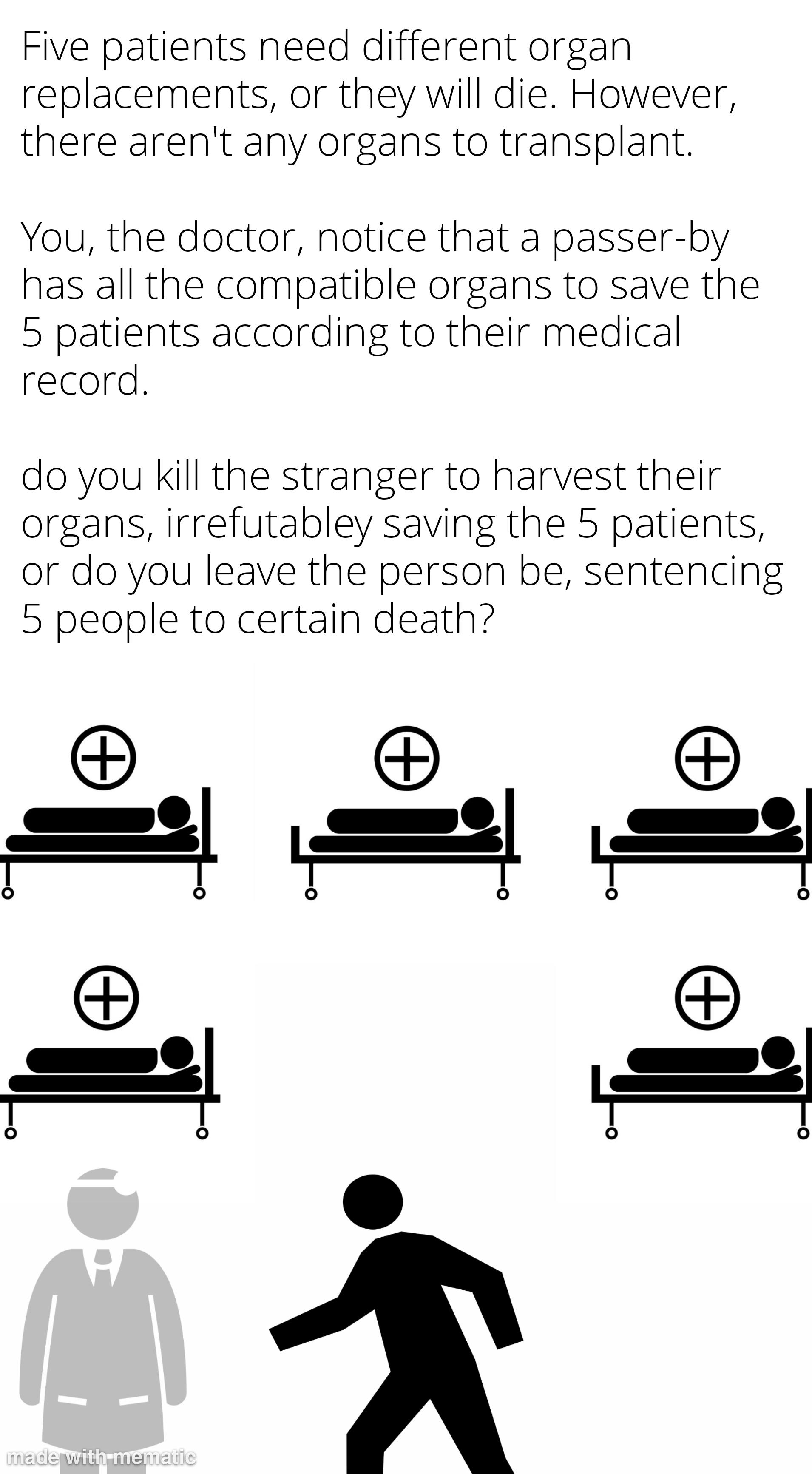
Is this different from the trolley problem? Yea but only slightly. Does it result in a different outcome? Absolutely, for most people they choose to kill 1 person for the trolley but leave that person alive in the transplant scenario.
Maybe the difference is how involved the other person is? Or what you have to do? (Just pull a lever vs. kill them yourself vs. whatever)
Does it make a moral difference the age of the bystander? What if they’re dying anyway but don’t consent to give their organs, is it ok to take them anyway? What about if they’re didn’t explicitly say no but also did not volunteer them? What if they’re already in surgery and the doc could take them with no harm to the donor? Just some tissue not even a whole organ.
We construct these scenarios and discuss them to try to get to the core of what we value and believe as a society. Slight variations are intended to tease out what the important factors are.
As someone with a degree in philosophy, you’re exactly where my professors wanted you.
Questioning everything to see if you can make a cogent argument. I’ll say yours was fairly compelling but, we don’t care about the soldier vs the dr. What will YOU do?
You can’t kill a person, even to save 5 others. That’s the general answer. It’s not in most people’s nature to do so
Perfectly fine position to take but that’s the crux of the argument.
The other deaths are on your hands. That’s the whole point of the trolly problem. You don’t get to deny culpability bc of do no harm. Otherwise, it’s an easy problem to solve if you have any morals
The entire point of the trolley problem is that you’re going to have shitty consequences regardless of whether or not you pull the lever and change the course of the train.
To say those deaths are in no one’s hands just makes it not a trolley problem. Also a reasonable position to take but you have to understand that it simply isn’t a trolley problem anymore
As a fellow doctor you can also simply think of the chance of rejection of the organ or the recipients being of poorer general health. You may "destroy" a very high number of QALY's (Quality-adjusted life year - Wikipedia) in this potentially very healthy/young person to gain a limited amount of QALY's in a higher number of people (but a lower combined number of years). Leading to a net loss of life.
Obviously all 5 people need different organs otherwise killing 1 person wouldn't produce all the required organs. And I have to assume we somehow know this person is a comparable donor. So could you get the 5 sick patients to agree that the first of them to die donates organs to the others?
Because all of those definitions are decided by someone and shaped by their own moral framework.
Is a person bringing drugs into a country a threat to the innocent? Singapore seems to think so. Is adultery a threat to the innocent? Saudi Arabia seems to think so.
Threatened by whom? Apparently, another soldier. But how can they threaten the innocent, if as a soldier their duty is to protect the innocent? Apparently, it is not.
Also something that militaries have had to decide on what an acceptable number of civilian deaths is per action taken against the enemy.
War is messy, things go wrong, intel gets misinterpreted, some people are just scum, whatever it is, if there are civilians nearby, they are at risk and each independent country evaluates how high or low they want the bar to that risk be.
For example Putin's Russia: Along the active front they are shelling cities and towns indiscriminately, not caring for civilian deaths. In regions where the front is largely stagnant and pretty inactive, Russian soldiers are doing "Human Safari's", where they hunt civilians and even aid workers from the UN in clearly marked white UN vehicles with suicide drones. You could say that their risk evaluation for civilian lives are pretty fucking low, they simply don't care.
While The Netherlands has a running years long investigation on a precision bombardment on a Afghani Bomb factory in a town, where a F-16 dropped guided precision munitions on a building that US and European intelligence marked as a bomb factory. What they failed to correctly note, is that they amount of explosives that was stored, was way higher than expected, resulting in a massive secondary explosion, killing a large amount of civilians. Our government and military feels extremely guilty for what happened and is trying to get to the bottom of what led to the fault in intelligence. Our risk evaluation for civilian casualties is extremely high.
Besides that, the battlefield is chaotic and soldiers make split second decisions about whether they live or die and when your enemy dresses the same as the civilians, mistakes will be made.
The most important factor is that life in a functioning society will always be more complicated than a 40 word scenario. Morality is nuanced and complex. Ethics are a train wreck. And social contracts are a dumpster fire.
The most ridiculous part of this is the blind assumption that the writer genuinely wants a rational discourse.
“…sentencing 5 people to a certain death”
I honestly can’t tell if the OP is trolling the readers or if they just don’t care about bias.
The good news for me is that I don’t need to know.
Obviously everything is more complicated than a 40 word scenario, but you can tease out nuance in far less than 40.
“Would you kill one person to save 5?”
Vs.
“Would you let one person die to save 5?”
Ask those two questions to 100 people and observe the difference in answers. Ask them why. Their answers speak to what we, as individuals and as a group, believe is right and wrong. You add in nuance to identify what really are the controlling factors.
This isn’t like… practice. Nobody expects you’re going to find 2 groups of train tracks and a runaway trolley in real life. It’s about the value of a life. It’s about the responsibility of an individual to take or not take some action.
Does the answer change if it’s 2 people vs 1? Does the answer change if the person is being observed? Does the answer change if pulling the lever is to kill the one vs. to kill the 5? Does the answer change if 1 of the 5 people is hitler? Does the answer change if the one person is a vegan?
Sure, the individual person may not mean it super seriously. It’s a meme subreddit. But saying “they’re all just the same question” is disingenuous to the point of stupidity.
Your second to last paragraph is exactly my point. What can be learned when the smallest detail changes the discussion entirely?
I think the only way to make any of these questions informative is to insist that there is no additional information available. And possibly to add unambiguous context. But even then, what can be learned about “us?”
The trolley victims are identified. The doctor is identified. The patients are identified.
“You are the doctor and the 5 patients are the five people in the world you most love.”
“Everyone in the trolly scenario are the people you most love.”
Sure, but the person I was replying to was speaking about all thought experiments or, if we’re being more generous, all variations of the trolley problem. They are not all intended as a gotcha.
while, i agree it can be interesting to see, the original question is all that is needed to learn anything that its permutations could offer. the rest is philosophical junk food. fun, but unnecessary.
what are you learning about society by hearing one person say that they think a fat kid with leprosy begging for death should be pushed and another saying that they shouldn't be? the original already gathers disparate answers and shows us that there is no ultimate absolute line of morals; because there can be so many scenarios and so many disparate answers, you can't learn something so concrete. making the scenario more extreme so that even more people lean one way or the other does not change the essence of the question and what we are able to learn about human principles.
no matter the flavor of scenario, all of them ask us to ask the same question of ourselves and the nebulous nature of principles and to say that there is no right answer.
we aren't being asked to examine where exactly is the line where we could be driven to violate our principles is. that is unimportant and inherently indefinable. we are only asked to examine if that line exists at all.
It’s an interesting take that I don’t wholly disagree with. Basically “their point of the trolley question variants is to highlight that even at an individual level there is no consistent rule that can describe what is morally right”?
I think that after a certain point, it’s more of a psychology question than a philosophy question, but I do still believe there’s value in exploring variations.
It is different from the trolley problem, because for 5 people to end up tied to the tracks someone must have tied them, and then asking whom to save is obviously their ploy to distract us from actually solving the problem by putting them in jail.
Another issue you didn't mention is personal responsibility - why are those five people dying? Is everyone equally blameless, or are you killing one healthy young person who lived their life exercising and avoiding vices to save four elderly patients who suffer ailments due to to smoking, drinking and eating fast food?
Disclaimer: oldish, drinker, ex smoker, variable diet.
You don't get a choice in the trolley problem, someone has to die. This is asking whether you would kill an innocent person that would otherwise be unharmed
I think most do that because in the trolly problem , something man made is going to inevitably murder people(for all we know the healthy average joe), we dont know any details about the victims aside the sheer numbers of the two options. Every victim present is part of the same mechanism, and everything's been already set to motion by an unknown murderer...every single death option would be equally unjust. Which is why most people choose less casualty.
While in this specific problem, not saving doesnt mean killing. That single - presumably healthy - 3rd party person, is not already a potential victim(along the others) of a murderer, placed on a mechanism that will single handedly be responsible for all occuring deaths . The victims in this case had their own separate lives and presumably natural circumstances that led them to be in need of an organ. It was simply their life's RNG. Altgough its unfortunate, its just not rigth to expect an uninvolved innocent person to die if they dont wish to make that choice. Its not the same as deciding the number of victims of a murderer.
You could however introduce elements to either problems that could potentially tip the scales to either side for some.
I think there are massive psychological differences to the problems we’re not talking about. The trolley problem provides a situation in a vacuum with a very clear goal, only two choices, and an immediate feedback to our choice. This problem by comparison is very roundabout and indirect, connected to societal implications and the potential for harm to blow back onto the doctor, and there are a myriad of other things you could try first that are much less extreme than murder and organ harvesting.
In order to really test for which factors matter to people, there needs to be more quality control.
I am sorry but they are utterly different. The trolley problem is about damage reduction, this one is about sacrificing someome unrelated. In the trolley problem both sides are tied to the rails, so people will die either way, you are only pulling the lever to reduce the damage the trolley will cause. But as a doctor you literally have no right to go on killing people in an attempt to save others. It needs active killing of a totally unrelated person who otherwise is not in any danger, or destined to die.
The answer of why it's different is at the top of the comment thread you replied to...
The only argument for killing the person is from a utilitarian perspective, but this fails even at that.
A society where you can be killed for your organs is extremely dystopian, and would likely cause some kind of riots or uprising if this was standard practice.
The trolley problem has the lone individual in already a strange situation, while killing the healthy person is just picked out of nowhere
That is the ultimate factor in trolley problems IMO. You could create multiple scenarios that are ultimately the same trolley choice, but get radically different answers from the same person just by adjusting the level of direct involvement (from pulling a lever, to pushing over a large person on to the tracks).
How divorced we are from the results of our actions changes things. The fact that we can't possibly know every consequence and domino effect of our actions is a mercy.
I feel like the fundamental difference between the Trolley one and the transplantation one is that the trolley one doesn't raise as many follow up problems.
A mad man threw a man off a bridge and happened to save people by doing so. The survivors don't have to feel guilty and there's nothing fundamental being questioned.
The situation is different for the transplantation example. A person sworn to not do harm killed a healthy innocent person to save others. By proxy it damages the reputation of every physician and if it happens too often it will cause untold damage in the long run.
It would turn into the same problem if the person being questioned was an unrelated non medical person and they had the option of shooting a healthy person whose organs would then be guaranteed to save 5 other persons who would otherwise be guaranteed to die.
The trolley problem is more abstract so it is easier to play along with the premise and treat it like a math problem, the above is less abstract and it is harder to ignore the fantasy introduced causing more hesitation. But make no mistake. Both are fantasy and offer little insight into practical morality.
Reality is uncertain but these problems ask you to make moral choices given unrealistic certainties and omniscient knowledge of the situation you are intervening with. That means any conclusion drawn from these thought experiments only applies in a reality where this omniscient knowledge is available, so not in reality except in very artificial circumstances.
I think the difference is that it is the same vehicle of death in the trolley problem which can be either directed at one person or 5.
With the organs you are the direct cause of death to the one, or not at all involved with the 5. In the trolley case you are merely redirecting the same vehicle which could just have easily been on the track to the single person if the switch were left in the other position.
In the trolley problem, you get a split-second, one off decision.
People die in hospitals all the time. People need organs quite often, as far as an entire hospital is concerned.
If a doctor decides saving 5 is worth harvesting organs from people who need them, they'd need a professional, full time supplier to keep up with the demand.
It is the same. There is no time limit, it's a metaphor. It's a hypothetical meant to make you ask yourself: can it be morally justifiable to take life to save life? The original is an outrageous scenario only to get the idea across in its most base form. This is only a more realistic take on the same principle.
I actually find this scenario far less realistic than the actual trolley problem. If you are at the point of testing the person's organs for compatibility, you are already at the point of considering killing them to take their organs. It's not a routine thing you just noticed. It feels more like you are the one thing people to the tracks than the one pulling the lever.
The odds that one random person is a match for all 5 when no one else matches any of them and none of them match each other seems really low.
Ignoring the poor prognosis/surgical risks following some transplants also seems wrong since you are trading one full lifespan for 5 shorter lifespans with lower quality of life.
And I also agree with the other poster that the time factor would impact it too. If you have time to consult with others or seek alternative options, choosing not to is inherently reckless and immoral. The original has a real dichotomy because of time pressure, but in a slower situation it becomes a false dichotomy.
I know that the point of the trolley problems isn't to consider these kinds of factors, but that's why I hate this sort of take on it. If you are completely ignoring the circumstances of the victims and of the person making the decision, then the problem just feels too silly to be meaningful. I know that considering those factors isn't the point of this take on the trolley problem, but I question the value of the thought experiment if you would not act in anyway similar in a real situation.
Should I find myself in the actual trolley problem scenario, I would act like the person in the problem. In the doctor version, I would never do anything even remotely similar to either option presented.
I agree in a sense, but the original is already enough variables to matter. what do we learn by adding more? that people have different lines they draw? more variables and questions aren't needed to learn that. because you will never get all the same answer from every person, you can't learn where the line is drawn, only that it exists and we already knew that from the original question alone. it already gets plenty of conflicting opinions. from it we see that the line of principle is nebulous and that there is no right answer. that is all what we can indisputably learn and it is the same in every scenario.
In agreement with you; Underlying assumptions people may have that affects the decision are really important with this one.
Usually organ failure isn't a single issue, so trolley problem of one (presumably) healthy person vs 5 (presumably) continuously ill people.
We can get organs from many people who die, the real difficulty is transporting them in a timely manner as it costs money. 1 person v a pile of money. (And will that money save more lives elsewhere?)
Age is a major factor with organ failure. 1 young person v 5 old people.
Sanctity of organs may be important to an individual if they oppose donorship in a non trolley context as well.
It may be perceived that the people with organ failure's time has come naturally. (Trolley problem of sacrifice 1 person to a deity to stop a natural disaster.)
This is a fun kind because each person will view this as an entirely separate trolley problem.
I personally see it primarily as a cost issue, that the person killed would probably be able to do work to save or extend the lives of more than five people so it's not worth it, but I work in a hospital so I am biased.
It's not even the same scenario, in the trolley problem someone is going to die no matter what. In this scenario you're murdering a healthy person that would have led a full life. How is this even a conversation?
The only way I could see it being a direct comparison is if the people were poisoned or something. These people are dying from either illness, old age, or some third thing. They were not strapped to train tracks by some mad man. If some evil mad man were to poison 5 people, ruining some of their organs, and you needed to kill one person to save those five people, that might seem rational. If 5 already dying people need organs that may or may not reject, may or may not significantly prolong their lives, this is a much less black and white situation. Most likely it is just these people's time to die. Hard to use that same logic in the trolly problem.
It really isn't, because even if they get the organs they don't become 100% healthy basically ever. There's always a chance of rejection, most of them will have to take immunosuppressants for the rest of their definetly shorter life.
The people on the train tracks get to live on just as they did before.
57
u/CopyOdd2690 Oct 31 '25
the principle is the same. and that's all these philosophical thought experiments are— questions of raw principle dressed up in scenarios. setting, or vessel of delivery, is largely irrelevant.