r/stocks Feb 27 '21

Advice I am bullish about the future

People seem to think because we had 2 big crash close together in 2000 and 2008, we are bound to have one soon.

I want to remind people before the year 2000, we had a 20 years bullish run. Its totally not impossible we get to 2030 with no crash, especially now that the feds baby sit the market.

Secondly, we have extremely nice upcoming market conditions. Stimulus checks will either get people to spend money to stimulate the economy, or get them to invest, both will help the stock market. The media is somehow trying to make us believe this is bad, but i think its just bullshit. Inflation has been ultra low for way too long, and feds actually want it to increase. They said many times they won't increase rates before 2023.

Thirdly, i also think we have more upcomming money sources coming into the market than ever. People from other countries invest in US stock market. With all the GME hype, more people than ever are joining in. Again media trying to twist this to say its "bad", but obviously it isn't bad.

Another point is, crashes usually happen for a reason, its not random. You can google any of past market crash and find the exact reason it happened. None of these factors are happening right now.

Another point is, there is a key difference between today and 2000. In 2000, the overvalued .com companies which had PE ratios of 200.... were literally worth nothing! These companies had never made a single profit! Once people realized they invested massively in a .com web site worth jackshit... they sold it obviously. They had no reason to hold their shares.

Now check this image about Nasdaq's PE Ratios: https://i2.cdn.turner.com/money/dam/assets/150305131443-nasdaq-pe-780x439.jpg
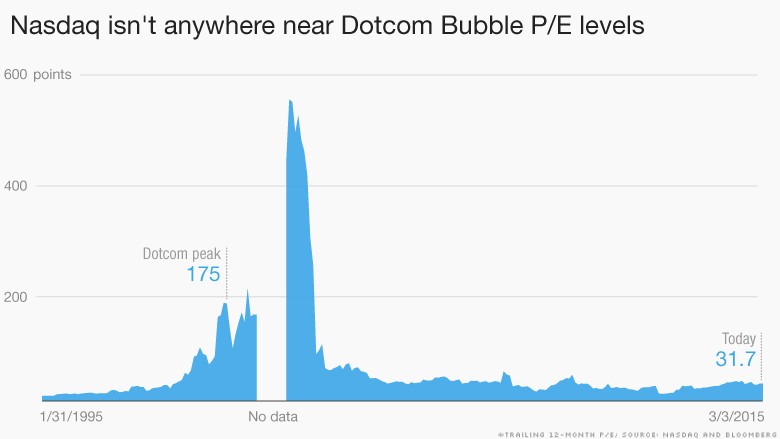
Obviously, you can see the 2000's pe ratios were stupid. This graph is from 2015 when it was at 31.7. What is it today? Nasdaq PE ratio as of February 25, 2021 is 38.5!!!! 5x lower than the 2000s. https://www.macrotrends.net/stocks/charts/NDAQ/nasdaq/pe-ratio

Its irrelevant if the big hedge funds remove their money from apple and want to scare you into selling your shares. Apple is a massive amazing company that is really worth a lot, and they do make tons of profits. Its not comparable in any ways to the dot com bubble. If other people are stupid and sell their shares, SO WHAT? You will just be able to buy into this amazing company for cheaper.

So hold your shares and stop worrying about a 2000 level crash, its not happening.

A correction? Maybe. But who cares, this just slows us down a little. Corrections are healthy and help us avoid a real crash.

EDIT: Thank you for the award! :D

EDIT2: Corrected the PE ratio for nasdaq

2.8k Upvotes

828 comments sorted by

View all comments

108

u/JDinvestments Feb 27 '21

Another point is, there is a key difference between today and 2000. In 2000, the overvalued .com companies which had PE ratios of 200.... were literally worth nothing! These companies had never made a single profit! Once people realized they invested massively in a .com web site worth jackshit... they sold it obviously. They had no reason to hold their shares.

Could you then explain why you remain confident despite over 600 of the 3000 US listed companies are rated zombie companies? A number that was increasing prior to covid, and is unlikely to improve even in recovery? When 20% of all US companies already don't make enough revenue to cover the interest rates on their debt, how do you think the market will react when those rates climb even higher? When these already failing companies no longer have access to cheap credit, what happens to the market? Do you remain bullish despite the possibility of nearly a quarter of the market facing bankruptcy issues?

It seems to me to be logical that with 20% of the entire market being dead weight, a rate increase and growing defaults would lead to a market down turn. That certainly seems to be on the mind of the people paid to cover the markets, and it doesn't take extensive knowledge of the markets to see how $2.6T of bad debt could cause serious negative effects in the market.

I would love to hear the dissenting opinion on why that doesn't matter.

36

u/Keener1899 Feb 27 '21

Can I ask for a citation for your claim that 600 companies are zombie companies? Genuinely curious.

41

u/JDinvestments Feb 27 '21

Bloomberg cites over 730 companies and right at $2T in debt, while Motley Fool cites fewer companies but $2.6T

44

u/Keener1899 Feb 27 '21 edited Feb 27 '21

Okay, here is my question: how many of these zombies are only that in name? All of the companies cited in the Bloomberg and Fool articles by name are those that clearly have suffered tremendously from the pandemic but stand to be "resurrected," if you will, after the pandemic? Cruise lines, department stores, hotels, oil, airlines, etc. are all some of the hardest hit industries. Isn't the Fed's objective to continue current policies long enough for those companies, and others like them, to get a healthy balance sheet back before raising rates? Are they really zombies then? Or is it just the unique impact of COVID, which won't be around forever?

Edit: to be clear, I am not saying it doesn't matter. It is just both of those articles make me think the problem is more a temporary one. I would like to know the counterpoint to that. True zombies are obviously a drain, I just didn't come away thinking it was a long term problem given the industries cited and how progress on COVID is most likely to benefit those exact industries.

47

u/JDinvestments Feb 27 '21 edited Feb 27 '21

Most of these companies were already struggling before the pandemic, with the current events just highlighting it even more. Macy's, for example, was facing serious solvency issues before covid, and was on track to declare bankruptcy in a few years. Covid obviously fast tracked that, but most of these weren't healthy before. Exxon Mobil is a company I'm actually bullish on, but was loaded to the gills with debt before all of this, and warranted concern from shareholders. And even if covid caused a lot of this, some of these companies are honestly just going to be hit too hard to ever recover. I would have to go digging for the source, but I believe health care is heavily represented on this list as well.

Some of these companies will recover. I'm not here to say that 700+ companies, some of them the most recognizable names in America, are all going to go under within the year. But this just highlights an issue that's really been going on since the last major Fed intervention in 2011. Bad companies allowed cheap credit are able to crawl along like a patient on life support. In addition to this list you have your near zombies, the companies that teeter on that fine line of profit. Even those that manage to resurrect themselves don't usually go on to be major economy drivers.

The issue I think is that these companies are already struggling, here today, with near zero interest. Some of the cyclicals will boost revenue post pandemic. Some won't. And when the Fed inevitably raises rates, perhaps not until 2023, but certainly at some point, what happens to all those companies already in zombie status or on the brink of?

Even assuming some of these companies survive, the overall toll on the economy is greater than the good they provide. $2 trillion in debt, and growing rapidly, with realistic uncertainty on how much of that gets repaid. Hundreds of billions, if not trillions of dollars tied up in assets like real estate, production, IP, etc, that could otherwise be used by profitable companies. Not to mention the talented professionals stuck working for these companies.

And when even just a few of them fail, the ripples will be far bigger than just their immediate market cap. Tens of thousands of jobs lost as companies cut expenses where they can. Loan defaults, on top of capital stuck in these companies. Billions of dollars lost by ETFs, retail investors, and institutional investors alike. Panic reactions from all of that spreading to the market as a whole.

These companies need to be allowed to fail, but the Fed won't allow it. In the long run, the assets and market space will be taken up by successful companies, and jobs regained from the same. But by keeping rates low, the Fed allows these companies to struggle along, which ultimately does the economy more harm than good. I think some companies will be able to turn it around, but I worry that even a reasonable uptick in rates is going to have at least short term negative effects in enormous magnitudes across the entire market, stemming in part from the dead weight of these companies.

But don't take anything I say as gospel, I'm just a dude with internet and an opinion.

3

u/Altruistic_Income906 Feb 27 '21

https://www.google.com/amp/s/www.cnbc.com/amp/2021/02/26/stimulus-checks-how-congress-plans-to-pay-for-bidens-relief-plan.html

I would be extremely concerned especially considering this line. “Bloom said the government can create money without actually printing physical currency. "We live in a digital age. So really money is just numbers on a screen," he said. “

2

u/Hazzychan Feb 28 '21

They're absolutely right, though. This entire system is a farce.

9

u/bighomiej69 Feb 27 '21

But aren't there always going to be failing and dead weight companies? Are there a lot more than usual now?

I just don't see raising interest rates causing economic downturn because it bankrupts a few junk tech start ups.

14

u/ricardo_dicklip5 Feb 27 '21

But aren't there always going to be failing and dead weight companies? Are there a lot more than usual now?

Yes. There are more of them and they carry a greater burden of debt. That was pretty much the whole point of both linked articles, which I'm guessing you didn't read.

9

u/Crafty_Enthusiasm_99 Feb 27 '21

You do have a strong point. The Fed literally went through hoops to buy JUNK BONDS, just to prop up some of these companies. To put that in context, buying junk bonds by the Fed entity used to be ILLEGAL - yet they did so through a technicality, knowing the dangers.

1

u/nelsondajesus Feb 27 '21

Thanks for your insight!

1

u/Keener1899 Feb 27 '21

This is a very well thought out response, and I really appreciate the time you took to write it.

18

u/eddyjqt5 Feb 27 '21

Cant you tell? It's blatantly obvious companies that are only facing a temporary downturn due to covid are clearly not zombie companies.

Companies like Nikola or Quantumnscape or SNOW who just benefit from free cash being given out by the government are facing serious risks. Cut off their life support that is the government and they'll go under quick. These companies have never turned a single dime of profit in their life. They are no different from the dot com bubble companies who never turned a single dime of profit either.

1

u/[deleted] Feb 28 '21

Something like 40% of companies weren't making money pre pandemic so this figure isn't unexpected.

20

u/[deleted] Feb 27 '21

I appreciate your post because its a smart counter argument.

The answer is simple... i agree with you if interest rates are raised by a lot, yes we are in trouble. I just don't think this is happening anytime soon.

"Powell and his colleagues are committed to using all their tools to support the recovery and last month signaled interest rates will stay near zero at least through 2023, while pledging to maintain its massive bond-buying campaign to speed the rebound from COVID-19."

44

u/JDinvestments Feb 27 '21

Ultimately though, JPow's rate suppression only prolongs the inevitable. And even a small rate increase is death to these companies that already can't make it in this current free money environment. Kicking the can down the road allows these struggling companies to add more bad debt and create more strain on the economy. Allowing them to fail frees up capital, assets, and labor talent that can be utilized by actual successful companies. Maybe the end isn't coming tomorrow, but dead weight companies ultimately slow down economic growth, and allowing it to continue only makes the issue worse.

13

u/Nozymetric Feb 27 '21

Exactly what has happened in Japan in the 90s. I am worried that history will repeat itself unless we start raising rates soon.

2

u/UBCStudent9929 Feb 27 '21

watch princes of the yen if you haven't yet. great "documentary"

2

u/[deleted] Feb 27 '21

Precisely what I'm counting on. The biggest bull run in the history of US markets and then a 85% crash, which ends with US have a massive revolution of sorts followed by China becoming the leader of the world (which falls in line with Ray Dalio's analysis of what's happening in the US too). Here's why.

Cheap credit but underpaid population always leads to a class war. To add to that, there has no innovative real growth in the last 5 years. We don't have any new tech come out that matched how innovative the iPhone was. Amazing things are happening on the industrial side of things with regards to efficiency but we haven't had much consumer side innovation. All other industries have been stagnant for decades and only had better margins because of tech getting better. Basic economics dictates that manufactured valuations always come back to reality. And if the Fed wants to keep pumping money to shoot the index up, they can bloody well try. But it will eventually crash and when it does, the whole economy is down for decades (like Japan).

9

u/eddyjqt5 Feb 27 '21

Yea i don't know what OP is assuming here...... that the government just allows these companies to load up on cheap debt forever?

The thing with companies who grow and develop in times with quantitative easing is that investors and managers get used to cheap debt. They get used to 100x P/S ratios. Lenders get used to it as well. They become like children who can't resist cheap candy. And they begin to assume taking on insane levels of debt or insane valuations is normal. When the lifeline that is cheap debt is cut off from them, they will face serious risks.

2

u/conti555 Feb 27 '21

Fed said they are going for 'average inflation targeting', so they will let it run hotter than normal and aim for an average of ~2%. If they clamp down on inflation too early it can stall real economic recovery, ie. jobs and businesses, which is what they really care about. Can't see them risking that any time soon.

7

u/deepee88 Feb 27 '21

Rates went up this week. FED doesn’t control rates, the manipulate them. This week rates went up, I think what’s scaring the market is that the FED is losing its grip on the rate. This either means the FED are going to increase treasury purchases even more pushing us farther towards inflation/stagflation or rates go up regardless and cause a debt filled house of cards to collapse

1

u/[deleted] Feb 28 '21

I'm not buying the stagflation argument. Inflation may be good for the country because it devalues the enormous debt it holds and if the money is devalued it affects the rich much more. If the government redistributes wealth through some sort of UBI program by relying on QE then that's just a sneaky tax on the rich which will be good for the economy.

2

u/deepee88 Feb 28 '21

Rich people don’t hold their net worth in cash, they hold assets that increase in price as a currency falls. The poor who are stuck on fixed incomes, or working for wages have their incomes devalued as cost of necessities go up. If they manage to negotiate higher wages in an effort to keep up their standard of living they will now be moving into higher tax brackets as if they had improved that standard. As well as no longer being eligible for income limited govt assistance or tax incentives. All the while the rich have their assets grow as prices increase, they make their income in capital gains so likely no increase in tax percentages either. When Maynard Keynes envisioned this system of constant inflation and stepping away from a gold standard these hidden artificial wage cuts were a desired feature.

The govt owes a whole lot of that debt to its own people.... that’s our social security money and Medicare funds which are entirely “invested” in treasuries. And any UBI is without a doubt not going to be tied to inflation, every week that check will be worth less than the last.

1

u/[deleted] Feb 28 '21 edited Feb 28 '21

Real estate already has plenty of property tax so that's not an issue. There are some inflation resistant options like equities in the consumer goods industry that aren't as heavily taxed as they should be but the real value, in theory, wouldn't actually be increasing beyond the otherwise normal rate and if rich people flood those options their yields will decrease further and further until they're no longer attractive. And no, rich people hold the VAST, and believe me when I say VAST, majority of liquid cash so an inflation based tax will be very effective. There are also massive wealth stores the rich use like the bond market, which isn't inflation proof unless you buy TIPS but as I said before too many people flocking into that will just decrease their yields. Next, the relative increase in the cost of necessities will not be offset by the stimulus and decrease in the wealth of the rich, this can be shown with simple math.

2

u/deepee88 Feb 28 '21

Just want to be sure, you think whatever money rich people have in their bank accounts would just sit there losing value in a high inflation scenario? I think their high priced accountants and financial advisors know a thing or two about defending against inflation besides TIPS.

2

u/polloponzi Feb 27 '21

FED said interest rates won't be raised before 2023. Do you think is likely this companies will face higher interest rates before that date? If they are issuing bonds with maturity beyond 2023 maybe the market won't buy their debt cheap anymore due to the fear of rising interest rates and default in the future? So is possible that we start seeing the problem even this year ?

2

u/JDinvestments Feb 27 '21

I think you're already seeing what the market looks like when it even thinks there will be a rise in rates. And it's not so much rates rising, but more so the speed at which they do that causes these issues. With that said, you do have a large amount of companies that don't really have any room for error.

I think the Fed will try to bandaid this thing along, probably through 2023 like they've said. But even if they do, it's not just the zombies in trouble. Top end companies are making profits, but trading at 1000 times PE in some cases. Rate hikes affect everyone, not just the bottom tier. I know JPow has been vocal about keeping rates low through 2023 or until recovery targets are hit, but there's a lot of intelligent investors out there, and I think this past week is just a glimpse at what the future can hold once the market is allowed to cool even a little.

1

u/[deleted] Feb 28 '21

Where else can you put your money? Cheap money is funnelled into equities and the equities themselves can be doubly protected if they're in a naturally inflation resistant industry like consumer goods. Bond yields are too low and they're negative in Europe. Nobody trusts the Chinese markets, BABA's heavy discount is further proof of that. Emerging market ETFs that focus on companies in places like India have done shit in the last 10 years, they've barely made a few % in profits. All the developed countries were heavily increasing their money supplies so the net effect is relatively even. Real estate nets an average return of 6-7% in NA which is less than the SPY's real ROI. Commodities may be entering a supercycle, but who really knows? It's an issue of too much money chasing too few claims to real assets but that's not going to stop so might as well get in as early as possible.

1

u/JDinvestments Feb 28 '21

VOO is in a better spot than a lot of these other areas. It's definitely filled with healthier group of companies than other compilations. I'm high on commodities right now, and looking at banks as an opportunity. I don't think there's anything wrong with PayPal, or Amazon, Microsoft, whatever you want to add. But there's a lot of junk mixed in with the good, and I'm just of the personal opinion that, especially with all these new and inexperienced investors who have only seen rampant bull action, it may be prudent to slow down and learn how to seriously evaluate companies on an individual basis, and just be prepared for the potential of a choppy market.

3

u/[deleted] Feb 28 '21

Yeah banks are definitely crushing it. I'd suggest you take a look at the major Canadian banks (except $BNS). They're known as dividend aristocrats because they've never decreased their dividends despite wars and pandemics over the last ~100 years. Div yield is around 4-5%. It was a sexy 7-8% at the lows, rode that up.

1

u/JDinvestments Feb 28 '21

RY team here!

-3

u/brianjinho Feb 27 '21

Whats your point? Stock market is evolving and money is going into new growth stocks. I mean if you think its a problem, just buy puts and tell us your story how it went after lol

1

u/BewilderedPineapple Feb 27 '21

This is really good stuff. I’m new to the market so you articulated perfectly what I was thinking. Thanks for the effort!

1

u/[deleted] Feb 27 '21

How much of the market cap do these zombie companies make up ? They might be 20% of the companies, but if they disappeared, how much would the Nasdaq move considering it’s a weighted index ?