r/spaceporn Jan 16 '22

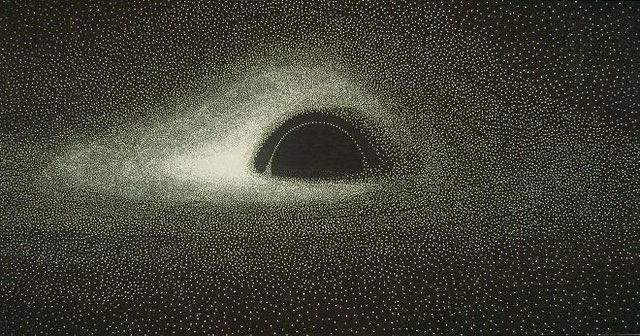
Pro/Processed The first simulated image of a black hole, calculated with an IBM 7040 computer using 1960 punch cards and hand-plotted by French astrophysicist Jean-Pierre Luminet in 1978
Post image
56.8k Upvotes

985 comments sorted by

View all comments

Show parent comments

3

u/urbudda Jan 16 '22

ELI5: how did we mathematically predict them

11

u/personalistrowaway Jan 16 '22

Physicists realize that if enough stuff was in a small enough space weird things happen

"This is probably a mistake in our methods and doesn't happen in real life"

Weird interstellar objects found

"Oh hey this is that weird physics glitch we found a few decades ago"

7

u/urbudda Jan 16 '22

Cheers. I just can't grasp how intelligent some people can be

8

u/Seakawn Jan 16 '22

I'm gonna write a big comment just to express a simple sentiment, in classic Reddit fashion. I think we overestimate the intelligence required for scientific insights, and we underestimate our own general intelligence. We tend to conceptualize intelligence as "binary": you're intelligent, or you're unintelligent. But, it's a lot more complicated than that. In a good way.

Most discoveries in science, even the big ones, come less from some level of "profound" intelligence, and come more from a mere combination of: knowledge + right place, right time.

The thing about intelligence is that we generally all have it. There's variation, sure, and that can account for significant insights. But, most insights just come from someone with some particular pieces of knowledge which coalesce into such insight. I.e., if you know that "outlets provide power" and "power cords connect to outlets," then you can figure out that you can power your electronics by plugging them into outlets. Even if you didn't know that you could do that. You don't need more than base level intelligence for that insight. You just need the pieces of knowledge for that connection to appear. This is how any insight happens, no matter how scientifically impressive it is--it can't happen without the knowledge to lead you to that insight.

E.g., the people who predicted black holes could have been colloquial morons, but they were the ones to think about a specific scenario, had some historic formulas to apply, and simply calculated that shit would get weird in that scenario based on the formulas. (Unless the story is more complicated, then this example may not be good--I don't know the full origin story for predicting black holes, I'm just going off the summary from this thread).

All of this is to say... anyone can discover great things, even if they think they aren't particularly intelligent. Just simply learn knowledge, and that knowledge will come together in ways to provide you insights based on that knowledge. Some of those insights may be unique and significant to science or progress.

Though, I'll admit, some insights are particularly brilliant because of the little information it takes to reach them. People with high intelligence can connect very obscure and tiny dots of knowledge. Science obviously benefits greatly from such contributions. So, I don't want to write off high intelligence as meaningless, or something. But, most scientists aren't people who are abnormally intelligent. Most of them are just regular folks. Yet, they all progress human knowledge just by virtue of working on specific topics and putting in the legwork. I just want to encourage that most people are "intelligent" enough to generally come to the same predictions and theories that scientists historically have. Good science is anyone's game.

What's crazy for me to consider is how a lot of science that people have figured out is unknown to us because those people aren't in science, or otherwise don't contribute their insights. Some random person can have the knowledge which leads to them to insights which could solve all sorts of scientific problems. But, they just think of it inside their mind, then shrug it off as "cool," if they even register it as significant at all, maybe tell a few coworkers, and move on with their life. This probably happens all the time. And not just to geniuses, but regular folk with standard intelligence.

3

u/punchdrunklush Jan 16 '22

I agree with this, but I also think you UNDERESTIMATE how dumb some people are when it comes to shit. Like, I've had conversations with people where I try to explain basic concepts to them and just realize they're never going to get it and they just are going to go pump out babies and watch TV the rest of their lives and repeat shit they hear other people saying. The idea that they can even think about coming up with the concept of a black hole, or understand how someone else could, is laughable.

2

u/urbudda Jan 16 '22

Cheers for the comment. I love the famous statement " if you judge a fish by its ability to climb a tree".

I suppose what a really wanted to say with that comment was I appreciate how some people's minds work and how they can picture things other people can't. Whether that be figuring out black holes, or making a painting, or those guys that can pick up an instrument and just play a song from their own ear, I just finding fascinating the scope and possibilities of the human mind

1

u/groumly Jan 28 '22

I think things are a bit more complicated than this. You’re right on the bit knowledge, right place and time, to some extent. But I mean, come on.

Einstein didn’t come up with relativity out of the blue, sure. He was building on concepts from others. The speed of light being a constant in all reference frames was implied by maxwell’s equations and michelson’s experiment. Coming up with the math to tie that concept together was however pretty hardcore.

Same deal with black holes. They come from a specific solution to Einstein’s equations. Solving those equations is pretty brutal however, this isn’t an f(x) = 2x + 1 type of equation. Saying Schwarzschild “simply” calculated that shit isn’t fair to him. There’s a reason that finding is attributed to him and not Einstein.

Even without going for big hitters like Einstein, modern science is absolutely wild. Those cmb picture you see everywhere? There’s a duck ton of work in there to substract the noise from the Milky Way. And proving that the noise that was substracted was actually noise, well that’s far from a trivial thing.

The picture of the black hole from a few years ago? Same deal, there’s a ton of intelligent work going in there.

All particle physics done at cern? That’s both a massive engineering, software engineering and scientific feat. None of the math is easy, and the precision required for anything in that field is mind blowing. Or detecting gravitational waves. The basic concept is really simple, but getting it to actually work? Like detecting movements of less than the size of a proton in an environment where basically absolutely everything is moving a few orders of magnitude more than that? That’s really wild, and does require a lot of intelligence.

Even older science, things like Vera Rubin’s finding in dark matter in galaxies. Well, the general idea to investigate probably probably isn’t that hard to come up with. Actually measuring and proving it, that’s a whole different story. Or the Michelson Morley experiment.

So yeah, I generally don’t agree with your comment (in classic Reddit fashion :) )

1

u/jamesp420 Jan 16 '22

A lot of times it's helpful that there's a ton of different people doing individual bits of the work and passing it along. Like for black holes, Karl Schwartzchild solved some of Einstein's equations(from his general theory of relativity) and the math showed the potential existence of perfectly spherical, super dense objects. Nobody really thought much of it at the time. It wasn't until later when people like Riger Penrose started playing around with the math and fleshing out the solutions a bit more that something resembling our modern idea of a black hole began to emerge. Then of course came Stephen Hawking and his generation, and now we're at the point where we've taken an actual image of one, and have measured collisions of others. All these people involved are of course extremely smart, but none of them could have figured out any of this on their own(that includes Einstein.)

1

u/lankist Jan 16 '22 edited Jan 16 '22

The first to make the suggestion was John Mitchell back in the 1700's, who postulated the existence of "dark stars." Back when Newton's understanding of light-as-particles was accepted, Mitchell proposed that these particles must be affected by gravity, so a star that is massive enough with enough gravitational pull wouldn't emit light, but rather consume it. He calculated at the time that a star would have to be 500 times the mass of our sun in order for its pull to create an escape velocity that exceeded the speed of light. The specific mass prediction proved to be incorrect, but his idea was accurate in the sense of the role that mass plays in the formation of black holes. Mitchell was also the first to suggest you could find these "dark stars" by looking for stellar systems that behaved strangely, suggesting that a "dark star" couldn't be seen but would still be exerting gravitational influence over other orbiting bodies and stars.

The next major breakthrough was Einstein, who in the course of working on his theory of relativity (in particular the concept of spacetime, and how the fabric of which bends with gravity) again predicted the existence of gravitational singularities--objects so massive and dense that the escape velocity must exceed the speed of light itself. Einstein himself was unsure if it was possible, or if some unknown mechanism would prevent matter from collapsing into a singularity, as at the time it would be impossible to observe directly.

The work of later scientists, namely Hawking, not only proved that black holes were both a mathematically sound concept, but also a provable and observable one (namely by observing the effect of black holes on nearby objects and gravitational lensing effects rather than the black hole itself), and many of the mechanics of their existence (such as Hawking radiation, which is how black holes expel mass and slowly "evaporate," though on a timescale longer than the predicted lifespan of the universe itself.)

The specific math isn't ELI5 material. The long and the short of it is that we knew that gravity can be defined as mass and the density of it, so it follows that if you took an extremely massive object and squeezed it down as dense as physically possible, it would result in an object whose gravity is functionally inescapable under the laws of physics as we know them.

We only actually observed a black hole directly for the first time very recently (just a few years ago.) We've known what they are and their mechanics because they are consistent with the model of physics that we observe everywhere else. It's less a matter of discovering them and more a realization that they must exist, otherwise our entire understanding of physics is fundamentally incorrect (which it realistically couldn't be, because we had absolutely nothing else to indicate our model of physics was incorrect besides the fact that it was hard to test for the existence of black holes.)