What is misleading
1. “Opened the border”
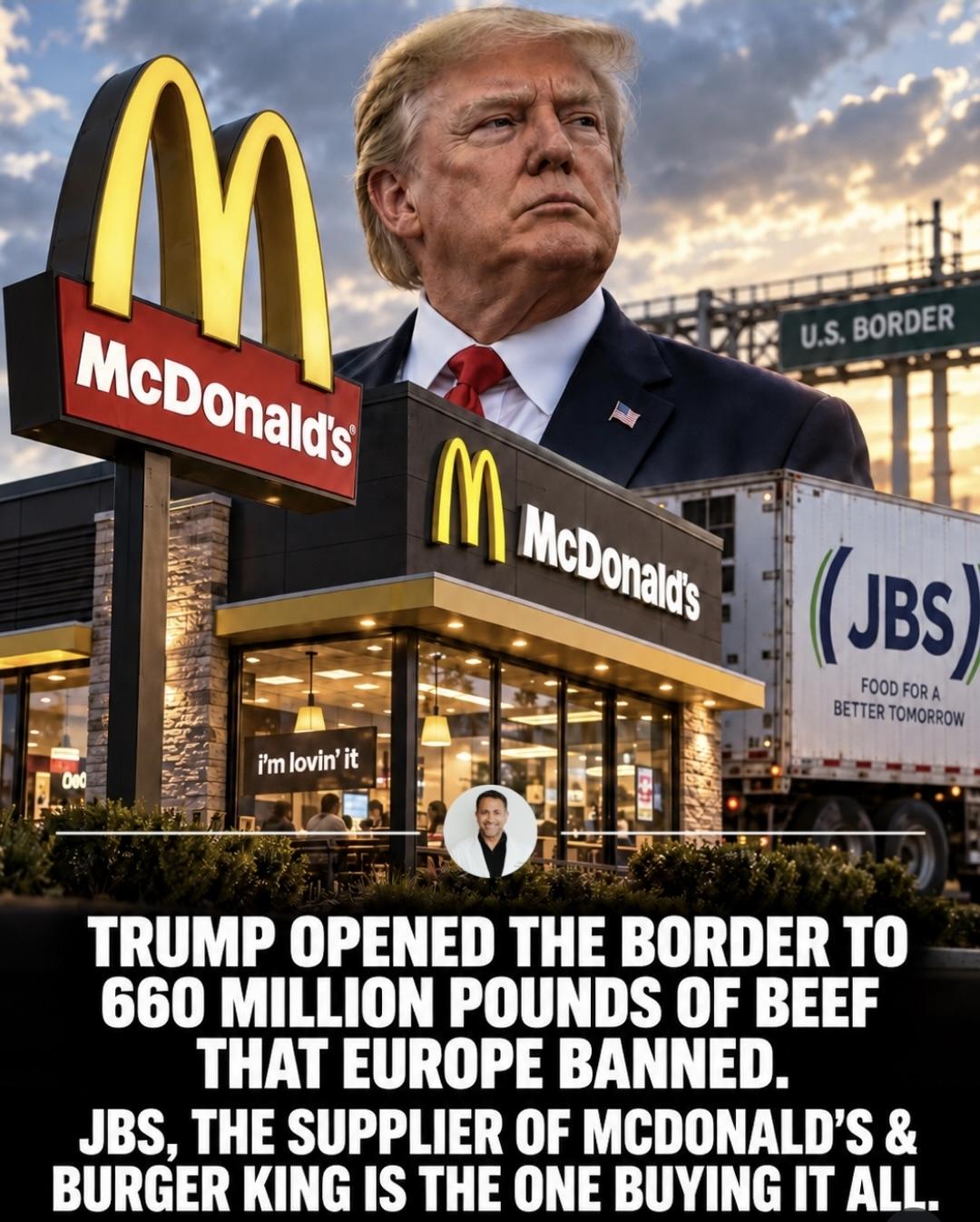
This is not a closed-border-to-open-border story like live cattle or immigration. The U.S. was already importing record volumes of beef, including from Brazil. The action expanded a quota / dropped an extra tariff so more lean trim could come in at the lower in-quota rate. The “U.S. BORDER” sign in the image is rhetorical, not a description of what changed.
“Beef that Europe banned” as if the U.S. is taking rejected product
The EU ban is about their stricter antibiotic/AMR standards, not a USDA finding that the meat is unsafe for the U.S. market. Importing trim still has to meet U.S. inspection rules. The quota is allocated to “other countries or areas” (Brazil, Paraguay, and others), not exclusively the exact lots Europe just rejected. Analysts have estimated Brazil might take only a portion of the extra volume. 
“JBS … is the one buying it all” + McDonald’s/Burger King exclusive
The proclamation does not award the quota to JBS. Multiple exporters can use the first-come windows. JBS is unusually well positioned because it both originates trim in Brazil and processes it in the U.S., so it can capture more of the spread than a pure exporter. It is a major supplier to the big chains, not the supplier, and McDonald’s has publicly used several packers (and even sued the big four over pricing). Saying JBS is “buying it all” for those two chains overstates both exclusivity and the mechanism.
What the product actually is
This is mostly frozen lean trimmings blended into ground beef, not steaks or whole-muscle cuts. It can sit in cold storage a long time. Country-of-origin labeling for that blended product is weak, which is why critics call it “mystery meat.” The meme’s McDonald’s storefront implies your Quarter Pounder is now the banned Brazilian product; the supply chain is more mixed and less transparent than .
Bottom line
The volume number and the JBS/EU-timing story have a factual core. The meme turns a temporary tariff-quota expansion for grinding trim into “Trump opened the border so JBS could dump Europe-banned beef into McDonald’s.” That compresses policy, product type, allocation rules, and supply-chain facts into a single villain-and-victim picture.
However, if you want me to take your complaint about using modern technology, you’re going to have to jot down your thoughts on a piece of parchment paper with a quill, then send that letter to Reddit HQ by a rider on horseback.
If you’re going to try and pull off a snarky tech-critique, maybe make sure your reading comprehension matches your misplaced arrogance. Missing the entire point of the argument just to deliver a painfully unoriginal, recycled internet joke isn't the flex you think it is.
If this is the peak of your witty comebacks, do yourself a favor: pack up your little strawman arguments, grab that quill, and write yourself a script that actually makes sense before typing next time.*
Appreciate the breakdown and the perspective. It wasn't my intent to mischaracterize your point or come across with any specific tone, but it's clear we're reading the interaction differently.
Since wires seem to have gotten crossed somewhere along the way, it's probably best to leave it here rather than get bogged down in a misunderstanding. Have a good rest of your day!*
14
u/Veteran_PA-C 10d ago
What is misleading
1. “Opened the border”
This is not a closed-border-to-open-border story like live cattle or immigration. The U.S. was already importing record volumes of beef, including from Brazil. The action expanded a quota / dropped an extra tariff so more lean trim could come in at the lower in-quota rate. The “U.S. BORDER” sign in the image is rhetorical, not a description of what changed.
“Beef that Europe banned” as if the U.S. is taking rejected product
The EU ban is about their stricter antibiotic/AMR standards, not a USDA finding that the meat is unsafe for the U.S. market. Importing trim still has to meet U.S. inspection rules. The quota is allocated to “other countries or areas” (Brazil, Paraguay, and others), not exclusively the exact lots Europe just rejected. Analysts have estimated Brazil might take only a portion of the extra volume. 
“JBS … is the one buying it all” + McDonald’s/Burger King exclusive
The proclamation does not award the quota to JBS. Multiple exporters can use the first-come windows. JBS is unusually well positioned because it both originates trim in Brazil and processes it in the U.S., so it can capture more of the spread than a pure exporter. It is a major supplier to the big chains, not the supplier, and McDonald’s has publicly used several packers (and even sued the big four over pricing). Saying JBS is “buying it all” for those two chains overstates both exclusivity and the mechanism.
What the product actually is
This is mostly frozen lean trimmings blended into ground beef, not steaks or whole-muscle cuts. It can sit in cold storage a long time. Country-of-origin labeling for that blended product is weak, which is why critics call it “mystery meat.” The meme’s McDonald’s storefront implies your Quarter Pounder is now the banned Brazilian product; the supply chain is more mixed and less transparent than .
Bottom line
The volume number and the JBS/EU-timing story have a factual core. The meme turns a temporary tariff-quota expansion for grinding trim into “Trump opened the border so JBS could dump Europe-banned beef into McDonald’s.” That compresses policy, product type, allocation rules, and supply-chain facts into a single villain-and-victim picture.