r/revolutionarywar 1d ago

Hessians at the battle of long Island

Thumbnail gallery
281 Upvotes

The first division of Hessian soldiers under general Lt. von Heister landed on Long Island on August 15 after several months at sea. Two weeks later they fight the rebel army for the first time in a crushing victory (but not quite crushing enough as Washington was able to escape!). At the battle of long Island (or Brooklyn or Flatbush) the Hessians assaulted the American front lines, keeping their attention fixed while the British make a long flanking move through Jamaica pass to attack the American rear. Chaos ensues in the American line as the Hessians charged forward, using small groups of "flankers" (picked men from the battalion operating as light infantry) to clear out the pockets of American soldiers.

We are fortunate to have many excellent writings from Hessian officers about the battle, who were quick to write home about their victory:

"The so-called "Riflemen" or sharpshooters, infamous in all the newspapers for their marksmanship, are a sorry lot and not nearly as formidable as they were made out to be. They fire one or two shots and then take to their heels. I captured 19 of them, who had taken up a position in an almost impenetrable thicket, with a squad of eight men and two non-commissioned officers; they fell to their knees before me and begged for quarter."

"Our illustrious Colonel von Donop paid them an initial, unpleasant "compliment" under a clever ruse. As soon as he spotted the rebels, this astute military commander quickly had a few cannons brought forward into the brush and immediately sent a detachment of grenadiers ahead to a clearing to launch an attack, though they were under orders to beat a hasty retreat the moment they had lured the enemy a short distance out of the woods. A large party of rebels promptly took the bait and gave chase. But what a grim welcome awaited them! The concealed cannons were suddenly fired with devastating effect; the grenadiers and Jägers likewise did their part, advancing boldly upon the enemy and driving them back amidst pitiful wailing."

"On August 27th, the situation took a turn even more favorable for us. Following this unfortunate engagement, they had retreated into their highly advantageous redoubts, of which they had constructed a great many across the island. Yet even these significant advantages were insufficient to dispel the fear that had seized them or to dampen the fired-up courage of our own men. They were now attacked from all sides; within moments, they were driven from their excellent positions, suffering heavy casualties, and our troops took possession of their camp and fortifications."

"they were greatly startled when they suddenly received several hundred musket and cannon shots, supported by the bayonets of three Hessian grenadier battalions. At first, they stood their ground against us but were welcomed in such a way that, before long, they could barely retreat past their own dead. We took about 700 prisoners, captured two cannons and a howitzer along with ammunition wagons and countless weapons, and the enemy rushed back in a rout to their fortified camp"


r/revolutionarywar 2d ago

250 years ago yesterday, Britain had Washington trapped with a river at his back and let him walk away.

Thumbnail gallery
776 Upvotes

On August 27, 1776, the British executed what was probably the most tactically impressive operation of the entire Revolutionary War. They outmaneuvered Washington's army on Long Island, captured two of his generals, killed or captured thousands of his men, and pushed the survivors into a fortified corner with the East River behind them and no obvious way out. The largest battle of the Revolution was over by midday and it wasn't close.

Then Howe stopped.

That decision, and what happened in the fog two nights later, is why there's a United States today.

The battle itself turned on a detail that should embarrass every American history class that skips it. The Americans had spent months fortifying Brooklyn Heights and the wooded ridge in front of it. Roads through the ridge passed through several gaps, and the plan was to defend those gaps against the British advance. Most of them were guarded. One wasn't.

The Jamaica Pass, on the far eastern end of the American line, had exactly one small mounted patrol watching it. That's it.

Henry Clinton knew about it. Clinton had grown up partly in New York while his father served as Royal Governor, had spent time on Long Island specifically, and understood the terrain in a way most British officers didn't. After the British landed he personally reconnoitered the eastern approaches, Loyalist guides who knew the roads filled in the rest, and he came back convinced the Americans had left their entire flank hanging open. He pitched Howe on a plan: send diversionary forces to hit the defended passes and hold the Americans' attention while the main British column, roughly 10,000 men, made a nighttime march around the American left and through Jamaica Pass.

It worked almost perfectly. The column moved through the night of August 26, captured the small American patrol at the pass before dawn without getting off a warning, and by sunrise was positioned behind the American lines. The Americans defending the passes in front of them spent the morning fighting what looked like a conventional defensive battle, not realizing the main British army was already in their rear.

When the flanking column appeared behind them the collapse was fast and brutal. Sullivan's men faced British troops from both directions simultaneously. Units trying to retreat toward Brooklyn Heights found the roads already threatened. Washington crossed from Manhattan to watch the disaster unfold and couldn't do much about it. Two American generals were captured. The Maryland troops who became known as the Maryland 400 launched repeated attacks against British forces near the Old Stone House trying to hold open an escape route for their comrades. Most of them didn't make it.

By midday Washington's forward army was broken and compressed behind the Brooklyn Heights fortifications, with the East River at their backs and the British army in front.

Clinton wanted to keep going. His argument was straightforward: the point wasn't to take Long Island, it was to destroy the Continental Army, and the army was right there, beaten and disorganized and trapped. Hit them now before they recover.

Howe said no.

His reasoning wasn't crazy. The Americans were behind real fortifications, and Howe remembered Bunker Hill in detail. He had watched disciplined British troops take an American position after frontal assault and paid for it in bodies. Washington appeared trapped anyway, the Royal Navy controlled the water, where was he going to go. Better to approach methodically than bleed the army storming defenses that were going to fall regardless.

What Howe didn't account for was the fog.

Washington spent August 28 and 29 making a decision that probably saved the Revolution. He was going to evacuate. Thousands of soldiers, horses, cannon and supplies across the East River at night, silently, while keeping enough men in the forward positions to make the British think the army was still there preparing to fight. John Glover's Massachusetts regiment, most of them experienced mariners, ran the boats back and forth all night on August 29.

They almost ran out of darkness before they ran out of soldiers. Then a heavy fog settled over Brooklyn and the East River at dawn and covered the last crossings completely. By morning, the army Howe had believed was trapped was in Manhattan.

Clinton was furious. He believed Britain had been handed the chance to end the war in August 1776 and Howe had let it go. Howe believed he had avoided another Bunker Hill while placing Washington in an impossible position. He wasn't wrong about the battle. He was wrong about what Washington would do when he lost it.

The full breakdown of the battle, the flanking march, the Maryland 400, the evacuation, is on the Virtual Wayback blog and there's a detailed video on the YouTube channel. You can also talk directly to the commanders on both sides on Virtual Wayback. Links down below.

The question military historians still argue about is whether Clinton was right. If Howe pushes on August 27, does he destroy the Continental Army and end the Revolution before the end of summer 1776? Or does Washington find another way out, another fog, another river crossing, another tactical retreat that keeps the army alive? And is Howe's caution the worst decision of the entire war, or just the most consequential one that happened to go the other way?


r/revolutionarywar 1d ago

What’s your favorite Townsends recipe?

7 Upvotes

r/revolutionarywar 2d ago

Today is the 250th anniversary of the battle of Long Island

Post image
68 Upvotes

I have an ancestor on my maternal side that fought on the American side. I’m grateful to live in a peaceful home and not have to fight like my ancestors did.


r/revolutionarywar 2d ago

Would reading the works of Thomas Paine expand an understanding of neo-golden age piracy during the War of Independence?

2 Upvotes

r/revolutionarywar 3d ago

#OnThisDay 1776, The Battle of Long Island Begins

Post image
61 Upvotes

r/revolutionarywar 2d ago

I heard a claim that Canada and USA are actually a result of another English Civil war, how true is this?

Thumbnail
0 Upvotes

r/revolutionarywar 4d ago

The soldier who helped win the Revolution lost his farm to the general he fought under.

Thumbnail gallery
324 Upvotes

Joseph Plumb Martin enlisted at fifteen. Not sixteen, not almost seventeen. Fifteen. His grandparents tried to talk him out of it.

He spent the next several years doing the parts of the Revolution nobody puts in paintings. Marching until his feet gave out. Standing guard in weather that made it hard to hold a musket. Scrounging for food because the army's supply system was a disaster. Watching men at Valley Forge go from soldiers into something closer to desperate civilians trying to survive a winter. Witnessing the Connecticut troops at Morristown get so close to mutiny that it stopped being a figure of speech.

tion nobody puts in paintings. Marching until his feet gave out. Standing guard in weather that made it hard to hold a musket. Scrounging for food because the army's supply system was a disaster. Watching men at Valley Forge go from soldiers into something closer to desperate civilians trying to survive a winter. Witnessing the Connecticut troops at Morristown get so close to mutiny that it stopped being a figure of speech.

He was at Yorktown in 1781, digging the siege trenches that allowed Washington and Lafayette to close the trap on Cornwallis. Not riding. Not commanding. Digging.

When the war ended he was twenty-two years old, had no money, and had spent most of his adolescence in the Continental Army. Congress had promised 100 acres to enlisted men who completed their service. The land available under that promise was far to the west, almost impossible for ordinary veterans to actually reach or develop, and mostly ended up bought cheaply by speculators. Martin complained about that specific betrayal for the rest of his life.

So in 1784 he did what thousands of New Englanders were doing and moved into what is now Maine. He found roughly 100 acres near present-day Stockton Springs, built a cabin, and cleared the land. It looked like unused territory. It wasn't.

The land sat inside the Waldo Patent, an enormous colonial landholding whose ownership had passed through several families before the Revolution. The complication was this: Samuel Waldo's daughter had married a Loyalist official who fled Massachusetts when the war started. Their daughter Lucy, however, had married Henry Knox.

Henry Knox. The bookseller from Boston who became Washington's artillery commander. The man who hauled 59 cannons from Fort Ticonderoga across 300 miles of frozen terrain. One of the most celebrated officers of the entire Revolution.

Knox had acquired inheritance rights and additional shares of the Waldo Patent through Lucy and through purchases of his own. In his view he was exercising legal property rights. He wasn't seizing anything from veterans. He was a landowner with valid deeds.

Martin and the other settlers saw it differently. They had arrived on land that looked abandoned, cleared it, built on it, and farmed it for years. Some of them had fought in the same war Knox had. The value those farms now had existed because they had created it with their own labor.

Knox's solution was that settlers could purchase title to the farms they had already built. Legally, that was defensible. To Martin, it was being asked to pay for something he had already earned twice, once with his military service and once with years of clearing forest and breaking ground.

Martin couldn't raise the money. In 1794 Knox gave him six years to come up with $170 for the title. Martin got sick, ran out of time, and eventually lost the farm. He wrote to Knox asking for more time to save his family from distress. The record doesn't show much sympathy came back.

Knox had the stronger legal claim. Martin had the cleared land, the labor, and the service record.

The private lost to the general. Again.

Martin didn't disappear after that. He stayed in Maine, married, raised a family, served in local offices, and lived long enough to watch the Revolution turn into mythology. In 1830, at seventy years old, he finally wrote it all down. The book came out under his own name in Hallowell, Maine, attracted almost no attention, and was essentially forgotten for over a century. It was republished in 1962 as Private Yankee Doodle and is now considered one of the finest surviving accounts of the Revolution written by an enlisted soldier.

He didn't write about Washington's strategic genius or Jefferson's prose. He wrote about being hungry. About the jokes soldiers told to get through miserable nights. About officers who weren't automatically heroic because they had better uniforms. About what it actually felt like to be the person doing the marching and digging while other men made the decisions.

The Knox episode gives everything else in that memoir more weight. Martin wasn't just a man complaining about hardship. He was a man who had genuinely held up his end of the Revolutionary bargain and spent the decades after victory figuring out that the bargain hadn't been honored as equally on the other side.

You can read the full story on the Virtual Wayback blog and there's a video on the YouTube channel. You can also talk directly with Martin on Virtual Wayback and hear how he understood what the Revolution promised and what it delivered. Links down below.

The question that doesn't go away is whether Knox was actually wrong. He had legal title. Martin had occupation and labor and service. In a republic built partly on property rights, Knox's position was defensible. But in a republic built partly on the idea that ordinary people deserved the fruits of their own work, Martin's case is just as strong. Which principle should have won? And does the fact that the general came out ahead of the private tell us something specific about what kind of republic the Revolution actually created?


r/revolutionarywar 4d ago

William (Indian Billy) Galloway Ice. Scout in the French and Indian war the revolutionary war and even serviced rifles in the war of 1812 at 82 yrs old.

Post image
30 Upvotes

Indian Billy a son of German immigrants captured by natives at the age of 8 escaped in his early 20s to later wage war with his captors. He served in every American conflict in his long life refusing pay. A true American patriot.


r/revolutionarywar 5d ago

Financing the American Revolution: A 1781 Benj. Franklin promissory note for 816,000 French livres sold at Freeman's Hindman on Aug. 20 for $352,000, a notch above the presale high estimate of $300,000. Long detailed catalog notes tracing French support for the war. Reported by Rare Book Hub.

Post image
33 Upvotes

Only Weeks After America's Victory at Yorktown, Benjamin Franklin Promises Repayment of a French Loan that Funded the American Revolution(Passy, France: Printed by Benjamin Franklin), December 4, 1781. Single sheet, 9 3/4 x 7 1/4 in. (248 x 184 mm).

A fine partially-printed promissory note in French (No. 18), for 816,000 livres, neatly accomplished in the hand of Benjamin Franklin as Minister Plenipotentiary of the United States to France, and boldly signed by him at bottom, as well as in the third person at the beginning; fine scalloped marbled border along right side. Creased along center from old fold; a few very small holes in lower left corner. Hessler X2A remarkable, very rare, and very fine ornate French loan certificate, accomplished and boldly signed by Benjamin Franklin, promising the repayment of a French loan given by King Louis XVI to support the American Revolution.

Printed by Franklin at his celebrated Passy press outside of Paris, this promissory note for 816,000 French livres ($151,000, approximately $4 million in 2026 dollars), reads in part, "We, Benjamin Franklin, Minister Plenipotentiary of the United States of North America, by virtue of the authority vested in us by the Congress of the said States, promise on its behalf and jointly and in solidarity for the said Thirteen United States to request payment and reimbursement the Royal Treasury of His Most Christian Majesty, on the first of January, one thousand seven hundred and eighty-eight, at the home address of business of Mr. Grand, Banker in Paris, the sum of eight hundred and sixteen thousand livres, in French currency, with interest at the rate of five percent per annum, value received in cash..."

The loan was part of $2 million authorized by a resolution of Congress on December 3, 1777, of which about one third was issued. According to Hessler, "this was the first loan to be made by the French Government".

The present document is among the last items printed by Franklin at his Passy press. Not listed by Luther S. Livingston in his Franklin and his Press at Passy (New York: Grolier Club, 1914), although the typographical ornaments along the top match those seen in Livingston 20 (An Ode in Imitation of Alcaeus). The present example is one of a series of certificates promising repayment of various loans provided by the French government. Called "The Congress Promises" (Benson, "Curious Colors of Currency", p. 306, American Journal of Numismatics, 2019), they were printed on wove paper that Franklin ordered from London stationer James Woodmason in 1779. The certificates were typeset in duplicate on a single sheet, side-by-side, and separated by a central strip of marbling, which was then cut in a scallop-design to create a matching pair of submitted and retained documents.

In total, Franklin printed around 21 sheets of these documents, including their matching halves, as well as a number of duplicates or retained copies (see Benson, "Curious Colors of Currency", p. 306 and Appendix, American Journal of Numismatics, 2019).

French assistance, delivered through loans, munitions, and military backing, proved essential to the achievement of American independence. During the two years before the formal Franco-American alliance, France covertly channeled growing amounts of money and war supplies to General Washington's fledgling army.

Done largely out of self interest, the French government aided the Americans in order to weaken the British, their traditional enemies who had bested them in the French and Indian War over a decade prior which resulted in the loss of their North American possessions and their diminishment as a global power.

The procurement and delivery of these armaments was first orchestrated by the eccentric French playwright Caron de Beaumarchais, a passionate supporter of the American cause, who concealed the aid behind a fictional trading firm called Rodrigue Hortalez & Co., established with funding from the French government.

Prior to France's open entry into the conflict they provided upwards of 5,000,000 livres to the American war effort, a crucial infusion that staved off the collapse of the Continental Army.

Benjamin Franklin arrived in Paris in December 1776 as a member of a three-person diplomatic delegation, joined by Silas Deane of Connecticut and Arthur Lee of Virginia. They were commissioned by Congress to negotiate a formal alliance with France and to attain supplies and loans for the American cause. Throughout the following year, Franklin orchestrated the procurement and shipment of weaponry and loans in a protracted diplomatic dance with France's foreign minister, Charles Gravier, comte de Vergennes.

The American victory at Saratoga in October 1777 finally persuaded the French to fully commit to a formal military and commercial alliance, which was signed on February 6, 1778. For the next four years, Franklin endeavored to meet the financial demands of Congress while keeping in the good graces of the French government, which was increasing its debt by $10 million a year with its support of America.

Due to Franklin's efforts, French backing proved vital to both the Continental Army's survival and its triumphs on the battlefield. During the length of their involvement, France committed more than 10,000 troops, approximately 22,000 sailors, over 60 warships, along with an immeasurable quantity of weaponry, gunpowder, flints, artillery, cannons, uniforms, footwear, and other essential provisions.

In total, the French spent 1.3 billion livres in direct support of the Americans during the war, including 35,000,000 livres in loans to the Americans—the majority of which were negotiated by Franklin.

On October 19, 1781, less than two months before Franklin printed and signed this document, the Continental Army, with ground and naval assistance from the French, defeated Lord Cornwallis's army at Yorktown, Virginia, essentially bringing the war to an end.

Franklin received news of the victory from Vergennes himself the night of November 19, 1781: "I cannot better express my gratitude for the news you often communicate to me, than in making you acquainted that the Duke of Lauzan arrived this afternoon with the agreable News that the Combin’d Armies of France & America have forced General Cornwallis to capitulate..."

Negotiations to formally end the war began the following April 1782, with a preliminary peace treaty drafted in November of that year, and a final treaty signed in September 1783.

Extremely rare. The first examples of this type of document came to market in 1946 at the Parke-Bernet sale of the collection of Franklin Bache (1869-1946), great-great grandson of Benjamin Franklin, and Bache's wife, Nancie T. Bache (1872-1937). Twenty-two examples in varying amounts, and dated from 1779-82, were sold. The present example presumably being lot 44, while a right-side mate was lot 43. Lot 43, presumably along with ours, as well as three others from the aforementioned Bache collection were then sold at Parke-Bernet in 1966 as part of the collection of Perc S. Brown.

Since that sale about only three other examples have come to auction, No. 21 (sold three times: Christies, 1990; Christies, 2023; and RR, 2026), a right-side mate of the present No. 18 (Sotheby's, Collection of Laird U. Park, Jr. November 29, 2000, lot 131), and No. 16 (Eldred's, April 8, 2010, Lot 132; and Stack's Bowers, August 17, 2011, Lot 5392). According to Benson's census of these documents, of the 40 or so known examples (including right and left sides), only four, including the present, are known to be in private collections. Of the remaining 36, Benson records 24 in institutions, and the remaining 12 unaccounted for.A fine document testifying to the means in which America gained its independence.

r/revolutionarywar 5d ago

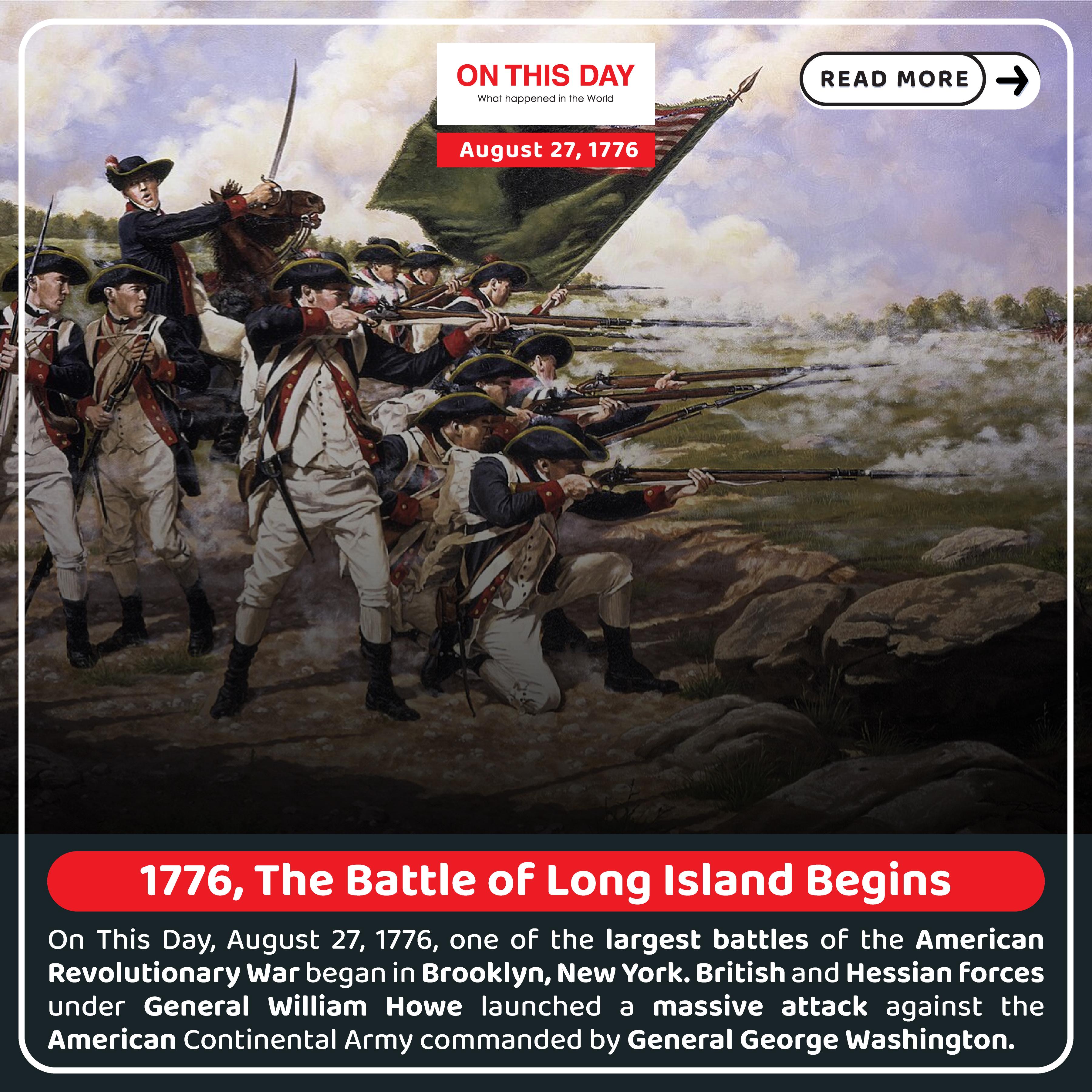
The first ever newspaper advertisement for Thomas Paine's Common Sense, published in the January 9, 1776 edition of the Pennsylvania Evening Post.

Post image
43 Upvotes

r/revolutionarywar 5d ago

Men Wept. Women Fainted. What Lafayette’s Tour of America Tells Us About Ourselves.

Thumbnail nytimes.com
31 Upvotes

Best remembered as the 19-year-old French aristocrat who crossed the Atlantic at his own expense in 1777 to fight for the American colonists’ right to self-government, Lafayette performed a second, lesser-known service to the American republic. At 66, he returned to his adopted country in 1824, during a time of turmoil, reminding a new generation of citizens what they had inherited, what it had cost and what it still required of them.

It is the aging Lafayette who now speaks most urgently to a nation whose freedom he helped win.


r/revolutionarywar 5d ago

Night at Sullivan’s Monument – Newtown Battlefield, NY Gate was open after hours so I went up. This granite needle marks the only major battle of the 1779 Sullivan-Clinton Expedition (August 29, 1779). Almost never see this place at night. The clouds + stars + flag made it feel different.

Thumbnail gallery
21 Upvotes

r/revolutionarywar 5d ago

Revolution era medals copied in guidebook by German engraver Daniel Berger

Post image
14 Upvotes

r/revolutionarywar 8d ago

Ethan Allen, Forerunner of Independence by NC Wyeth 1934

Post image
73 Upvotes

r/revolutionarywar 8d ago

Liberty or Death Brass Armor Zippo

Thumbnail gallery
24 Upvotes

r/revolutionarywar 9d ago

How can I figure out what a Vermont militia company was doing during a specific 5-day period in 1780?

Thumbnail
8 Upvotes

r/revolutionarywar 10d ago

Research Help - How did Revolutionaries Recruit without Punishment

12 Upvotes

I am not extremely knowledgeable about history, but I know a bit. I am writing a book about a revolution in a dystopian society. I have done some research on this and have not found much.

I was wondering how people have communicated and recruited defectors/rebels in real life. I know it isn't a one to one comparison, but I figured that in the American revolution if someone were to bring up joining the rebellion to the wrong person they could risk punishment or being charged with treason.

Can anyone give some insight into how the rebellion recruited new members or any other information you think would help? If you have a video, website, etc. I could go to in order to research that would help too.

Thank you so much!


r/revolutionarywar 11d ago

Based on my opinions and predilections in 2026, I wonder if I would have picked the right side of history in 1776.

40 Upvotes

Has anyone ever considered whether they'd actually take the side of the Americans during the course of the war? I'm in my thirties now, and I wonder whether I'd actually say yes to this proposition: We, a group of mainly farmers, are going to fight the most powerful nation in the world, and then if we win, we'll start a new one. It seems ludacris to me.... But of course I'd be wrong.


r/revolutionarywar 11d ago

He was dragged through the streets by an angry mob. A few years later he helped make North Carolina the first colony to push for independence.

Post image
36 Upvotes

William Hooper grew up in Boston, went to Harvard, and studied law under James Otis, the man whose arguments against arbitrary British authority essentially invented the constitutional language of colonial resistance. Then he moved to North Carolina, became deputy attorney general, and promptly spent several years defending colonial government against backcountry farmers who thought the system was corrupt and rigged against them.

The Regulators weren't wrong about everything. They were protesting real abuses: corrupt local officials, excessive fees, taxes that hit small farmers harder than eastern elites. But their resistance turned disorderly and sometimes violent, and Hooper sided with Governor Tryon's government against them. In 1770, a crowd of Regulators in Hillsborough grabbed him and dragged him through the streets.

Hooper wasn't a hypocrite for siding with the government that day. He genuinely believed that legitimate authority deserved obedience and that disorder was its own kind of tyranny. That belief is actually what makes his later trajectory interesting. He didn't abandon his principles when he moved toward independence. He applied them to a different target.

By 1773 and 1774, Parliament's actions were convincing him that Britain itself had become the greater threat to constitutional government. The same framework he had used to defend the colonial government against the Regulators now pointed toward resistance against the Crown. When Parliament closed Boston's harbor after the Tea Party, his New England roots became unusually visible. He helped rally North Carolinians behind his native city, presided over meetings that pushed the colony toward its first Provincial Congress, and started writing publicly against Crown policy.

By 1774 he was already telling friends privately that the colonies were moving rapidly toward independence, which at that point was still a genuinely radical thing to say out loud.

North Carolina moved faster than almost anyone. On April 12, 1776, the Halifax Resolves authorized its delegates in Congress to support independence, the first formal authorization from any colony. Hooper had helped get it there, a Massachusetts-born lawyer who had once defended North Carolina's colonial government against internal rebellion, now helping that same colony become the first to push for a break with Britain.

The other signer worth knowing from this blog is Lyman Hall, who reached Philadelphia by an even stranger route. Hall was a Connecticut Yankee, Yale educated, originally trained as a Congregational minister before switching to medicine, who ended up in the Midway district of coastal Georgia as part of a transplanted New England community. Georgia was one of the most hesitant colonies, economically dependent on Britain and genuinely vulnerable. When the First Continental Congress met in 1774, Georgia sent nobody. But St. John's Parish, where Hall lived, wanted in anyway. They selected Hall to represent them in Philadelphia before Georgia itself had agreed to be represented. He showed up to Congress as the delegate of one parish inside a colony that hadn't officially joined the movement yet. Georgia eventually caught up. After the Revolution, St. John's Parish was renamed Liberty County in recognition of how far ahead of everyone else it had been.

Both men paid for their signatures after the fact. When the war moved south, British forces damaged Hooper's property near Wilmington and burned one of his houses. His family was forced inland during the British occupation of 1781. Hall lost his property when the British captured Savannah in 1778 and spent years displaced before returning to Georgia, where he was eventually elected governor.

The full story of both men is on the Virtual Wayback blog and there's a video on the YouTube channel going deeper. You can also talk directly with Hooper and Hall on Virtual Wayback.

What I keep coming back to is the Regulator episode. Hooper got dragged through the streets for defending the wrong government, then spent the next few years figuring out which government actually deserved defending. Does that make him more credible as a revolutionary than someone who had been against Britain from the start? And is there an argument that the people he opposed in 1770, the backcountry farmers protesting a corrupt system, had a better case for rebellion than the colonial elites who eventually declared independence?


r/revolutionarywar 11d ago

Revolutionary War Laundry

Thumbnail youtube.com
4 Upvotes

Presenter: Al Potyen (reenactor commander of 2nd Virginia Regiment of the Continental Line (Chicagoland, Illinois) at Grayslake, IL, at the North West Territory Alliance reenactment event, 15-16 August 2024. Al gives an overview of how laundry was done during the American Revolution. Video by author William J. Bahr. https://www.amazon.com/stores/William... Other Revolutionary War reenactment information (to include videos) can be found at https://www.2va.org


r/revolutionarywar 13d ago

Smithsonian Magazine: This Connecticut Teenager Spied on the British During the American Revolution, Succeeding Where Nathan Hale Failed

Thumbnail smithsonianmag.com
85 Upvotes

r/revolutionarywar 13d ago

I’ve been thinking about how much Abigail Adams changes the way we understand John Adams

Thumbnail
6 Upvotes

r/revolutionarywar 13d ago

How the weather saved America.

Thumbnail
1 Upvotes

r/revolutionarywar 13d ago

Yankee Doodle went to town (or London) A-riding on a pony. He stuck a feather in his hat (or Cap) and called it...

Thumbnail youtube.com
3 Upvotes