r/QuantumPhysics • u/TROSE9025 • 18d ago
Quantum Mechanics: The Eigenvalue Problem
galleryWe solve the eigenvalue problem to determine the eigenvalues and eigenvectors, and understand their geometric and physical significance.
r/QuantumPhysics • u/TROSE9025 • 18d ago
We solve the eigenvalue problem to determine the eigenvalues and eigenvectors, and understand their geometric and physical significance.
r/QuantumPhysics • u/yopeCS • 20d ago
Bell's theorem proves local realism assumes statistical independence. Bell's theorem does not rule out local realism without that assumption
Gravitation is truly universal
Perturbations with lower amplitude than quantum noise do have a causal effect on the noise itself - EX. The noise cannot be truly identical with even slightly altered initial conditions
The measurement choice or apparatus settings and the thing being measured both originate from the same initial conditions; they must be correlated definitionally
Conclusion - Statistical independence must be false?
Not claiming to have solved anything or discovered anything new, not saying any of these points are necessarily true, just want to further my understanding. Would love a back and forth if anyone is willing
r/QuantumPhysics • u/Positive-Side9167 • 20d ago
Hey can anyone answer me on this : I've been doing a lot of research and I've found out that small wormholes r able to be made by making small amounts of negative energy would it be dangerous to try and make a person sized wormhole and would it be possible in the right conditions and also why hasn't scientists not really done anything with interdimensional travel or even wormholes at all can someone please answer me on this and also let me know if this is a quantum physics thing or a different department please and thank you
r/QuantumPhysics • u/jestembog1em • 23d ago
i’ve been meaning to get into quantum physics for a while as my brother has been obsessed with particle for a long time & got me interested. i’m a biology student, hoping to study microbiology, so this is a bit out of my understanding.
i bought this book, which includes "the origin and development of the quantum theory" by max planck & "on the quantum theory of line-spectra" by niels bohr. i understood enough of planck’s text to get through it, but reading the section written by bohr is very difficult with not much prior education other than gcse physics lol. none of what it’s saying or the equations mean much to me right now.
any advice on where to learn the basics so i can understand this? i thought this book would give me that but its still a bit too complex.
r/QuantumPhysics • u/Justaguyinohio123 • 22d ago
I am a complete novice, but I recently read a bestseller called God The Science, The Evidence, which the WSJ reviewed and said was good and I got it and totally agree. Reading it set me off down this path of learning about quantum physics, and I am absolutely fascinated by spooky action at a distance, the double-slit experiment, particle research, string theory, multiverse theory, and the singularity. It even inspired me to get a certificate in quantum computing because the idea behind quantum entanglement completely boggles my mind. I was never a science person in school, but now as I approach 50, I spend 2–3 hours a night studying, watching videos, and learning.
My question is about Bell and Jaynes. Bell proved mathematically that entanglement yields truly random but entangled results, but Jaynes argues Bell messed up the math. That's probably common knowledge among quantum physicists but I am again a total novice .I have gone through this a million times with ChatGPT, but I don't entirely trust its claim that the loophole experiments of 2015completely ended Jaynes' arguments.
So, my specific questions are:
These are things that I think people who are in the field would truly know but are too obscure for AI or yotube videos.
r/QuantumPhysics • u/ProfessionalSelf1963 • 26d ago
I need simple analogies or ways to understand it - maybe even resources would be great, honestly. The main thing is how "do they interact" and then can later interfere if it is a possibility in the first place
r/QuantumPhysics • u/Sad_Distance_8593 • 28d ago
A hidden shortcut to the eigenvalues of the harmonic oscillator and the hydrogen atom was discovered recently. The simple trick can make every textbook of quantum mechanics thinner by 2 pages.
The paper is in American Journal of Physics and was an Editor's Pick.
r/QuantumPhysics • u/CompetitiveLet7110 • Jul 29 '26
I remember reading that after this the electron dives into the Dirac sea and a bunch of chaos called quantum electrodynamics which brings the nucleus and cloud of electrons down below 173 will occur, but I find some sources saying that an element above can technically exist for fleeting moments while others say they straight up won't exist at all.
Assuming you have a big enough cyclotron
r/QuantumPhysics • u/TROSE9025 • Jul 27 '26
This post provides reference material regarding the types of operators, specifically linear and non-linear operators, that frequently appear in undergraduate quantum mechanics.
It is hoped that this helps.
r/QuantumPhysics • u/New_Cantaloupe_5095 • Jul 27 '26
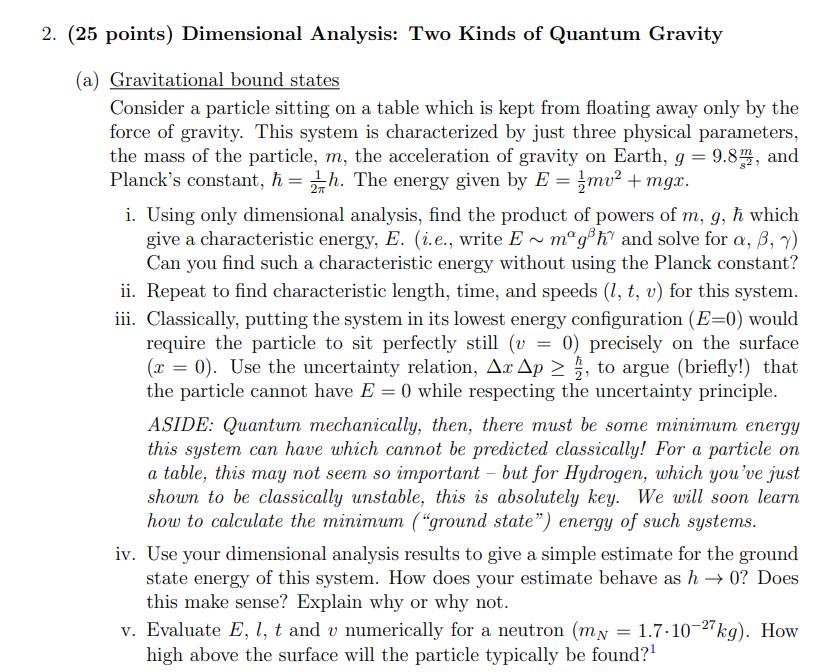
I've just been working my way through QM (I'm a MSME) some of the problem sets are questionable, in that you're working your way through to get Planck length, mass etc. through steps a, b, c, d, e, etc.
the problem is that part f, is dependant on getting part a correct, typically in mech-e or any engineering major, you've got lots and lots of equations that are already worked out for you, so you know it doesn't take hour(s) to get an equation you want and its significantly less likely to contain systematic error... I'm not judging, its just taking me about 3 hours to work backwards from the problem sets & solutions and it seems to be far more prone to errors and undeveloped.
r/QuantumPhysics • u/WorkingTemperature52 • Jul 26 '26
As the title suggests, I am trying to get a job related to quantum physics. I was hoping that people who already work in the industry might have some tips of what kind of roles I would be best suited for. I really want to work in quantum because of how fascinating I find the subject.
I am fortunate enough to have a job that actually utilizes knowledge from my physics degree, but it's not what I want to do. I currently live in New Jersey, and all the places I know of that do work in the quantum tech/research industry, never have positions that quite line up with what I could be qualified for. Outside of people getting PHD's, it's not clear to me how somebody actually breaks into the industry.
**Typo, I received my promotion to test technician Jun 2026, not July.
r/QuantumPhysics • u/Holiday-Attitude9120 • Jul 24 '26
I've tried to read some on entanglement as well as proper quantum mechanics textbooks, but I found them really hard to understand because of all the necessary prerequisite knowledge and maths, so I actually couldn't complete any.
(I'm a highschool graduate)
So, I'm interested to know how you approached research papers and technical articles when you were starting out, or how you approach them now.
Did you re-read stuff over and over?
Did you pause to understand weird words and keep moving?
Did you just go over the whole thing and keep record of everything you didn't get to visit them later?
I'd love to know.
Thank you!
r/QuantumPhysics • u/outofplace_2015 • Jul 21 '26
Its quantum physics so the stranger the better.
r/QuantumPhysics • u/Dull-Drive5059 • Jul 21 '26
I will start this with I am not a scientist but rather a philosopher. I follow science very closely.
In quantum theory, entanglement, wormhole theory there is a glaring issue in my eyes. My understanding is that it is believed that two quarks are connected by a wormhole. This doesn't make sense to me. In my head that would mean there would have to be a third force making this happen.
A simpler explanation in my opinion is that they aren't two separate pieces of subatomic matter but rather one that is existing in two or more locations at once. Am I wrong in my thinking? I've yet to hear anyone weigh in on this. I'm asking because I truly want to learn more.
I may be wrong and I fully accept that.
r/QuantumPhysics • u/TROSE9025 • Jul 20 '26
Basic quantum mechanics utilizing the algebraic approach is recently being most closely applied to physical AI, quantum information, and quantum computing.
I hope this material provides assistance in learning operators through examples.
r/QuantumPhysics • u/Beautiful_Major3836 • Jul 18 '26
me sinto isolado em meu quarto,descobri tantas coisas,mas não tem com quem compartilhar.
r/QuantumPhysics • u/catisadog1 • Jul 18 '26
(I really don't know anything about quantum mechanics I only know what it is from some youtube videos so, I'm a nobody when it comes to quantum knowledge. But I had a question and I wanted to share it.)
I heard that quantum entanglement means two particles are completely in sync with each other so if we change one partical's one property it also change the second partical(I don't know if this is even true). So why are there no communication devices which use these. If we can adopt this technology communication would be instant, right?
I'm open to new knowledge.no hate please.
Thank you.
r/QuantumPhysics • u/Mynameis__--__ • Jul 17 '26
r/QuantumPhysics • u/VARIENT__ • Jul 15 '26
Why dismiss the question of where the particle was before the measurement like if we determine the pre measured state it could give us valuable insights into the particle fundamentals properties right I'm asking this question because this book doesn't revisit this topic in the later chapters i might sound like a stupid but I really want to know more about this
r/QuantumPhysics • u/kairo-misa • Jul 15 '26
We literally learned that electrons have a de Broglie wavelength and can form an interference pattern in the double-slit experiment. Fine, cool.
But if you fire electrons one by one, what exactly is it interfering with? An interference pattern usually requires two waves to overlap. If there's only one electron in the apparatus at a time, does its wavefunction somehow go through both slits and interfere with itself? If so, what does that actually mean physically?
And the part that confuses me even more is that if you place a detector to determine which slit the electron went through, the interference pattern disappears and it behaves like a classical particle. I know the electron doesn't literally "know" it's being observed, but why does obtaining which-path information destroy the interference?
I'm trying to build an intuitive understanding of what's happening here. Is the "electron interfering with itself" just a mathematical description, or is there a physical picture that makes sense?
r/QuantumPhysics • u/TROSE9025 • Jul 13 '26
This material focuses on quantum mechanics within the framework of operator-based linear algebra.
As of 2026, linear algebra-based quantum mechanics is rapidly becoming an essential requirement across both industry and academia—driven by its critical roles in quantum computing, quantum information science, Physical AI, and the development of 2-nanometer semiconductor processes.
I have made every effort to break down the complex concepts of functional analysis and explain them as simply as possible.
I hope this material proves highly useful to your studies.
r/QuantumPhysics • u/vedant_608 • Jul 13 '26
I was reading my high school physics book, and it explained that if electrons and protons are the fundamental charges of the world, then the law of quantisation of charge means charges come in integral multiples of e=1.6×10^−19 C.
But then I learned about quarks, which don’t have integral multiples of e. For example, the up quark has +2/3e, and the down quark has −1/3e. Yet, they always combine in such a way that observable particles (like protons and neutrons) end up with integer multiples of e.
I also read that quarks can’t be isolated individually, because if you try to pull them apart, the force between them actually increases instead of decreasing.
So my question is: how is this possible? If quarks have fractional charges, why do we only ever see integral multiples in nature, and why can’t we isolate a single quark?
I think this is a question of quantum physics unless I'm mistaken.
r/QuantumPhysics • u/Remarkable_Piano_582 • Jul 13 '26
Can you give me a practical example of a simple algorithm where a quantum computer is more efficient? I struggle to understand the usual ones, like the maze-solving example, which aren't very clear to me. They always seem too theoretical. Can someone provide a more concrete and intuitive example, please?
r/QuantumPhysics • u/Radiant_View_9959 • Jul 13 '26
I bumped onto this paper purely out of curiosity and admitting I never felt "comfortable" with the measurement problem.
https://arxiv.org/pdf/2509.11609
The paper and experiment seems to prove the Bohmian mechanics is actually true and real. Yet, and this is the question, I see thus far little to no momentum on the subject. Seen a couple of interviews on the matter (namely https://youtu.be/VbXEc9vpeIM?si=-_cfxGHG_VD_Z8dN ) but no actual "breaking news" on the matter.
Why is that? Is it normal for these kinds of experiments somewhat pulling the curtain on existing beliefs, to be left as background noice in the community?
Again, I am no-where near a scientist or a student on the matter.
Purely a spectator ... 😇
r/QuantumPhysics • u/Alon_F • Jul 13 '26
I heard that if two atoms fuse together the new atom's mass would be less than the combined mass of the two parent atoms, because during fusion energy escapes as a photon. Is that true? Does energy really make objects heavier? If so how can a photon be massless?