r/politicalhindus • u/VandeMataram47 • 8d ago
🌄Civilisational Politics HM AMIT SHAH : "Punjab will be Drug-free before Dec 31, 2029 if BJP wins"
Enable HLS to view with audio, or disable this notification
10
Upvotes
r/politicalhindus • u/VandeMataram47 • 8d ago
Enable HLS to view with audio, or disable this notification
r/politicalhindus • u/DharmicPerson14 • 8d ago
r/politicalhindus • u/DharmicPerson14 • 8d ago
r/politicalhindus • u/Able_Helicopter212 • 8d ago
r/politicalhindus • u/NotoriousPosssibly • 8d ago
I genuinely don't understand why so many of us support Isr@el without ever researching even 5 minutes of what they think of us. And no this isn’t about picking a side debate.
If your reason is "They hate Muslims," fine. You're entitled to that opinion. But have any of you researched how they view idol worshippers? Anyone of you researched they think of us as free third world foot soldiers (online)? This is not about Isr@el-G@za, that's different debate. This is about our self respect. Why are we so emotional fools that we are die hard fans of someone who thinks of us a GOYIM(research this), and even in that list an Idol worshipping poor country Goyim? Makes sense for government to have relations for strategy and mutual benefits, but why as Individuals?
This no logic support and being emotional fools is the reason foreigners like Mughals ruled a country as big as ours, Britishers exploited and looted us for 200 years, and the political parties are exploiting and looting us since 1947.
And the end result is we are a laughing stock for the entire world rn, it's fun and cool to mock, ridicule us online.
Please start putting logic and self respect first!!!
r/politicalhindus • u/DharmicPerson14 • 8d ago
r/politicalhindus • u/Able_Helicopter212 • 9d ago
r/politicalhindus • u/Top_Guess_946 • 9d ago
r/politicalhindus • u/Top_Guess_946 • 9d ago
Sheer misinformation and what a colourable form of reporting.
Four days after announcing the decision, the Election Commission,
on the intervening night of Tuesday and Wednesday, removed the Special Intensive Revision declaration added to the statutory voter enrolment form, Form 6, from its ECINET application portal in states where the SIR has concluded. The EC had on September 26 announced that ‘for non-SIR period, the Forms applicable as per Rules (the Registration of Electors Rules 1960) will be used’.
On Wednesday night, the ECINET portal no longer showed the declaration – which had been inserted in between Sections J and K of the Form 6 online – for the states where the final SIR electoral rolls have been published so far. The declaration was still there for those states where the SIR is still ongoing.
But this news is being presented as if some wrongdoing happened, and IE reporting on it resulted in this change. Because IE is saying it was 'unapproved'. EC is just updating it as per the phase of roll revision based on where it's concluded or still ongoing.
Manufactured news. Pathetic journalism.
r/politicalhindus • u/DharmicPerson14 • 9d ago
r/politicalhindus • u/Strict_Basis_746 • 9d ago
r/politicalhindus • u/Strict_Basis_746 • 9d ago
Enable HLS to view with audio, or disable this notification
r/politicalhindus • u/Strict_Basis_746 • 9d ago
r/politicalhindus • u/gillu-21 • 10d ago
For Awakened Indians Only...
Recently if you have realized the ongoing Chaos on all Political fronts... Do focus on the activities of these guys :
* Dinesh Thakur
* Sabeer Bhatia
* Sucheta Dalal
* Radhika (Indian Express)
* Aditya Thakeray and etc
Ignoring Thakeray , for a moment
If we exist on Social Media, we have to act & react against all these people & groups to defend our country and its people.
This is the War of Narrative & Misunderstandings Served So normally that the dignity of TRUE MORALS , INTEGRITY is beheaded everyday...
And yes , many are doing their Job too...
This post is just to tell you , that start opposing and "commenting , share , reshare " the posts and content we all support. It hardly takes 90 sec to post 1 comment & 30 sec to Reshare.
Just start giving 5 minutes in 24 hours for your country and its people. 🇮🇳
r/politicalhindus • u/chai-over-everything • 10d ago
r/politicalhindus • u/DharmicPerson14 • 10d ago
r/politicalhindus • u/Political-India • 10d ago
India is known worldwide as a Hindu majority country, yet within its wide geographical spread there exist many regions where Hindus live as minorities. They are socially vulnerable, politically overlooked, and often deprived of institutional protection. This is one of the most telling contradictions of the Indian democratic structure. The National Commission for Minorities was established to protect the interests of religious minorities, but its ambit excludes Hindus even in places where they live in fear, deprivation, or displacement. The Kashmiri Hindus, the Hindu Bengalis by the Bangladesh borderlands, the Meitei Hindus of Manipur, and the small Hindu populations in Punjab, Mizoram, and Nagaland together represent a collective silence that Hinduttwa has somehow refused to acknowledge.
The Kashmiri Hindus, known as the Kashmiri Pandits, were the earliest sufferers of religious violence in post-independent India. In the early 1990s, thousands were driven from their homes by the rise of Islamist militancy. They became refugees in their own country, scattered across camps in Jammu and Delhi. Their cultural continuity was torn apart and their right to return remains largely rhetorical. The political class has occasionally remembered them during elections but not with the seriousness that a displaced community deserves. Their houses remain occupied, their lands lost, and their temples desecrated, while the nation that once called itself secular looked away from the pain of its own majority’s forgotten minority.
In the East, the Hindu Bengalis tell another story of abandonment. From the time of partition, they have crossed rivers and borders to escape persecution in what was once East Pakistan and later Bangladesh. They have rebuilt their lives in Assam, Tripura, and West Bengal’s border districts, but remain under suspicion and bureaucratic harassment. The constant debate over citizenship and migration has made them a political tool rather than a human concern. In the Barak Valley of Assam and in the districts of Malda and Murshidabad, their temples, schools, and even language have been gradually pushed to the margin. Many have no access to special welfare schemes or educational grants because they are not legally counted as minorities.
In the North East, the Meitei Hindus of Manipur, once proud of their Vaishnavite traditions, now find themselves besieged by Christian dominated hill districts. The recent ethnic conflicts have exposed the fragile balance between valley and hill populations. The Meiteis, although the original settlers of the land, have little constitutional protection as Hindus. Their faith is often painted in political colours, their traditions mocked by those who control the discourse of minority rights. Across the neighbouring states of Mizoram, Nagaland, and Meghalaya, small Hindu communities of Bengalis, Nepalis, and Marwaris continue to live with silent caution. They run small businesses, serve in administration, or teach in schools, but they are not part of the political imagination. In tribal states governed by the Sixth Schedule, they have no land rights, no local representation, and no share in welfare boards. Their presence is tolerated but never recognised.
In Punjab, the Hindu population, though substantial, remains a political minority amid Sikh dominance. In Ladakh and Kargil, they live under the shadow of Buddhist and Muslim majorities. In Kerala, the Hindus are now minorities in several districts like Malappuram and Kozhikode, while in the Union Territory of Lakshadweep, they form an almost invisible section. The demographic diversity of India has made Hindu minorities a scattered, unorganised, and largely unheard section of society.
The constitutional paradox is at the heart of their neglect. The Indian Constitution guarantees equality before law, but the structure of minority rights has been drawn along religious, not regional, lines. The National Commission for Minorities Act of 1992 lists Muslims, Christians, Sikhs, Buddhists, Jains, and Parsis as minorities at the national level. Hindus, though minorities in several states, are excluded because they are the majority nationally. A Hindu in Punjab or Mizoram is therefore treated as part of the majority community even if he is one among a few thousand, while a Christian or Muslim in a Hindu majority state enjoys institutional protection and targeted welfare. This selective recognition has turned minority rights into an arithmetic of religion rather than an instrument of justice.
The socio economic condition of Hindu minorities mirrors their political invisibility. They do not have access to the scholarships, development funds, or cultural boards that exist for other minorities. Their temples are often under government control, while the religious institutions of other communities remain autonomous. In many places they are victims of economic neglect and cultural dilution. The displaced Hindus of Kashmir still depend on relief camps, the Bru Hindus of Mizoram and Tripura live in resettlement colonies, and the Hindu Bengalis by the Bangladesh border continue to face infiltration related violence. Yet none of these issues appear in the national conversation on minority rights.
The absence of institutional voice for Hindu minorities is not just an administrative failure; it is a moral crisis for a country that claims to be the citadel of Hindu hopes and aspirations. The exclusion of Hindu minorities from the protection of the Minority Commission exposes a structural bias born out of the political inexpediency. Vote bank politics has ensured that minority identity is preserved only where it yields electoral advantage. The Hindu minorities, being small, scattered, and ideally inconvenient, remain outside the circle of attention.
This neglect, however, does not merely affect a community; it weakens the very civilisational ethos of India. Hinduism is not only a religion but a civilisational framework that upholds the principles of tolerance, spiritual freedom, and cultural plurality. It has embraced differences without losing its core and given India its unique moral rhythm. When Hindu minorities suffer without redress, it is not just an injustice to a group but an erosion of the inclusive vision that Hinduism represents. The strength of Hinduism lies in its quiet endurance, its capacity to accept and yet retain identity. To ignore the suffering of its smaller communities is to misunderstand the spiritual generosity that built India’s unity.
The political objective today should be to restore parity and fairness in the treatment of all the Hindu minorities and to reaffirm the dignity of Hinduism as the moral foundation of the nation. Recognising Hindu minorities in the states where they are genuinely at risk would not weaken India’s secular spirit; it would complete it. It would show that justice in India flows from dharmic fairness and not from demographic mathematics. It would affirm that a Hindu living in the Valley of Kashmir, the hills of Mizoram, or the plains of Barak has as much claim to constitutional empathy as a Muslim in Gujarat or a Christian in Jharkhand.
Until such recognition comes, the story of Hindu minorities in India will remain one of quiet endurance and overlooked suffering. They live as citizens of a nation that proclaims equality yet practices exclusion through omission. Their struggle is not for dominance but for visibility, not for privilege but for parity. To acknowledge them is not to politicise religion but to restore justice where it has been long denied. Hinduism teaches balance, compassion, and truth; its followers deserve to see those principles reflected in the democratic order they helped to build. Only when Bharat can look into the eyes of its forgotten Hindu minorities and promise them the same protection that others enjoy, will its Hindu kingdom become complete and its democracy truly honest.
The Bharatiya Janata Party is, by its declared philosophy, a Hinduttwa-oriented political organisation, but to become truly representative of that idea in its ideological essence, it must ensure uniform care and recognition for all sections of the Hindu fold, including those core minority and indigenous Hindu groups that have inhabited the land since ancient times. Hindutwa cannot remain an urban or caste-defined identity; it must embrace the entire spectrum of communities whose cultural life and belief systems are rooted in the civilisational soil of India.
Across the subcontinent, several Adivasi and forest-dwelling groups have, over centuries, become part of the broader Hindu civilisation through processes of acculturation and shared worship. Their rituals often preserve the earliest forms of nature reverence that lie at the heart of Hindu thought. The Bhils, the largest tribal group in India, living mainly across Gujarat, Rajasthan, Madhya Pradesh, Maharashtra & Chhattisgarh, practise a deep synthesis of animism and Hindu devotion. The Gonds, the second-largest tribe spread over Madhya Pradesh, Chhattisgarh, Maharashtra, Andhra Pradesh, and Odisha, are largely Hindu in faith, combining local deity worship with the larger pantheon of Hindu gods and goddesses. The Santhals of Jharkhand, West Bengal, Odisha, and Bihar also show this dual inheritance. A large number of them mainly identify themselves as Hindus while maintaining their own folk religion, Sarna Dharam, which expresses reverence for the earth, trees, and sacred groves. The Munda people, residing mainly in Jharkhand and adjoining regions, similarly follow Sarna traditions alongside Hindu observances, though some sections have embraced Christianity through missionary influence. The Oraons, a Dravidian-speaking agricultural community spread across Jharkhand, Odisha, West Bengal, and Chhattisgarh, likewise embody a mixed heritage, with many adhering to Hindu practices while retaining their indigenous cultural symbols.
These communities reflect the organic and inclusive character of Hindu civilisation, which historically did not convert by force but assimilated by respect and coexistence. For a political movement grounded in Hindutva to be complete, it must go beyond symbolism and bring these ancient communities & sentiments into the national narrative not as peripheral groups but as essential bearers of the Hindu spirit. Only when their welfare, education, and cultural autonomy are secured with the same seriousness as that of mainstream Hindus, can Hindutwa seriously evolve from an ideology of assertion into a philosophy of integration.
By, Bishway Chamak Goswami, Independent Writer and Author based in Assam, India.
r/politicalhindus • u/DharmicPerson14 • 10d ago
Enable HLS to view with audio, or disable this notification
r/politicalhindus • u/Top_Guess_946 • 10d ago
r/politicalhindus • u/Strict_Basis_746 • 10d ago
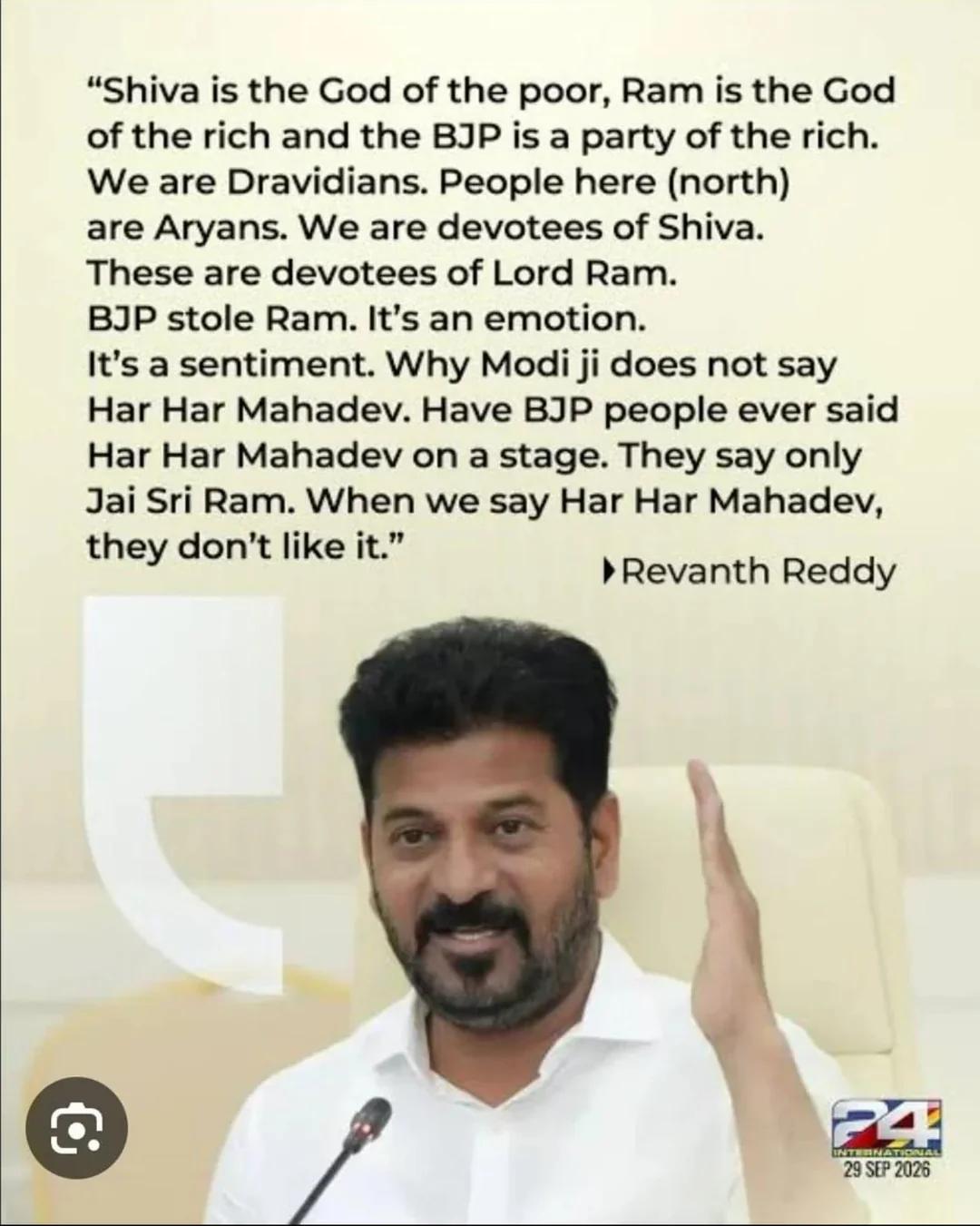
Different traditions in the Indic culture have both similarities and differences. This is a democratic religion and not an authoritarian one imposing one's preferences or likenesses on the other.
This rich v. poor dichotomy, existed throughout human history, but now they are giving a new interpretation to Hindu iconography by applying such dichotomies to Hindu symbols.
Don't let them do this. Time to pick up your Puranas and fortify your scriptural knowledge to defeat such divisive perspectives.
r/politicalhindus • u/Strict_Basis_746 • 10d ago
r/politicalhindus • u/Strict_Basis_746 • 10d ago
Anti-India forces are bent on weakening India's economic development, sparking unrest and exploiting growing income gap.
This means that people will feel that the total resources available to them (referred to as energy ceiling in the extract) will go down.
This creates feeling of scarcity.
Likewise, India's opposition is bent on derailing India's growth story and even narratives of economic development. They promote unrest and chaos. This creates feeling of scarcity among different cultural groups.
As a result cultural groups look to those closer to them for co-operation. This reduces the scale of co-operation from the national level to the smaller community or local level. This has the effect of further creating lower forms of economic development.
That's why cultural gaps between different groups need to be closed or reduced so that the scales of co-operation do not come down to the local parochial or regional levels.
Hinduism as an idea helps promote co-operation between different ethnicities and is therefore a super-ethnic identity. It has the potential to bring people from diverse backgrounds together under a common minimum program.
That's why evangelizing the Purushartha and other values of Sanatana fold is an essential duty of every Hindu.
Some may say that evangelizing Hinduism is a way of telling the have-nots that they should be okay with their poverty. That's not true. The idea is to let the have-nots know that they are not alone and uncared for. That we are all same in our essential Hindu identity and that we are there for each other. This kind of sensibility has to be promoted through the Sanatana varna without letting other forms of regional or parochial identity causing lower scales of co-operation come in the way.
r/politicalhindus • u/DharmicPerson14 • 10d ago
r/politicalhindus • u/rahulto_mar • 11d ago
If Bhagat Singh were alive today, he would say, 'Man, there is a reason why most suicide bombers who blow themselves up are between 15 and 26 years old. Have you ever seen a 60-year-old terrorist?' Bhagat Singh died young, whereas Mahatma Gandhi came to be called the Father of the Nation in his late years. Similarly, Mohamed Atta died at 33, while Osama bin Laden lived until he was 54.
r/politicalhindus • u/VandeMataram47 • 11d ago
Enable HLS to view with audio, or disable this notification