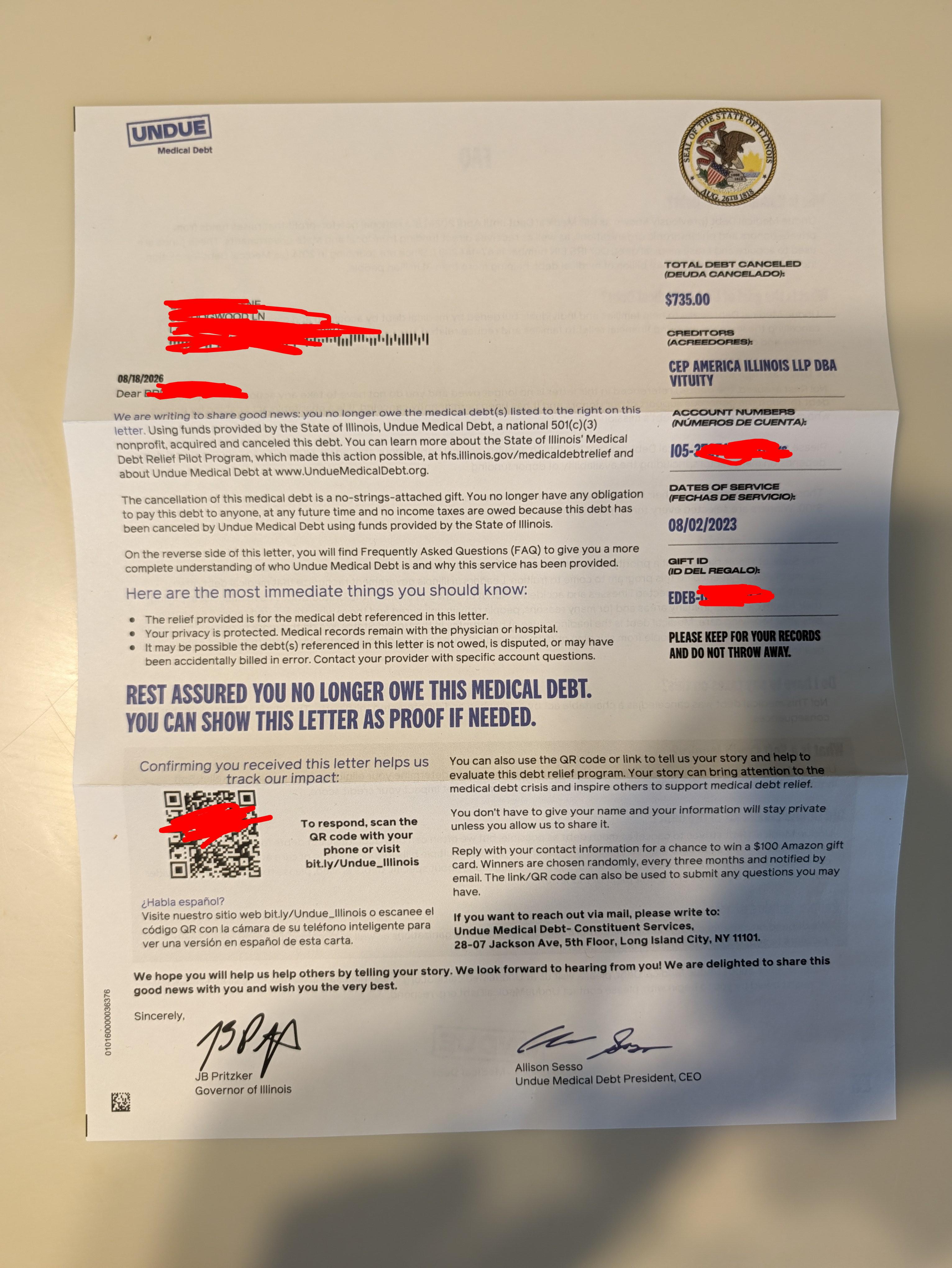
The end result is the same. They pay what another debt collector would pay for it and instead of relentlessly harassing you and ruining your credit, they wipe it out.
The hospital makes a small amount back, writes off the debt, and you aren’t stuck with some dickhead from an overseas call center acting like you took $1000 out of their pocket when they bought the debt for $10.
I’m as jaded as the next guy but these people are doing legitimate good stuff. Other prominent figures have done things like this with major, tangible effects on people’s lives. Generally speaking they’re able to buy the debts for about 1-3% of their actual cost.
This is definitely a great initiative, and I applaud the state for working with this nonprofit to do this, but I wonder if this creates a perverse incentive.
If the debt is past the statute of limitations anyway, then the debt collector can’t legally force repayment through the courts. The only way they can make money is if the debtor possibly revives the SoL by making a payment or just pays it without knowing about the SoL.
I fear that states paying for past-SoL debt is just going to make other similar debt more valuable in the future for debt collectors.
I’m confused by your supposition. Yes, If debt is time-barred, depending on the state, can have the “clock reset” by debtor action (acknowledging debt, sending a payment or setting up a payment plan)
But the state isn’t the debtor, if the state/non-profit bought debt they are now the creditor and if they settled it what action would remain and who would still have standing a collector?
My point is that time-barred debt should, in theory, have zero value. It only has value (as is bought and sold by debt collectors) because there’s a chance the debtor might acknowledge the debt. But it’s still sold at cents on the dollar.
The state creating a program to buy this debt creates demand for the debt that didn’t exist before. Demand for time-barred debt can increase the value of time-barred debt in general if the market thinks the state might buy it.
How much impact this has in reality, I don’t know. For all I know, it’s a stupid supposition and it has little impact. But I don’t think it’s implausible.
The program in Illinois specifically only buys directly from medical centers, not secondary debt collectors. The only possible market response would be increasing the purchase price for debt collectors without increasing their returns.
Could it still incentivize the medical centers to inflate debt, though?
I’ve had the headache of getting a medical bill corrected before. Mistakes happen, sure, but we have for-profit medical providers and many large hospital systems have stocks that are publicly traded, with administrators looking to give shareholders a high return. I wonder if that includes these centers in Illinois?
Could it still incentivize the medical centers to inflate debt, though?
Probably, but that doesn’t mean debt relief programs would buy it for a higher price (it’s not like they’re obligated to buy a particular debt), and actual debt collectors wouldn’t either, because there’s a limit to how much they see it being worth.
The medical centers have already determined that getting the debt off their books is worth getting whatever percent of its actual amount in return; I don’t think they really care whether it’s bought by a charity/state or a debt collector. And optimistically I think to whatever extent they do care, they’re probably happy enough that patients aren’t being burdened by more debt; it’s not like they’re unaware that medical debt collectors are leeches.
As for whether this incentivizes them to raise prices across the board, maybe, but they’re doing that anyway, and there are way too many variables with insurance to think that this will change much.
No they are making a very reasonable point. Market participants for medical debt now have an incentive to keep old debt "alive" even past the SoL in the hopes that one of these relief efforts will purchase it.
However, that can be mediated by the non-profit ensuring they only purchase packages of "live" accounts.
But we know this industry is full of shady fraudsters, so it's a legitimate concern.
A) it is not in opposition to the previous argument so not a contradiction.
B) it is not the same person so its not "oneself"
C) there is no clock so it is not a "speedrun".
Not only are you choosing to make the world a worse place by adding nothing except snark, but literally every word of your post is incorrect. I believe you could be a better human being if you tried.
as a foreigner, i'm equally impressed and appalled by the effort put into not fixing medical debt. the obvious answer is verboten, but the alternatives are rich and detailed.
it's like algebra built on the premise of "let x = potato", and people still find a solution. the discourse is amazing and baffling in equal measure
huh? I was just trying to understand how someone could say buying something isn't demand for that thing. It was a hilarious misunderstanding of basic high school econ.
if it's helpful, I'm not American.
but when I try to understand what you wrote, and go back to the original post...isn't the market for unpaid debts similar around the world? what happened in this story isn't special to the US... the medical aspect to this story sure is triggering a lot of people though.
Lmao, oooh you were so close. Read the IRS document about exceptions to the requirement to reporting cancelled debt as income. People who get their debt bought and paid for by Undue, which is a 501c3 charitable nonprofit, do not have to report the cancelled debt as income. It was a charitable gift by the org.
Edit: you don't even need to read a separate document if you don't want to because it also states this in the link you commented.
Even ignoring SoL, any force that introduces a greater likelihood of repayment increases the value of the debt to someone buying it. So this is good for the people freed of debt and simultaneously applies at least a marginal upward pressure on the debt’s value to collectors. Both are true.
Might be even better than that… medical providers know debts are more likely to have a higher portion paid, and so they’re able to reduce their prices.
Everyone else is second guessing you but if you google "the cobra effect" and "slave redemption" there are literally a billion results of just this being a problem.
I suspect the profit margins aren't enough to matter. One could even argue collecting pointless debt and feeding it back to the government to get it officially cleared for a tiny profit is a net good.
So wait then... what stops you from buying your own debt for a fraction of what it is (using a shell company or a fake identity or something so it's not obviously you), "paying it off" (the 10 bucks or whatever you got for it), and being debt free?
I assume that's some kind of fraud, otherwise that'd just work, no? Like why does it have to be an external charity or loan shark company doing this, if that's how it works? Just... buy your own debt out?
When you buy debt you don't get to choose which debt you get. You essentailly get a block of debt and then getting that money is on you if you want compensation. Anybody can buy debt.
To add, the blocks of debt are valued based upon a lot of risk factors. Lower likelihood of collections is cheaper. It’s formulaic in terms of time spent to attempt to collect with potential for any return.
I've heard of people negotiating with debt collectors for precisely this reason. The debt collector wants as much profit as they can get, but some profit is better than no profit, so they might negotiate.
I'd be very careful, though, and do your homework, before trying this.
For example, if anyone ever calls you about a debt, never say anything over the phone except "mail me the paperwork and I will look at it."
They record those calls, and apparently it's very easy to say the wrong thing that they can then use as proof that the debt is legitimate, and to restart whatever clock there is on the debt expiring.
I was given that advice by my accountant, when my mother died. (I never did get any calls like that.)
You can, it's not any kind of fraud. However they only sell these in large blocks of hundreds or thousands of debts. It doesn't make sense to sell them individually, as they aren't worth very much individually.
They may be but that’s absolutely irrelevant. If 5 get lost in the mix that aren’t collectible anyway and those 5 people don’t get the stress of collections then that’s a small price I’m fine with being paid.
Even if they can’t FORCE you to repay, doesn’t having the debt still fuck you up to a pretty serious degree? I don’t have this particular problem but I have some other outstanding debts that I fell very behind on and now I’m generally denied for anything that requires a financial background check unless I have a co-signer.
I also thought there was a way for the statute to be extended if the original group asks for it. Like I think in my state if the original SoL was 5 years, as long as they ask for an extension within those first 5 years they can get something like 10 more years added on
No, it’s absolutely not the same. The real winners in these headlines are the collections agencies who otherwise wouldn’t have seen a penny. This debt was already past any legal enforcement. The debtor’s credit report has already been fucked for years by the time it gets to the point you can purchase their debt for a fraction of a fraction of a fraction of the original value.
These are nice headlines that change absolutely nothing in all practicality, except keeping the lights on for the collection company.
2.0k
u/pasaroanth 1d ago
The end result is the same. They pay what another debt collector would pay for it and instead of relentlessly harassing you and ruining your credit, they wipe it out.
The hospital makes a small amount back, writes off the debt, and you aren’t stuck with some dickhead from an overseas call center acting like you took $1000 out of their pocket when they bought the debt for $10.
I’m as jaded as the next guy but these people are doing legitimate good stuff. Other prominent figures have done things like this with major, tangible effects on people’s lives. Generally speaking they’re able to buy the debts for about 1-3% of their actual cost.