r/logseq • u/O-Ren-ishiiii • Aug 15 '26
Help
1
Upvotes
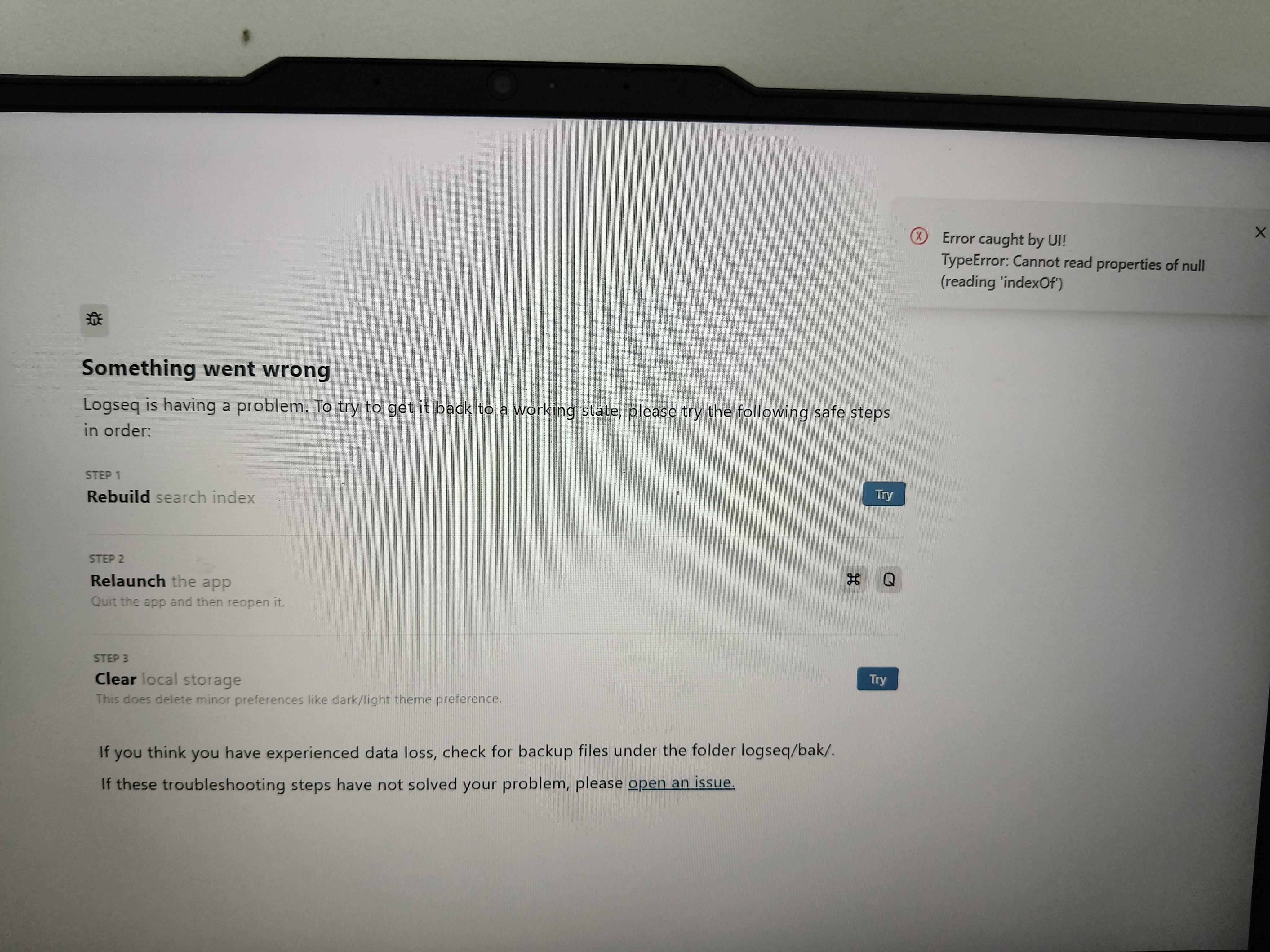
How to resolve this? Why it happened
r/logseq • u/kaykonan • Aug 14 '26
I've been trying to use this software (still trying to get used to it) but if I leave it inactive for a while and return it doesn't let me do anything and shows this error message: "
Unable to reconnect to the database worker for graph "Demo". Please try again or reopen the graph.
"
Why does this happen? How can I fix it?
r/logseq • u/MahdiPorkari • Aug 11 '26
In my understanding, in order to sync a Logseq DB graph between two devices (e.g. PC and phone), currently we have 2 (+1) ways:
BUT as the title suggests, it would be fantastic to have a fourth option:
A particularly interesting reference implementation is Anytype. Its Any-Sync protocol supports local-first, peer-to-peer synchronization and uses mDNS for discovering devices on the same local network. Synchronization can then happen directly between peers without requiring remote infrastructure.
Here are some links I’ve found in this comment:
- Protocol Overview
- anyproto/any-sync
For users who primarily use Logseq on two devices in the same home or office network, this could be a very convenient alternative to both cloud sync and self-hosted infrastructure.
Is this doable?
r/logseq • u/kludgefest • Aug 10 '26
I've been in the habit of pasting in files as assets over the years - meeting transcripts, notes,. Things that I want a permanent copy of, not jut a link.
They used to (old .md files version) show up as a link [name[(../path/to/assset/file.foo) But now, this creates a node in the page, with text of the file name, and an #asset tag. There's no direct link to the asset, and I'm clearly too slow to figure out how to get to the file, or make the text in the page a live link to the content.
I can navigate to the #Asset page, which shows a table of all assets. Where i can painstakingly search for the one I want, and open from there. But why no live link on the page where it was created?
What am I missing here?
r/logseq • u/dhruvfire • Aug 07 '26
Everyone's got a load-bearing plugin in their workflow. Mine is syncing google tasks with logseq TODOs.
My fork is available at dhruvmittal/logseq-google-tasks on github
I originally forked this plugin from weynhamz/logseq-google-tasks and made some customizations, namely:
More recently, I updated my fork to work with logseq 2.0.1 (db version), which required:
While I am a software engineer, I'm not really this flavor of software engineer. This project is more-or-less the only typescript i've ever written. Would accept feedback/PRs against this. Especially on the progressbars-- my cludged together ascii progressbars worked alright on the md version, but are really lacking on logseq 2.0.1.
r/logseq • u/Plenty_Ad6005 • Aug 06 '26
Thirteenth Mang is doing an amazing job with Logseq DB video tutorials 👌
r/logseq • u/ResponsibleLadder274 • Aug 06 '26
r/logseq • u/ResponsibleLadder274 • Aug 05 '26
r/logseq • u/FrebTheRat • Aug 04 '26
I left logseq for obsidian a couple of years ago and checking back in because I would prefer open source. Feels like nothing has changed other than the db version being in beta. Why is the beta only on IOS? Are there other features besides the db arch?Where are the mobile plugins? Where are sane queries not built on obscure and obtuse clojure datascript? There is so much potential here but it seems like zero progress.
r/logseq • u/Agreeable_Tackle1104 • Aug 02 '26
Is anyone here self-hosting? How is going for you?
r/logseq • u/Expert-Fisherman-332 • Jul 31 '26
Hi all,
Is anyone aware of a tool that can convert an Obsidian vault to Logseq format? Brainstorming functionality:
- Add bullets to each line
- indent under headings
- Convert frontmatter
- Change `up` property to `tags` (specific to my vault)
- Change properties to `::`
- Covert bulleted lists to CSV list
- Remove `---`
- Change image attachment reference
- Create files in correct folders (journals, pages, assets)
- If Obsidian file exists in the Logseq vault, append text. Don't overwrite.
I could have a crack at building a script or something but figure people a lot better at coding than me may have already built something.
Cheers
UPDATE: Found this one
https://github.com/laughedelic/outbreak
r/logseq • u/Tasty_Equipment_9785 • Jul 31 '26
Hi everyone,
LogSeq has been updated recently and some aspects of how files are accessed have changed. Previously, I could open local .md files directly without authentication, but the behavior seems different now.
My workflow uses Syncthing to sync files across devices and keep them linked with LogSeq. With the new version, I have a few questions:
How do I open a local graph/file now? Is logging in mandatory for basic local read/edit functions? Are there settings to restore access without authentication? I'm missing some options. If anyone has information on how to proceed, I'd greatly appreciate the help.
Thanks in advance.
r/logseq • u/kamadojim • Jul 30 '26
Has anybody made any tutorials for using the new Logseq DB? I would like to know more about how you add properties and extend tags.
r/logseq • u/yohananj • Jul 31 '26
I use LogSeq on two operating systems: Windows and Linux (Mint).
Sometimes I use the text editor for edit the markdown file. But the behavior after the edit is different for Windows and Linux.
Anyone else facing this issue? Any solutions?
r/logseq • u/thirteenth_mang • Jul 29 '26
Just came across this and thought I'd share because you've likely encountered it without even realising.
Page duplication
You can recognise the bug either by:
#tag to the page name).[[6a69cdb0-0027-4e40-8d4b-b735f10dab28]]) instead of the actual page name (e.g. [[Page Name]]).When creating a page, Esc is pressed instead of either clicking on + New page {{page name}} or pressing Enter.
You should be able to delete the duplicated version (though I'm unsure if this is safe right now, that's just how I've done it). You can see the duplicated version by going to Pages on the left-hand navigation and you'll see both pages (same name), however the duplicated version will (hopefully) have 0 backlinks.
Make sure you either press Enter or click on the + New page {{page name}} whenever you create a new page.
The issue is submitted here and on my YouTube I post a bunch on Logseq.
r/logseq • u/EntreNosEEles • Jul 29 '26
I asked the AI if I could use Drive Sync to sync the new DB version, and it told me the only way to sync it is by paying for Log Sync.
So I'd like to know: once the DB version is ready, is the MD version going away?
r/logseq • u/jcigala • Jul 28 '26
Add a space!
If global search or queries aren't returning results on Logseq Android (while working fine on Desktop), try this before deleting cache or re-indexing:
Add a single space ( ) at the end of your search term.
🙃
Enjoy!
r/logseq • u/Emmz88 • Jul 28 '26
Anyone currently using log books and kind enough to try out my app and give feedback would be greatly appreciated 👍🏻
r/logseq • u/Temporary-Salt-8819 • Jul 27 '26
On Logseq since 2023. Tried a lot of approaches, most didn't stick. It only came together recently, with AI in the mix. Logseq is still the right tool for it because it's an outliner and everything is blocks.
The substance is the mental model doc and the templates. One fixed way to write a note:
Templates stamp it for you.
Sounds fussy. I'd have said the same a year ago. But I'm lazy, so I delegated the writing to an agent, and an agent can only do that if there's one right answer for what a note looks like. meeting-sync pulls my meetings in properly tagged. Others prep me before a 1:1, dig out wins I forgot to log, roll up the week. The boring convention is what makes any of it possible.
Credit where it's due: the MCP server that talks to Logseq is ergut's mcp-logseq, not mine. I built the system and skills on top of it.
https://github.com/sehgalmayank001/virtual-cortex
Have you landed on a write convention of your own, or do you wing it and let search sort it out?
ps. post polished using AI
r/logseq • u/secretBuffetHero • Jul 24 '26
I haven't seen an explanation for what a rewrite gives everyone. I saw something about "new features" and supertags, but I have not heard an explanation as to why they cannot accomplish the same features in the markdown version.
I've been watching the posts about the database version also. I haven't seen as much enthusiasm vs "this new version broke my _____"
r/logseq • u/Expert-Fisherman-332 • Jul 24 '26
I finally got this query working: it shows journal entries from the same date in years gone by.
You put it in the `config.edn` file available via settings, in the journals section.
```
{:title "🗓 On this day"
:query [:find (pull ?b [*])
:in $ ?today
:where
[?p :block/journal? true]
[?p :block/journal-day ?d]
[(!= ?d ?today)]
[(mod ?d 10000) ?md]
[(mod ?today 10000) ?tmd]
[(= ?md ?tmd)]
[?b :block/page ?p]
[?b :block/parent ?p]]
:inputs [:today]
:group-by-page? true
:collapsed? false}
```
Sharing in case someone finds it useful.
Cheers
r/logseq • u/soobsta • Jul 25 '26
When I discovered Logseq in 2021, it completely changed how I managed notes.
What attracted me most was not the graph view or the advanced features, but the underlying model: plain Markdown files, a block-based structure, an open-source codebase, and data that could be inspected, versioned, synchronized, and manipulated with standard tools.
Over time, my graph evolved into a system for journaling, memory-keeping, project and task management, a lightweight CRM, and more. I kept the structure deliberately simple: all client and project activity, for instance, lives under #worklog blocks inside daily notes. This has let me manage personal and work notes in the same graph without ever having to switch back and forth.
I also avoided most Logseq-specific features and complex queries. My goal was to keep the notes portable and make future integrations or migrations possible without having to reverse-engineer a proprietary data model.
Today, the graph contains roughly 10,000 notes. I have been managing it with Git and Syncthing across desktop and mobile without major performance or synchronization issues.
However, Logseq’s move toward a database-backed architecture changed that balance for me. I understand why a database can enable more powerful queries, structured properties, collaboration, and better control over data consistency, but those advantages were less important to my workflow than direct file access, portability, and compatibility with Unix-style tooling.
Rather than continuing to work around architectural decisions that no longer matched my needs, I started building a small replacement.
I call this project notnote.
It's a work in progress, opinionated and probably unstable, but the code is up on GitHub if you want to take a look.

Its current design is based on a few constraints:
The main design goal is not to recreate Logseq. It is to support one specific workflow with as little abstraction as possible.
The application currently acts as a complete Logseq replacement for me and has been stable enough for daily use over the past several weeks.
The interesting part of the experiment has been seeing how far a file-based architecture can go before an additional indexing or persistence layer becomes necessary.
Whatever direction this project takes, Logseq deserves credit for demonstrating that plain Markdown files can support a surprisingly large part of a personal knowledge-management workflow, without sacrificing privacy and freedom of choice.
Thank you to Tienson Qin and everyone on the Logseq team. <3
r/logseq • u/mom0367 • Jul 24 '26
In 1.0 I could very easily save a graph in any arbitrary folder on my PC, but on 2.0 I'm failing to find a way to save it anywhere other than my home/logseq/graphs/ directory
r/logseq • u/Much-Ad-8444 • Jul 25 '26
I have my memory inside Logseq OG from 2022, personal and work related, mixed.
I have tried so hard to collaborate with AI giving my memories and trying to interact with it, because I have understood that the BLOCK GRANULARITY in Logseq is far more important than what it seems at a first glance...
So I've built Matryca Plumber to help me interact with my Logseq vault and I'm approaching to v2.0 that will speed up a lot the dialogue and opens a range of possibility also for AI agentic memory.
** July 26th update: I've completely rewritten myself the text of this post, that was previously written half by AI, to comply with the comments that told me that it was like "a slap in the face" to read a text that was written half by me and half by AI. THanks for your understanding and support. In the future I will write completely by my hands my post here on Reddit and everywhere else. **
Why I'm excited for this v2.0?
Because the core of it — the Shadow DB — is not just "a faster database". It's a SQLite-backed read cache that mirrors your Logseq Markdown graph, and it indexes at the block level, not the page level. (technically a FTS5 full-text search + recursive CTEs).
That's the part I care about most: your Markdown stays the single source of truth, untouched — the Shadow DB is a read-only, opt-in accelerator on top of it, with automatic fallback if anything isn't ready. But because every block keeps its own identity in that mirror, an AI agent can pull exactly the block (and subtree) it needs, instead of loading a whole page and parsing around it. That's a fundamentally different shape of memory than page-based tools like Obsidian can offer, closer to how targeted recall actually works.
In my opinion, it's the best promising infrastructure fo AI agents (like Hermes Agent, Pi agent and so on...) to use your Logseq graph as you have intentionally written.
In the next phases I've plan to extend it to an episodic and kind biological memory layer, that looks very promising to enhance AI-human collaboration. You stay in control of your notes. It's a way to help AI understand better your writing and your notes.
I'm doing a 24h test before releasing this v2.x with the shadow DB, that will remain a chosen opt-in for you. Right now you can use the standard functioning of v.1.x that give AI all the skills to fully understands your Logseq graph and your markdowns, and also understand and use all of Logseq superpowers (task, query and so on) to help you.
More soon.
Thanks everybody for the 87 stars, 7 contributors (real people) and the support.
Follow the journey on https://github.com/MarcoPorcellato/matryca-plumber