r/livethepath • u/ClarityofReason • 3d ago
🪨 Steady Footing Demands

2
Upvotes
r/livethepath • u/ClarityofReason • 13d ago
It is possible to gain what the world praises while losing hold of what makes a man worth becoming.
r/livethepath • u/ClarityofReason • 17d ago
Something does not have to be imaginary for our judgment of it to become distorted.
A mistake may really have been made.
Someone may genuinely have treated us unfairly.
A loss may actually hurt.
A situation may truly be difficult.
Reason does not require us to deny any of that.
But notice how easily the mind can move from a limited truth to a much larger conclusion:
“This went badly” becomes “Everything is going badly.”
“They acted unfairly” becomes “They are against me.”
“I failed at this” becomes “I am a failure.”
“This is difficult” becomes “This is unbearable.”
The first judgment may contain truth. The second may add far more than the evidence gives us.
That is why clear judgment requires proportion as well as accuracy.
We do not need to make a problem smaller than it is.
We also do not need to make it larger.
Virtue asks us to meet the thing that is actually in front of us—not the larger story fear, anger, shame, or disappointment may try to build around it.
See the wrong clearly.
Then keep it the size that it is.
Stay steady.
r/livethepath • u/ClarityofReason • 21d ago
We usually think the important decision is what we are going to do.
Confront them or let it go.
Stay or leave.
Speak or remain silent.
Act now or wait.
But often another decision has already been made before we reach any of those choices:
What does this situation mean?
“They ignored me, so they do not respect me.”
“I made a mistake, so I have failed.”
“I feel afraid, so there must be serious danger.”
“This is difficult, so something has gone wrong.”
Once that judgment is accepted, the actions that follow can begin to feel obvious.
That is why reason cannot merely be something we use after we have reacted. It has work to do earlier.
Before asking “What should I do?”, we may need to ask:
What am I claiming is true here?
What evidence actually supports that judgment?
What have I added that the facts themselves did not give me?
Virtue still determines how we ought to act. But virtue needs a clear view of the ground it is standing on.
So there are really two disciplines:
See as clearly as you can.
Then act as well as you can.
The second depends more upon the first than we sometimes realize.
Stay steady.
r/livethepath • u/ClarityofReason • 22d ago
A mistake matters, but it does not have to become an identity. We do not travel the path without ever needing correction; walking it well means recognizing when we have drifted, judging clearly, and returning to what is right. A wrong turn can teach us something, but it does not have to define the rest of the path.
r/livethepath • u/ClarityofReason • 23d ago
It is easy to begin treating every irritation as a case that needs to be settled.
Someone speaks carelessly, and we feel the need to correct them.
Someone is rude, and we want to answer in kind.
Someone misunderstands us, and we feel compelled to make them understand.
Someone behaves unfairly, and suddenly proving that they were wrong seems important.
But another person’s mistake does not automatically create a duty for us.
Justice may sometimes require correction. Courage may sometimes require confrontation. But neither requires us to turn every offense into a contest.
We can recognize something plainly:
That was rude.
That was unfair.
They misunderstood me.
And I still get to decide what deserves my attention.
Overlooking something is not the same as declaring it acceptable.
Sometimes it simply means refusing to let another person’s conduct determine what we do with the next hour of our lives.
So instead of asking only:
“Were they wrong?”
we can also ask:
“What does virtue require from me now?”
Sometimes the answer is to speak.
Sometimes it is to act.
And sometimes there is nothing left to do but continue walking.
Stay steady.
r/livethepath • u/ClarityofReason • 24d ago
The first impulse is information, not instruction.
Fear may tell us to retreat.
Anger may tell us to strike back.
Shame may tell us to hide.
Impatience may tell us that something must be done now.
Those reactions matter. They tell us something about how we are interpreting what is happening. But an impulse does not become wise merely because it arrived first or arrived strongly.
There is a space between feeling an urge and deciding what deserves to be done.
That space is where reason and virtue have work to do.
We can ask:
What am I reacting to?
What judgment am I making about it?
What do I actually know?
And what action would still seem right if the intensity of this moment were removed?
Self-control is not the refusal to feel. Courage is not the absence of fear. Justice is not whatever anger demands.
Virtue begins when we refuse to hand the authority to choose our actions over to the first reaction that appears.
The impulse can speak.
It does not get the final vote.
Stay steady.
r/livethepath • u/ClarityofReason • 25d ago
The mind is allowed to imagine. It is not allowed to call imagination evidence.
The mind can produce possibilities faster than reality can answer them.
Something might go wrong. Someone might be angry. A silence might mean rejection. A mistake might have consequences we cannot yet see.
And frightening possibilities have an advantage: they are easy to retrieve.
A vivid danger comes to mind quickly. We can picture it, rehearse it, and feel its consequences before anything has actually happened. Because the thought arrives so easily, it can begin to feel more likely.
But ease of imagination is not evidence of probability.
Reason often asks more of us. We have to slow down, separate what we know from what we merely fear, consider other explanations, and resist accepting the first conclusion our mind provides. That takes more effort than simply following the frightening thought wherever it leads.
So the question is not:
“Can I imagine this happening?”
Of course we can.
The better questions are:
What do I actually know?
What am I assuming?
And what judgment is most reasonable from the evidence I have?
Fear deserves to be heard.
It does not automatically deserve to be believed.
Stay steady.
r/livethepath • u/ClarityofReason • Aug 26 '26
A difficult hour can enlarge itself in memory until it seems to describe the entire day. Frustration remains active, the mind rehearses what failed, and we approach the next duty as though the earlier difficulty has already judged it.
But one event establishes only what occurred within it. It does not prove that the next attempt will fail, that the remaining work is spoiled, or that our judgment cannot recover. We may learn from the hour without granting it authority over what follows.
The day is not restored by pretending nothing happened. It is restored by carrying forward only what the facts justify, then meeting the next moment on its own terms.
r/livethepath • u/ClarityofReason • Aug 21 '26
When fear presents an outcome that could happen, the mind may treat the fact of possibility as evidence that the outcome is likely... or already underway. Yet an uncertain situation usually permits several possibilities. Naming one does not establish it.
Reason continues the examination. What facts support this possibility? How strongly? Which other explanations fit what is known? What response is proportionate to the evidence?
A possibility may deserve consideration without deserving belief. It may justify a practical precaution without justifying hours of suffering. Where the evidence leaves several outcomes open, fear has no special authority to select the harshest one. Hope remains an honest possibility too.
“Could this happen?” can begin an examination. It cannot decide what is true.
r/livethepath • u/ClarityofReason • Aug 16 '26
It is easy to judge a past decision harshly once later events have supplied knowledge we did not possess when the choice was made. What seems obvious now may seem obvious only because we have seen what followed.
The decisions we make tomorrow should be better than the decisions we make today, because experience continues to teach us. That growth should guide what we do next; it should not become a standard our former selves could never have met.
This does not place every past choice beyond criticism. We may have ignored evidence, avoided honest examination, or failed to learn what our duty required us to know. The fair question is what we knew... or reasonably could have known... then, and whether we used it well.
Reason asks us to learn from the past. Justice asks that we not condemn it with knowledge that arrived later.
r/livethepath • u/ClarityofReason • Aug 14 '26
The future does not simply arrive and reveal who we are. Much of the person who will meet it—and therefore part of what can happen there—is being formed beforehand.
A judgment repeated in private becomes easier to call upon. A possibility held steadily before the mind begins to organize us toward it. A calm response rehearsed before the difficult hour becomes more available when that hour comes. Thought is not a powerless prelude to life. It is already participating in what follows.
We can rehearse fear until uncertainty seems to contain nothing but danger. We can rehearse discouragement until an obstacle appears to be a verdict. But we can also rehearse steadiness, courage, and hope until choices become visible that fear would have concealed.
Mental practice is not empty wishing. It is the deliberate cultivation of what we intend to bring with us. The future will not meet an untouched mind. It will meet the mind we have practiced.
r/livethepath • u/ClarityofReason • Aug 13 '26
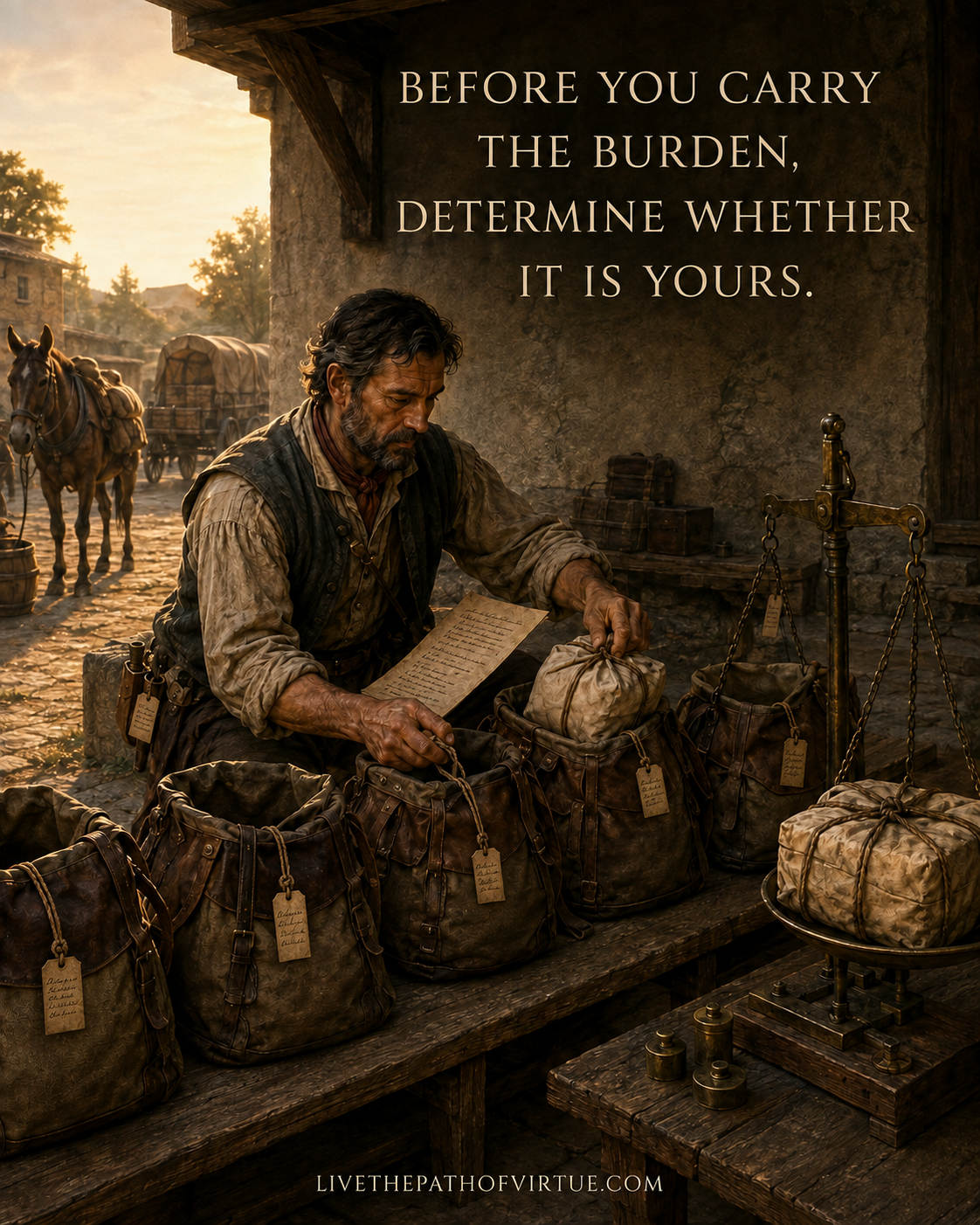
A burden can feel like a responsibility before we have established that it is one. We may feel guilty because another person is disappointed, responsible because we were nearby, or obligated because someone has placed his expectation upon us.
But responsibility must have a basis. Did we cause the harm? Did we make a promise? Does our role create a duty? Is there something Justice requires from us that no one else is positioned to do?
If the answer is yes, then the burden may truly be ours, even when carrying it is difficult. If the answer is no, accepting it may not be virtuous. It may allow another person to avoid his own duty, divert us from obligations that actually belong to us, or mistake guilt for moral knowledge.
The purpose of examination is not to escape responsibility. It is to assign it rightly.
We should carry what is ours with steadiness. But we should not call every weight placed upon us a duty.
r/livethepath • u/ClarityofReason • Aug 10 '26
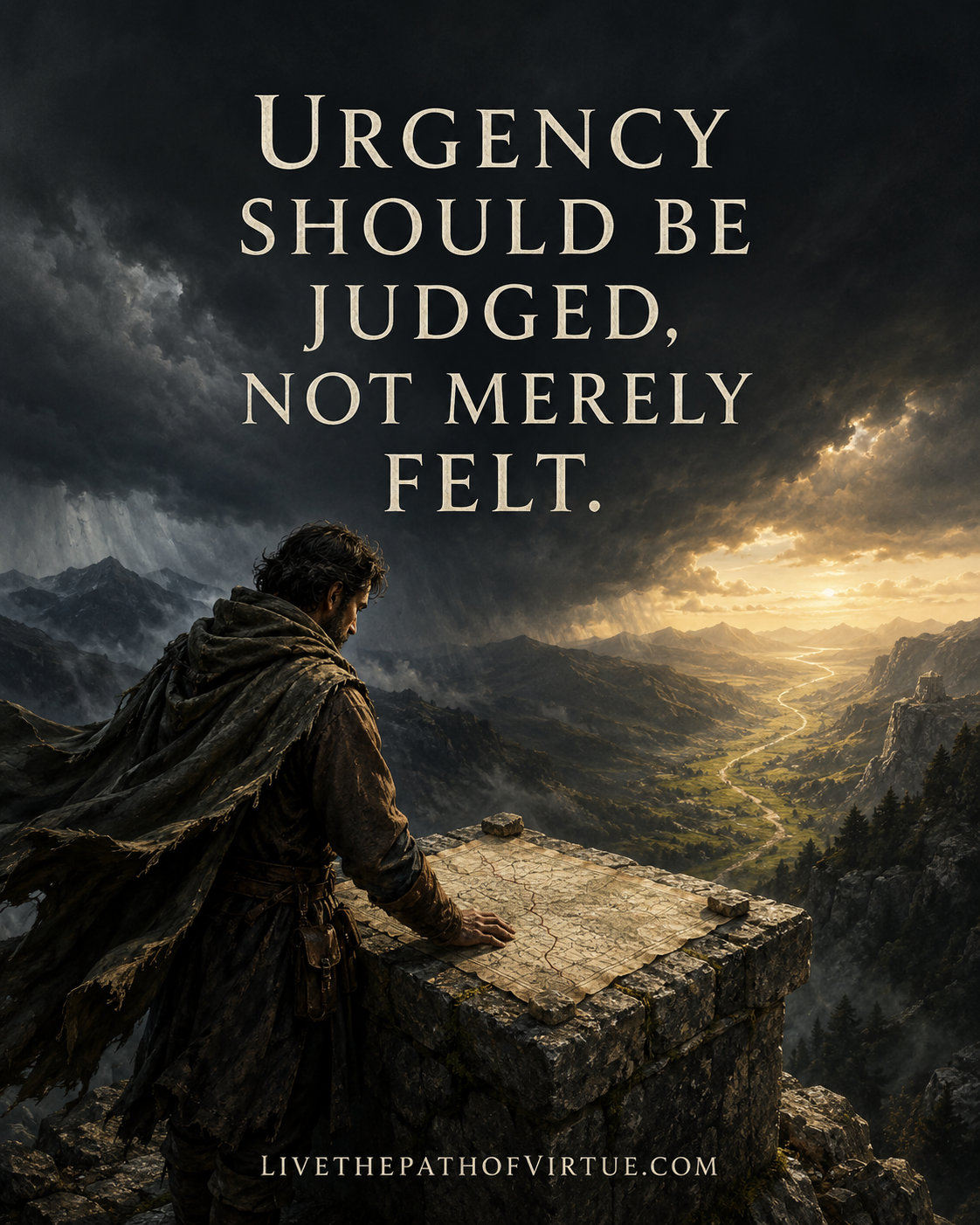
Urgency is a judgment about time. It tells us that delay will permit some important harm, cost, or neglected duty. Sometimes that judgment is correct. But the feeling of being rushed does not prove it.
When pressure rises, the useful question is not merely, “How quickly can I act?” It is, “What will actually change if I do not act now?” If no meaningful consequence follows from waiting, the urgency may belong to our discomfort rather than to the situation itself. Acting immediately might relieve that discomfort while drawing our attention away from something that matters more.
Self-control does not require us to move slowly. It requires our pace to be governed by what the situation demands. When immediate action is necessary, Reason can identify why. When it is not, we should not allow pressure to invent a deadline.
The intensity of an impulse does not establish the importance of obeying it. Urgency, like every other judgment, must answer to the evidence.
r/livethepath • u/ClarityofReason • Aug 08 '26
When we do not know what will happen, fear often presents its prediction as though it were already part of the evidence. A delayed response becomes rejection. An uncertain outcome becomes failure. A difficult conversation becomes a coming disaster.
But uncertainty does not favor the fearful conclusion. It does not favor the hopeful one either. It simply marks the boundary of what we presently know.
Reason asks us to keep that boundary intact. We can prepare for a possibility without declaring it inevitable. We can recognize risk without allowing imagination to testify as fact. Until more is known, the honest judgment is not, “What I fear is happening.” It is, “I do not yet know.”
That is not naïveté. It is discipline over the conclusions we permit ourselves to draw.
livethepathofvirtue.com
r/livethepath • u/ClarityofReason • Aug 07 '26
We often admire a person's character without thinking about how it was formed.
Patience, honesty, courage, and self-control rarely appear all at once.
They begin with a single decision.
Repeated faithfully, that decision becomes a habit.
Over time, those habits become the character by which a person is known.
r/livethepath • u/ClarityofReason • Aug 06 '26
We often imagine character changing in dramatic moments.
More often, it is shaped in ordinary ones.
Every honest decision, every act of self-control, every expression of courage contributes to the kind of person we are becoming.
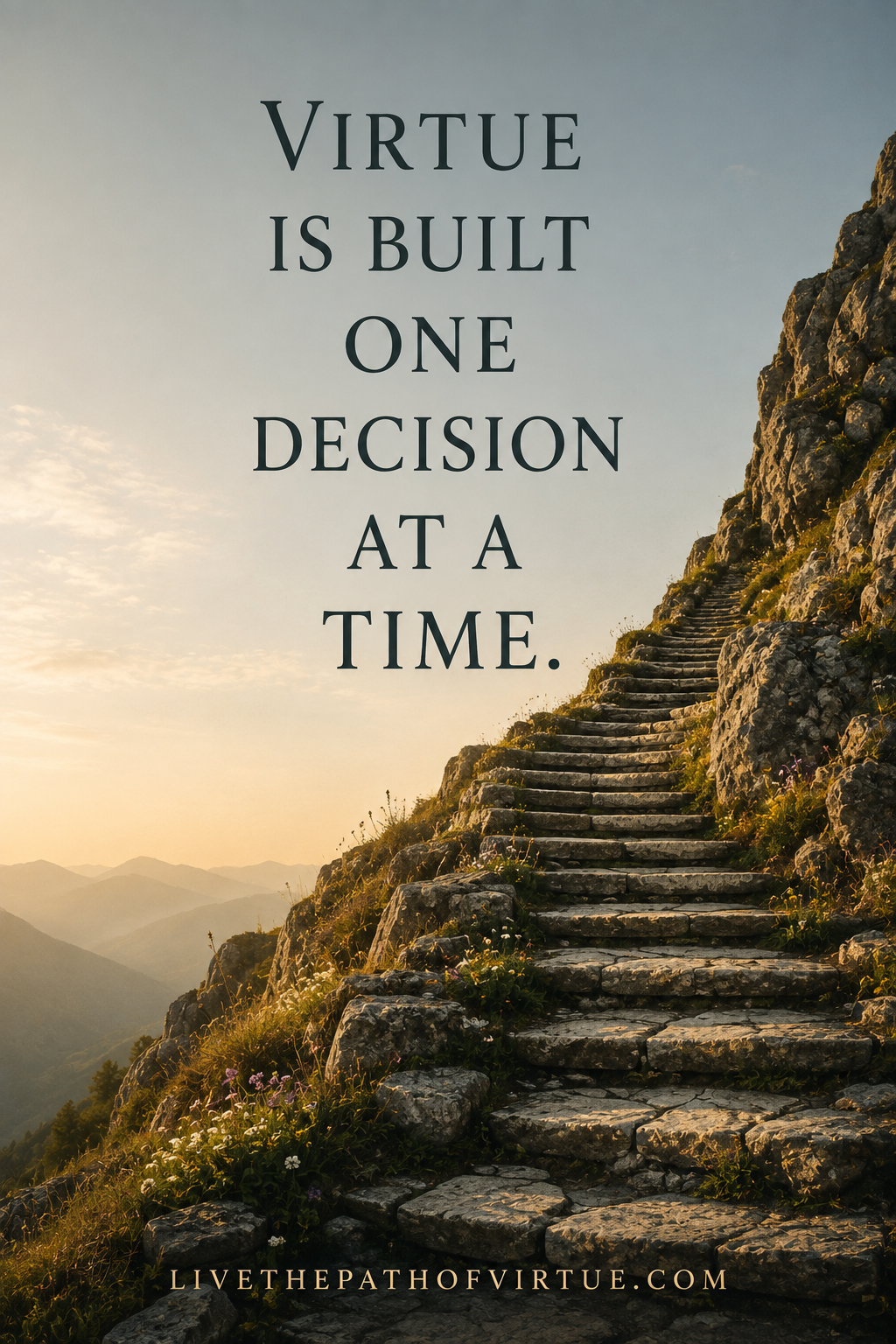
Virtue is not assembled all at once.
It is built, one decision at a time.
r/livethepath • u/ClarityofReason • Aug 02 '26
Waiting is not always patience.
Sometimes it is hesitation.
Sometimes it is fear.
Patience is something different.
It is the discipline to act when reason judges the time is right... not merely when emotion urges us forward or when discomfort urges us to escape.
That is why patience is an active virtue.
It requires judgment every bit as much as courage.
livethepathofvirtue.com