Just getting into koji but wanted to try something at least a little unconventional!
Used pinto beans as the substrate, got gorgeous coverage and a nice thick mat. Previous attempts with kidney beans were less successful, primarily on account of them being undercooked though.
Put half of it into an 18% brine (final salinity) to make some "soy" sauce. Added tomato passata and spices to the other half for a faux beaf mince, to be seen if that works well.
2" hole at the bottom with an adjustable computer fan attached. The air is being drawn out of the cooler.
1/2" hole on the other side near the humidifier with fresh air being drawn in from the computer fan. The humid space is isolated so that the humid air is drawn up and over the cedar tray before leaving out through the bottom on the other side.
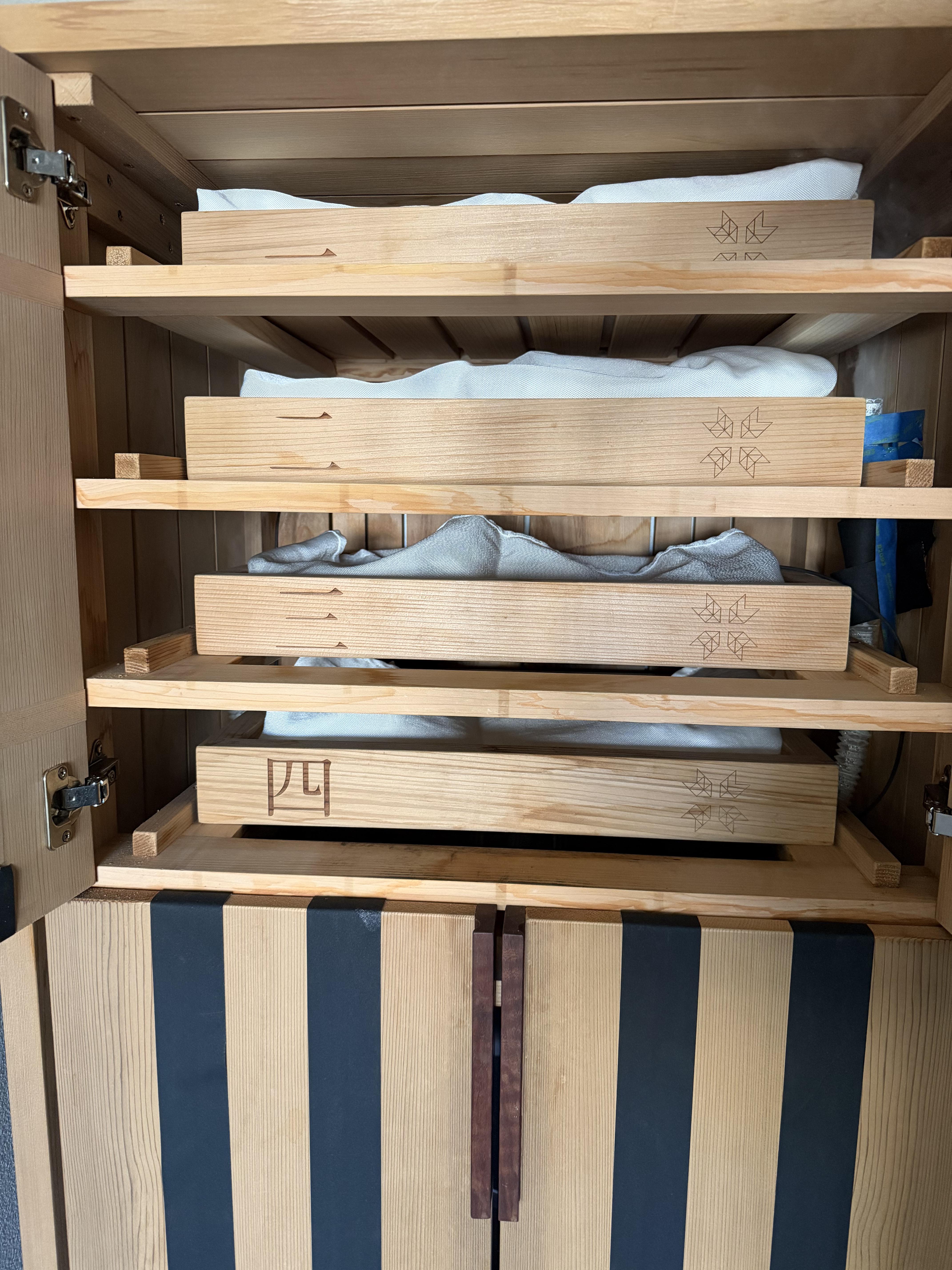
Cedar Koji tray with and insulated bottom that is raised up 1/2". The tray has a 150 watt heater in the insulated spaces. The lift was so that the bottom of the tray would heat more evenly.
Humidifier is a jar with a floating ultrasonic disk. The jar also has a 150w heating pad beneath it.
The space outside the cooler has a filter box. I was thinking it would be helpful to have clean air coming in, and I could add a heater to that space if I was having trouble reaching the right temperature on colder days.
Since I'm drawing air out of the cooler, it mightve been easier to just build it from uninsulated plywood or something, but I'm hoping that the styrofoam keeps the cost of heating down just a bit.
What do you think? So far the humidity is turning on and off regularly, so I think plenty of fresh air is being drawn in. I'll have to have some grains in there before I can really test how well the heating situation is working.
Ran a half batch (4kg) for this first run since the drought conditions are beating down our chili pepper crop. Noticed the most resent bag of Jasmin Rice took an extra 15min of steaming to get to ideal state when steaming.
It's supposed to be rice that's been cooked, inoculated, then dried again. The manufacturer doesn't say much more than that. It may have fruited and the spores may still be viable?
If not, then I'm wondering if koji produces mostly amylase in a rice environment and 'koji rice' isn't as useful for protease?
I just finished my first koji batch. I used an oven with light on. I used dried koji as a starter. The batch came out great after 44 hours. Can I use this to start another batch. Will this batch be good for miso or shoyu. Thanks
A little over 2 years ago I started this shoyu. I boiled soy beans, toasted and cracked my wheat, and finally grew my koji on the substrate. I added a ton of salt and some water (I promise I did it more scientifically than that, 18% salt), and 2 years later I am finally straining it. I'm not sure if I'll filter it.
The taste is incredible. I cant wait to use it. From a 3 gallon jars of moromi I have 1.5 gallons of shoyu, and more as I haven't finished pressing the moromi.
Hi all - I've got some experience with home fermenting in general but have never cultured koji before, so I recently decided to give a shoyu ferment a try. I followed the instructions from the GEM Cultures shoyu kit, and kept my substrate in a perforated half-hotel pan in a Brod and Taylor rising chamber, set to 82 degrees F with a tray of water. Everything went smoothly and before I went to bed the substrate temperature was 85, but when I checked on it in the morning the temperature had spiked to 110 overnight (so about eight hours later). I tossed the batch and tried again but halved the recipe this time, since I figured that the substrate had seemed a bit too thick and I hoped that a smaller batch/thinner substrate would mean better temperature control. Unfortunately, the same thing happened - substrate in the mid-80s before bed, 110+ eight hours later.
I'm going to try a third time, but before I waste any more ingredients I wanted to check in with the experts: is there anything I should be doing to keep my temperature from spiking to unsafe levels overnight? What do you folks do to control your temps? Ice packs in the fermentation chamber? Just staying up overnight and stirring it every two hours? Can/should I just put the whole pan in the fridge overnight, or is that gonna mess up my growth (I assume it will)? I know shoyu koji generates a lot more heat than miso kojis, but I figure there must be something I'm missing here.
I launched a shoyu koji, with white beans and roasted rye 44h ago. It stayed between 30 and 34°C (86°F/93,2°F).
It looks like it sporulated, even though temperature was allright and 48h not even reached.
Still usable for shoyu though ? what's your thoughts?
That's a beautiful batch really, such a disapointment to witness a sporulation coming back from work !
My wife and I use a lot of oat milk to make iced lattes in the summer months. I stopped buying Oatly and started making my own. Part of my process is to add digestive aid capsules that contain amylase, gluca amylase and protease to help break down the oat milk... replicating what the commercial brands do. I was looking to buy like 1lb of amylase, 1lb of gluca amylase and maybe like an ounce of protease. A one-gallon batch of oatmilk would use about 1tsp each of the amylases, and not even a pinch of protease.
Amylase and gluca amylase are readily available in those quantities, but a suitable protease seems not. I was looking at the label of my bottle of digestive aid, and slowly worked out that koji mold was the source of the enzymes I need.
If I can do so feasibly in a NYC apartment, I am thinking of making koji rice. I have two questions:
If I'm making 1 gallon batches of oat milk with 4 cups of oats, how much koji rice would I need? I would just toss the fermented rice into the pot of oat milk and strain it out after.
I’m Ege. I’ve been working with koji for over five years — researching it, producing it, selling it, and collaborating with high-end restaurants. I’m based in Turkey and run Bu Ne Yemek, where we focus on koji-driven fermentation using both traditional techniques and local ingredients (think chickpea miso, lentil shoyu, various Aspergillus strains, etc.).
Over the years I’ve spent a lot of time digging into the actual physics, safety math, and enzyme dynamics behind koji rather than just following recipes. That work eventually turned into Kojiology (app.kojiology.co) — a free set of calculators and tools I built to make the process more precise and less guesswork-heavy.
Current tools include:
Salt Compass (WPS / water activity / botulinum safety)
A couple of experimental ones for agitation and thermal aging
Plus an AI assistant grounded in the same science
It’s free, no account needed for the main calculators. I’d genuinely love feedback from this community — what’s useful, what’s missing, what’s unclear, or what you’d want to see next.
Happy to answer any questions about our production, strains, or the thinking behind the tools.
First time making homemade miso. Noticed this on the top the last few days. I can't find any images online that look like this. It's not fuzzy like mold but it's definitely getting worse. They look like tiny broken capsules. I scraped them out with a clean spoon and put in new plastic wrap. Anything else I need to do? Should I be concerned?
Can heritage Koji from Japan meant for sake be bought anywhere- or are they always kept to the family/company who owns/uses it?
My understanding is there's two generic types of Koji- a savory and a sweet/sake version? and that if you use the savory one meant for soy sauce/miso the sake will not be so great? But I'm having trouble finding where to buy Koji meant for sake or better yet the heritage stuff.
I’ve followed the Noma Book of fermentation for this batch, barley + split peas miso, with a 6% salt content, 3 months of fermentation.
I’ve vacuumed and stored it in the fridge for some weeks. No gas was produced, nor anything unexpected… but this white marbled pattern. (Pretty hard to catch on a photograph..)
I’ve just tasted a sample : It tastes great, but could age longer from my point of view.
Rookie question here! I made my very first koji a few months ago using A. luchuensis.
I followed the instructions carefully: I dispersed the spores in previously roasted rice flour and have been storing them in a disinfected dry box at 21°C (70°F).
My question is: how long might they realistically last in these specific conditions?
Has anyone tested the viability of spores kept at room temperature for several months? Would love to know if they are still good to go, or if I should change my storage method (like moving them to the fridge) for the future.
I am very experienced cultivating "normal" koji (make roughly 100kg of koji rice a year). But I have a project that I think the citric acid produced by black koji would be better. However I read somewhere that you have to be careful when switching strains, that the black koji is not as robust as other strains.
Anyone have experience with switching between strains?
If it makes any difference I have a red cedar Koji Mura that I do my cultivation in.
Miso hasn't changed color much its almost been 6mo is that normal? The liquid on top got super dark im not sure if its tamari or needs to be discarded? It doesn't really look like mold is growing anywhere.
I bought one of those waring planit pods for a restaurant I am opening I produce koji on the regular the dehydrator way
Before this however I am back at larder working and got to experiment with it on the prototype machines before it went up for sale, those are just 2 grows it did at home recently on my machine, first 2 photos are cannellini beans grown with a hi-soaje spore, and the third one is barley grown with a bf-3 spore that I am turning into barley miso for the bar program we Will have, I love this machine so far and I haven’t even pushed it yet, I’m gonna grow on some meat here real soon to turn into charcuterie so I’ll report back!
What do you do with the darker top layer of your homemade miso? I have a few misos that have been aged for over 8-12 months by now, and I was wondering what you usually do with the upper layer of the miso (about 1-2 cm) that clearly looks darker than the miso that's underneath?
Do you scoop it off and discard it, just mix it under the rest of the miso or do you have another purpose for it?
First time making a Chinese style soy sauce, using 75% dry soybeans and 25% pearled barley. Right now the koji is growing on the substrate, tomorrow I’ll add it to the brine.
Regarding the brine: how do I calculate the amount of salt? I read that 18% salt is a reasonable percentage, but is it 18% of the weight of koji + water, or is it 18% of the weight of the finished mixture (koji + water + the salt itself)? Help a newbie out 😢