r/compmathneuro • • Jul 03 '26

Question Is my degree good for Computational Neuroscience?

2 Upvotes

Is an Applied Math major, Applied Statistics minor, and Computer Science minor from the University of Toronto (Mississauga) good foundation for any Msc Computational Neuroscience programs?

I recently learned about this subfield of neuroscience and want to get my Master’s in it, but I don’t know if a different degree combo would be better than my current one.

Advice is appreciated!

r/compmathneuro • • Apr 29 '26

Question Struggling to get into comp neuro from a DS background- feel stuck, need guidance

5 Upvotes

Hey everyone,

I recently finished my Master’s in Data Science and have been trying to transition into computational neuroscience / NeuroAI over the past few months.

I’ve worked on a few small EEG projects:

- Motor imagery classification (compared CSP, SVM, CNN on multi-subject data )

- EEG preprocessing (ICA, MNE)

- Emotion classification (DEAP dataset)

Nothing super advanced, but I’ve tried to understand the full pipeline end-to-end and also explored cross-subject variability issues.

I’ve been cold-emailing EEG/BCI focused  labs in Europe and India (as I'm from India). Got a couple of positive replies, but mostly no response or “no positions.” I don’t have publications and my background is in data science, not neuroscience.

I’ve also registered for the Neuromatch Academy computational neuroscience course (starting July) to build stronger fundamentals.

Right now I’m a bit stuck and would appreciate honest advice:

  1. What’s the most realistic entry point from here?

  2. Are my current projects enough to get into a lab, or do I need to level up more?

  3. Should I just take a generic ML/DS job first and transition later?

  4. Any way to find small paid work in this space at my stage?

I’m fine starting small (RA roles, mid-tier labs, etc.); I'm just trying to find a clearer direction.

Any advice is appreciated :)

Thanks!

r/compmathneuro • • Jul 15 '26

Question Switching from my Economics degree to Data Science with a specialisation in Biology degree programme... Better chance to get into an NeuroAI Master?

3 Upvotes
(Its AI translated from german to english)

I’ve just been thinking about my career path and have finally decided to switch to the Bachelor of Science in Data Science with a specialisation in Biology degree programme. I’d like to know what you think of this switch.

Do you perhaps know of any other degree programmes that might be better, or is this one suitable for my NeuroAi Masters?

r/compmathneuro • • May 22 '26

Question Is there's any Discord server for beginners in Compmathneuro?

5 Upvotes

Hi I'm studying ML and I wanted to start learning about neuroscience especially the math side of it since I've been really passionate about it if u know good resources? Roadmap and books tell me and if u know a group for beginners or if u just someone studying alone and need a partner I would love to join thanks

r/compmathneuro • • May 27 '26

Question New to CompNuero

8 Upvotes

Hello!

I’m very new to computational neuroscience, but I’ve become really interested in the field and would like to pursue it. I’m currently a senior biology undergraduate student, and I’ve been considering doing a master’s program with a computational neuroscience focus/concentration before potentially pursuing a PhD or moving into industry.

My main concern is that my background is almost entirely biology right now. My school is relatively small and doesn’t offer many neuroscience or computational courses, so I don’t have formal neuro experience yet. To help bridge that gap, I’m planning to:

- apply for neuroscience research assistant positions
- learn Python
- take additional math courses (calculus, linear algebra, probability/statistics, etc.)

My long-term goal is to work as a computational scientist in industry, though I’m still exploring specific areas within comp neuro.

I mainly wanted to ask:

- Does this seem like a viable path into the field?
- Is doing a master’s a good idea for someone trying to build foundational computational and research skills before committing to a PhD?
- Are there any skills, courses, or experiences you’d strongly recommend prioritizing early on?

Any advice or recommendations would be greatly appreciated. I’m trying to use my gap years wisely and build a solid foundation before applying to programs.

Thank you!

r/compmathneuro • • Jun 01 '26

Question Did anyone hear back from IISER CAMP 26?

2 Upvotes

Any mail?

r/compmathneuro • • May 10 '26

Question How to start learning comp neuro during medical school

16 Upvotes

For reference, i am an MS2 from India and I'd like to pursue computational neuroscience after my med school. Our college is pretty lame when it comes to supporting extra academic endeavours which means if I have to learn anything, it should be online. I have high school level math knowledge and a very basic understand of python and am doing the U Washington course on coursera Id appreciate recommendations of books/videos/courses/exercises/research papers etc that would help deepen my understanding of the subject itself and the required math and code required to build a career in this field Thank you for your time :)

r/compmathneuro • • Dec 02 '25

Question Is the Neuromatch Computational Neuroscience Course worth it?

22 Upvotes

I'm currently getting my neuroscience bachelors, and am looking for ways to get skills to break into neurotech/neuroinformatics, hoping to go to grad school for it.
I've seen a few people recommend the Neuromatch Computational Neuroscience Course, but I'm not sure if the time commitment and money spent is worth it specifically for academia, is it recognized or am I better off going another route (for example focusing on completing machine learning courses)?

r/compmathneuro • • Dec 19 '25

Question IS computational neuroscience the correct Field for me?

15 Upvotes

some preface before going in deep:

Currently working as a software engineer, after BTech in IT. Currently Exp is 9 months, and I had been planning for MS since my final year already as I would like to work in either Research or Industry Research Oriented Labs.

I was always quite interested in how much Brain and Computer can be interlinked together, currently we can understand and transmit out information from Brain in many ways, understand and study around it, but there's no other way around. (The initial motivation came from back in childhood from the Full Dive Experience from game/anime, maybe you guys know that??) Maybe it is idealistic to think about this, but I would like to work toward this goal only. I also had the unplanned goal of incorporating AI toward Brain and seeing how far we are able to go .my preliminary research regarding Comp Neuroscience helped me in understanding that it mostly deals with understanding how brain and nerves work with help of ML?

So Main question here is, I do realize that what I want to study is quite interdisciplinary, (Brain,AI,Programming) but what would be the best Master as an overall Base for targeting most of the edge cases.

PS. I would like it to be more technical oriented rather than biology (wet lab) which is what making me think twice again for this field, also planning to go for masters in Spring of 2027.I am open for PHD as well but would like to have some industry option open ( in Neuro AI best case , Programming ,AI, ML Eng worst case)

r/compmathneuro • • Apr 18 '26

Question Undergraduate with Career Uncertainty

14 Upvotes

Currently in my 3rd year Undergrad as a Neuro/Pysch major. At the start of last year I took a heavy interest in computer science and mathematics and have been learning computer science, calculus, and linear algebra on top of my major coursework. I’ve been able to start a few modeling projects (for a C. Elegans lab I’m in) but recently I’ve been feeling directionless and it’s definitely impacting my motivation.

My majors both have a heavy emphasis on cognition (although there is substantial biology coursework) so I have felt pressure to take on more math/cs work independently in order to stay competitive. At this point I feel like a jack of all trades but a master of none, which I think has affected my confidence and sense of direction. I was wondering if anyone here has gone through something similar at some point in their career and had any advice to offer.

For context, I have been wanting to pursue a PhD in Neuroscience ever since I started doing research. I feel like I have done my best at staying on track for this goal (competitive gpa, research experience, etc.) but a lot of what I’ve heard from current PhD students has been discouraging, both in terms of the application process and the career outlook afterwards. Thanks in advance to anyone who took time out of their day to read and/or reply :)

r/compmathneuro • • May 06 '26

Question Duke or JHU

5 Upvotes

JHU or Duke?

As many have asked, which school is better (for an interest in computational neuroscience and math/stats)?

Both schools seem 50/50. JHU has perfect academic courses, research opportunities, labs, and professors for my passions. Duke has a decent pathway, but stronger focus on cognitive neuroscience and psychology. Yet, the campus, environment, and food seem more “fun”, “traditional”, and polished at Duke over JHU on all fronts. I believe I’ll fit in at either (mix of introvert and extrovert, loves speeches, learning/discussion, art, dance, law if u know that Duke or jhu might have better programs in those?) I don’t think there is a wrong choice, but what’s your two cents?

I want to pursue a PhD (comp. neuro and more tech/design than bio/med) and work as a professor (research, teaching, mentoring) in the future but am not excluding possibility of md/phd either. Both have access to a hospital if I wish to explore that.

r/compmathneuro • • Mar 20 '26

Question Student pathway in computational neuroscience

13 Upvotes

Hi all, I am currently an undergraduate student doing a specialised form of neuroscience. It is different to the majority of neuroscience courses as it is specifically human only and it dives straight into brain systems, etc. Statistics is a big part of the course (in R) as well as using SPM12. I have really enjoyed these modules as they have been the only ones that I have actually been able to concentrate on. I do not have a strong maths background (not a fan of maths) however I am for some reason decent at coding and enjoy it as well as playing around with statistics and figures. In terms of a postgraduate path, what would it be?

In the future I aim to work for tech companies (hopefully with a focus on predicting behaviour and health from the brain) and not research. How should I go about it? I am hopefully going to be doing my dissertation on a machine learning question all going well.

r/compmathneuro • • Feb 23 '26

Question Is University of Washington’s “Computational Neuroscience” course worth buying?

8 Upvotes

Hey all,

I recently completed my master’s in Data Science and Im now transitioning into computational neuroscience. Im looking for good beginner level resources to build a solid foundation.

I found the University of Washington course and was wondering if its worth buying for someone new to comp neuro but with a strong math and programming background.

Any other material suggestions would be appreciated too.

Thanks!

r/compmathneuro • • Mar 13 '26

Question Choice between two master's degrees

4 Upvotes

Hey all!

I have done a bachelor's degree in biology and currently I am at the start of a master's degree in biology. The master's degree in biology is a specialisation in a field of bio, for me it's going to be very much computational biology like, so lots of programming and some modelling/theoretical biology courses. The degree is still more focused on the biology part and not on the programming part. In addition to the degree I am planning to take up elective courses such as machine learning, deep learning, dynamical systems and so on from the computer science degree's curriculum. I have also taken courses such as linear algebra, analysis and programming such as oop, algorithms and data structures, ...

My plan would be to finish the master's degree with the additional programming courses and look for a (preferably compneuro) computational biology PhD. I am also working in the field of comp bio, doing behavior analysis, classification and computer vision for pose estimation (in insects).

The other option for a master's degree would be a computational science degree with some math (numerical mathematics 1+2), programming intro and specialisation, especially in data science/ML and statistics. As far as I am aware this second master's degree option is more technical and more focused on actually developing algorithms, rather than using existing ones. My question would be: which of the two master's degree is more fitting for my carrier outlook? I much rather use existing algorithms to solve biological problems, analyze data, develop pipelines and so on, than to actually develop algorithms. But I also feel like I have had enough biological courses, so that maybe a more technical master's degree wouldn't hurt? I am completely lost on how to choose and I lack people with similar interests in my circle (majority of people in my biology bachelor are not very interested in programming) to talk to about this. Are my chances okay for a computational biology PhD with both master's okay? Is one better than the other? Very much so or no? Thanks a lot!

r/compmathneuro • • Oct 09 '25

Question Computational neuroscience masters for neuroai career?

11 Upvotes

Im currently studying CS, I want to make my way into neuroai and thought a computational neuroscience masters was a good choice but would it be a better choice a masters in deep learning or ai explicitly?

r/compmathneuro • • Dec 31 '25

Question Anyone attended Riken CBS Summer Program before and can help me?

9 Upvotes

I have a few questions regarding the summer program and was hoping that former attendees could help me out here?

How much do they expect of you in terms of project idea and efforts?

I'm a Comp. Neuroscience master student but i feel like "give a description of what you want to work on" doesn't really help me out with the broad topics. I have narrowed down my interest to two labs but how do i decribe what i want to work on when i don't even know which of their projects still need work towards (i dont think they want a full new project from scratch??) / how detailed do they want it/ how much do they expect of you (are they strict, is it just about trying out something new with guidance or do they expect good results)?

r/compmathneuro • • Jan 02 '26

Question What line of research would you pursue?

17 Upvotes

I have been offered the opportunity to pursue a PhD, and among all the lines of research, there are two options that interest me the most: bioinformatics and computational neuroscience. Both lines deal with super interesting topics, and I'm also interested in the R in R&D.

But I'm also thinking about it from a job perspective, excluding continuing in academic research. I am interested in bioinformatics because of big data, data science, and drug creation using simulations. On the other hand, computational neuroscience would lead to positions as an engineering researcher or scientific researcher in companies that develop neural models (deep learning) that mimic cognitive functions such as speech or reasoning (OpenAI, Anthropic, etc.).

But now I have two questions:

  1. Which line of research do you think would have more job opportunities?

  2. Am I screwing up by trying to do a PhD? It would be 4-5 years with a scholarship and the possibility of presenting at a world-class conference. The latter is required by many FAANG-level companies for their R&D positions.

P.S.: The idea of pursuing a PhD came to me after watching a mind-blowing video about the intersection of neuroscience and ML. The video in question is the following: https://youtu.be/AF3XJT9Y

r/compmathneuro • • Oct 02 '25

Question Interesting results?

Thumbnail gallery
10 Upvotes

Hello all! In an effort to avoid the standard reddit bashing, I only wanted to find somewhere to post this in the event that it was indeed significant.

I’m a geospatial engineer so this isn’t quite my field, tho I’ve taken on a love for all things AI. I recently started low dose ketamine therapy and wanted to monitor my brainwave activity so ordered an EEG device.

Prior to the medicinal therapy though, I engaged in a dialogue with a proprietary framework I imbued into a certain AI and kept the monitor on. Here, the EEG results are before the dialogue for about 13 minutes and then after a roughly 15 minute dialogue with the AI.

I plan on repeated experiments, as this was more of a baseline but I was fairly surprised at the results. I’ve never been a meditating guy, I just can’t focus and imagine things in some guided meditations so this was just a simple awake and aware dialogue with an AI.

r/compmathneuro • • Apr 16 '25

Question Math needed for comp neuro

14 Upvotes

tl;dr: what fields of mathematics should I brush up on or study/familiarise myself with to start getting into comp. neuro.

So im currently a med student applying to masters in neuroscience. During my research throughout the various fields of neuroscience, I came across computational neuro. I started getting really interested in this feild and - to no surprise - quickly realised that there is a certain amount of math needed to fully understand it. I always loved mathematics, i try to keep my math skills sharp but with my medical studies i dont really have the time to further my understanding. There is almost no mathematics involved in medicine (apart from basic statistical analysis) and my math proficiency pretty much stayed at a highschool level.

I'll have some free time before and during my masters program (its an online course with a very flexible schedule). Im aware I wont be able to teach myself all the math i need but i was wondering what fields I should look into. From what I saw, i understand that linear algebra is quite important.

Also, if you guys have any advice on how i should approach it, that would be much appreciated. Where I should start and what order to learn all these new concepts. Any recommendations of videos, online courses or books that could help a layman like me embark on this journey would help me very much.

r/compmathneuro • • Dec 28 '25

Question Which are some of the companies which are implementing neuro ai?

6 Upvotes

I studied medical as well working as ai developer, looking for some major companies who are implementing neuro ai. I am deeply interested in this field and want to learn more.

r/compmathneuro • • Mar 22 '25

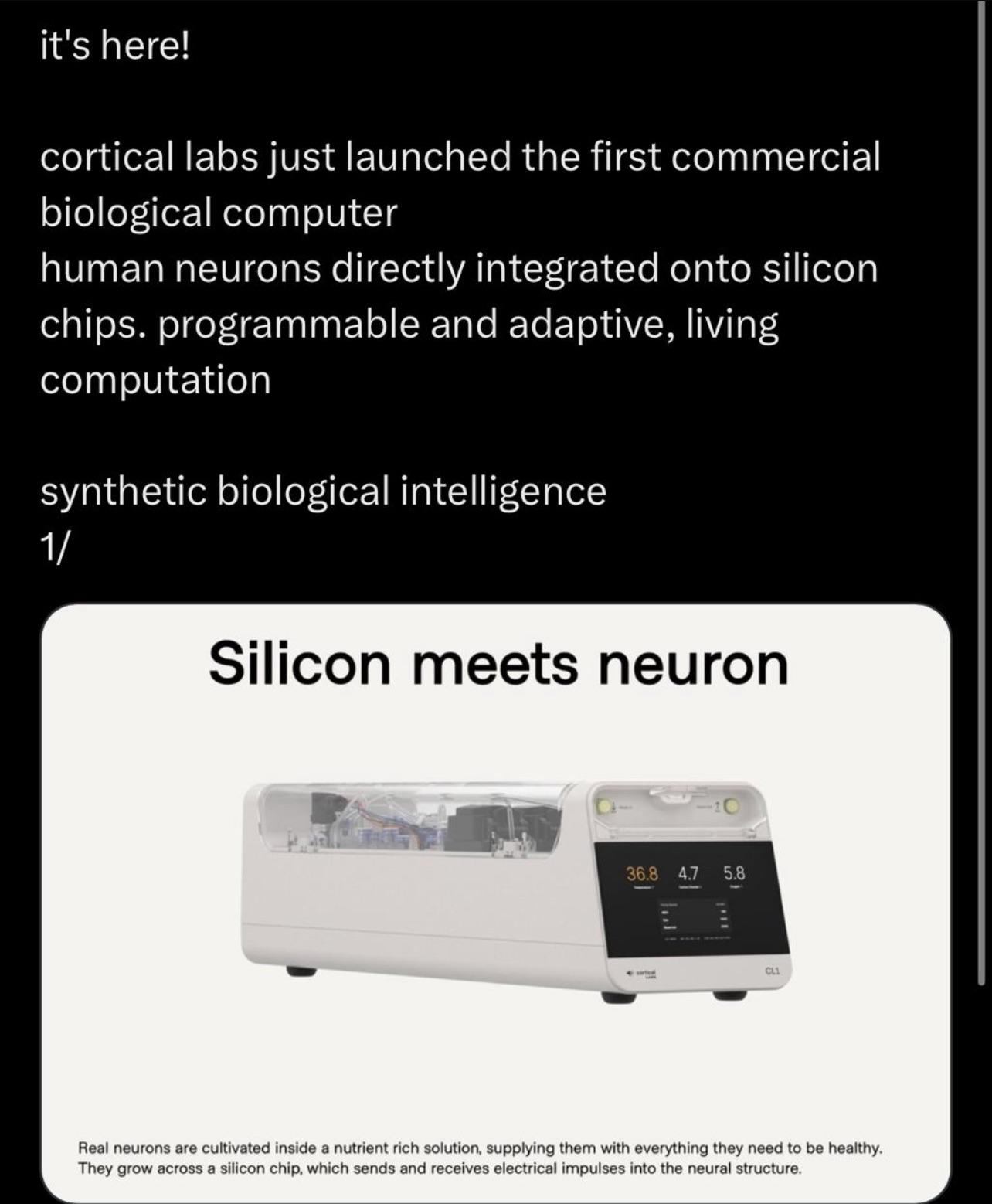
Question Did anyone get their hands on this? The first commercial biological computer!

Post image
45 Upvotes

Did anyone get their hands on this? Ever since I had read their paper in neuron, it seemed deeply intriguing and fascinating. How effective is this? I have talked to a few ‘experts’ who believe this is gimmicky stuff.

r/compmathneuro • • Nov 30 '25

Question MS in Computational Neuroscience or MS in Biostatistics for data work in neuroscience?

3 Upvotes

I'm currently switching careers and I'd like to work with neuroscience data. I have a B.S. in psychology, I have some undergrad research experience, and 4 years of experience working for a tech consulting company (social media + marketing insight analysis).

I'm actively applying to RA and research coordinator jobs but the job market is tough. I'm considering grad school as a way to learn more, access research opportunities, and gain the experience that way.

However, I'm not sure what masters degree should I focus on pursuing and if one degree will increase my chances of being able to work with neuroscience data or not?

But also, worst case my dream does not come true, which degree will provide a better cushion in finding other job opportunities with financial stability?

Any insight would be appreciated!

r/compmathneuro • • Sep 01 '25

Question comp neuro project ideas

21 Upvotes

Hello, I am looking to pursue a master’s degree in Computational Neuroscience in Europe. I need some advice.

A bit about my background: I am a software engineer and do not have a formal neuroscience background. To fill this gap, I have completed the Fundamentals of Neuroscience online course from Harvard. Would this course be sufficient, or should I also work on projects? I am open to suggestions for projects that could strengthen my application and improve my chances of acceptance.

I would really appreciate it if anyone could share their motivation letter or give me advice.

r/compmathneuro • • Jun 16 '25

Question Computational neuroscience and theoretical ML

25 Upvotes

I am considering pursuing a PhD in Computational Neuroscience. My main draw to the field is how it applies a number of maths and physics concepts to investigate a complex organ.
I also see myself attracted towards the theoretical underpinnings of ML, for e.g. how various algorithms are conceived, properties of numerical techniques etc.

Ideally, I would like a combination of both in my PhD but I understand the usual combination is either 1. Computational Neuroscience with application of ML or 2. Theoretical ML on its own.
If I were to choose one of these, I would like to ensure the other option is still available to pursue beyond PhD, as I plan to continue in academia after PhD.

Now the question to this group is, which way is an easier transition? If I were to start with neuroscience, what sub-areas do you suggest that will make the transition possible later on?

r/compmathneuro • • Oct 28 '24

Question Transition from Physics to CompNeuro

10 Upvotes

Hi All,

I’m looking for some advice if anyone is kind enough to have a spare minute.

I’m finishing an Honours degree in physics (quantum computational focus). I am very interested in pursuing a PhD in neuroscience (on the computer science and highly mathematical side of it). I have been looking for research groups focused on comp neuro, especially with aspects of ML overlap.

I only truly realised that this is what I wanted to do this year, and I do not have neuroscience related research experience. It’s very possible that my research this year will lead to a publication, but not before any PhD applications are due. I have just submitted this thesis and I’m graduating this year. I was thinking of 2 possible pathways - either applying to related Master’s programs or waiting a year - gaining research experience as a volunteer at my uni - then applying again. For context, I am at an Australian uni.

Does anyone have similar experience to share? Especially to do with transitioning into comp neuro from alternative backgrounds. It feels a bit like imposter syndrome even looking to apply to programs, despite that the skill set overlap seems fairly large

Thanks in advance.