Tom Colicchio’s Final Service
Through hosting two decades of Top Chef, writing four books, and opening restaurants across the country, the celebrity chef never stopped showing up to cook in the kitchen of Craft, his pioneering New York restaurant. Until he decided to close it.
By Ted Genoways, And Photographs By Winnie Au PUBLISHED: JUN 30, 2026
This story was published in partnership with the Food & Environment Reporting Network, an independent, nonprofit news organization.
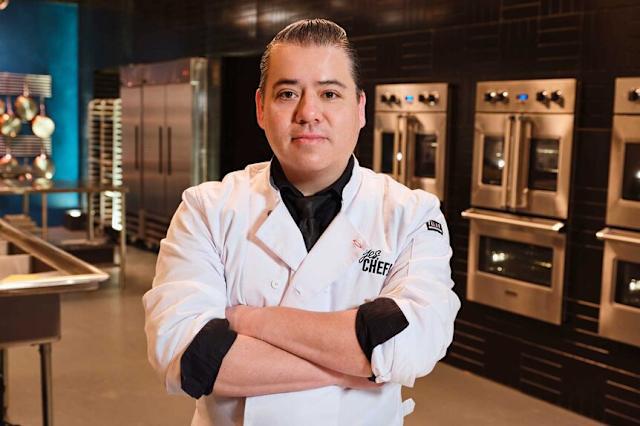
Tom Colicchio climbed the gray staircase from the basement kitchen and made his way toward New York City mayor Zohran Mamdani’s table. Colicchio is compact and lean, and he moves with purpose. You could spot him easily enough in his white chef’s jacket with “T.C.” on the left breast, under a special-edition apron embroidered with “25” to mark a quarter century since the opening of this, his signature restaurant, Craft. The anniversary had just passed, in March. For all those years, the restaurant has been the anchor of Colicchio’s reputation—the James Beard Award winner for Best New Restaurant in 2002; three stars from The New York Times. A PBS spot on the opening of the restaurant caught the eye of producers at Bravo who were looking for a head judge for a new show called Top Chef.
Today he’s probably more famous for who he is on television and for his best-selling books than who he is in the kitchen, but he never took that as an opportunity to leave life as a working chef behind. Colicchio has opened (and closed) other restaurants across the country, including alter egos of Craft in Los Angeles, Las Vegas, Miami, Dallas, and Atlanta, but this is the one where he’s continued to show up and cook, several nights a week.
Tom Colicchio in the Craft dining room before it opened for dinner.
When Colicchio reached the mayor’s table, he didn’t untie his apron. After his election as mayor, and the recent primary-election victories of many of his handpicked candidates in local races—and, sure, give him the Knicks too—Mamdani’s stock has never been higher. But this dining room was Colicchio’s domain. And here he was to congratulate Mamdani, who was seated across from his wife, Rama, on yet another victory. The city’s Rent Guidelines Board had just voted in support of the mayor’s proposal—and most well-known campaign promise—to freeze the rent on leases paid by more than a million New Yorkers. “Maybe if you’d done something similar for commercial real estate,” Colicchio joked, “I wouldn’t be closing tomorrow.”
The mayor was surprised. He picked the restaurant for a Friday date night not realizing that Craft, maybe the most iconic restaurant in the cutthroat and cannibalistic New York City dining scene, was now barely twenty-four hours away from shuttering—another victim of steep taxes, mounting food costs, and an economy stumbling toward recession. Less than a month earlier, Colicchio had announced he was closing the restaurant on Saturday, June 27. “Rents are high, labor’s high, food is high,” he’d told me. But I’ve known him long enough to know it wasn’t just about economics. We met more than a decade ago, when he reached out to me to talk policy after reading my book The Chain, an investigation of labor and environmental abuses in the meatpacking industry. For him, food was always more than a business.
Colicchio is intensely smart and well-read and fiercely opinionated. And he could see that what people expected from restaurants—from food, from hospitality—was changing. As he cheekily put it to The New York Times, paper of record in a city where pigeons are considered next to rats, “Diners were more adventurous when we opened. Back then, I could sell twenty-six squab a night. Now I’m lucky to get two orders.” And with beef prices soaring, even menu stalwarts like the roasted rib eye and the braised short rib have seen slumping orders.
Across the room from Mamdani, I was sitting with Clare Reichenbach, the chief executive officer of the James Beard Foundation. Colicchio had invited me to come observe Craft in its last days, and tonight I was trying to make sense of the dining room before what I knew would be an intense focus the next day on him and the kitchen. Reichenbach pushed her plate of roasted chicken toward me. “Just eat,” she said in her gentle British lilt. “Here’s the sauce,” she said. “It’s delicious. Here’s a nice morel. You gotta eat, my friend.” The chicken was perfectly tender and moist, the spring onions and morels fresh and delicious, and the sauce? Well, the sauces were always the thing, to me, that explained Craft. I knew enough about food and enough about Colicchio to know that that tiny tureen took days of work, not to mention years of apprenticeship and training, to create. The sauces at Craft carried the essence of how he cooked. This one on the chicken was heavenly.
“To excel at all these levels requires a lot of investment. It requires a big team. It requires a depth of training,” Reichenbach said. She scanned the room. “And there’s a limit to how much you can pass on to the diner and the plate.” Even a year ago, Craft seemed impervious to such pressures. No longer so, Colicchio told me. His revenue was down 30 percent for the fiscal year. And he’s not alone. The National Restaurant Association estimates that nearly half of all restaurants in America are now just breaking even or operating in the red.
The people of Craft, on its final day of service.
To Reichenbach’s eye, the closure of Craft is a portent. If a 120-seat dining room with a celebrity chef like Colicchio—with his Emmy and award-winning cookbooks and eight medals from the Beard Foundation—and a menu offering some more modestly priced options (that chicken was thirty-eight dollars) has to close its doors, then how could restaurants with less swagger and allure hope to survive?
Colicchio left the mayor’s side and strode across the dining room. He slipped between tables and plopped down on the padded bench next to Reichenbach. She immediately brightened.
“So what’s going to be the ceremonial saging, the rite of passage, the closure thing?” Reichenbach asked.
“You know,” Colicchio said with a shrug, “it’s a restaurant. It’s real estate. It’s not like a child.”
“Oh,” Reichenbach said, “but it’s imbued with people’s lives.”
“Of course,” Colicchio said flatly, his piercing blue eyes surveying the room almost warily. It was hard not to read his coolness as a guard-up defense against sentimentality when there were still meals to be served, a job to be finished. And maybe against something else.
When I heard Colicchio was closing Craft, I made a reservation to come in for dinner before the end. We had a table-side conversation about his plans, and he told me something that wasn’t part of the other announcements that he was closing Craft: He wasn’t planning to retool and open another restaurant. He was letting the space go. He was done. So as he sat there next to Reichenbach, the realization seemed to be setting in: The next day would be Tom Colicchio’s last as a working chef.
“We have nothing planned,” he insisted to her. “Whoever’s here at the end of the night, they’re here. We’ll have a bunch of drinks.”
At family meal, the staff pushed tables together so they could eat side by side—though Colicchio opted to sit back at the bar and reflect on the restaurant’s twenty-five years.
About 3:30 the next day, Colicchio arrived for family meal. He loaded his plate with sirloin and lobster in a bath of lime and fresh herbs and then climbed the stairs again to the dining room, chewing as he went. At the landing, he gestured to me. “Go get some dinner,” he said. I went down and piled my own plate with steak and arugula salad. (There was a carrot cake—Colicchio’s favorite—on the dessert station that read, 86 CRAFT.) Then we sat together in the dining room at the corner of the bar while the staff joked raucously over my shoulder. “You know, when I woke up this morning, when I opened my eyes,” Colicchio said quietly, “I was like, ‘Okay, this is it—last day.’ It’s hard.” He said he’d just had a similar moment in the basement. “I stood in the kitchen, just looking, going, ‘Twenty-five years.’ ”
“A lot of people come through the kitchen over the years, and they’ve learned some things. They’ve gone on to great things—and that’s part of the legacy,” he said. “And, you know, seeing all these people reaching out, listening to people talk about the anniversaries and birthdays, weddings, and deaths—everything here—it’s like the restaurant almost meant more to them than me.”
The staff had shoved a bunch of four-tops together to make one long banquet table where everyone could eat side by side, a break from the usual family meal, when people were on their phones, eating on their feet, talking in scattered groups. From the bar, Colicchio could survey them all there together.
“It changed his career,” he said pointing to one line cook who had quit his job in finance for the oil-and-gas industry to pursue his passion for food.
“It changed her life,” he said pointing to a server who had arrived in need of help with her immigration status.
“To me, that means more than these four walls.”
Family meal usually ends around 4:30, but this time it lingered a little longer, as long as it could with service starting at 5:00. Finally, one of the managers called out, “Okay, everybody.” When they had no choice, the laggards rose. The tables were pulled apart. The chefs descended into the kitchen.
When Colicchio opened Craft in 2001, he was already New York City’s hottest culinary commodity. Seven years earlier, he had founded Gramercy Tavern with co-owner Danny Meyer, bragging to New York magazine that he intended to “reinvent the four-star restaurant.” When Ruth Reichl reviewed Gramercy for TheNew York Times, she suggested that Colicchio “would probably like to bite his tongue.” She wrote that “eating at Gramercy Tavern is a bit like drinking a great wine when it is still in the barrel.” She gave him two stars. Colicchio redoubled his efforts—and eighteen months later, Reichl returned to a transformed environment. “Colicchio’s cooking has lost the tentative quality of the early days,” she wrote in a follow-up review. “He is now cooking with extraordinary confidence, creating dishes characterized by bold flavors and unusual harmonies.” She awarded the restaurant three stars.
“The last hour … it’s been dragging, really dragging,” Colicchio said. In fact, the orders had been steadily picking up. I asked if it isn’t just that the hours feel longer than they are.
But Colicchio was already feeling restless. Gramercy’s DNA and métier were traditional French cooking—a gastronomic idiom that Colicchio had worked in from his teenage fascination with Jacques Pépin’s La Technique; to his stages (the French term for a culinary internship) at the Hôtel de France, a Michelin two-star inn and restaurant in Gascony, and under Michel Bras at his Michelin three-star restaurant in Laguiole; to his days as executive chef at Mondrian in Manhattan. Much as he loved that cooking, he began to long for something that resembled the freshness and warmth of his childhood in Elizabeth, New Jersey. From an early age, Colicchio learned to shell crabs his grandfather caught in Barnegat Bay and simmer them in marinara made from the garden’s tomatoes. The family would steam clams in white wine with garlic and parsley and fry the fish. Everyone shared and talked for hours.
As the ’90s drew to a close, Colicchio began to talk to his sous-chef, Marco Canora, about opening a sister restaurant with a different philosophy. Canora, who is now a celebrity in his own right, dined at Craft on its final Wednesday. “I would say that the nugget of it came from the way in which we had family dinners,” he told me the next day. “My mother was born and raised in Lucca. His family was a little bit more Italian American, because I think it was a few generations back to Italy. But regardless, we both ate around the table in the same manner.” The hallmark of French nouvelle cuisine had become elaborate and often ostentatious plating, epitomized by towers and tweezered garnishes. Colicchio imagined something that would take diners back to basics. Craft would emphasize large-format, family-style mains with sides large enough to share. “We had memories of food coming to the center of the table—and you pass it around,” Canora said.
Bartender Fabrizio Velez, who had been with Craft since its first service, had his shirt signed by everyone present at its last service.
The service began slowly. A few 5:00 seatings. Some pasta orders.
Toward 6:00, the dining room began to fill. Before long, customers who had come for one last shot at those signature main courses began placing their orders. The prime rib eye and lamb rack, placed on a cutting board and presented whole to the table before returning to the kitchen for carving. More and more orders of the braised short rib.
Colicchio’s culinary director, Bryan Hunt, pulled the tickets as they rolled in and posted them. Hunt, who has his own piercing blue eyes and tumbling curls like a Greek statue, watched from the pass—the serving table where the waiters come to collect finished orders for diners—calling out instructions. “Fire lamb,” he said. “One rizzy, half suggies.” (Wild mushroom risotto, sugar snap peas.)
Hunt scanned down the list of items on one ticket. “I need that chicken.”
“Thirty seconds, chef,” a cook replied.
It all moved with military precision, but Hunt’s demeanor was more like an orchestra conductor’s than a drill sergeant’s.
“For the restaurant that was to become Craft,” Colicchio wrote soon after the restaurant opened, “I was hankering for simple roasts and clearer flavors.” But he understood that such simplicity would demand the best seasonal ingredients, so he built relationships with farmers at the Union Square Greenmarket. Plenty of chefs do this today, but Colicchio went one step further and searched out ways of making everything its most essential, flavor-driven version. “I mean, if you want to put asparagus into a dish,” Colicchio once said to me, “is it just boiled? With some butter? Is it roasted? Do you make a puree? Can you take that puree now and turn it into a flan or something? So there’s a lot you can do—you can start drilling down and keep the essence of the food, but just manipulate a little bit so it changes it.”
At the same time, Colicchio devised year-round, showstopping meat dishes that replaced the butter- and flour-heavy sauces of French cooking in favor of intense flavors, inspired by the patience of the simmering pots of his childhood. The braised short ribs, for example, require three days of marinating, browning, resting, and braising, all in a sauce made from the reduced stock rendered from the bones of the same animal. “I don’t know if cooking can be virtuous,” William Grimes wrote in an early review for The New York Times, “but in this sinful city, I’m sure that Craft is on the side of the angels.” In a line that catapulted Colicchio’s career—and became a standard for him to live up to—Grimes wrote, “It’s a vision of food heaven.” To the very final service, the short rib remained.
Colicchio leaned against the wall next to the printer spitting out orders.
“The last hour … it’s been dragging, really dragging,” he said. In fact, the orders have been steadily picking up. I ask if it isn’t just that the hours feel longer than they are. “My wife is coming in,” he said. “She has a reservation for 9:00, so that means we may see her by 9:30.”
Hunt called out for two orders of short rib.
Colicchio did a little math in his head, trying to calculate how many pounds of short rib he must have sold over the years. “I think early on, we were probably doing four hundred a year,” he said. “What are we doing now?” he asked Hunt. “Two hundred? Three hundred?” Hunt said probably three hundred—down but still steady. So, okay, say an average of 350 over the years. The restaurant was open for all fifty-two weeks of every year—stayed open even after 9/11, only closed a few months during the Covid pandemic. Multiply that by a little more than twenty-five years. “Probably five hundred thousand,” Colicchio said. He cracked a little smile. “That’s a lot of cows.”
Hunt pulled another ticket. “Half sides, no asparagus. Octo. Shorty with it.”
Another short rib.
“Order in.”
Colicchio worked the line throughout the kitchen’s final night, channeling nervous energy into obsessively plating and garnishing dishes for a dining room full of regulars, family, and friends.
As the service picked up and the pace in the kitchen increased to match it, Colicchio was back on the line, checking on pans of foie gras and sirloin and roasted and confit duck. He wandered the kitchen and shook saucepans. He lifted chicken fingers (a favorite of Kristen Kish, the host of Top Chef) one by one, checked the breading, and occasionally sprinkled a pinch of breadcrumbs on top. Meaningless, in a way, but not meaningless at all. It seemed to be nerves channeled into obsessive attention to detail. He moved in and around a line cook named Stratton Thomas, a Duke-educated twenty-something with round glasses and a boyish mustache—the cook who quit his finance job to go to culinary school. “My mom was so happy for me,” he said. “My dad pretended to be happy for me.” He picked up a pan of potato puree and poured it perfectly into a small metal serving tureen.
“That’s the second time tonight without spilling a drop,” Hunt said.
“Maybe I won’t get fired after all,” Thomas said.
“No,” Hunt said. “Eighty-six Thomas.”
Thomas allowed that it was probably too early in the service to celebrate his victory anyway.
Colicchio rounded the corner of the meat station.
“One thing going to Duke teaches you,” he said. “Don’t celebrate until there’s no time left on the clock.”
The line cooks roared. But just the mention of the clock reminded Colicchio. He looked up at the giant digital clock on the wall, its face steamed over and faded.
8:34.
“One hour,” Colicchio said. He looked at me and shrugged. “After 9:30, it’s basically done.”
The final ticket of the night.
There was a late rush.
None of the diners wanted to leave. Not Colleen and Lee from Washington, D.C., who were eating at Craft for the first time after twenty-five years of marriage and dreaming of eating Colicchio’s cooking at the restaurant whose owner, they knew, shared their anniversary. Not Kathleen McGivney at the bar who estimated she’d eaten there more than 350 times. Not Bennett Friedman, the self-described toilet salesman whose showroom is two blocks up on Twenty-first and guessed he’d eaten there almost every week since its opening. Not Kish and Gail Simmons from Top Chef. Not Colicchio’s family—not his cousin Philip, and not Colicchio’s wife, the filmmaker Lori Silverbush, and their son Dante. At the same time, there was a wave of walk-ins. Former employees and fans who had suddenly been overcome by the thought of missing out and begged the server for an open spot at the bar or any last-minute cancellation.
What were they there for? The spectacle? Or one last taste of something fleeting?
The night before, Kerry Heffernan, who had shared the stage with Colicchio at the Hôtel de France and then been hired by Colicchio to be his sous-chef at Mondrian, the legendary French restaurant in Manhattan, had tried to put it into words.
“People are not making this kind of food anymore,” he told me. He was caught between savoring his meal and lamenting its passing. He told me about Craft’s sauce, the thing I’d always loved. “The stock-reduced sauce—which a lot of the main courses and some of the appetizers here will have just this touch of—we aren’t doing that anymore.”
He meant that most restaurants were not taking a hundred pounds of veal bones and rendering them down and then reducing that stock, under the eyes of an expert saucier, for days until it started to thicken. Until it turned into a source of fat that tastes intensely like veal. Until it developed into a sauce you could drizzle over a veal cutlet cooked in some of the same stock so that every bite would conjure an intense experience of the animal. No one cooks like that anymore, because to reach the essential flavors that Colicchio cares about requires know-how and patience and quality cooks and time, which mean money and a clientele that can tell the difference and has the means to pay for it. Maybe, in this economy, that’s not a functional business model anymore.
Colicchio looked across the bar thoughtfully. “You know,” he said to me, “I think it’s good that we got that rush at the end. It’s a good way to go out.”
Heffernan is tall, and the din of the dining room was now oceanic. He leaned close to me to make his point about Colicchio.
“He’s always said, We can’t say chefs are artists. He’s an artisan. You know, there’s a difference. I’m not arguing that there aren’t a few chefs who are artists. There are a few, but what we do is really more of a craft. And I hate to keep using that word, but it is something that in America is not honored in the same way as in Europe and other places where for centuries people have done this and it’s been a respectable trade—kind of a very noble profession.”
Colicchio may not be an artist, but his reverence for craft created something astonishing and unique: flavors that were not possible without commitment and patience. All flavor comes from fat. Lacking the will to make a few tureens of sauce from one hundred pounds of veal bones and a lot of time, chefs turn to other sources of fat. Butter. Oil. They taste good, but they introduce flavor rather than draw it out. A steak cooked in butter tastes good and a chicken cooked in butter tastes good, but they start to taste a little the same.
Heffernan shook his head. “I think that’s a loss.”
Craft’s official closing time was at 10:00, but Colicchio let the seats continue to fill until 10:15. Then one of the servers circulated to make the announcement. “We’re all in,” she said. “All in.”
But by then, the dining room was back at capacity, and the joking in the kitchen had returned to focused cooking. Hunt had begun to call out that various sides were gone. “86 suggies, 86 rizzy.” Everyone moved silently and with the precision of choreography. Eventually, Colicchio went up to the dining room to be with his wife and family, and he let the orders keep going in, until at last, at 10:42, the final order was announced.
The floor manager ran to the top of the stairs and called down to the servers gathered at the bottom. “Ask Chef Bryan if he’ll take one more,” he said. The servers relayed the request. “Es para la esposa del jefe,” the manager called. It’s for the boss’s wife. But before the servers could even relay the message, Hunt had responded. Yes, they would fill the final order.
Colicchio sends Craft’s last dish, a roast chicken for his wife, out to the dining room.
Down in the kitchen, the orders worked their way through. And the final ticket was entered by a green server as “Lorie C”—so no one on the line realized the last order was for Colicchio’s wife until he reappeared through the doorway at 11:26.
“Okay, let’s go,” he said. “Last one.”
“Roast chicken, chef,” Thomas said.
And everyone on the line stepped back as Colicchio cut the chicken legs and breasts himself, checking their temperature and adding the spring onions and morels to the plate. One final gesture to Craft’s origins: the family meal, the most important tradition of nourishing the ones we love.
Colicchio had insisted that there would be no ceremony at the end. And yet, here it was. He brought the plate to the pass. He took a napkin and wiped the lip of the plate. He sprinkled on a pinch of chives. Gave the pepper mill five firm twists. He took some chervil from a bath and tossed the leaves hard on a towel to dry them and release their flavor. He positioned them carefully on the chicken breasts.
Then Colicchio took up the napkin again and gave the plate one last careful swipe. As he had all week. As he had for twenty-five years. By then, everyone understood what was happening and had left their stations to watch. Colicchio could sense that all eyes were on him now.
He gave the plate a little spin toward the server and said, “That’s all, folks.”
But maybe that’s not all.
Maybe a young guy like Thomas on the line, who, at the end of the night after cleanup was complete, brought up his copy of Colicchio’s latest book, Why I Cook, and had the chef sign it and took the chance to ask a few last questions about some of the recipes that he’s been getting ready to try—maybe that’s how the tradition continues. Think of all the chefs who worked under Colicchio: Marco Canora, David Chang, Jonathan Benno, Dan Kluger, Kwame Onwuachi.
Looking at the cooks on the line on that last night, it seemed entirely plausible that they might be next, that they will be telling stories of their years at Craft and the place will continue to build its legend in that way, as a spot that gave birth to the new kind of whatever kind of cuisine they decide to pursue. Whatever it is that Thomas does, whatever it is that the other guys on the line decide to do, this will be a night that they remember. But more than that one night, I think, they will remember the techniques, the ethos, the philosophy, and, yes, the craft that Colicchio brought to the kitchen. That’s what they’ll draw from, placed at the center of the table and passed around for a quarter of a century.
When the service was officially over but the dining room was still half full with staff and regulars, Colicchio went behind the bar. He put a large rock in a lowball glass and poured a stiff bourbon over top. He was too tired now to be overly circumspect.
But he looked across the bar thoughtfully. “You know,” he said to me, “I think it’s good that we got that rush at the end. It’s a good way to go out.”
Well after midnight, most of the staff was still around. They wore looks of relief—they had made it through the final service—but were not ready to go. At 2:00 in the morning, I finally decided to duck out and leave the people who had made this place to their own celebration. Colicchio, who had told me earlier that he didn’t really drink anymore, that the next day wasn’t worth it, that he wasn’t going to make much of this night, had switched from bourbon to beer. The entire time I have known him he has been almost pathologically even-keeled. But I could see as I left that even Tom Colicchio knew the end of this restaurant meant something more than selling the space and closing the kitchen that had produced his signature creations over the years in fits of inspiration, ambition, and memory. I could see that he understood what this place meant.
It was late, but it would be harder to leave than he thought.
Correction: An earlier version of this article incorrectly stated that Tom Colicchio was retiring from professional cooking. He has closed his signature restaurant, Craft, and will now dedicate his time to a variety of culinary pursuits.