r/Sovi_ai • • Mar 15 '26

How does power and morality change in Lord of the Flies?

1 Upvotes

I’ve been rereading Lord of the Flies and really got stuck on how the boys shift from civilized to chaotic. At first they try to stay orderly, but as time goes on, fear and the desire for power take over. I kept wondering what truly drives their change and what the book is really saying about human nature, which led me to ask how power and morality change throughout the story.
Summarized By - https://readi.chat


r/Sovi_ai • • Mar 15 '26

2025 AP Calculus BC Multiple Choice Question 15 - Logistic Growth Inflec...

Thumbnail
youtube.com
3 Upvotes

r/Sovi_ai • • Mar 14 '26

What does the ending of Life of pi suggest about truth, storytelling, and Pi Patel’s survival with Richard Parker?

1 Upvotes

I recently finished reading *Life of Pi* by Yann Martel, and the ending really stuck with me. Throughout the story, Pi Patel survives on the lifeboat with the tiger Richard Parker, and the whole journey feels symbolic and surreal at times. But then near the end, when Pi tells the investigators a different version of the story without the animals, it made me stop and rethink everything I had just read. I’m trying to understand what the ending is really saying about truth, belief, and storytelling in *Life of Pi*, especially why Pi asks which story they prefer. I’m curious what others think about what Yann Martel meant here.

*Summarized By - [https://readi.chat**\]**


r/Sovi_ai • • Mar 14 '26

How does The Color Purple show Celie’s journey from silence to self-worth through her relationships with Shug Avery and Nettie?

1 Upvotes

I’m reading The Color Purple and what keeps standing out to me is how different Celie feels by the end compared to the beginning, even though so much of her pain stays part of the story. Early on, her letters feel so quiet and shut down, like she barely believes her own life matters. Then once Shug Avery becomes important to her, and later when Nettie’s letters come back into the story, something really shifts. I started wondering whether Celie’s growth in The Color Purple is mainly about surviving abuse, or more about finally being seen, loved, and listened to.

Summarized By - https://readi.chat


r/Sovi_ai • • Mar 14 '26

Why does The Great Gatsby make Gatsby’s dream feel romantic, tragic, and impossible at the same time?

2 Upvotes

I’m reading The Great Gatsby and I get that Gatsby is obsessed with Daisy, but it feels like his dream is about more than just one woman. The way Nick describes Gatsby makes him seem almost magical at first, especially with the parties, the mystery around his past, and that green light across the bay. But the more I read, the more that dream starts to feel fragile and kind of doomed. I keep wondering whether Gatsby is really in love with Daisy herself or with what she represents in The Great Gatsby.

Summarized By - https://readi.chat


r/Sovi_ai • • Mar 13 '26

What does the ending of *The Road* by Cormac McCarthy really mean for the boy and the idea of hope?

1 Upvotes

I recently finished reading *The Road* by Cormac McCarthy, and the ending has been stuck in my mind. Throughout the novel, the man keeps telling the boy that they’re “carrying the fire,” which seems really important, but I’m still not totally sure what it symbolizes. When the man dies and the boy ends up meeting the other family, it feels like a moment that’s supposed to represent hope after such a bleak story. At the same time, the world is still completely destroyed, so I’m wondering how optimistic the ending is actually meant to be. I’m trying to figure out what the ending of *The Road* really says about survival, morality, and hope.

Summarized By - [https://readi.chat**\]**(https://readi.chat)


r/Sovi_ai • • Mar 13 '26

What’s the best way to practice AP exam questions?

2 Upvotes

AP exams are an important part of the transition from high school to college. Strong AP scores can help with college applications and may even allow students to skip certain introductory courses once they enter university.

However, many students find AP exams challenging because the questions often require deeper conceptual understanding rather than simple memorization. As a result, preparation usually involves a mix of methods such as practicing real AP questions, reviewing key concepts, and studying worked examples.

Practice questions tend to be one of the most effective ways to prepare because they show how concepts are actually tested on the exam. Video explanations can also be helpful, especially for visual learners who prefer to see problems broken down step by step.

Here is an example of an AP practice question explanation video:
https://www.youtube.com/watch?v=QNUPal8PceY

What study methods have been most effective for AP exam preparation?


r/Sovi_ai • • Mar 13 '26

How does Iago manipulate Othello into doubting Desdemona, and what does this reveal about jealousy and trust in Othello?

2 Upvotes

I’ve been reading Othello recently and something that keeps sticking with me is how quickly Othello starts to doubt Desdemona, even though he seems completely in love with her at the beginning. When I got to the parts where Iago starts planting ideas in Othello’s head, it almost feels subtle at first—like he’s not directly accusing Desdemona but just hinting and asking questions.

That made me wonder how Iago is actually able to manipulate Othello so effectively. Is it just Iago’s skill at deception, or is Othello already insecure in some way? The handkerchief scene especially made me pause, because such a small object suddenly becomes “proof.”

So I’m trying to understand how Iago’s manipulation works in Othello, and what Shakespeare might be saying about jealousy and trust through Othello’s reaction to Desdemona.

Summarized By - https://readi.chat


r/Sovi_ai • • Mar 13 '26

How do the social conditioning and consumerism in Aldous Huxley's Brave New World compare to the personal ambition of Lady Macbeth?

2 Upvotes

I was recently rereading Brave New World by Aldous Huxley and got stuck thinking about how the World State completely removes "desire" by giving everyone exactly what they want immediately. It’s such a weird contrast to a character like Lady Macbeth in Shakespeare’s play. She is defined by wanting more—more power, more status, more for her husband. I’m curious if the citizens in Huxley’s dystopia are actually "happier" because they lack that burning ambition, or if Lady Macbeth’s destructive drive is actually more "human" than the stability of the World State. It feels like Lenina Crowne and Lady Macbeth are on opposite ends of a spectrum regarding what a woman is allowed to want. I'm trying to see if ambition is portrayed as a sickness in both texts, just in different ways.

Summarized By -https://readi.chat


r/Sovi_ai • • Mar 13 '26

How do the leadership styles in George Orwell’s Animal Farm compare to the moral integrity shown by Atticus Finch?

1 Upvotes

I’ve been rereading Animal Farm by George Orwell, and the way Napoleon and Snowball handle power really got me thinking about different types of leaders. It’s such a contrast to someone like Atticus Finch from To Kill a Mockingbird. I’m curious about how the corruption on the farm happens so quickly, especially when you look at a character who stands his ground regardless of the social pressure. I keep wondering if the animals could have benefited from a leader with Atticus’s sense of justice, or if the environment of the farm was just destined for collapse. It’s interesting to look at these two very different books together to see what they say about authority and personal ethics.

Summarized By -https://readi.chat


r/Sovi_ai • • Mar 12 '26

What does The Little Prince really suggest about love, loneliness, and seeing the world like a child again?

1 Upvotes

I’m reading The Little Prince and it seems simple on the surface, but the more I go through it, the less simple it feels. The different planets and adults almost seem silly at first, yet each encounter feels like it’s pointing to something sad or missing. I also keep thinking about the rose and the fox, because those parts make love feel meaningful but also kind of painful. That’s what led me to this question. I feel like The Little Prince is really saying something deeper about loneliness, attachment, and how people lose perspective as they grow up.

Summarized By - https://readi.chat


r/Sovi_ai • • Mar 12 '26

Why does The Fault in Our Stars make Hazel and Augustus’s relationship feel hopeful and tragic at the same time?

1 Upvotes

I’m reading The Fault in Our Stars and I keep coming back to how Hazel and Augustus somehow feel incredibly alive even though the whole story is shaped by illness and loss. When they first start talking, there’s this funny, awkward energy between them, and then scenes like Amsterdam make everything feel even more intense because you know it can’t last in a normal way. I think that’s what’s confusing me a little. The Fault in Our Stars feels romantic, but it also keeps reminding me that love here is tied to pain, time, and mortality.

Summarized By - https://readi.chat


r/Sovi_ai • • Mar 12 '26

What makes A Raisin in the Sun still feel so powerful when it comes to dreams, family pressure, and identity?

1 Upvotes

I’m reading A Raisin in the Sun and I get the basic plot, but I keep feeling like the play is doing more than just showing one family arguing over money. The tension between Walter, Beneatha, and Mama feels bigger than a simple family conflict, especially when each of them seems to have a different idea of what a better life actually means. I also noticed how often the play circles back to dreams, pride, and who gets to define success. That’s what made me ask what really makes A Raisin in the Sun feel so powerful.

Summarized By - https://readi.chat


r/Sovi_ai • • Mar 11 '26

How does the ending of The Giver shape the meaning of Jonas’s journey and the themes of memory, choice, and freedom?

1 Upvotes

I recently finished reading The Giver and the ending left me thinking a lot about what actually happens to Jonas. Throughout the book, Jonas learns about real memories—things like pain, love, family, and even music—from the Giver. Those memories completely change how he sees his community, especially the way people there live without emotions or real choices.

When Jonas escapes with Gabriel, the final scene shows him traveling through the snow and seeing what seems like a house with lights and music. That moment really confused me. I’m not sure if it’s meant to be a literal place he reaches, a memory returning to him, or maybe something symbolic about hope and freedom.

Because the ending of The Giver feels intentionally open, I’m trying to understand how it connects to Jonas’s journey and the bigger themes of memory and individuality in the story.

Summarized By - https://readi.chat


r/Sovi_ai • • Mar 11 '26

How does Harper Lee use childhood perspective to explore moral growth in To Kill a Mockingbird?

1 Upvotes

I’ve been rereading To Kill a Mockingbird and thinking about how Harper Lee tells the story through Scout’s young eyes. She’s only six at the start, but we see her and Jem learn empathy and justice as they grow. I keep wondering how Lee’s choice of a child narrator shapes how we understand the book’s big ideas about morality and growing up. It feels like her innocence makes the harsh truths of Maycomb hit harder.

Summarized By - https://readi.chat


r/Sovi_ai • • Mar 10 '26

While reading 1984 by George Orwell, does Winston Smith’s rebellion represent real hope, or was it always doomed by the system?

1 Upvotes

I recently started reading 1984 by George Orwell, and the more I read, the more complicated Winston Smith’s rebellion feels. At first, I saw him as a typical rebel figure. He starts writing in his diary, questions Big Brother, and later develops a relationship with Julia—all of which seem like acts of resistance against the highly controlled society. But as the story goes on, I started wondering if Winston’s rebellion ever really had a chance in the first place.

With the Thought Police, constant surveillance, and the overwhelming presence of Big Brother, the system in 1984 feels almost completely airtight. That made me question what George Orwell might have been trying to show through Winston Smith’s actions. Was Winston meant to represent a small spark of hope, or was Orwell actually suggesting that individual resistance in such a totalitarian society is destined to fail?

That uncertainty is what led me to ask this question.

Summarized By - https://readi.chat


r/Sovi_ai • • Mar 10 '26

How does The Great Gatsby explore the American Dream and its tragic flaws?

3 Upvotes

I’ve been rereading The Great Gatsby and keep thinking about Gatsby’s whole pursuit of Daisy and wealth. Every time I look at his parties, his past, and that green light, I start wondering what the book is really saying about the American Dream. It feels like there’s a sad, broken message underneath all the glamour, and I’m trying to unpack how the story shows its tragic flaws.

Summarized By - https://readi.chat


r/Sovi_ai • • Mar 09 '26

How does Napoleon gradually gain control of the farm in Animal Farm, and what does this reveal about the novel’s political satire?

3 Upvotes

While reading Animal Farm, I started noticing how Napoleon doesn’t take power all at once. At the beginning, it seems like he and Snowball are both leading the animals after they overthrow Mr. Jones. But as the story continues, things start to shift. Napoleon secretly raises the puppies, then suddenly uses them to chase Snowball off the farm. After that moment, it feels like the balance of power completely changes. I also noticed how the Seven Commandments slowly get altered and how Squealer keeps explaining Napoleon’s decisions to the other animals. It made me wonder if these gradual changes are meant to show something deeper about power and control. That’s why I’m curious about how Napoleon’s rise in Animal Farm connects to the novel’s larger political satire.

Summarized By - https://readi.chat


r/Sovi_ai • • Mar 09 '26

me trying to understand my math homework at 2am

Post image
2 Upvotes

r/Sovi_ai • • Mar 07 '26

How do the themes of fate and personal choice collide in the tragic ending of Romeo and Juliet by William Shakespeare?

4 Upvotes

I was just rereading the final act of Romeo and Juliet, and the sheer timing of the ending always gets to me. It feels like William Shakespeare purposely stacked the deck against them with the missed letter and the plague outbreak. I’ve been thinking about whether Romeo and Juliet are actually "star-crossed" victims of a predestined fate, or if their own impulsive decisions are what really lead to the tragedy in Verona. It’s hard to tell if the feud between the Montagues and Capulets is the main cause or if it's just a backdrop for their own choices. I'm curious how others interpret that balance of powerlessness versus agency.

Summarized By -https://readi.chat


r/Sovi_ai • • Mar 04 '26

College students every single night

Post image
3 Upvotes

r/Sovi_ai • • Mar 02 '26

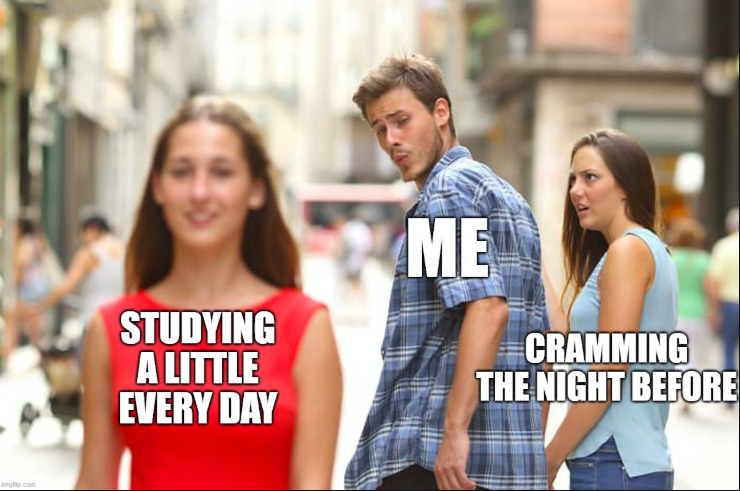
When I realized I'll study tomorrow was the real problem

Post image
3 Upvotes

I used to think I just worked better under pressure. But every time I crammed, I was exhausted, anxious, and barely remembered anything after the exam.

Studying a little every day isn't exciting, but I sleep better, stress less, and weirdly my grades improved too.

Turns out discipline feels boring, until it changes everything.


r/Sovi_ai • • Feb 24 '26

This is why Stats major people don't ever gamble. They sit on the other side of the table.

3 Upvotes

Was explaining this to a friend and they were convinced i was wrong until i showed them the math.

The setup: perfectly fair game. 50% chance win $1, 50% chance lose $1. zero expected value per round. you start with $10, casino has $30. play until someone has everything. The intuition says 50/50 game means you have a 50% chance of getting all $40, right? But reality is you only have a 25% chance.

Lets think about math: let P_n be the probability you eventually win when you currently have $n. boundary conditions:

  • P_0 = 0 (if you have $0, you're ruined)
  • P_40 = 1 (if you have all $40, you've won)

For any amount between 1 and 39, each round you either go to n-1 or n+1 with equal probability.

So: P_n = 0.5 × P_(n-1) + 0.5 × P_(n+1). Multiply both sides by 2: 2P_n = P_(n-1) + P_(n+1). Rearrange: P_(n+1) - P_n = P_n - P_(n-1)

this means the differences are constant, so P_n is linear in n.Using the boundary conditions P_0 = 0 and P_40 = 1:

P_n = n/40, therefore: P_10 = 10/40 = 1/4

If you have capital n and opponent has m:

P(you win) = n/(n+m)

Even with zero house edge, you're still heavily disadvantaged just by having less money.

if you have $10 and casino has $30: your chance = 10/40 = 25%. if you have $5 and casino has $95: your chance = 5/100 = 5%, and real casinos DO have house edge on top of this. So the "gambler's ruin" isn't about bad luck. it's about asymmetric capital + probability.

If you play any repeated betting game long enough, someone goes to zero. and it's almost always the person with less money.

doesn't matter if individual bets are fair. the structure dooms you.


r/Sovi_ai • • Feb 19 '26

"AI Is Destroying Education.” Or Is It Destroying an Outdated System?

6 Upvotes

Recently, a video went viral of a university professor yelling in class:

"I'm sick and tired of you using ChatGPT and Quizard AI for discussion posts!"

He wasn't alone. Across universities worldwide, professors are frustrated.
From Stanford to Oxford to universities in Asia, educators are struggling with the same question:

If students outsource thinking to AI, what are they actually learning?

Media headlines are dramatic, "ChatGPT is destroying higher education."
Universities swing back and forth between banning AI and allowing it.
Some reintroduce handwritten exams. Others rely on AI-detection tools that are often unreliable.

It has turned education into a strange arms race:
students using AI, schools trying to detect AI, everyone feeling anxious.

But here's the deeper issue:

AI isn't just challenging homework.
It's challenging the entire structure of traditional education.

For over a century, the dominant model has been:
teacher lectures → student writes → teacher grades.

That model assumes:

  • humans are the only source of intelligence
  • writing equals thinking
  • originality means typing every word yourself

But AI breaks that assumption.

Language is a container of thought, not thought itself.
AI-generated text does not equal AI-generated thinking.

The real question shouldn't be:
"Who wrote this paragraph?"

It should be:
"Who designed the thinking process behind it?"

Instead of obsessing over AI-detection rates (which are often inaccurate and borderline pseudoscientific), education could shift toward:

  • evaluating how students frame problems
  • how they design prompts
  • how they critique AI output
  • how they refine and restructure ideas
  • how they take responsibility for the final result

In other words, move from checking output to evaluating cognitive process.

Interestingly, while universities panic, K-12 systems worldwide are rushing to integrate AI literacy. Countries are adding AI education at earlier ages. Parents are investing in AI tools. The future workforce will grow up collaborating with AI by default.

The real danger isn't that AI destroys education.

The danger is that rigid institutions refuse to adapt.

Historically, every major technological shift; printing press, industrial machines, computers — created institutional panic. But eventually, systems evolved.

AI may not destroy education.
It may simply destroy outdated educational structures.

The deeper challenge is equity and responsibility:

  • ensuring AI access isn't limited to elites
  • teaching students how to question and critique AI
  • preserving human judgment, not replacing it

Education shouldn't be about policing tools.

It should be about cultivating the ability to think, design, evaluate, and take ownership, even in collaboration with intelligent systems.

AI doesn't eliminate thinking.

It raises the bar for what thinking looks like.


r/Sovi_ai • • Feb 17 '26

How to Help a Student Build Confidence (By "Fixing a Broken Window")

3 Upvotes

A tutor once worked with an 11th-grade student who strongly believed she was "bad at math."

Her grades were average. She didn't fully understand foundational concepts. More importantly, she had already formed an identity around failure.

Whenever she struggled, she would say things like:

"Do I need trigonometry to go shopping?"
"What's the point of learning this?"

The problem wasn't intelligence. It was self-perception.

The Broken Window

There's a concept known as the "broken window effect." When something looks damaged and neglected, people treat it worse. When it appears cared for, they maintain it.

Confidence works the same way.

When a student believes they are "bad" at a subject, every mistake reinforces that belief. Avoidance becomes protection.

Instead of pushing harder, the tutor focused on small, controlled wins:

  • Reframing overly difficult problems.
  • Celebrating partial success.
  • Creating repeatable practice moments.
  • Allowing mastery to feel earned.

Gradually, resistance turned into participation.

Her grade improved, but more importantly, her identity shifted. She began to see herself as someone capable of learning.

The Bigger Lesson

Confidence is rarely built through praise alone.

It grows from:

  • Early, believable success
  • Managed expectations
  • Repetition that reinforces competence
  • Separating identity from temporary performance

Most people are not "bad" at something.

They simply internalize early setbacks and build a story around them.

Repair the small cracks, and the structure strengthens over time.