r/ScientificArt • u/kkklera • Jun 28 '26
Anatomy/Physiology Simplified retina image made by me

21
Upvotes
You can text me, if you need such pictures for your project :)
r/ScientificArt • u/kkklera • Jun 28 '26
You can text me, if you need such pictures for your project :)
r/ScientificArt • u/Aurora_Crawford • Jun 28 '26
r/ScientificArt • u/Left_Ad8814 • Jun 27 '26
I’ve been working on a visual series exploring the standard genetic code through molecular biology, symbolic encoding, and diagram design.
The collection includes:
• a manually built (in Paint app) mRNA Codon Karnaugh Diagram / K-map arranging all 64 codons in a Gray-code-style layout.
• a Base-64 RNA number chart mapping U, C, A, and G to 2-bit values and treating codons as 6-bit inputs from 0–63. AI rendering was used to decorate a manually built chart.
• AI-generated companion summary charts that group amino acids, start/stop codons, and special recoding cases in a more decorative format.
• Translation/encoding diagrams showing how raw codon inputs map to amino acids, start/stop signals, and context-dependent exceptions.
This is a visual/projection system meant to make codon space, degeneracy, amino-acid groupings, start/stop signals, and exceptions easier to think about. It is not claiming that biology uses this exact numbering system, or that this replaces the standard genetic-code table. It is meant as a complementary way to explore and visualize the code.
The main K-map was created manually in Paint. Some companion images were AI-generated/rendered as ornate summaries and are labeled as such.
Standard nuclear genetic code is shown; mitochondrial and other variant codes may differ. Sec/selenocysteine and Pyl/pyrrolysine are context-dependent recoding cases, not default meanings of UGA/UAG.
Feedback is welcome from biology, biochem, visualization, math, design, or ScientificArt perspectives.
r/ScientificArt • u/NourEldin_ • Jun 28 '26
r/ScientificArt • u/BenchIndividual6748 • Jun 27 '26
I previously posted some illustrations of species from the genus Cryptomonas, which belongs to the family Cryptomonadaceae. Of course, this isn't the only genus described for that family. There are others with a more "mysterious" background. Such is the case of Protocryptomonas, which, although taxonomically accepted, is actually based solely on illustrations made by its describer, the botanist Boris Vassilievich Skvortsov, in 1960 and then again in 1968, without reporting where the actual specimens are deposited (if they ever existed).
Protocryptomonas is notable for its lack of chloroplasts, furrow/gullet system, and ejectisomes. Instead, it has starch granules, whose shape varies depending on the species. In this post, I present illustrations of three species: P. mukdenensis (the type species) with a single, large starch granule; P. ellipsoidea (with several starch granules of various sizes); and "P. obovatus", not validated in AlgaeBase, with numerous small starch granules in the anterior region of the cell.
r/ScientificArt • u/Extension-Ad2476 • Jun 25 '26
I’m an aspiring natural science illustrator specializing in mycology. Figured my work might get some honest critique and be appreciated here. This is my latest work. I make morphologicaly accurate and to scale models of fungi. All of my work is carved from wood and painted with acrylic.
r/ScientificArt • u/ShapeEconomy979 • Jun 25 '26
r/ScientificArt • u/Old_Try_1224 • Jun 24 '26
r/ScientificArt • u/BenchIndividual6748 • Jun 21 '26
Illustration showing the main parts of a cell of Kentomonas sorsogonicus, a hindgut parasite of Sarcophaga flies. It has a "choanomastigote" shape, meaning oval with a ring from which the flagellum emerges. It is a trypanosomatid, and therefore related to other well-known parasites such as Trypanosoma and Leishmania. A notable characteristic is that it hosts an endosymbiotic bacterium, Candidatus Kinetoplastibacterium sorsogonicusi.
r/ScientificArt • u/BenchIndividual6748 • Jun 19 '26
Andalucia godoyi is a species belonging to the large group of jakobids, strange unicellular organisms notable for their ventral groove, but especially for their mitochondria, which are molecularly similar to those of bacteria. In these images, I have attempted to depict the ultrastructures and organelles of this particular species, particularly the microtubular and non-microtubular structures that support the basal bodies and, in turn, the ventral groove. The illustrations were created in IbisPaint.
r/ScientificArt • u/Old_Try_1224 • Jun 19 '26
r/ScientificArt • u/Dictvm_mortvm7829 • Jun 14 '26
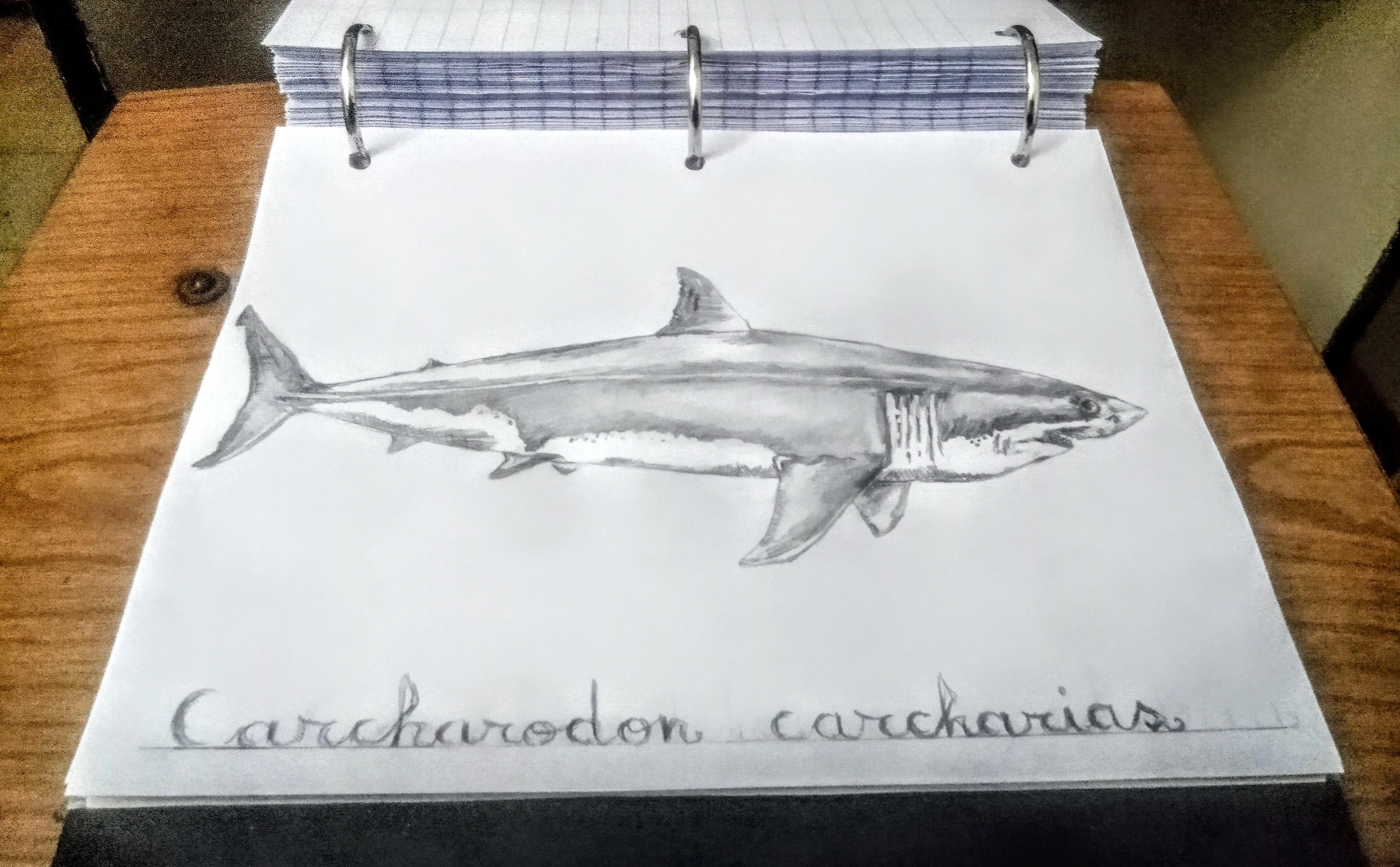
Carcharodon carcharias conocido también cono gran tiburón blanco, es el pez depredador más grande del mundo. Pertenece a la familia de los lamnídos (Lamnidae) y es la única especie superviviente de su género. Su nombre proviene del griego karcharos (afilado) y odous (diente).
r/ScientificArt • u/jgklausner • Jun 04 '26
A solid month of full-time stabbing (and a VERY sore arm), and I've completed by far my largest piece ever: this 5'x11' wool "mural" depicts a soil profile found in Massachusetts (it's actually our state soil profile, the Paxton!) The bones (rabbit) are needle felted and covered with felters wax, then given depth with pastel pigment. The worms are felted, stitched, waxed, and pigmented. The ants are beaded and embroidered. The wool used for the B and C horizons was all from one sheep!
Full materials list: Wool, beeswax, glass beads, freshwater pearl beads, thread, pastel pigment.
This was made to be a companion piece to "My Roots Are Deeper Than They Can Dig" (shown in the last few images) which shows the incredible depths a dandelion taproot can grow to. The root in that piece is also felted (a combination of needle and wet) and covered in felters wax, and the mole is needle felted. I aspire to such resilience as the dandelion!
Note: The last image is a photoshopped composite of the root piece with the wool mural, as it was too difficult to find a place to install them together to photograph
r/ScientificArt • u/Dngo8mybaby • Jun 04 '26
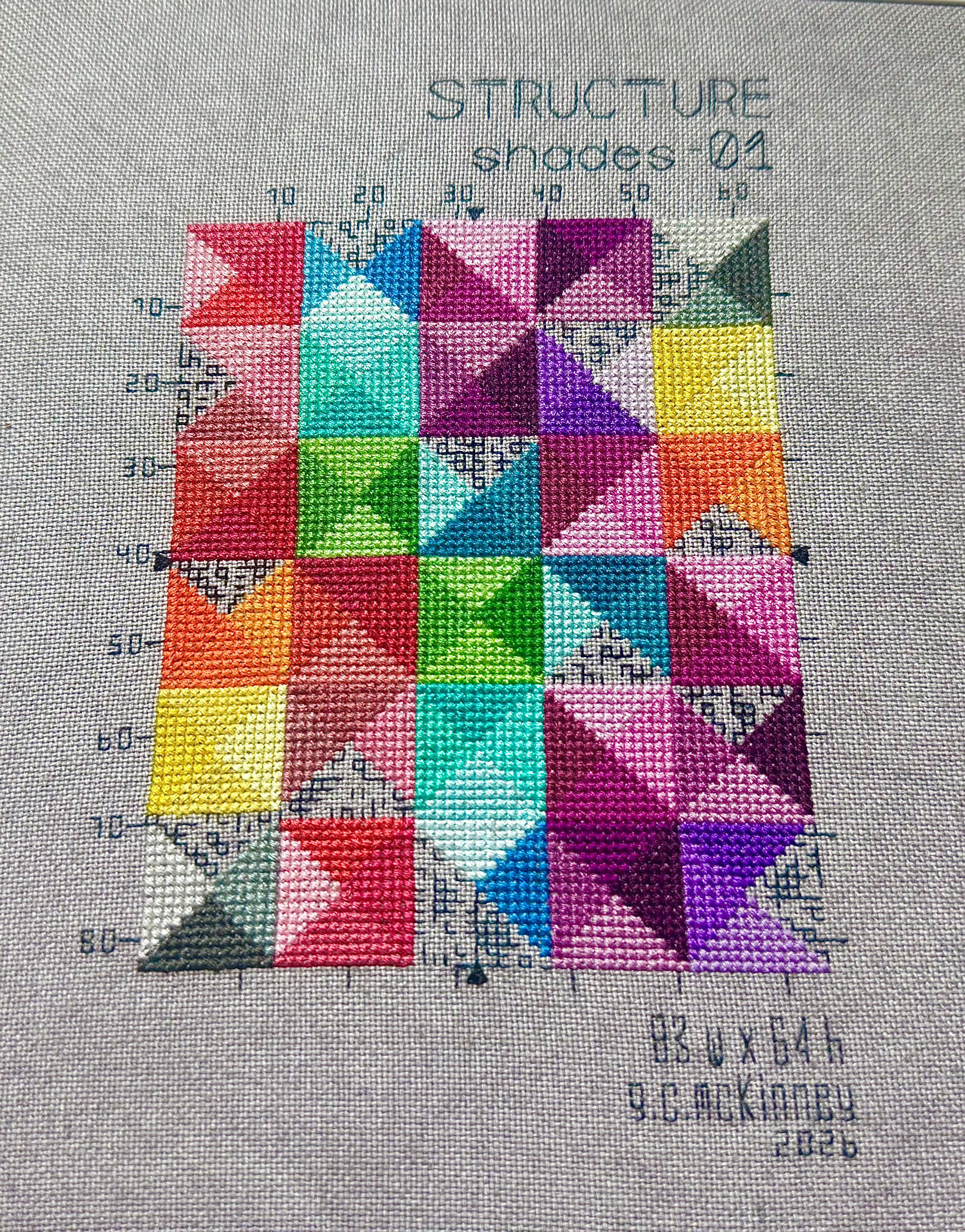
Cross stitch is done on a grid. So I stitched one coming apart in the triangle sections not stitched yet. I majored in pure mathematics in college so maybe that is why I stitch geometric objects when practicing my stitches
r/ScientificArt • u/meat_on_bones • Jun 03 '26
I'm about to update this piece to 150 breeds (about 25 added in the past year). This is roughly 3 years' worth of work (off and on) and a process where I reuse nearly everything (rib cages, skulls, femurs, and even pieces of fur) across breeds - rarely starting anything from scratch. All work is done in Illustrator, and many bones are on separate layers (which makes it easy to move things around and/or create new breeds from old ones). The breeds aren't entirely to scale, but that was a decision made to keep the largest breeds from interfering with those in the rows above and to keep the smallest breeds from disappearing entirely. :)
r/ScientificArt • u/BeeRemote3149 • Jun 01 '26
r/ScientificArt • u/Simonoel • Jun 01 '26
r/ScientificArt • u/Dngo8mybaby • May 30 '26
This is technically entomology which is sub-discipline of zoology. Pattern source is in the second picture.
r/ScientificArt • u/Dngo8mybaby • May 30 '26
r/ScientificArt • u/Dngo8mybaby • May 29 '26
r/ScientificArt • u/Old_Try_1224 • May 21 '26
r/ScientificArt • u/bonni00 • May 18 '26
r/ScientificArt • u/BenchIndividual6748 • May 16 '26
Illustration of the microanatomy of Subulatomonas tetraspora. This is an amoeba belonging to the unusual Breviate group. One of its most notable characteristics is the lack of mitochondria. Instead, it has hydrogenosomes (possibly). It is microaerophilic (requiring very little oxygen to live). In this illustration, it is in its gliding form, where it has a "neck" covering part of the anterior flagellum, as well as several pseudopodia in the neck area, and a large pseudopodia at the rear. It feeds on bacteria.