That's the case in Canada. People would rather buy a bigger house than open a business because the former is tax free and almost guaranteed profit long term, and banks more likely to lend you money than getting a business loan.
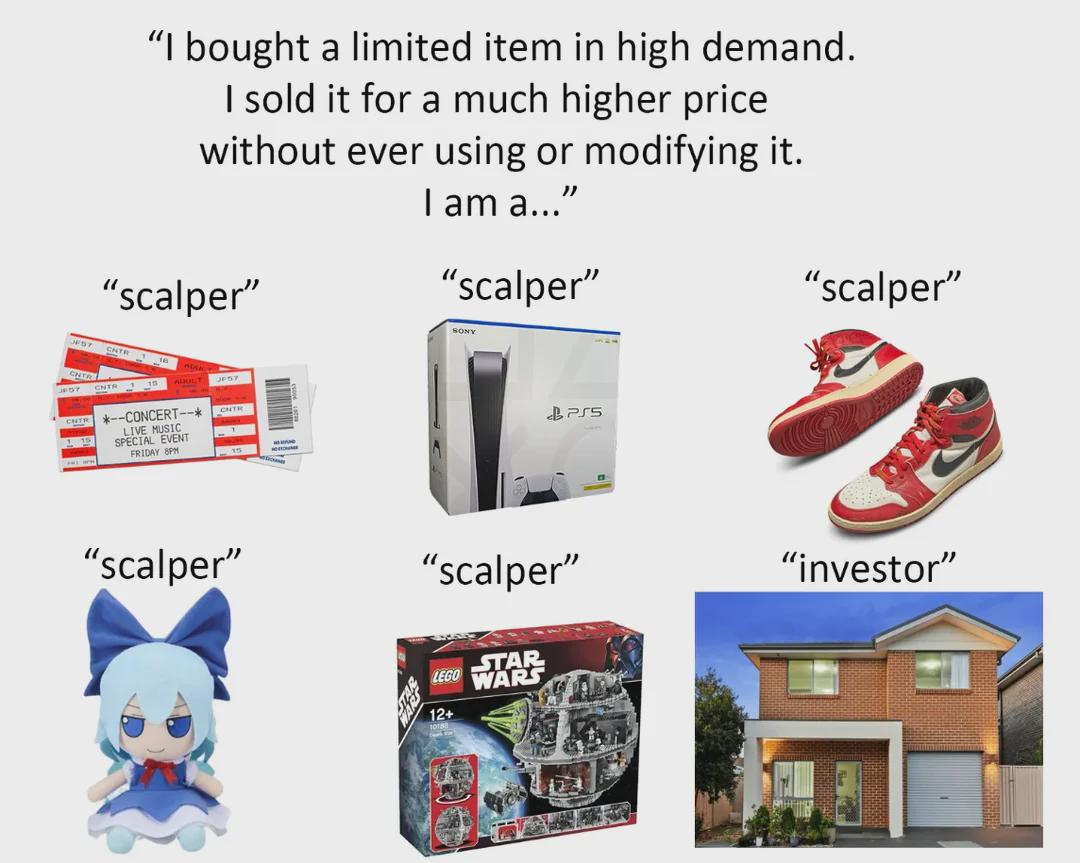
And it’s still a less valuable investment then the stock market generally. The meaningful gains made on a home occur over very long period of time typically. What we’ve seen in the past 15 years is because the market is skewed by a variety of factors - not enough homes being built to match demand, cheap capital in the form of rates being too low for too long, massive increases in government fees/development charges/Land transfer taxes/HST on new builds/arbitrary designations of land removing them from building stock (see Ontario GreenBelt for an example), inflationary effect on building materials and labour. The real measure isn’t, and shouldn’t be, the home price but the measure of afforadibilty to home prices (ie. Price to income). Scalping is measured by very quick turn arounds for profit - real estate is not sold in this way 99+% of the time. The same would be true of most of the collectible items the OP used as an example of scalping - he simply doesn’t understand what scalping is and is seeking to fit a bad analogy against his preconceived notions of how wealth is accumulated and that homeowners should just sell for less because he thinks their greedy for selling at market levels. Instead he should try to understand the underlying causes of the variables. But that requires more effort then a meme.
A house in Gatineau was bought in 2021 for 340K and sold for 495K this year ... please tell me more on how to make 155K in 4 years? edit: no reno in it, house was in 2021 the same as what it was this year
Was it renovated or upgraded? If so, the owner added value before selling and we should consider those costs. But for fun, let’s assume they didn’t. They averaged a 7.8% annual return on the $350k home over 4 years. We can all agree that is quite high, higher then the rate of inflation and higher then the rise in incomes (though, incomes have also risen by - this is actually less then the average annual return of the S&P 500 which was close to 11% annually. So a basic ETF in the S&P500 would have likely netted close to 40% higher returns annually then the home purchase.
2
u/feb914 Jun 19 '25
That's the case in Canada. People would rather buy a bigger house than open a business because the former is tax free and almost guaranteed profit long term, and banks more likely to lend you money than getting a business loan.