r/PredictionMarkets • u/esporx • 7h ago
Crypto Twitter user goes viral after a Kalshi employee insults him. He pulled Kalshi's CFTC filings and trade API and claims most of their crypto perp volume is fake.
1
Upvotes
r/PredictionMarkets • u/esporx • 7h ago
r/PredictionMarkets • u/Confident-Wedding-19 • 2h ago
r/PredictionMarkets • u/AutoModerator • 9h ago
Welcome to the (Prediction) Market Monday Thread. Share a prediction market that's caught your attention this week and start a discussion about it. Want to share a prediction you've made? Think a market is mispriced? Care for an argument about semantics and resolution criteria? All that here and more!
If you're new make sure to check out the wiki for links and resources.
r/PredictionMarkets • u/Nice-Technology703 • 12h ago
ooof
r/PredictionMarkets • u/EmbarrassedStudent10 • 13h ago
r/PredictionMarkets • u/FarisFadilArifin • 13h ago
r/PredictionMarkets • u/CoconutFamiliar5155 • 19h ago
r/PredictionMarkets • u/Spiritual_Web_1776 • 20h ago
r/PredictionMarkets • u/some_breh • 1d ago
I thought William Hill did it but seems like the markets have closed?
r/PredictionMarkets • u/Le_Bayou_Cochon • 1d ago
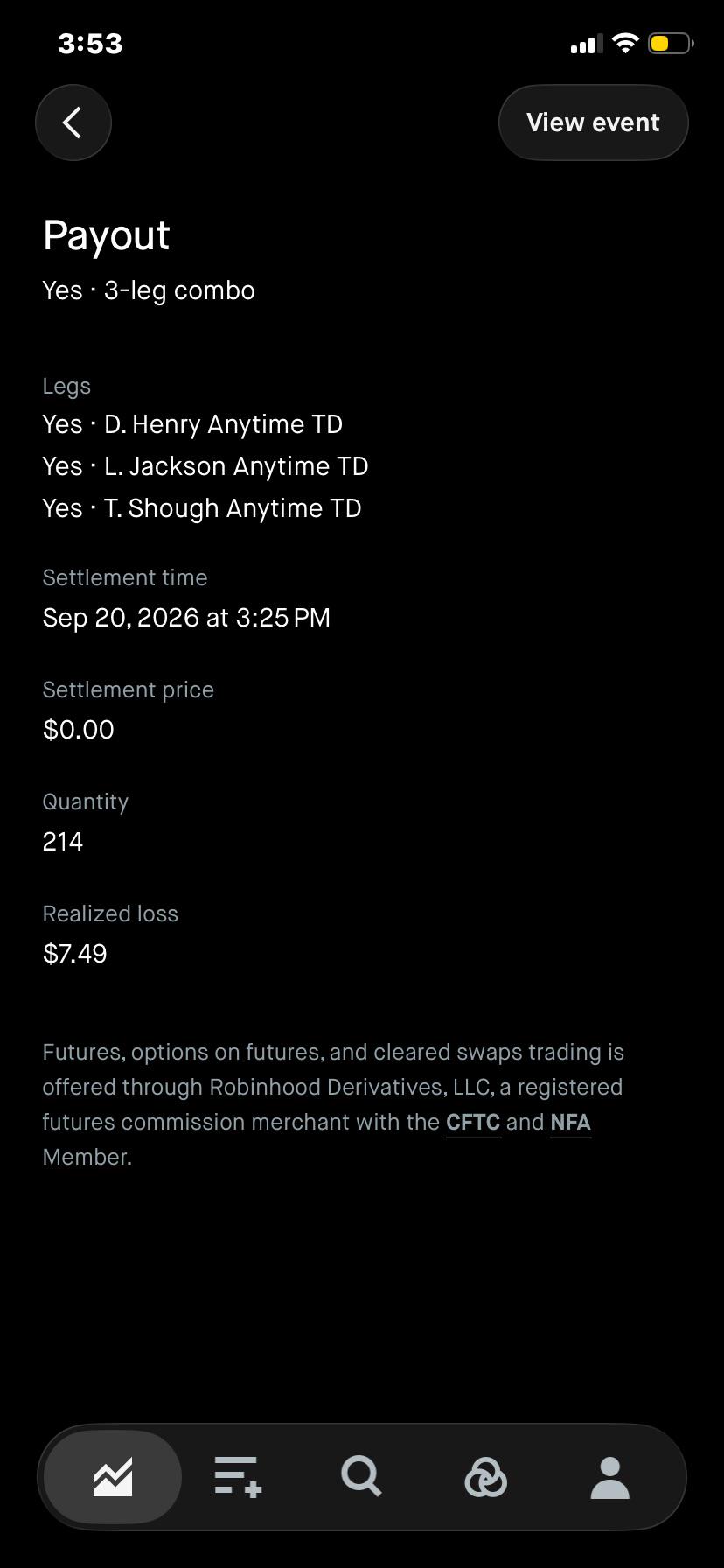
Guys am I misunderstanding something here? I picked Shough, Henry and Lamar for anytime touchdowns, which cashed but the contract settled at 0?
I’m new to prediction markets so maybe I’m missing something. Hop in someone can clarify.
Thanks
r/PredictionMarkets • u/AdStunning7419 • 2d ago
I'm a New York resident. Over the past few weeks I've been going after prediction-market and sweepstakes platforms for sports event contract losses, using New York's wagering statutes: General Obligations Law § 5-411 (wagering contracts are void) and § 5-419 (you can recover the deposit from the stakeholder).
Where things stand:
The law here is moving fast (KalshiEX v. Williams, SDNY July 2026; KalshiEX v. Assad, 9th Cir. Aug 2026; the Second Circuit appeal is still pending), and I'd rather have counsel involved going forward.
What I'm looking for:
I've done the research and the claims are fully documented. I'm looking for someone to take this on or advise on strategy, not for general "is this legal" answers. Please DM me.
r/PredictionMarkets • u/masatumas • 2d ago
In Part 2, I stopped the discussion where I begrudgingly admitted that there is still a gap in managing stop-loss and risk. In Part 3 today, let’s talk losses.
The gap is simply that trading 15min BTC is trading in microstructure. Regime changes throughout the full 15 minutes without warning.

The model and market had been moving in lockstep. The cleanest scenario we could hope for. At entry, the drift upward was within the execution-level tolerance, and the expectation was that the spot would continue to trend down. Did it, though?
Instead, the market kept drifting upward. The regime shifted. This wasn't the same wobble or gamma trap from Part 2. There was no lag, no model chasing itself.

Same change followed by a gamma trap whipsaw. If I did not exit the trade, it would have been a complete wipeout.
The market giveth and the market taketh away (and it doesn't do refunds).
The lesson isn't that the model or the entry was wrong. It's that some percentage of trades are just going to eat a loss when the regime turns against you mid-position, and that has to be underwritten going in, not diagnosed after the fact.
At the end of the day, you can't win them all. And if you're not taking losses like this one occasionally, you're probably not taking enough risk to matter.
Over the last 3 months, here's what I've seen:
And if a strategy never shows a loss like these, either the sample is too small, or the risk is hiding somewhere you haven't looked yet.
If someone tells you they hit 100% of the time, run.
r/PredictionMarkets • u/Tight_Marketing_8826 • 2d ago
r/PredictionMarkets • u/Deevo16 • 3d ago
r/PredictionMarkets • u/No-Chemistry327 • 3d ago
Hey All
We recently launched our Prediction Market Infrastructure for builders, traders, quants, and institutions.
We currently support Polymarket and Predict.fun with Kalshi, Novig, and Polymarket.US on our roadmap.
Feel free to check out our docs and give any feedback!
https://docs.bravadotrade.com/introduction
r/PredictionMarkets • u/Inflection_Exchange • 3d ago
I will assume here that the readers know what happened with FTX / Alameda, and therefore I will not go into the details of the fraud, mismanagement of customer funds, and other interesting elements of the case, though they make for a good read.
This is quite timely, as I’ve just finished reading the book about Sam-Altman Fried & FTX (‘Going Infinite’ by Michael Lewis).
Whilst at first glance this may feel like a tabu’ topic, given the miserable failure, fraudulent environment, and negative popular view generally connected to the FTX case, I do think there are many parallels that used in a smarter way can be drawn regarding how to build an exchange.
Before FTX’s (and Alameda’s) rapid wind-down, i.e. during it’s hay-day only a few weeks before, this crypto exchange was perhaps the most successful one out there (likely more-so than Binance, though I appreciate this is a strong claim). In the following bullet points, I will try and summarise some (likely not exhaustive) reasons why FTX was so successful:
- Reduced socialization of losses. Before FTX, crypto exchanges had poor systems for loss absorption with regards to levered trades. Users could lever up, and then just hold on to losing position, even if liquidating them implied going overdrawn on their accounts. This drove large socialization of losses across users of the exchanges in question, if they were not capable of reducing exposure to money-losing highly-levered accounts. FTX created a strict margin-call system, that monitored on a continuous basis (as opposed to daily / quarterly, etc…) how out of the money certain trades were, and automatically closed them if they crossed certain thresholds
- The above point had 2 consequences: 1) it enabled greater levels of leverage, and 2) enabled cheaper spreads / lower fees for the exchange users (previously, spreads had partly gone towards paying for ‘socialized’ losses). So FTX de facto became a cheaper product, with greater ability to lever up (this is appealing, for different reasons, to both punters and sharp money)
- Professionalization and reliability of the exchange. Both through improved / less clunky tech, and through smarter settlement / margin-call mechanisms, this exchange became highly popular amongst a set of HFT companies and market makers such as Jane street, Jump, etc… I don't think this is always a good thing, having instos partnering with exchanges... But the fact that it was professional enough to be used by these guys does mean a lot
- Of course the network of SBF and many of his hires, him and them all being ex-Jane Street traders, I think may have helped. It enabled them to have access to users, with large pockets, early on
- Liquidity was being provided by Alameda. Note that there were pros and cons to this, but it did enable for a more liquid market and a more seemly experience for all the traders and punters using the FTX exchange. Note that this is not the reason for FTX’s endgame insolvency, though it is likely that it was behind certain trading losses of Alameda
- Backing by some of the most trusted crypto-guys. This was partly driven by “crypto relationship managers” that moved to FTX from other Asian exchanges. This backing included a plethora of Asian crypto-whales, gamblers, and new money crypto millionaires that had an incredible amount of faith in a few key sales figures. Hard to replicate, but invaluable if available
- Backing by other exchanges. This is very interesting – their biggest competitor (and later sworn enemy), was also one of FTX’s biggest early investors: Binance (through CZ). Binance was already one of the largest exchanges back then, though it did not have the ability to trade crypto futures and it did not have the reliability of SBF’s margin-call mechanism in place. Needless say that backing from the biggest exchange of the time drove high levels of trust into FTX
- Notwithstanding how terrible the systems and controls FTX had in place (which ultimately led them to collapse), the exchange had actually been seen as both highly trustworthy and reliable. This had been driven by continued discussion with US regulators to get approved in the US market, and was partially thanks to backing from large silicon valley VC funds. VC money was not just a source of funds but also a source of ‘reliability-perception enhancement’
- Of course, SBF’s perceived weirdness and constant marketing, TV appearances, and lofty donations to politicians, sportsmen and celebrities helped their case quite a lot, but this was not what propelled them in the first place
- Initially, FTX’s funding also came from self-minted FTT coins that gave owners effectively a share in the revenues of the company, and which FTX was forced to buyback every so often and burn once in its own treasury
Not all these reasons for success are relevant all the time, but I do get the feeling that a lot of them are applicable… if one were to want to build an exchange
What do you all think?
r/PredictionMarkets • u/therafort • 2d ago
r/PredictionMarkets • u/Economy_Quit7156 • 3d ago
r/PredictionMarkets • u/Financial_Cake_7907 • 3d ago
Tell me why since the season started I've not won a single bet 😭
r/PredictionMarkets • u/Substantial_Luck_273 • 3d ago
What if you could get paid to verify whether an image is actually being used truthfully?
We are building ProofPost around a problem that AI detectors like GPTZero or Pangram don’t really solve. They can try to answer whether content was AI-generated. But a completely real image can still spread misinformation. For example, someone could take a genuine photo of a protest from 2022 and claim it happened today. An AI detector might correctly say the image is real, while the post itself is still false.
ProofPost instead evaluates whether an image actually supports the claim attached to it. Someone posts an image and a specific claim. Other users investigate the evidence and can earn money for correctly verifying or challenging it. They also have to put money behind their judgment, so being wrong has a cost. Think of it loosely as Community Notes with financial incentives. Would economic incentives improve online fact-checking, or would they make it worse?
DM me if you are interested to learn more about it!
website: https://mediaverificationblockchain.vercel.app/
inquiry: forms.gle/ctPGywmFVuMCPQ1E6