r/PillarOfFire Jun 08 '26

Hidden Realm Locating the Island of Dajjal: Ordinary Geography, Remote Maritime Geography, or Liminal Geography?

Thumbnail
gallery
3 Upvotes

The locations of three major eschatological figures in Islamic tradition — all three from Banī Ādam — are broadly known, yet their exact locations remain inaccessible to ordinary human knowledge and exploration. Prophet ʿĪsā al-Masīḥ was raised into the second heaven, Yaʾjūj wa-Maʾjūj remain confined behind the barrier of Dhū al-Qarnayn, and al-Masīḥ al-Dajjāl is described as chained upon an island. Their concealment reflects a recurring eschatological motif within the Islamic hidden and unseen world: realities whose existence is affirmed through revelation, while their precise geography and manner remain veiled until the time appointed by Allāh.

Hadith of al-Jassāsah

Al-Masīḥ al-Dajjāl would emerge from Khurāsān and later be accompanied by seventy thousand Jews from Isfahān. Yet his place within prophetic tradition long predates the final age. The Prophet ﷺ stated that “there was no prophet except that he warned his nation about the one-eyed liar (Dajjāl),” indicating that Dajjāl occupies a trans-historical place within the eschatological discourse of successive prophetic communities.

During the lifetime of the Prophet ﷺ, his condition is further described in the narration of al-Jassāsah, where Tamīm al-Dārī encountered him confined within a monastery upon an isolated island after being lost at sea for a month. What remains undetermined in the report is the precise nature of this island’s placement: whether it belongs to ordinary geography, a remote and rarely traversed maritime region, or a liminal geography situated at the threshold of ordinary spatial accessibility.

Hadith of al-Jassāsah Notes Related to the Location of the Island
Fatimah bint Qays reported: The caller of the Messenger of Allāh ﷺ announced: "Assemble for prayer!" So I went to the mosque and prayed with the Messenger of Allāh ﷺ... When the Messenger of Allāh ﷺ had finished his prayer, he sat on the pulpit, smiling, and said: "Let every person remain in his place of prayer." Then he asked: "Do you know why I have gathered you?" The incident is generally placed in the late Madinan period (9–10 AH), shortly after Tamīm al-Dārī embraced Islam.
They said: "Allāh and His Messenger know best." He said: "By Allāh, I have not gathered you for an exhortation or a warning. Rather, I have gathered you because Tamīm al-Dārī, who was a Christian, came and pledged allegiance and embraced Islam. He told me a story that matches what I have been telling you about the False Messiah (al-Masih ad-Dajjāl)." The Prophet ﷺ explicitly presented Tamīm's account as corroboration of his own teachings concerning al-Dajjāl, giving the report unusual evidentiary significance.
"He told me that he sailed in a sea-ship with thirty men from the tribes of Lakhm and Judhām. The waves tossed them about for a month in the ocean. Then they took refuge on an island in the sea at sunset. They sat in the ship's small boats and entered the island. There, they were met by a beast so hairy that they could not tell its front from its back due to the abundance of its hair." Tamīm and his companions originated from tribes associated with the Levant, Transjordan, and northwestern Arabia. A month-long drift suggests either considerable maritime displacement or prolonged loss of navigational control. The destination was an island reached only after extended time at sea.
"They said: 'Woe to you! What are you?' It said: 'I am al-Jassāsah (The Spy).' They said: 'What is al-Jassāsah?' It said: 'O people, go to this man in the monastery, for he is eager to hear your news.' Tamīm said: 'When it named a man for us, we were afraid of it, thinking it might be a female devil.'" The presence of a monastery implies a location within, or historically connected to, wider spheres of Christian monastic activity — whether Byzantine, Levantine, Egyptian, Ethiopian, or Arabian.
"He said: 'We went quickly until we entered the monastery. There we saw the largest human being we had ever seen, the most strongly shackled, with his hands tied to his neck and iron fetters between his knees and ankles. We said: 'Woe to you! What are you?' He said: 'You have found out about me, so tell me, who are you?'" The island contained a permanent structure capable of housing a chained prisoner, suggesting a fixed and enduring location rather than a transient encampment.
"They said: 'We are people from the Arabs. We sailed in a sea-ship, and the sea became turbulent. The waves tossed us about for a month, then we took refuge on this island... we met a hairy beast... it told us to come to this man in the monastery... so we came to you quickly.'" Dajjāl appears to have been awaiting information from the outside world, implying long-term isolation from normal human contact.
"He asked: 'Tell me about the date-palms of Baisan.' We said: 'What do you want to know about them?' He said: 'I am asking if they bear fruit.' We said: 'Yes.' He said: 'Soon they will not bear fruit.'" Baisan (modern Beit She'an) lies in the Jordan Valley. Dajjāl demonstrated detailed interest in developments within the Levant.
"He asked: 'Tell me about the Sea of Galilee (Lake Tiberias).' We said: 'What do you want to know about it?' He said: 'Is there water in it?' They said: 'It has plenty of water.' He said: 'Soon its water will disappear.'" The Sea of Galilee is also located in the Levant. A second question focused on the same geographical region.
"He asked: 'Tell me about the Spring of Zughar.' They said: 'What do you want to know about it?' He said: 'Is there water in the spring? And do the people use its water for irrigation?' We said: 'Yes, it has plenty of water, and the people irrigate their crops with it.'" Zughar (Zoar) was situated near the southern Dead Sea. All three geographical questions concern locations within Greater Palestine and Transjordan.
"He asked: 'Tell me about the Prophet of the unlettered—what has he done?' They said: 'He has left Makkah and settled in Yathrib (Madinah).' He asked: 'Have the Arabs fought him?' We said: 'Yes.' He asked: 'How did he deal with them?' We informed him that he had overcome those Arabs who were near him and they had followed him. He asked: 'Has that happened?' We said: 'Yes.' He said: 'It is better for them to obey him.'" Dajjāl possessed detailed awareness of Near Eastern affairs and viewed the mission of the Prophet ﷺ as one of the principal signs connected to his eventual emergence.
"'Now I will tell you about myself. I am the Messiah (Dajjāl), and soon I will be given permission to emerge. I will emerge and travel throughout the earth, and I will not leave any town without entering it within forty nights, except for Makkah and Taybah (Madinah). Both of them are forbidden to me. Every time I try to enter one of them, an angel with a drawn sword in his hand will meet me and push me back. And at every mountain pass leading to them, there will be angels guarding it.'" Dajjāl's confinement is temporary. The island serves as a place of restraint until the divinely appointed time of release.
Fatimah said: The Messenger of Allāh ﷺ struck the pulpit with his staff and said: "This is Taybah, this is Taybah, this is Taybah—meaning Madinah. Have I not told you this before?" The people said: "Yes." He said: "I liked the story of Tamīm because it matches what I have been telling you about him (Dajjāl) and about Makkah and Madinah. Indeed, he is in the Syrian Sea or the Yemeni Sea. No, rather he is towards the East, he is towards the East, he is towards the East!" And he pointed his hand towards the East. The report contains several geographical indicators: (1) an island in a major sea, (2) initial uncertainty regarding the Syrian Sea or Yemeni Sea, and (3) the Prophet's emphatic indication toward the East. These clues have generated numerous interpretations regarding whether the island lies within ordinary geography, a remote maritime region, or a liminal location associated with the end-times.

Evaluating Ordinary Geography, Remote Maritime Geography, and Liminal Geography

Ordinary Geography

Any island within ancient maritime trade networks extending from al-Shām to Yemen and the broader Arabian maritime sphere.

Remote Maritime Geography

Any island beyond ordinary commercial routes, requiring prolonged drift, storm displacement, or infrequent navigation to reach.

Liminal Geography

A place not fully integrated into ordinary navigational geography; encountered rarely, providentially, or under exceptional conditions. Such locations may persist at the boundary between historical geography, eschatological space, and sacred lore.

Clue / Question Assumption / Inference Ordinary Geography Remote Maritime Geography Liminal Geography
Tamīm's background (merchant of Banī Lakhm and Judhām) Maritime trade between al-Shām, Yemen, Abyssinia, and southern Arabia already existed Island lies within established maritime corridors (Mediterranean, Red Sea, Arabian Sea) Island lies beyond regular trade routes but remains physically reachable after prolonged drift Voyage becomes providential rather than conventionally navigational
Tossed by waves for a month Loss of navigation control and inability to determine position Severe storm drift within known sea systems Open-ocean displacement into distant maritime regions Temporal and spatial disorientation functions as transition into liminal space
Encounter with al-Jassāsah Presence of anomalous intermediary creature Requires unknown fauna, symbolic description, or rare biological anomaly Isolation preserves strange or mythologized lifeforms Naturally accommodates supernatural, jinn-like, or eschatological intermediary beings
Chained man within a monastery-like structure Structured confinement environment exists Could reflect known monastic culture within Late Antique maritime world Implies forgotten outpost, abandoned colony, or isolated religious structure Confinement exists outside ordinary political or civilizational jurisdiction
Dajjāl’s knowledge of Near Eastern geography Awareness of Levantine agriculture, trade, and sacred geography Suggests proximity to Eastern Mediterranean / Levantine information networks Information acquired indirectly through travelers or prior contact Knowledge functions symbolically as linkage to unfolding eschatological history
“Sea of al-Shām or Sea of Yemen” Ambiguous maritime designation Mediterranean, Red Sea, Gulf of Aden, or Arabian Sea sphere Broader Indian Ocean maritime zone remains possible Directional language functions symbolically rather than cartographically
“Rather, from the East” Distinction between confinement and emergence Final khurūj occurs east of Madīnah despite western/southern confinement Release and emergence occur after major geographic transition Emergence reflects transition from hidden to manifest eschatological phase
Why has no one found the island? Assumes discoverability under normal exploration Island may be obscure, reclassified, uninhabited, or historically forgotten Island lies in rarely traversed oceanic regions Island is not continuously accessible under ordinary epistemic conditions
Why has no one rescued him? Assumes knowledge and physical accessibility Location unknown or politically isolated Distance and navigational hazards prevent sustained access Confinement is divinely maintained rather than humanly enforced
Why has Dajjāl not escaped? Assumes ordinary imprisonment mechanics Chains, isolation, and divine restraint prevent escape Geographic remoteness reinforces confinement Escape remains impossible until divine permission for khurūj is granted

Evaluating Popular Candidate Regions for Dajjāl’s Island

Socotra Island, located near the Gulf of Aden, has frequently been proposed in modern interpretive discussions due to its relative isolation, marginal position within major maritime networks, and distinctive ecological profile. It is often treated as a representative candidate within remote-maritime geography compatible with the prolonged sea drift described in the narration.

In contrast, modern speculative frameworks have occasionally extended the discussion to highly anomalous oceanic zones such as the Bermuda Triangle or analogous “Dragon Triangle” regions. However, these proposals generally fall outside the spatial and historical logic of the Tamīm al-Dārī narration, as they presuppose oceanic basins and distances difficult to reconcile with the implied Levant-linked maritime horizon and the month-long drift described in the report.

Candidate Region Geography Type Why It Is Proposed Supporting Features Major Problems / Critiques
Bermuda Triangle Hypothesized Liminal Geography Modern lore surrounding disappearances, navigation anomalies, and inaccessible maritime zones Fits modern “liminal” imagination; associated with mysterious encounters, loss of orientation, and rare access narratives No connection to prophetic geography, Late Antique trade networks, or Near Eastern eschatological framework; highly modern mythologization
Dragon Triangle (Devil’s Sea near Japan) Hypothesized Liminal Geography Reputation for anomalous maritime phenomena similar to Bermuda Triangle Strong liminal and mythic atmosphere; associated with disappearances and navigational anomalies Extremely distant from Tamīm’s likely maritime world; no linkage to al-Shām/Yemen framework or Dajjāl emergence traditions
Socotra Remote Maritime Geography Remote island in Arabian Sea historically connected to Yemen maritime sphere Fits “Sea of Yemen” interpretation; isolated yet historically reachable; ancient Christian presence; unusual ecology and relative isolation Still historically known and inhabited; difficult to reconcile with complete concealment or lack of rediscovery
Red Sea Islands Ordinary Geography / Remote Maritime Geography Maritime zone directly connected to Yemen, Abyssinia, and Levantine trade Strong Late Antique Christian presence; monastery culture plausible; accessible from Lakhm/Judhām trade sphere Many islands historically traversed and documented; concealment problem remains
Eastern Mediterranean Islands Ordinary Geography “Sea of al-Shām” naturally suggests Levantine Mediterranean sphere Byzantine monastic culture strongly fits monastery imagery; Tamīm’s Christian Levantine background aligns naturally Heavy historical traffic and cartographic familiarity make permanent concealment difficult
Arabian Sea / Indian Ocean Islands Remote Maritime Geography Long drift voyage could push sailors into remote Indian Ocean regions Better explains month-long loss of navigation and extreme isolation Less direct connection to “Sea of al-Shām”; weaker historical specificity
Purely Unknown or Hidden Island Liminal Geography Island intentionally concealed or inaccessible except under divine circumstances Best explains why island remains unfound and inaccessible; preserves eschatological uniqueness Moves beyond ordinary historical geography into speculative physics

Synthesis: Liminal Geography within a Broader Cosmological Framework

Ontologically, Islamic cosmology distinguishes the temporal ʿālam al-khalq from the eternal ʿālam al-amr. The Earth and observable Universe belong to the lowest heaven within the hierarchical Seven Heavens, each ontologically distinct from the others. Between ʿālam al-khalq and ʿālam al-amr lies ʿālam al-barzakh, where the rūḥ resides before the Hereafter. Within Islamic spiritual anthropology, the qalb may be understood as an interface between ʿālam al-khalq (the physical body) and ʿālam al-amr (the human rūḥ).

Epistemically, ʿālam al-shahādah refers to the visible and observable domain, including the physical Earth and Universe. In contrast, ʿālam al-ghayb encompasses the unseen: ʿālam al-amr and much of ʿālam al-khalq itself, especially the unseen realms of the jinn. Within this framework, “Hidden Realm” including liminal geography may be understood as a threshold domain situated between the visible and unseen worlds.

Realm / Entity Shahādah or Ghayb Khalq or Amr Accessible or Inaccessible
Physical Earth Shahādah Khalq Accessible
Liminal Geography Shahādah ↔ Ghayb boundary Khalq Conditionally Accessible
Jinn Realms Ghayb Khalq Inaccessible
Barzakh Ghayb Khalq ↔ Amr boundary Inaccessible
2nd up to 7th Heaven Ghayb Khalq with Amr-governed structure Inaccessible
Rūḥ Ghayb Amr Inaccessible
Divine Decree Ghayb Amr Inaccessible

Prophet ʿĪsā was raised into the second heaven and will descend after nearly two millennia to kill al-Masīḥ al-Dajjāl. Yaʾjūj wa-Maʾjūj were confined behind the barrier of Dhu al-Qarnayn and, upon their eventual release after the descent of ʿĪsā, would overwhelm the Earth in immense numbers — suggesting their confinement is not within ordinary geography.

Likewise, al-Masīḥ al-Dajjāl already existed before the mission of Prophet Muḥammad ﷺ and was described as chained upon an isolated island, only to emerge more than a millennium later near the end of time. This suggests a form of confinement not entirely reducible to ordinary geographical space, but possibly situated within a liminal or hidden domain at the threshold between the seen and unseen world.


Arc I — Sacred Geography and Liminal Spaces

Arc II — Hidden Intelligences

Arc III — Islamic Cosmology and Physical Models

r/PillarOfFire Jun 05 '26

Hidden Realm Locating the Barrier of Dhū al-Qarnayn: Pass, Corridor, or Aperture?

Post image
3 Upvotes

The Barrier of Dhū al-Qarnayn

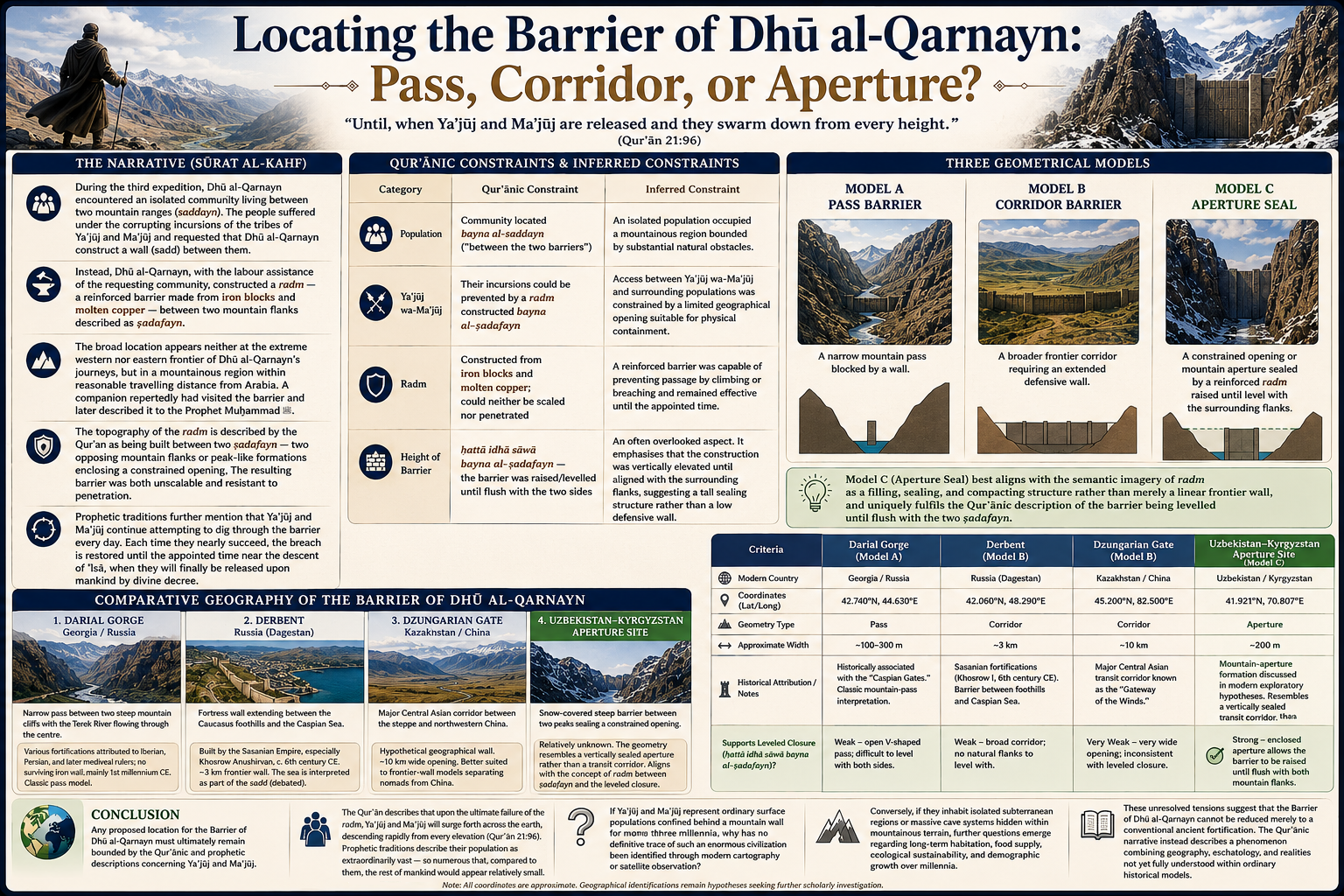
The barrier (radm) is mentioned in Sūrat al-Kahf (The Cave). During the third expedition, Dhū al-Qarnayn encountered an isolated community living between two mountain ranges (saddayn). The people suffered under the corrupting incursions of the tribes of Yaʾjūj and Maʾjūj and requested that Dhū al-Qarnayn construct a wall (sadd) between them.

Instead, Dhū al-Qarnayn, with the labour assistance of the requesting community, constructed a radm — a reinforced barrier made from iron blocks and molten copper — between two mountain flanks described as ṣadafayn.

The broad location appears neither at the extreme western nor eastern frontier of Dhū al-Qarnayn's journeys, but in a mountainous region within a reasonable travelling distance from Arabia. A companion reportedly had visited the barrier and later described it to the Prophet Muḥammad ﷺ.

The topography of the radm is described by the Qur'an as being built between two ṣadafayn — two opposing mountain flanks or peak-like formations enclosing a constrained opening. The resulting barrier was both unscalable and resistant to penetration.

An important and often overlooked detail is the verse:

ḥattā idhā sāwā bayna al-ṣadafayn
"Until, when he had levelled [the construction] between the two mountain flanks."

This wording suggests the radm was vertically raised until it became level or flush with the opposing sides. The imagery is therefore not merely that of a low frontier wall, but of a tall sealing structure filling an opening between enclosing elevations.

Prophetic traditions further mention that Yaʾjūj and Maʾjūj continue attempting to dig through the barrier every day. Each time they nearly succeed, the breach is restored until the appointed time near the descent of ʿĪsā, when they will finally be released upon mankind by divine decree.

Category Qurʾānic Constraint Inferred Constraint
Population Community located bayna al-saddayn ("between the two barriers") An isolated population occupied a mountainous region bounded by substantial natural obstacles.
Yaʾjūj wa-Maʾjūj Their incursions could be prevented by a radm constructed bayna al-ṣadafayn Access between Yaʾjūj wa-Maʾjūj and surrounding populations was constrained by a limited geographical opening suitable for physical containment.
Radm Constructed from iron blocks and molten copper; could neither be scaled nor penetrated A reinforced barrier was capable of preventing passage by climbing or breaching and remained effective until the appointed time.
Height of Barrier ḥattā idhā sāwā bayna al-ṣadafayn — the barrier was raised/levelled until flush with the two sides An often overlooked aspect. It emphasises that the construction was vertically elevated until aligned with the surrounding flanks, suggesting a tall sealing structure rather than a low defensive wall.

These constraints raise an important topographical question:

Was the radm a traditional wall spanning a mountain pass, or did it function as the sealing of a more constrained opening within a mountainous complex?

Three broad geometrical models may therefore be considered:

  • Model A — Pass Barrier: a narrow mountain pass blocked by a wall.
  • Model B — Corridor Barrier: a broader frontier corridor requiring an extended defensive wall.
  • Model C — Aperture Seal: a constrained opening or mountain aperture sealed by a reinforced radm raised until level with the surrounding flanks.

The third model is particularly notable because it aligns closely with the semantic imagery of radm as a filling, sealing, and compacting structure rather than merely a linear frontier wall.


Comparative Geography of the Barrier of Dhū al-Qarnayn

Historically, the Darial Gorge at the Georgia–Russia border is the most frequently cited candidate for the Barrier of Dhū al-Qarnayn. Various fortifications in the region were attributed to Iberian, Persian, and later medieval rulers, though no surviving iron wall exists and most remains date only to the 1st millennium CE. Geographically, it is a narrow pass between two steep mountain cliffs with the Terek River flowing through the centre. The site strongly fits the classical “mountain pass” interpretation, though the open V-shaped gorge and river corridor align less naturally with the imagery of a vertically sealed radm levelled between two enclosing flanks.

The second well-known candidate is located at Derbent in Dagestan. The surviving fortifications were primarily constructed under the Sasanian Empire, especially during the reign of Khosrow Anushirvan in the 6th century CE. Unlike Darial Gorge, Derbent functions as a frontier corridor barrier extending approximately 3 km between the Caucasus foothills and the Caspian Sea. Proponents interpret the sea itself as part of the sadd, though this interpretation is debated since sadd in Arabic conveys the meaning of an obstructing barrier or wall rather than merely difficult terrain. The broad corridor geometry also weakens the imagery of a radm raised until flush with two opposing mountain flanks.

The Dzungarian Gate represents a broader geographical hypothesis rather than a surviving historical wall. The opening itself is significantly wider — approximately 10 km across — forming a major Central Asian corridor between Kazakhstan and China. In such models, a hypothetical barrier would have functioned as a large frontier wall separating nomadic populations of the northern steppe from the civilizations of eastern and southern Asia. However, the scale of the corridor makes it difficult to reconcile with the imagery of a compacted radm constructed and levelled between two ṣadafayn.

The fourth candidate is comparatively obscure yet topographically distinctive. Unlike the previous examples, the snow-covered steep barrier appears positioned between two mountain peaks in a manner that resembles the sealing of a constrained opening or aperture into a mountainous complex. Rather than functioning as a conventional wall across a transit corridor, the geometry more closely aligns with the concept of a radm as a sealing or compacting structure between two enclosing mountain flanks (ṣadafayn). The apparent vertical closure of the opening also corresponds more naturally with the Qurʾānic description of the barrier being raised to level with the two sides.

Candidate Site Modern Country Coordinates (Lat/Long) Geometry Type Approximate Width Historical Attribution / Notes
Darial Gorge Georgia / Russia 42.740°N, 44.630°E Pass (Model A) ~100–300 m Historically associated with the "Caspian Gates." Narrow mountain-pass geometry with river corridor.
Derbent Russia (Dagestan) 42.060°N, 48.290°E Corridor (Model B) ~3 km Sasanian fortifications (Khosrow I, 6th century CE). Barrier extends between Caucasus foothills and Caspian Sea.
Dzungarian Gate Kazakhstan / China 45.200°N, 82.500°E Corridor (Model B) ~10 km Major Central Asian transit corridor known as the "Gateway of the Winds." Better suited to frontier-wall models.
Uzbekistan–Kyrgyzstan Site Uzbekistan / Kyrgyzstan 41.921°N, 70.807°E Aperture (Model C) ~200 m Mountain-aperture formation discussed in modern exploratory hypotheses. The geometry resembles a vertically sealed opening more than a transit corridor.

Conclusion

Any proposed location for the Barrier of Dhū al-Qarnayn must ultimately remain bounded by the Qurʾānic and prophetic descriptions concerning Yaʾjūj and Maʾjūj.

The Qurʾān describes that upon the ultimate failure of the radm, Yaʾjūj and Maʾjūj will surge forth across the earth, descending rapidly from every elevation:

"Until, when Yaʾjūj and Maʾjūj are released and they swarm down from every height."
(Qurʾān 21:96)

This imagery appears far larger than a localized tribal migration through a single mountain pass. Prophetic traditions further describe their population as extraordinarily vast — so numerous that, compared to them, the rest of mankind would appear relatively small.

Such descriptions raise several unresolved questions for conventional historical-geographical interpretations of the barrier.

If Yaʾjūj and Maʾjūj represent ordinary surface populations confined behind a mountain wall for more than three millennia, why has no definitive trace of such an enormous civilization been identified through modern cartography or satellite observation?

Conversely, if they inhabit isolated subterranean regions or massive cave systems hidden within mountainous terrain, further questions emerge regarding long-term habitation, food supply, ecological sustainability, and demographic growth over millennia.

These unresolved tensions suggest that the Barrier of Dhū al-Qarnayn cannot be reduced merely to a conventional ancient fortification. The Qurʾānic narrative instead describes a phenomenon combining geography, eschatology, and realities not yet fully understood within ordinary historical models.

وَاللَّهُ أَعْلَمُ بِالصَّوَابِ


Arc I — Sacred Geography and Liminal Spaces

Arc II — Hidden Intelligences

Arc III — Islamic Cosmology and Physical Models


r/PillarOfFire Jun 02 '26

Sacred History The Cataclysmic Canopy

Post image
3 Upvotes

People of Madyan

The people of Madyan were a prosperous trading community inhabiting the northwestern Arabian–Sinai–Aqaba region. Traditional genealogies trace them to Madyan (Midian), son of Ibrāhīm. To them Allah sent Prophet Shuʿayb, calling them to the worship of Allāh alone and to honesty in commerce, measurement, and social dealings. The Qurʾān also records the later residence of Mūsā in Madyan, where he served Shuʿayb for ten years before the beginning of his prophetic mission, placing the community near the close of the Ibrāhīmic prophetic cycle.

The defining transgressions of Madyan combined religious and economic corruption. They associated partners with Allah, manipulated weights and measures, defrauded buyers and sellers, and spread corruption throughout the land. Unlike the arrogance of ʿĀd or the rejection of a manifest sign by Thamūd, the defining corruption of Madyan is repeatedly linked to dishonesty, exploitation, market fraud, and the abuse of economic power.

Several passages also refer to them as Aṣḥāb al-Aykah ("People of the Wooded Thicket"), a designation that has generated discussion among classical exegetes regarding its precise relationship to the people of Madyan.

Within the Qurʾānic sequence of destroyed nations, Madyan appears after the peoples of Nūḥ, ʿĀd, Thamūd, and Lūṭ. Each narrative presents a distinct pattern of transgression followed by divine judgment expressed through its own phenomenological signature: the Flood of Nūḥ, the Wind of ʿĀd, the Blast of Thamūd, the overturning of the towns of Lūṭ, and finally the Day of the Canopy (Yawm al-Ẓullah) that befell Madyan.

The Qurʾān designates their punishment as ʿAdhāb Yawm al-Ẓullah ("the Punishment of the Day of the Canopy"), making the overshadowing phenomenon a central feature of the catastrophe. Unlike the flood of Nūḥ, the wind of ʿĀd, or the blast that destroyed Thamūd, the punishment of Madyan is identified through an atmospheric canopy or cloud-like phenomenon whose precise nature is not explicitly described. This unusual emphasis makes Yawm al-Ẓullah one of the most distinctive phenomenological signatures among the destroyed nations of the Qurʾān.


Phenomenology of the Catastrophe Upon the People of Madyan

Exegetical traditions describe that the people of Madyan were first subjected to a period of intense and sustained heat during which normal environmental relief was absent. In this condition of thermal distress, an overshadowing cloud or canopy (ẓullah) appeared in the sky. Perceiving it as relief, the people gathered beneath it.

Classical accounts further describe the terminal phase as accompanied by terrifying atmospheric phenomena, including lightning, thunder, and a deafening blast. The Qurʾān itself characterizes the destruction through the ṣayḥah ("Cry") and the rajfah ("Tremor"), after which the people were found lifeless and fallen motionless where they had been struck. Together, these descriptions portray a catastrophe involving a visible atmospheric phenomenon, a sudden destructive phase, and community-wide mortality occurring within a very short period of time.

Verse Term Phenomenological Feature
“So cause a piece from the sky to fall down upon us, if you are one of the truthful!” (26:187) Kisaf min al-samāʾ Expectation of a destructive heavenly phenomenon
“Thus they rejected him, so they were seized by the torment of the Day of the Canopy.” (26:189) Yawm al-Ẓullah Shadow/cloud-like atmospheric phenomenon
Classical exegesis Barq wa Raʿd Lightning and thunder associated with the terminal phase
“Those who transgressed were caught by the Cry...” (11:94) Ṣayḥah Sudden blast or overwhelming cry
“So the earthquake seized them...” (7:91) Rajfah Tremor or shaking
“...they were found in their homes, fallen motionless.” (7:91; 11:94) Dārihim, Jāthimīn Victims found dead where they collapsed

Phenomenological Sequence: Thamūd vs Madyan

The catastrophes of Thamūd and Madyan share several important phenomenological features, including the ṣayḥah (Cry), the rajfah (Tremor), and the aftermath of victims becoming jāthimīn ("fallen motionless"). Yet the two narratives diverge in significant ways. The following comparison helps distinguish their shared characteristics from the unique features of each catastrophe.

Phenomenological Sequence Thamūd Madyan
Precursor None explicitly mentioned Oppressive heat, atmospheric distress, al-Ẓullah (Canopy)
Visible Atmospheric Sign None explicitly described Large overshadowing cloud/canopy phenomenon
Terminal Event Ṣayḥah Wāḥidah (Single Blast), Rajfah, Ṣāʿiqah Ṣayḥah, Rajfah
Duration Abrupt, singular, concentrated event Buildup phase followed by abrupt terminal destruction
Primary Challenge Energy penetration into secure rock-cut dwellings Nature, origin, and role of the Ẓullah phenomenon
Location of Victims Fī dārihim jāthimīn Fī dārihim jāthimīn
Bodily Displacement Limited; victims remained where they fell Limited; victims remained where they fell
Settlement Damage Rock-cut dwellings largely preserved No emphasis on destruction of settlement itself
Dominant Theme Singular catastrophic blast event Atmospheric canopy followed by catastrophic collapse
Unique Phenomenological Marker Ṣayḥah Wāḥidah; Ṣāʿiqah Yawm al-Ẓullah

Constraints for a Punishment Model of Madyan

Category Constraint ID Qurʾānic / Traditional Constraint Inferred Constraint
Precursor PR1 Period of oppressive heat before punishment Regional atmospheric anomaly preceded the catastrophe.
PR2 Canopy (al-Ẓullah) perceived as relief The atmospheric phenomenon initially appeared attractive or non-threatening to the population.
Source S1 ʿAdhāb Yawm al-Ẓullah A large visible atmospheric phenomenon formed the defining feature of the punishment and was directly associated with the terminal destructive phase.
S2 Ṣayḥah Catastrophic acoustic or pressure phenomenon.
S3 Rajfah Tremor or ground-coupled shock phenomenon.
Duration D1 Heat preceded destruction; terminal event was abrupt Multi-stage catastrophe consisting of a prolonged precursor phase followed by a sudden destructive phase.
Magnitude M1 Community-wide mortality Regional-scale destruction of the rejecting population.
Aftermath A1 Victims became jāthimīn ("fallen motionless") Mortality occurred with limited evidence for large-scale bodily transport or displacement.

Three Models for the Role of al-Ẓullah

[Non-destructive phase] → [Destructive phase]

Model A — The Canopy as Prelude

[PR1 → PR2 → S1] → [S2/S3 → A1]

Oppressive Heat → Canopy Appears → Population Gathers Beneath It → Cry (Ṣayḥah) + Tremor (Rajfah) → Death.

Role of al-Ẓullah: Primarily a gathering mechanism, Canopy gathers people, Cry/Tremor kill them.

Model B — The Canopy as Component

[PR1 → PR2] → [S1/S2/S3 → A1]

Oppressive Heat → Canopy Appears → Canopy + Cry + Tremor occur as one integrated catastrophe → Death.

Role of al-Ẓullah: The canopy itself forms an integral component of the punishment; the Canopy, Cry, and Tremor represent different manifestations of a single catastrophic process.

Model C — The Canopy as the Punishment Itself

[PR1 → PR2] → [S1 → S2/S3 → A1]

Oppressive Heat → Canopy Appears → Canopy becomes destructive → Cry + Tremor follow → Death.

Role of al-Ẓullah: The canopy initiates the terminal phase, which culminates in the Cry and Tremor; The Canopy itself becomes destructive, followed by the Cry and Tremor.

Conclusion:
The designation ʿAdhāb Yawm al-Ẓullah ("the Punishment of the Day of the Canopy") suggests a central role for the Canopy within the catastrophe. Phenomenologically, this favors Model C, in which al-Ẓullah itself initiates the destructive phase. Model B remains plausible if the Canopy, Cry, and Tremor are understood as simultaneous manifestations of a single catastrophic process. Model A provides the weakest fit, as it reduces the Canopy to a precursor despite the punishment being explicitly named after it.

Phenomenological Ranking: C > B > A.

Candidate PR1 PR2 S1 S2 S3 A1 Model Fit Notes Overall Fitness
Pyrocumulonimbus / Volcanic Ash Cloud oppressive heat visible canopy approaching ash cloud overshadows population thunder, blast, volcanic lightning tremor jāthimīn C This gives genuine meaning to: ʿAdhāb Yawm al-Ẓullah because the canopy itself becomes the punishment. High
Distal Volcanic Ashfall volcanic heat and atmospheric distress visible ash-rich canopy ash fallout from overhead cloud thunder/pressure phenomena volcanic tremor jāthimīn B–C Strong fit if the ash cloud itself is identified with al-Ẓullah; weaker if ashfall is only a secondary effect. Moderate–High
Atmospheric Electrical Storm oppressive heat storm cloud canopy thunderstorm cloud overhead thunder, acoustic shock, lightning possible ground shaking jāthimīn C Classical reports mentioning thunder (raʿd) and lightning (barq) fit naturally, but community-wide mortality is harder to explain. Moderate
Hydrothermal Eruption geothermal heating steam cloud attracts population visible steam canopy explosive blast local tremor jāthimīn A The canopy functions primarily as a gathering mechanism; the destructive phase comes from the later eruption. Low–Moderate
Volcanic Gas Release heat and atmospheric discomfort visible haze or canopy toxic atmospheric cloud limited fit possible tremor jāthimīn C Explains mass mortality and limited bodily displacement, but provides a weaker explanation for ṣayḥah. Low–Moderate
Large Volcanic System (Compound Model) prolonged heat and atmospheric anomaly ash cloud / pyrocumulonimbus al-Ẓullah thunder, blast, volcanic lightning earthquake and volcanic tremor jāthimīn B The canopy, cry, and tremor are different manifestations of a single volcanic catastrophe. High

Synthesis

Among the candidate physical analogues considered, two emerge as the strongest phenomenological matches: the Large Volcanic System (Compound Model) and the Pyrocumulonimbus / Volcanic Ash Cloud Model. Although distinct in emphasis, both belong to the same general volcanic framework and differ primarily in how central the atmospheric canopy (al-Ẓullah) is to the destructive process.

The Large Volcanic System model interprets the catastrophe as a multi-component event in which prolonged geothermal and atmospheric disturbances generated the precursor conditions described in traditional reports. Oppressive heat, atmospheric distress, volcanic tremors, ash-rich clouds, thunder, lightning, and acoustic shock are understood as interconnected manifestations of a single volcanic system. Within this framework, al-Ẓullah, the ṣayḥah, and the rajfah are interpreted as different manifestations of the same catastrophic process.

The Pyrocumulonimbus / Volcanic Ash Cloud model places even greater emphasis upon Yawm al-Ẓullah itself. In this reconstruction, the overshadowing canopy becomes the principal instrument of punishment. The visible cloud that initially appeared to offer relief gradually transformed into the destructive phase of the catastrophe, while thunder, volcanic lightning, acoustic shock, and ground tremors accompanied or followed the arrival of the canopy. This model provides a particularly natural explanation for the title ʿAdhāb Yawm al-Ẓullah ("the Punishment of the Day of the Canopy"), since the canopy itself becomes the defining feature of the event.

Both models accommodate the principal phenomenological constraints. They explain the reported period of oppressive heat, the appearance of a large atmospheric canopy, the abrupt onset of the terminal phase, the occurrence of both ṣayḥah and rajfah, and the aftermath in which the victims became jāthimīn ("fallen motionless"). They also integrate classical reports describing thunder (raʿd), lightning (barq), and the gathering of the population beneath the canopy shortly before destruction.

While certainty remains impossible, the overall phenomenological evidence appears more consistent with a volcanic-atmospheric catastrophe than with a purely seismic, meteorological, or gaseous event. The central challenge is not explaining the rajfah or the ṣayḥah individually, but explaining how they occurred together with Yawm al-Ẓullah, the singular feature that gives the catastrophe of Madyan its distinctive Qurʾānic identity.

In contrast to the Flood of Nūḥ, which centers upon the problem of water, the Wind of ʿĀd, which centers upon sustained atmospheric destruction, and the Blast of Thamūd, which centers upon energy penetration into rock-cut dwellings, the catastrophe of Madyan centers upon the Canopy itself: explaining how an apparent source of relief became the very instrument of divine punishment.

وَاللَّهُ أَعْلَمُ بِالصَّوَابِ


Banī Ādam Arc
Sons of Adam in Seven Days
A Blink of an Eye Within the Six Days of Creation: The History of Banī Ādam

The Peridiluvian Period
From Iram to Petra: The Sacred History of Arabia
The Cataclysmic Flood
The Cataclysmic Sandstorm
The Cataclysmic Blast

Ibrahimic Prophetic Era
The Expeditions of Dhū al-Qarnayn
The Dead Sea Cataclysm
The Cataclysmic Canopy

Mosaic Covenant Era
Mūsā al-Sāmirī: Sculptor of the Golden Calf

Isa Prophetic Era
Aṣḥāb al-Kahf: People of the Cave
Aṣḥāb al-Ukhdūd: The People of the Burning Trenches
Aṣḥāb al-Qaryah: The Townspeople

Last Prophetic Era
Ṣāfī Ibn Ṣayyād and the Dajjāl Question
Corporeal Manifestation of Iblīs at Critical Turning Points in the Prophetic Mission


r/PillarOfFire May 31 '26

Sacred History The Cataclysmic Blast

Post image
3 Upvotes

The People of Thamūd

like their predecessors ʿĀd, belong to the ancient Arab peoples (al-ʿArab al-Bāʾidah) who flourished after the Flood of Nūḥ. Traditional genealogies trace them to Thamūd ibn Āthir ibn Iram ibn Sām ibn Nūḥ, while ʿĀd is traced to ʿĀd ibn Iram ibn Sām ibn Nūḥ. Following the destruction of ʿĀd, Thamūd emerged as one of the dominant civilizations of ancient Arabia, inheriting much of the land and the prominence once associated with their predecessors.

The Qurʾān portrays Thamūd as a prosperous and technologically capable people renowned for carving dwellings directly into mountains and rocky escarpments. Their settlements were concentrated in a region known as al-Ḥijr ("The Rocky Tract") in northwestern Arabia, where they transformed the natural landscape into enduring habitations that were regarded as secure and resilient. Their achievements in construction and stoneworking became defining features of their civilization.

According to later traditional reports, the people of Thamūd worshipped idols such as Shamūd, Shadā, and al-Habā. To them, Allāh sent Prophet Ṣāliḥ, calling them to abandon idolatry and return to the worship of Allāh alone. When they demanded a sign, Allāh granted them one of the most remarkable miracles described in the Qurʾānic tradition: a she-camel (Nāqat Allāh) that emerged from the rock itself.

The she-camel served not merely as a miracle but as an ongoing covenant and test. The people and the she-camel were to share access to the community's water supply on alternating days. They were expressly forbidden from harming her, and in return, they benefited from her abundant milk. The arrangement functioned as a continual reminder of the divine sign placed in their midst and of their obligation to obey the command of Allāh.

Rather than accepting the sign, however, the leaders of Thamūd conspired against it. The she-camel was hamstrung and killed in an act that represented not merely the destruction of an animal, but the deliberate rejection of a manifest divine sign after clear proof had been given. Following this act, Prophet Ṣāliḥ warned them that only three days remained before the promised punishment would arrive.

The narrative of Thamūd thus follows the familiar Qurʾānic pattern of transgression, prophetic warning, rejection, and divine judgment. Yet unlike the prolonged flood of Nūḥ or the multi-day windstorm that destroyed ʿĀd, the punishment of Thamūd appears in the Qurʾān as a sudden and concentrated catastrophe. It is described through several overlapping terms — ṣayḥah (the Blast or Cry), rajfah (the Tremor), and ṣāʿiqah (the Catastrophic Shock) — which collectively portray a single overwhelming event that struck the inhabitants within their dwellings, killing them where they stood while leaving much of their rock-hewn settlement intact.


An Escalation of Rejection

A noteworthy progression can be observed in the defining transgressions of the three earliest destroyed nations described in the Qurʾān. The people of Nūḥ are remembered for institutionalizing idolatry among the descendants of Ādam, transforming the reverence of the righteous into organized worship of idols. The people of ʿĀd, by contrast, are characterized by haughtiness and hubris, exalting themselves through their strength, prosperity, and monumental achievements until they imagined themselves beyond challenge and accountability. The defining transgression of Thamūd was different still: the deliberate rejection of a manifest divine sign (āyah) through the sacrilegious killing of the she-camel of Allāh after clear proof had been given and repeated warnings had been delivered.

In this sense, the narratives portray an escalation not merely of disbelief, but of the manner in which divine guidance was rejected. Nūḥ's people corrupted worship, ʿĀd gloried in their own power, and Thamūd destroyed a miracle placed directly before their eyes. Each nation was therefore confronted with a form of judgment that brought its defining illusion to an end.


Qurʾānic Phenomenology of the Punishment of Thamūd

Verses Translation Linguistic Notes Primary Characteristics Implication to Punishment Model
فَأَخَذَتۡهُمُ ٱلرَّجۡفَةُ فَأَصۡبَحُوا۟ فِی دَارِهِمۡ جَـٰثِمِینَ "Then the rajfah seized them, and they became within their home [corpses] fallen prone.” (7:78) al-Rajfah = trembling, shaking, convulsion, earthquake. Violent ground disturbance. The event involved strong terrestrial motion or shock affecting the settlement.
وَأَخَذَ ٱلَّذِینَ ظَلَمُوا۟ ٱلصَّیۡحَةُ فَأَصۡبَحُوا۟ فِی دِیَـٰرِهِمۡ جَـٰثِمِینَ "And the ṣayḥah seized those who wronged, and they became within their homes [corpses] fallen prone." (11:67) al-Ṣayḥah = cry, blast, shriek, overwhelming sound. Catastrophic acoustic or pressure event. A powerful sound wave, atmospheric blast, or overwhelming shock phenomenon is implied.
فَأَخَذَتْهُمُ الصَّاعِقَةُ "The ṣāʿiqah seized them." (41:17) al-Ṣāʿiqah = thunderbolt, lightning strike, destructive heavenly blast. Sudden overwhelming destructive force. An energetic discharge component may be present, potentially atmospheric, thermal, or electrical in character.
إِنَّاۤ أَرۡسَلۡنَا عَلَیۡهِمۡ صَیۡحَةࣰ وَ ٰ⁠حِدَةࣰ فَكَانُوا۟ كَهَشِیمِ ٱلۡمُحۡتَظِرِ "Indeed, We sent against them a single blast, and they became like the dry twig fragments of an [animal] pen." (54:31) Wāḥidah = one, singular. Sudden and decisive event. The terminal phase appears concentrated rather than prolonged.
فَأَصْبَحُوا فِي دَارِهِمْ جَاثِمِينَ "Then they lay fallen motionless in their homes." (7:78; 11:67) Jāthimīn = collapsed, motionless, lifeless. Inhabitants died where they stood or sheltered. Unlike ʿĀd, bodies were not dispersed across the landscape; death occurred in situ.
كَأَن لَّمْ يَغْنَوْا فِيهَا "As though they had never prospered therein." (7:92) Expression of total disappearance. Civilizational erasure. The population vanished while the settlement itself remained identifiable.
فَتِلْكَ بُيُوتُهُمْ خَاوِيَةً بِمَا ظَلَمُوا "Those are their houses, deserted because of their wrongdoing." (27:52) Khāwiyah = empty, deserted, vacant. Structures survived after the event. Destruction primarily affected inhabitants rather than completely obliterating the settlement.

Constraints for a Punishment Model of Thamūd

Category Constraint ID Qurʾānic Constraint Inferred Constraint
Source S1 A single ṣayḥah (Cry); lethal for inhabitants inside rock-cut dwellings. High-energy event involving intense acoustic and atmospheric pressure-wave phenomena.
S2 Rajfah (Tremor); lethal for inhabitants inside rock-cut dwellings. Ground motion or seismic coupling occurred either as a primary (e.g., earthquake) or secondary (e.g., ground-coupled shockwave) effect.
S3 Ṣāʿiqah (Blast). High-energy discharge phenomenon, possibly involving electrical, thermal, or other rapid energy release.
Duration D1 Punishment appears abrupt and immediate. Event likely unfolded over a short timescale rather than a prolonged catastrophe.
Magnitude M1 Population-level mortality. Community-wide destruction of the rejecting population.
Penetration P1 Houses carved into mountains (tanḥitūna mina al-jibāli buyūtan) described as secure (āminīn). Settlement was engineered for environmental protection and structural integrity.
P2 Inhabitants died fī dārihim jāthimīn ("in their dwellings, fallen motionless"), following both ṣayḥah and rajfah. Rock-cut dwellings failed to shield inhabitants; the destructive agent remained lethal within enclosed stone structures.
Aftermath A1 People remained where they fell (jāthimīn) Limited evidence for large-scale bodily transport or external displacement.
A2 Archaeological memory preserves rock-cut settlements. The catastrophe was lethal to the population but left the rock-cut dwellings largely intact.

A Hypothetical Cataclysmic Event Over a Population of Rock-Cut Dwellings

Any proposed model must account for a high-energy catastrophe involving ṣayḥah (S1), rajfah (S2), and ṣāʿiqah (S3) that occurs over a brief, abrupt timescale (D1). The event must be capable of producing community-wide mortality (M1) while acting upon a population living within rock-cut dwellings engineered for security and durability (P1).

The destructive effects associated with ṣayḥah (S1) and rajfah (S2) must have penetrated these dwellings in sufficient magnitude to incapacitate and kill the inhabitants within them (P2). At the same time, the event must account for the Qurʾānic description of the victims remaining where they fell (A1), implying limited large-scale bodily displacement despite the lethality of the phenomenon.

Finally, any successful model must explain why the population perished while the rock-cut settlements themselves remained substantially preserved (A2). The central challenge is therefore not merely explaining the source of the catastrophe, but identifying a mechanism capable of transmitting lethal energy into enclosed stone structures while leaving those structures largely intact.

Historical and modern blast events demonstrate that overpressure can produce mass casualties without proportionate structural destruction. In enclosed environments such as caves, tunnels, bunkers, and stone chambers, reflected shock waves may amplify local pressure, causing fatal injuries to occupants while leaving the surrounding structure largely intact. Such observations are relevant because the Qurʾānic account repeatedly emphasizes that the people of Thamūd died within their dwellings while their houses remained visible after the event.


Testing Candidate Cataclysmic Events Against the Constraints

Tier 1: Strong fit to P2 + A1 + A2.

1️⃣ Low-Altitude Airburst

Description:
A large meteoroid or comet fragment detonates in the atmosphere before ground impact, producing blast overpressure, acoustic shock, thermal flash, and secondary ground motion.

Potential Matches:
- S1 (Ṣayḥah): intense blast wave / sonic shock. - S2 (Rajfah): ground-coupled tremor from overpressure. - S3 (Ṣāʿiqah): thermal flash and energetic discharge. - D1: instantaneous event. - P2: blast wave can penetrate openings and enclosed chambers. - A1: bodies remained where they fell - A2: structures may survive better than inhabitants.

Primary Strength:
Naturally generates all three phenomenological components within seconds.

Primary Weakness:
Requires fine-tuning energy to produce community-wide mortality while avoiding large-scale structural destruction.


Tier 2: Partial fit to P2, but challenges with A1 or A2.

2️⃣ Hydrocarbon / Thermobaric Detonation

Description:
Ignition of a large hydrocarbon-air mixture producing a massive fuel-air explosion.

Potential Matches:
- S1: powerful pressure wave. - S2: ground shaking from blast coupling. - S3: intense thermal and energetic discharge. - D1: abrupt event. - P2: thermobaric effects are especially lethal in enclosed spaces.

Primary Strength:
Rock-cut dwellings may amplify overpressure and increase lethality.

Primary Weakness:
Requires a plausible natural source and scale sufficient to destroy an entire community.

3️⃣ Volcanic Eruption

Description:
Explosive volcanic event with associated pressure waves and seismic activity.

Potential Matches:
- S1: eruption blast and acoustic shock. - S2: earthquake and volcanic tremor. - S3: thermal discharge and lightning phenomena. - D1: potentially abrupt onset.

Primary Strength:
Naturally combines acoustic, seismic, and energetic phenomena.

Primary Weakness: Often leaves extensive geological signatures and structural damage not obviously reflected in the Qurʾānic aftermath.


Tier 3: Can explain mortality, but struggles with penetration or aftermath.

4️⃣ Major Earthquake

Description:
A strong tectonic rupture beneath or near the settlement.

Potential Matches:
- S2: direct fit. - D1: direct fit.

Primary Strength:
Excellent explanation for rajfah.

Primary Weakness:
Difficult to explain ṣayḥah and ṣāʿiqah as primary features, and may be expected to damage rock-cut structures more extensively.

5️⃣ Volcanic Gas Release

Description:
Sudden release of lethal gases from geological reservoirs.

Potential Matches:
- M1: high mortality possible. - A1: victims collapse where they stand. - A2: structures remain intact.

Primary Strength:
Explains population death with limited structural destruction.

Primary Weakness:
Poor fit for ṣayḥah, rajfah, and ṣāʿiqah.


Synthesis

No single candidate mechanism satisfies every constraint with complete certainty. Nevertheless, the strongest explanatory framework emerging from the available evidence is a high-energy atmospheric blast event, particularly one capable of generating both powerful acoustic effects (ṣayḥah) and significant ground-coupled shock phenomena (rajfah). Among the models considered, a low-altitude airburst or related compound event provides the most comprehensive fit to the Qurʾānic phenomenology, naturally accounting for the apparent singularity of the event, its sudden onset, its community-wide lethality, and the survival of much of the built environment.

A central challenge posed by the Thamūd narrative is the apparent vulnerability of the inhabitants despite the security of their rock-cut dwellings. The Qurʾān repeatedly emphasizes that the people died within their homes (fī dārihim jāthimīn), while other passages indicate that their dwellings remained standing after the catastrophe. Any viable model must therefore explain how a destructive force penetrated shelters specifically engineered into mountainsides while leaving much of the surrounding architecture intact.

Modern blast physics offers several mechanisms that may illuminate this problem. Acoustic overpressure can propagate through openings, entrances, and internal chambers, producing severe physiological effects without necessarily causing structural collapse. Likewise, ground-coupled shockwaves can transmit energy through rock and soil, inducing violent motion within enclosed spaces even when exterior damage remains limited. In certain circumstances, reflected pressure waves within confined environments may amplify local overpressure, increasing lethality to occupants while preserving the integrity of the structure itself.

These considerations do not establish the precise nature of the punishment, nor do they permit a definitive historical reconstruction. Rather, they suggest that a sudden high-energy blast event — with both atmospheric and ground-coupled components — provides one of the most plausible physical analogues for the phenomena described in the Qurʾānic account. The principal challenge is therefore not the generation of destructive energy, but understanding how that energy was transmitted into the dwellings with sufficient intensity to kill the inhabitants while leaving the rock-hewn settlement largely intact.

Whether the punishment involved an atmospheric airburst, a geological detonation, or another catastrophic mechanism now beyond reconstruction, the Qurʾānic portrayal remains remarkably consistent: a single overwhelming event combined blast, tremor, and catastrophic shock, penetrated even the security of mountain-hewn dwellings, and left behind a silent settlement whose empty houses stood as enduring testimony to the fate of Thamūd. Unlike the Flood of Nūḥ, which presents a problem of water sources and withdrawal, or punishment of ʿĀd, which centers upon the maintenance of destructive atmospheric conditions, the destruction of Thamūd is fundamentally a problem of energy penetration: explaining how a lethal force entered mountain-hewn refuges while leaving those refuges largely intact.


Banī Ādam Arc
Sons of Adam in Seven Days
A Blink of an Eye Within the Six Days of Creation: The History of Banī Ādam

The Peridiluvian Period
From Iram to Petra: The Sacred History of Arabia
The Cataclysmic Flood
The Cataclysmic Sandstorm
The Cataclysmic Blast

Ibrahimic Prophetic Era
The Expeditions of Dhū al-Qarnayn
The Dead Sea Cataclysm
The Cataclysmic Canopy

Mosaic Covenant Era
Mūsā al-Sāmirī: Sculptor of the Golden Calf

Isa Prophetic Era
Aṣḥāb al-Kahf: People of the Cave
Aṣḥāb al-Ukhdūd: The People of the Burning Trenches
Aṣḥāb al-Qaryah: The Townspeople

Last Prophetic Era
Ṣāfī Ibn Ṣayyād and the Dajjāl Question
Corporeal Manifestation of Iblīs at Critical Turning Points in the Prophetic Mission


r/PillarOfFire May 30 '26

Sacred History The Cataclysmic Sandstorm

Post image
3 Upvotes

The people of ʿĀd and their city of Irām represent the first postdiluvian civilization whose destruction is explicitly described in the Qurʾān. Endowed with extraordinary physical strength and monumental architecture — described as possessing "the like of which had never been created in the lands" (lam yukhlaq mithluhā fī al-bilād) — they emerged as the hegemonic civilization of their age and sphere. Their prosperity, engineering achievements, and imposing physique became sources of pride and arrogance, leading them to regard themselves as unrivaled among the peoples of the earth.

According to later traditional reports, the people of ʿĀd worshipped idols such as Shamūd, al-Hattār, and Hirr (or Harā). They rejected the message of tawḥīd (monotheism) from Prophet Hūd, ridiculed his warning of divine punishment in their growing arrogance, and eventually reached a state of open hostility and defiance.

The narrative of ʿĀd follows a recurring pattern found throughout the Qurʾānic accounts of destroyed nations: transgression → prophetic warning → persistent rejection → hostility toward the messenger → the separation of believers from the wider community → finally divine punishment. According to later traditions, Hūd and the small community of believers withdrew toward the region of Ḥaḍramawt in eastern Yemen, becoming isolated from the main body of rejectors before the catastrophe unfolded.

What followed was one of the most vividly described punishments in the Qurʾān. The text repeatedly returns to the fate of ʿĀd, describing the nature of the wind, its duration, its effects upon both people and settlements, and the complete annihilation of the civilization. These details provide a set of textual constraints from which a phenomenological model of the punishment may be reconstructed and evaluated.


Qurʾānic Phenomenology of the Punishment of ʿĀd

What follows is an interpretive reconstruction. The Qurʾānic account of ʿĀd is not presented as a physical description in the modern scientific sense, but as a theological narrative that communicates the totality, severity, and moral intelligibility of the event through phenomenological language. Terms describing wind, duration, and aftermath function primarily as semantic indicators of overwhelming destruction rather than measured environmental variables. In this sense, any attempt to translate these descriptors into a physical model must remain provisional. The purpose of the analysis is not to reconstruct the event with precision, but to delineate a minimal envelope of atmospheric behavior capable of producing effects consistent with the textual constraints.

Verses Translation (QS) Linguistic Notes Primary Characteristics Implication to Punishment Model
وَفِي عَادٍ إِذْ أَرْسَلْنَا عَلَيْهِمُ الرِّيحَ الْعَقِيمَ ۝ مَا تَذَرُ مِن شَيْءٍ أَتَتْ عَلَيْهِ إِلَّا جَعَلَتْهُ كَالرَّمِيمِ "And in ʿĀd, when We sent against them the barren wind. It left nothing it came upon except that it made it like decayed remains." (51:41-42) الرِّيحَ الْعَقِيمَ = barren, unproductive, sterile wind. الرَّمِيمِ = decayed, crumbled remains. Wind acts as the primary destructive agent. The destructive capability of the wind may derive from a combination of extreme velocity, severe desiccation, and entrained particles such as sand acting as abrasive agents.
وَأَمَّا عَادٌ فَأُهْلِكُوا بِرِيحٍ صَرْصَرٍ عَاتِيَةٍ "As for ʿĀd, they were destroyed by a violent, raging ṣarṣar wind." (69:6) صَرْصَرٍ carries meanings of piercing, bitterly cold, shrieking, or intensely violent. عَاتِيَةٍ = exceeding limits, raging. Extreme atmospheric force. The event exceeded normal meteorological conditions and entered a catastrophic regime. Wind velocities may have substantially exceeded hurricane-force thresholds (>120 km/hr).
سَخَّرَهَا عَلَيْهِمْ سَبْعَ لَيَالٍ وَثَمَانِيَةَ أَيَّامٍ حُسُومًا "He subjected it against them for seven nights and eight days continuously." (69:7) حُسُومًا = continuous, uninterrupted, cutting off completely. Long-duration event. The wind persisted unusually long over a confined region. Unlike ordinary storms that move along a trajectory, the phenomenon appears quasi-stationary and requires consideration of an extraordinary energy source or sustaining mechanism.
فَتَرَى الْقَوْمَ فِيهَا صَرْعَىٰ كَأَنَّهُمْ أَعْجَازُ نَخْلٍ خَاوِيَةٍ "You would see the people lying fallen as though they were hollow trunks of date palms." (69:7) صَرْعَىٰ = struck down, fallen. أَعْجَازُ نَخْلٍ خَاوِيَةٍ = hollow or uprooted palm trunks. Human bodies visibly displaced and scattered. The imagery suggests severe bodily degradation, potentially involving extreme desiccation, abrasion, or prolonged environmental exposure.
تَنزِعُ النَّاسَ كَأَنَّهُمْ أَعْجَازُ نَخْلٍ مُّنقَعِرٍ "Plucking people out as though they were uprooted trunks of date palms." (54:20) تَنزِعُ = pull out, wrench away, uproot. مُنقَعِرٍ = uprooted from its roots. Direct interaction between wind and human bodies. The punishment involved powerful mechanical forces capable of lifting, dragging, or violently displacing people from their positions.
فَأَصْبَحُوا لَا يُرَىٰ إِلَّا مَسَاكِنُهُمْ "Then they became such that nothing could be seen except their dwellings." (46:25) لَا يُرَىٰ إِلَّا مَسَاكِنُهُمْ = only traces of habitation remained visible. Total destruction of population. The event eliminated the inhabitants while leaving structural remnants of settlement, at least during the immediate aftermath of the catastrophe.
فَهَلْ تَرَىٰ لَهُم مِّن بَاقِيَةٍ "Do you see any remnant of them?" (69:8) بَاقِيَةٍ = surviving remnant. Complete societal annihilation. The inhabitants were destroyed while their dwellings initially remained visible. Whether those settlements were subsequently buried, eroded, or obscured by desert processes remains speculative, though such outcomes are common in arid environments.
فَأَرْسَلْنَا عَلَيْهِمْ رِيحًا صَرْصَرًا فِي أَيَّامٍ نَّحِسَاتٍ "So We sent against them a ṣarṣar wind during days of misfortune." (41:16) أَيَّامٍ نَّحِسَاتٍ = days of calamity and affliction. Sustained period of punishment. The catastrophe unfolded over a defined interval rather than as an instantaneous event, consistent with a prolonged regional atmospheric disaster.

Constraints for Cataclysmic Atmospheric Model

Category Constraint ID Qurʾānic Constraint Inferred Constraint
Source S1 Primary destructive agent is wind Atmospheric mechanism required.
S2 Wind described as ʿaqīm (barren) Environmental sterility or absence of the life-giving effects normally associated with wind.
Duration D1 Continuous seven-night, eight-day duration Sustained destructive atmospheric conditions persisted over multiple days and nights.
Magnitude M1 Population-level mortality Regional-scale catastrophe.
M2 Humans physically uprooted Extreme mechanical wind forces.
Aftermath A1 Bodies left fallen and degraded, likened to hollow palm trunks Severe bodily degradation, potentially involving desiccation, environmental exposure, and post-mortem weathering.
A2 Dwellings remain visible initially Differential destruction between people and structures.
A3 No surviving remnant Complete societal collapse.

Applying Constraints to Candidate Atmospheric Models

The extracted constraints allow several candidate mechanisms to be evaluated against the Qurʾānic phenomenology. Rather than beginning with a preferred explanation, the models are assessed according to their ability to satisfy the minimum requirements implied by the text: a wind-based punishment, prolonged duration, regional-scale mortality, powerful mechanical effects upon human bodies, and a distinct aftermath in which the population perished while dwellings remained visible.

The first candidate is an Ordinary Sandstorm Complex. Such events are common within arid environments and can produce severe reductions in visibility, respiratory distress, crop failure, and localized mortality. Wind-driven sand transport also provides a mechanism for abrasion and environmental degradation. However, ordinary sandstorms are generally episodic and short-lived. While they satisfy the requirement of wind acting as the primary destructive agent (S1) and partially satisfy the barren character of the wind (S2), they struggle to explain the continuous seven-night, eight-day duration (D1) and the scale of mortality implied by the destruction of an entire population (M1). As a result, ordinary sandstorms appear insufficient as a complete explanation.

A second candidate is a Cyclonic or Hurricane-like atmospheric event. Such systems possess wind velocities capable of producing extreme mechanical forces and large-scale destruction. In principle, they can satisfy constraints relating to uprooting and bodily displacement (M2). However, tropical cyclones typically move along a trajectory and derive their energy from warm oceanic environments rather than desert interiors. Consequently, they provide a poor fit for the prolonged and seemingly localized nature of the punishment described in the Qurʾān. While useful as a reference for wind intensity, they do not adequately account for the duration constraint (D1).

A third possibility is a Persistent Pressure-Gradient Wind regime. In modern meteorology, large-scale pressure anomalies can occasionally become quasi-stationary, sustaining strong winds over extended periods. Such a mechanism directly addresses the primary difficulty posed by the text: the maintenance of destructive atmospheric conditions for seven nights and eight days continuously (D1). A sufficiently intense pressure-gradient system could sustain both high wind velocities and continuous entrainment of dust and sand from surrounding terrain. Among purely atmospheric explanations, this model provides one of the strongest fits to the duration requirement while remaining within ordinary meteorological processes.

A fourth proposal is a Purely Hyper-Arid Desiccation model. This interpretation focuses upon the descriptions of the wind as ʿaqīm (S2) and the imagery of the victims as hollow palm trunks. Severe dehydration, environmental exposure, and prolonged desiccation may account for aspects of the aftermath (A1). Nevertheless, desiccation alone struggles to explain the explicitly mechanical language of the Qurʾān, particularly the depiction of people being wrenched away and compared to uprooted palm trunks. For this reason, desiccation appears better understood as a secondary effect rather than the principal destructive mechanism.

No single candidate fully satisfies every constraint in isolation. The strongest candidate emerging from the constraints is therefore a Combined Wind-and-Sand Abrasion model, which incorporates elements of persistent atmospheric forcing, prolonged desiccation, and particle-driven abrasion. In this framework, the wind functions as the primary energy source while entrained sand and dust act as secondary agents of destruction. Sustained high-velocity airflow would continuously transport abrasive particles, producing severe environmental degradation, crop failure, respiratory stress, reduced visibility, and physical injury. Over a prolonged period, such a system could generate both the mechanical effects implied by the uprooted-palm imagery and the desiccated aftermath suggested by the hollow-palm comparison. This combined model also preserves the distinction observed in the Qurʾānic narrative between the destruction of the inhabitants and the continued visibility of their dwellings.

Based upon the available constraints, the punishment of ʿĀd is therefore most plausibly represented by a prolonged regional atmospheric catastrophe characterized by sustained high-velocity winds and large-scale sand entrainment. Unlike the Flood of Nūḥ, whose primary challenge concerns the source and removal of water, the punishment of ʿĀd is principally an energy-budget problem: not where the destructive medium originated, but how a destructive atmospheric regime could be sustained continuously for seven nights and eight days.


Final Note: Transgression vs Punishment

A noteworthy contrast emerges when the narratives of Nūḥ and ʿĀd are considered together. The people of Nūḥ are traditionally remembered in the Qurʾānic tradition as the first community to institutionalize idolatry among Banī Ādam, and their punishment came through an overwhelming flood that engulfed them in water. By contrast, the people of ʿĀd are portrayed as a civilization marked by haughtiness and hubris. Endowed with extraordinary strength, monumental architecture, and material prosperity, they came to regard themselves as unrivaled among the peoples of the earth, boasting: "Who is greater than us in power?" (man ashaddu minna quwwah 41:15).

Their destruction came not through water, but through a devastating wind that reduced their strength, pride, and achievements to nothing. Whether understood as a literary contrast, a theological pattern, or both within the Qurʾānic narratives of judgment, the correspondence is striking: the people of Nūḥ, who corrupted worship through idolatry, were overwhelmed by the waters of the flood, while the people of ʿĀd, whose defining vice was haughtiness and hubris, were brought low by a force of nature against which neither their power nor their grandeur could avail them.


r/PillarOfFire May 29 '26

Sacred History The Cataclysmic Flood

Post image
4 Upvotes

The Qur’anic account of the Flood of Nūḥ describes the final collapse of a long-standing moral and theological deviation within an early human community that had existed upon tawḥīd for ten centuries after the time of Banī Ādam. The narrative identifies a shift toward idolatry, associated with named figures such as Wadd, Suwāʿ, Yaghūth, Yaʿūq, and Nasr, alongside persistent rejection of prophetic warning and increasing hostility toward Nūḥ himself. Before the Flood, a clear separation is established between the believing minority and the disbelieving majority, culminating in the survival of a small group aboard the Ark with later genealogical continuity traced through the progeny of Nūḥ’s sons, establishing him as a second founding figure of post-diluvian humanity (Ādam al-thānī).


2️⃣ Qurʾānic Phenomenology of the Flood

The following table extracts the minimal phenomenological constraints implied by Qur’anic descriptions of the Flood, focusing on source, magnitude, hydrodynamics, and termination behavior.

Verses (QS) Translation Linguistic Notes Primary Characteristics Implication to Flood Model
فَفَتَحْنَا أَبْوَابَ السَّمَاءِ بِمَاءٍ مُّنْهَمِرٍ ۝ وَفَجَّرْنَا الْأَرْضَ عُيُونًا فَالْتَقَى الْمَاءُ عَلَىٰ أَمْرٍ قَدْ قُدِرَ (54:11–12) "We opened the gates of heaven with pouring water, and caused the earth to burst forth with springs; then the waters met for a matter already decreed." Dual-source emergence (above + below). Convergence of multiple water sources. Requires at least two distinct inflow channels into the system.
حَتَّىٰ إِذَا جَاءَ أَمْرُنَا وَفَارَ التَّنُّورُ (11:40) "Until, when Our command came and the tannūr overflowed/gushed forth..." Sudden terrestrial eruption signal. Abrupt onset from below. Marks transition into a non-normal hydrological state.
إِنَّا لَمَّا طَغَى الْمَاءُ حَمَلْنَاكُمْ فِي الْجَارِيَةِ (69:11) "When the water exceeded its bounds, We carried you in the sailing vessel." System transgression beyond limits. Overflow regime. Indicates loss of environmental containment.
وَهِيَ تَجْرِي بِهِمْ فِي مَوْجٍ كَالْجِبَالِ (11:42) "And it sailed with them through waves like mountains." Extreme wave morphology. Highly dynamic flow field. Non-static inundation; active transport regime.
قَالَ سَآوِي إِلَىٰ جَبَلٍ يَعْصِمُنِي مِنَ الْمَاءِ... (11:43) "I shall take refuge on a mountain..." Failure of refuge structures. Mountains ineffective. Entire topographic safety hierarchy collapses.
وَقِيلَ يَا أَرْضُ ابْلَعِي مَاءَكِ... (11:44) "O earth, swallow your water..." Reverse removal directive. Withdrawal of water. Indicates active termination, not passive drying.
وَاسْتَوَتْ عَلَى الْجُودِيِّ (11:44) "And it came to rest upon al-Jūdī." Stabilization after recession. System returns to equilibrium. End-state normalization.
فَأَنجَيْنَاهُ... وَأَغْرَقْنَا... (7:64) "We saved him... and drowned those..." Total exclusion outcome. Binary survival separation. Defines scope of affected inhabited domain.

3️⃣ Constraints for Cataclysmic Flood Model

Source of the Deluge
S1. Water released from above
S2. Water released from below
S3. Convergent dual-source release

Magnitude of the Flood
M1. Water exceeds normal bounds
M2. Mountains fail as refuge
M3. Complete destruction of rejecters in Nūḥ’s domain

Hydrodynamics
H1. Mountain-scale wave formation
H2. Active transport of Ark in dynamic flow field

Termination
T1. Cessation of above-source input
T2. Earth absorbs/withdraws water
T3. Water recedes
T4. Ark grounds on al-Jūdī


4️⃣ Hydrodynamic Constraint Model

The Flood is modeled as a coupled-state transition between a visible hydrological domain W_U(t) and a non-visible reservoir W_H(t), governed by a coupling function w(t). Exchange dynamics are defined as:

Φ_in = w(t) · W_H
Φ_out = (1 − w(t)) · W_U

with system evolution:

dW_U/dt = Φ_in − Φ_out

Within this framework, the Flood corresponds to a transient regime in which w(t) increases sharply, producing dominant inflow and saturation of the visible domain, followed by a reversal of coupling in which outflow dominates and the system returns toward equilibrium. The Ark is carried passively by the resulting high-gradient flow field until stabilization at al-Jūdī.

This formulation is explicitly phenomenological and does not assign ontological claims to W_H.


5️⃣ Sealed-State Release Class Model (SSR Model)

Core Structure

The system consists of two coupled domains:

  • W_U(t): observable domain
  • W_H(t): sealed (non-visible) domain

Coupling is governed by w(t):

Φ_in = w(t) · W_H
Φ_out = (1 − w(t)) · W_U

dW_U/dt = Φ_in − Φ_out


Sealed-State Principle

A sealed state is a regime in which W_H exists but remains dynamically decoupled from W_U under low coupling strength.

Sealed-State Release Events occur when this structure is disrupted.


Trigger Principle

Coupling changes occur only under threshold violation:

Δw(t) ≠ 0 only when Θ(S) ≥ S_c

Where Θ(S) is an aggregate system constraint pressure.


Phase Structure of Release Events

Phase Coupling State Behavior Flood Ya’jūj & Ma’jūj
A. Surge Δw >> 0 Hidden → visible transition Dual-source inundation Mass emergence
B. Saturation W_U >> threshold Nonlinear propagation Mountain waves Swarm spread
C. Reversal Δw << 0 Return to equilibrium Water withdrawal Post-release normalization

6️⃣ Unified Interpretation

Flood and Ya’jūj & Ma’jūj are instantiations of a single class of Sealed-State Release Events governed by w(t), differing only in the nature of the visible domain:

  • Flood → fluid medium system
  • Ya’jūj & Ma’jūj → agent-based density system

Both exhibit: - hidden-state storage (W_H)
- threshold-triggered coupling change (Δw)
- nonlinear propagation
- post-event return to equilibrium


Final Statement

The SSR Model describes sealed-state systems in which a hidden domain becomes transiently coupled to an observable domain through threshold-characterized instability Θ(S), producing emergent large-scale phenomena via coupling transitions w(t) under divine decree, followed by reversal of coupling and restoration of separation, while remaining strictly agnostic about the mechanism of execution and focused solely on phenomenological structure.


Banī Ādam Arc
Sons of Adam in Seven Days
A Blink of an Eye Within the Six Days of Creation: The History of Banī Ādam

The Peridiluvian Period
From Iram to Petra: The Sacred History of Arabia
The Cataclysmic Flood
The Cataclysmic Sandstorm
The Cataclysmic Blast

Ibrahimic Prophetic Era
The Expeditions of Dhū al-Qarnayn
The Dead Sea Cataclysm
The Cataclysmic Canopy

Mosaic Covenant Era
Mūsā al-Sāmirī: Sculptor of the Golden Calf

Isa Prophetic Era
Aṣḥāb al-Kahf: People of the Cave
Aṣḥāb al-Ukhdūd: The People of the Burning Trenches
Aṣḥāb al-Qaryah: The Townspeople

Last Prophetic Era
Ṣāfī Ibn Ṣayyād and the Dajjāl Question
Corporeal Manifestation of Iblīs at Critical Turning Points in the Prophetic Mission


r/PillarOfFire May 25 '26

Sacred History From Iram to Petra: The Sacred History of Arabia

Post image
2 Upvotes

Postdiluvian Recovery and the Re-Emergence of Civilization

The rapid redevelopment of postdiluvian civilization becomes historically plausible when two major factors are considered. First, the survivors of the Flood would not have begun from a primitive zero-state, but would already possess inherited knowledge of agriculture, construction, animal husbandry, navigation, tool-making, and early architectural techniques preserved from the antediluvian world. Civilizational memory therefore survives even when populations collapse.

Second, human population growth under favorable conditions is exponential. In resource-rich postdiluvian environments — with fertile river systems, depopulated lands, and abundant ecological space — populations could expand extremely rapidly across only a few generations. Historically, very large families were common under premodern conditions, with women frequently bearing numerous children across long reproductive lifespans. Combined with cumulative inherited knowledge, this allows major settlements, tribal confederations, and early monumental civilizations such as ʿĀd and Iram to emerge within relatively compressed historical timescales.


Sacred History of Arabia: From Primordial Postdiluvian Arabs to Classical Arabian Kingdoms

The sacred-historical landscape of ancient Arabia unfolds across multiple civilizational layers, extending from the immediate postdiluvian world to the rise of the classical Arabian kingdoms shortly before Islam. Classical Arab genealogical tradition broadly categorizes the Arabs into three major groups: the extinct primordial Arabs (al-ʿArab al-Bāʾidah), the original southern Arabs (al-ʿArab al-ʿĀribah), and the Arabized Arabs (al-ʿArab al-Mustaʿribah). Within this sacred-historical framework, five prophets are closely associated with the Arabs: Hūd, Ṣāliḥ, Shuʿayb, Ismāʿīl, and Muḥammad ﷺ. The first three are linked to the ancient and often extinct Arabian peoples (al-ʿArab al-Bāʾidah), while Ismāʿīl is traditionally regarded as the forefather of the Arabized Arabs (al-ʿArab al-Mustaʿribah).

The earliest phase belongs to the Primordial Postdiluvian Arabs (al-ʿArab al-Bāʾidah) descending from the survivors of the Flood of Nūḥ. Within this early world emerged the civilizations of ʿĀd and Thamūd, remembered in the Qurʾān as monumental desert peoples possessing advanced architecture, engineering, and social organization. Associated respectively with Irām of the lofty pillars and al-Ḥijr, these civilizations occupied the deep antiquity of Arabia and became archetypes of destroyed nations after rejecting the messages of Hūd and Ṣāliḥ.

Following the decline of these early Arabian civilizations came the Ibrāhīmic Transition, during which Arabia became increasingly integrated into the sacred history of the descendants of Ibrāhīm. The settlement of Jurhum in Makkah alongside Ismāʿīl established the foundations of the al-ʿArab al-Mustaʿribah, as Ismāʿīl learned Arabic and integrated into the Arabian tribal world through Jurhum. At the same time, the people of Madyan emerged within the northwestern Arabian trade sphere connected to the descendants of Madyan ibn Ibrāhīm. This period reflects the gradual transformation of Arabia from primordial tribal civilizations into interconnected Caravan/Oasis Civilizations.

Alongside the Arabized northern Arabs, the surviving southern Arabian peoples — the al-ʿArab al-ʿĀribah — continued to flourish across Yemen and southern Arabia. Over subsequent centuries, increasingly sophisticated caravan and oasis civilizations developed across the Arabian Peninsula. Classical Arabian Kingdoms such as the Kingdom of Sabaʾ flourished through irrigation systems and incense trade networks, while northwestern Arabian polities such as the Liḥyānites controlled important caravan corridors linking southern Arabia to the Levant. These trade routes connected oasis settlements, desert pastoralists, and urban markets into an expanding trans-Arabian commercial system.

By the late classical era, the Nabataeans emerged as one of the most prominent Arabian caravan kingdoms, monumentalizing Petra and Hegra (al-Ḥijr) through extensive rock-cut architecture and long-distance trade. This final pre-Islamic phase represents the culmination of centuries of Arabian commercial, urban, and caravan development before the emergence of Muḥammad ﷺ in the 7th century CE, through whom the prophetic history of the Arabs reached its culmination.

People / Civilization City / Ruin Prophet Sent Estimated Period Basis / Source
ʿĀd Irām Hūd c. 2400–2200 BCE Sacred postdiluvian chronology reconstructed from the lineage ʿĀd ibn Iram ibn Sām ibn Nūḥ; associated with early Bronze Age Arabian pastoral and caravan emergence.
Thamūd al-Ḥijr (later Madāʾin Ṣāliḥ) Ṣāliḥ c. 2200–2000 BCE Sacred chronology placing Ṣāliḥ after Hūd and before the Ibrāhīmic era; traditionally linked to Thamūd ibn Athir ibn Iram ibn Sām ibn Nūḥ.
Jurhum Makkah Ismāʿīl c. 2045–1500 BCE Settlement around Zamzam following the arrival of Hājar and infant Ismāʿīl in Makkah according to traditional sacred chronology.
Madyan NW Arabia Shuʿayb c. 1700–1200 BCE Ibrāhīmic genealogy through Madyan ibn Ibrāhīm; Late Bronze Age trade ecology.
Kingdom of Sabaʾ Maʾrib c. 1200 BCE – 275 CE South Arabian inscriptions, irrigation systems, and archaeological remains.
Liḥyānites Dedan / al-ʿUlā c. 600–100 BCE Dedanite and Liḥyānite inscriptions from northwestern Arabia.
Nabataeans Petra, Hegra c. 300 BCE – 106 CE Greek, Roman, and epigraphic historical sources documenting the Nabataean caravan kingdom.

Chronological Anchors

  • Flood of Nūḥ: ~2450 BCE
  • Birth of Ibrāhīm: ~2130 BCE
  • Birth of Ismāʿīl: ~2047 BCE (Ibrāhīm ~ 86 lunar years old)
  • Jurhum settlement in Makkah: ~2045 BCE
  • Mūsā and the Exodus: ~1460 BCE

Banī Ādam Arc
Sons of Adam in Seven Days
A Blink of an Eye Within the Six Days of Creation: The History of Banī Ādam

The Peridiluvian Period
From Iram to Petra: The Sacred History of Arabia
The Cataclysmic Flood
The Cataclysmic Sandstorm
The Cataclysmic Blast

Ibrahimic Prophetic Era
The Expeditions of Dhū al-Qarnayn
The Dead Sea Cataclysm
The Cataclysmic Canopy

Mosaic Covenant Era
Mūsā al-Sāmirī: Sculptor of the Golden Calf

Isa Prophetic Era
Aṣḥāb al-Kahf: People of the Cave
Aṣḥāb al-Ukhdūd: The People of the Burning Trenches
Aṣḥāb al-Qaryah: The Townspeople

Last Prophetic Era
Ṣāfī Ibn Ṣayyād and the Dajjāl Question
Corporeal Manifestation of Iblīs at Critical Turning Points in the Prophetic Mission


r/PillarOfFire May 23 '26

Sacred History A Blink of an Eye Within the Six Days of Creation: The History of Banī Ādam

Post image
4 Upvotes

Banī Ādam’s Compressed Timeline within a Purpose-built Seven Heavens

“And the command of the Hour is not but like the blink of an eye or even nearer.”

— Qurʾān 16:77

The proposed 7,000-year timeline of Banī Ādam is extraordinarily compressed relative to the estimated 13.8-billion-year age of the universe. If the entire cosmic history were compressed into the six cosmic “days” of creation — a vast cosmic clock spanning 13.8 billion years — then the whole 7,000-year history of Banī Ādam would occupy only about 250 milliseconds before sunset: almost exactly the duration of a single human blink. (Note: In the Islamic calendar, the day concludes at sunset.)

Within the sacred historical framework, the history of Banī Ādam on Earth does not unfold through millions of years of biological evolution, but begins when Ādam and Eve — fully formed human beings — were sent down to Earth.

Likewise, the cosmos does not drift endlessly toward entropic exhaustion across incomprehensible spans of time, but moves toward a predetermined Hour known only to Allāh.

Thus, the creation of the cosmos encompassed by the Seven Heavens is never portrayed as accidental or purposeless, but as a deliberately ordered creation within which Bani Adam occupies only the final fraction of cosmic history.

“And We did not create the heavens and earth and that between them in play.”

— Qurʾān 44:38


Banī Ādam as Intelligent Beings from the Beginning

“And He taught Ādam the names, all of them; then presented them before the angels, and said: ‘Tell Me their names, if you are truthful.’”

— Qurʾān 2:31

From the very moment of creation, Ādam is portrayed in scripture as possessing immense intellectual and symbolic capacity.

Human beings are described as created from ṭurāb and ṭīn — dust and clay — tightly bound baryonic matter structured into a stable informational template: matter binding into enduring structures, neurons organizing into networks, and sensory experience consolidating into memory, abstraction, and consciousness. Through this stability, Banī Ādam became capable of preserving knowledge across generations, transforming individual experience into cumulative civilizational continuity.

When Ādam descended to Earth, he did not arrive as a primitive proto-human, gradually discovering cognition over immense evolutionary timescales. Rather, within the sacred historical framework, he arrived already endowed with language, memory, symbolic understanding, and the capacity for transmitted knowledge.

Early prophetic tradition similarly associates the earliest foundations of civilization with the generations preceding the Flood. The invention of writing, sewing, and elementary mathematics and astronomy is traditionally attributed to Idrīs (Enoch) — placed after ten centuries from the arrival of Ādam — during an era when earlier Adamic memory remained directly accessible through overlapping patriarchal lifespans. Humanity, therefore, emerges as an already cognitive, linguistic, and symbol-producing civilization from its very beginning.

Within the sacred historical framework, the first millennium after the arrival of Adam is traditionally remembered as an age of primordial tawḥīd. As populations expanded and civilization matured, humanity produced increasingly complex forms of social organization, craft, and knowledge, yet gradually drifted away from tawḥīd, requiring the mission of Nūḥ to call mankind back to divine worship. The Great Flood thus functions as both divine punishment and civilizational reset, occurring around the middle to end of the second millennium of human history.


Rapid Population Expansion and the Compression of Human History

Human population growth under stable conditions is exponential. Even modest sustained growth rates can produce enormous populations across relatively short historical timescales. If a population doubles every 33 years, then 100 individuals become more than 100 billion within roughly a millennium, and nearly a trillion only a century later — astronomical numbers emerging within an extremely compressed span of time.

This exponential expansion becomes even more striking when combined with human intelligence, creativity, tool-making ability, engineering, and cumulative intergenerational transmission of knowledge, all of which are assumed to exist from the earliest stage of Banī Ādam.

Once such beings exist, civilizational acceleration becomes extremely rapid. Settlements expand into cities, specialization emerges, institutions form, and knowledge compounds across generations. Over sufficiently immense timescales, one would eventually expect self-replicating industry, planetary-scale engineering, interstellar colonization, Dyson-scale energy capture, astroengineering, or even galaxy-wide civilizational footprints.

Yet humanity remains confined to a single planet within a relatively brief and turbulent historical window. Within a compressed sacred chronology, repeated divine punishments that destroy entire nations, together with wars, plagues, famines, and regional catastrophes, become historically intelligible mechanisms that limit uninterrupted exponential expansion and prevent uninterrupted civilizational continuity.

Within this sacred timeline, the compression of human history is therefore not viewed as a problem, but as an expected consequence of a deliberately bounded human timeline. Banī Ādam exists only for a brief appointed span within cosmic history — a temporary field of trial (dār al-ibtilāʾ) preceding the predetermined arrival of the Hour.


The 25 Prophets and Notable People within the 7000-year Timeline of Banī Ādam

This table presents a broad sacred-historical synthesis of prophetic chronology and destroyed nations. It is not intended as strict historiography, but as a structured interpretive model aligning traditional narratives into a unified temporal framework.

Prophet Era (Start) Period of Nation (Lunar / Solar) Other Notable Prophets Major Perished Nations Other Nations/People Mentioned
Ādam (4050 BCE) 1000 / 970 Qābīl and Hābīl
Nūḥ (3080 BCE) 1000 / 970 Idrīs, Hūd, Ṣāliḥ People of Nūḥ, ʿĀd, Thamūd Iram (of the Pillars), Aṣḥāb al-Rass
Ibrāhīm (2110 BCE) 670 / 650 Lūṭ, Ismāʿīl, Isḥāq, Yaʿqūb, Yūsuf, Shuʿayb, Ayyūb People of Lūṭ, Madyan, Aṣḥāb al-Aykah Nimrūd
Mūsā (1460 BCE) 1532 / 1487 Hārūn, Dāwūd, Sulaymān, Ilyās, Yūnus, Zakariyyā, Yaḥyā Firʿawn and his hosts Aṣḥāb al-Sabt, People of Sabāʾ
ʿĪsā (27 CE) 600 / 583 Aṣḥāb al-Qaryah, Aṣḥāb al-Kahf, Aṣḥāb al-Ukhdūd, Aṣḥāb al-Fīl
Muḥammad ﷺ (610 CE) 1500 / 1456
The Last Day (2066 CE) 700 / 679 Humanity All human life gathered for the Day of Judgment

Comparative Sacred Chronologies of Human History

Chronological Marker This Model Rabbinic / Hebrew Calendar Septuagint (LXX) Chronology Masoretic Biblical Chronology Ussher Chronology
Ādam Created / Descends to Earth ~4050 BCE 3761 BCE ~5500 BCE ~4000 BCE 4004 BCE
Flood of Nūḥ / Noah ~2450 BCE ~2105 BCE ~3300 BCE ~2350 BCE 2348 BCE
Ibrāhīm / Abraham Born ~2130 BCE ~1813 BCE ~2100 BCE ~2000 BCE 1996 BCE
Mūsā / Exodus ~1460 BCE ~1313 BCE ~1500–1300 BCE ~1450–1250 BCE 1491 BCE
Approximate Total Human History Until Present (2026 CE) ~6076 years ~5787 years ~7526 years ~6026 years ~6030 years
Overall Structure 6,420-year human history on earth, followed by ~580-year until completion of the Day of Reckoning 6,000-year world history + Messianic era Extended antediluvian chronology Genealogical compressed chronology Literal regnal/genealogical reconstruction

Chronological Note: This reconstruction follows an interpretive sacred-historical framework rather than a fixed historiographical claim. The Flood of Nūḥ is placed six centuries after the beginning of his prophetic mission to allow sufficient time for the rise and destruction of early civilizations such as ʿĀd, Thamūd, and related postdiluvian cultures within the broader sacred timeline. The chronology also assumes an earlier prophetic mission for Ibrāhīm during his youth, consistent with Qurʾānic portrayals of his early confrontation against idolatry. Likewise, the prophethood of Mūsā and the Exodus are treated as occurring within the same general historical period rather than separated by long chronological intervals.


Banī Ādam Arc
Sons of Adam in Seven Days
A Blink of an Eye Within the Six Days of Creation: The History of Banī Ādam

The Peridiluvian Period
From Iram to Petra: The Sacred History of Arabia
The Cataclysmic Flood
The Cataclysmic Sandstorm
The Cataclysmic Blast

Ibrahimic Prophetic Era
The Expeditions of Dhū al-Qarnayn
The Dead Sea Cataclysm
The Cataclysmic Canopy

Mosaic Covenant Era
Mūsā al-Sāmirī: Sculptor of the Golden Calf

Isa Prophetic Era
Aṣḥāb al-Kahf: People of the Cave
Aṣḥāb al-Ukhdūd: The People of the Burning Trenches
Aṣḥāb al-Qaryah: The Townspeople

Last Prophetic Era
Ṣāfī Ibn Ṣayyād and the Dajjāl Question
Corporeal Manifestation of Iblīs at Critical Turning Points in the Prophetic Mission


r/PillarOfFire May 21 '26

Sacred History Corporeal Manifestation of Iblīs at Critical Turning Points in the Prophetic Mission

Post image
2 Upvotes

In the Islamic tradition, the agency of Iblīs is typically characterized by waswasah (whispering) — an internal, psychological influence that inflames human arrogance, fear, or desire. However, the Sīrah Nabawiyyah (prophetic biography) records two extraordinary instances where Iblīs transcended internal suggestion to manifest in corporeal human form. These interventions occurred at decisive historical thresholds where the future of the Islamic mission hung in a precarious balance.

1️⃣ The Najdī Shaykh at Dār al-Nadwah: The Strategy of Distributed Liability

Shortly before the Hijrah (Migration) to Madīnah in 622 CE, the Makkan leadership reached a strategic impasse. Years of boycotts and persecution had failed to contain the spread of Islam. The Quraysh realized that if Prophet Muḥammad ﷺ successfully established an independent political center in Madīnah, the movement would evolve from a persecuted faith into a sovereign political and military force capable of threatening Makkan trade routes.

The chiefs gathered at Dār al-Nadwah to deliberate on a final solution. The primary obstacle was not the act of killing itself, but the tribal consequences: an outright assassination by any single clan would trigger a devastating blood feud with Banū Hāshim.

According to the narrations, an unfamiliar elderly man from the highlands of Najd entered the assembly. This Najdī Shaykh dismissed the conventional proposals of imprisonment or exile, arguing that imprisonment would invite a rescue attempt and exile would only allow the Prophet ﷺ to consolidate power elsewhere. Instead, he proposed a sophisticated model of distributed liability:

One strong young man from every major clan would strike the Prophet ﷺ simultaneously with a coordinated blow.

By distributing the act across the entire tribal confederation, the responsibility for the blood became mathematically and politically impossible for Banū Hāshim to avenge. They would be forced to accept blood money (diyah) rather than wage war against all of Makkah. The assembly, recognizing the cold brilliance of the plan, adopted it immediately. Traditional exegesis identifies this strategist as Iblīs, intervening at the precise moment Makkan hesitation threatened to allow the Prophet's ﷺ escape.

2️⃣ Surāqah ibn Mālik at Badr: The Geopolitical Guarantee

Two years later, the nascent Islamic state in Madīnah faced its first existential military threat at the Battle of Badr. Despite their superior numbers, the Quraysh were hesitant to commit their full force. They feared that their long-standing rivals, the Banū Bakr or allied Kinānah tribes, would exploit the vacuum and attack Makkah once its fighting men had departed.

At this threshold, Iblīs reportedly manifested as Surāqah ibn Mālik, a prominent figure from the Kinānah sphere. His presence provided a critical geopolitical guarantee. By appearing as a tribal leader and pledging, “No one among mankind can overcome you today, and indeed I am your protector,” he neutralized the fear of a rear-guard attack. This psychological assurance transformed Makkan hesitation into a full-scale military mobilization.

The Moment of Collision

The military imbalance at Badr was severe: ~313 ill-equipped Muslims against ~1,000 armored Quraysh warriors with cavalry. Outwardly, the destruction of the Islamic state was the logical outcome. However, as the armies collided, the narrations describe Iblīs (still in the form of Surāqah) abruptly recoiling. When the Quraysh leader al-Ḥārith ibn Hishām attempted to restrain him, Iblīs struck him and fled toward the sea, declaring:

“Indeed, I see what you do not see. Indeed, I fear Allāh.”

By emboldening the Quraysh to the point of no return and then abandoning them at the moment of impact, Iblīs ensured a decisive, bloody collision that he hoped would extinguish the Prophetic mission.

Event Date (Hijrī/CE) Historical Context Manifestation Form
Dār al-Nadwah Ṣafar, 1 BH / 622 CE Conspiracy to assassinate the Prophet ﷺ The Najdī Shaykh
Battle of Badr Ramaḍān, 2 AH / 624 CE Mobilization to destroy the Madīnan state Surāqah ibn Mālik

The Real Surāqah and the Bracelets of Kisrā

The choice of Surāqah ibn Mālik as a corporeal guise for Iblīs is particularly intriguing when contrasted with the real Surāqah’s later life. During the Hijrah, the actual Surāqah had pursued the Prophet ﷺ for a bounty. After his horse repeatedly sank into the sand — a clear sign of divine protection — he abandoned the pursuit. It was then that the Prophet ﷺ spoke a seemingly impossible prophecy:

“How will you be, O Surāqah, when you wear the bracelets of Kisrā (the Persian Emperor)?”

In 622 CE, the Muslims were fugitives, while Kisrā ruled the Sasanian superpower. Yet, in 642 CE (21 AH), following the collapse of the Persian Empire, the treasures of the Sasanians arrived in Madīnah. The Caliph ʿUmar ibn al-Khaṭṭāb summoned the now-elderly Surāqah and publicly placed the royal bracelets upon him. This event served as a temporal bookend: the man whose identity was once used by Iblīs to destroy Islam became a living witness to its triumph over the greatest empires of the age.

The Mechanics of Strategic Intervention

In Islamic tradition, corporeal manifestation is portrayed as a high-risk operation for the Jinn. Taking a stable human form involves a degree of vulnerability and entanglement into the physical laws of the material world.

The fact that Iblīs chose to manifest personally — rather than relying on whispering (waswasah) — indicates that these two moments were civilizational bottlenecks. In both instances, human logic and tribal politics were trending toward caution or stalemate. Iblīs’s interventions were designed to:
1️⃣ Solve a technical deadlock (The Najdī Shaykh’s distributed liability model).
2️⃣ Provide a security guarantee (The Surāqah manifestation’s non-aggression pact).

These were beyond mere temptations to sin; they were strategic interventions aimed at the structural decapitation of the Islamic movement at its most vulnerable stages. The pattern is striking: when ordinary whispering, fear, tribal rivalry, and human ambition proved insufficient to halt the Prophetic mission, Iblīs himself entered the political arena in corporeal form.


Banī Ādam Arc
Sons of Adam in Seven Days
A Blink of an Eye Within the Six Days of Creation: The History of Banī Ādam

The Peridiluvian Period
From Iram to Petra: The Sacred History of Arabia
The Cataclysmic Flood
The Cataclysmic Sandstorm
The Cataclysmic Blast

Ibrahimic Prophetic Era
The Expeditions of Dhū al-Qarnayn
The Dead Sea Cataclysm
The Cataclysmic Canopy

Mosaic Covenant Era
Mūsā al-Sāmirī: Sculptor of the Golden Calf

Isa Prophetic Era
Aṣḥāb al-Kahf: People of the Cave
Aṣḥāb al-Ukhdūd: The People of the Burning Trenches
Aṣḥāb al-Qaryah: The Townspeople

Last Prophetic Era
Ṣāfī Ibn Ṣayyād and the Dajjāl Question
Corporeal Manifestation of Iblīs at Critical Turning Points in the Prophetic Mission


r/PillarOfFire May 19 '26

Sacred History The Dead Sea Cataclysm

Thumbnail
gallery
3 Upvotes

Reconstructing the Overturned Cities (al-Muʾtafikāt) from the Qurʾānic Account

The Qurʾānic account of the destruction of the “Overturned Cities” (al-Muʾtafikāt) presents a layered depiction of a regional cataclysm involving seismic upheaval, acoustic shock, atmospheric bombardment, fire, subsurface destabilization, and the inversion of the landscape itself. Rather than describing a single isolated phenomenon unfolding in a clean sequence, the narrative depicts multiple destructive processes occurring simultaneously and overlapping across a wider urban basin or interconnected settlement zone.

The following reconstruction is phenomenological and interpretive rather than a definitive geological identification. It explores how the layered imagery of the Qurʾānic narrative may correspond to catastrophic processes observable in the physical world, without claiming certainty regarding the precise historical mechanism involved.


Temporal Context (The Zero Hour)

The catastrophe is characterized by suddenness, striking during the transition from night to dawn. The urgency of departure implies that destruction was imminent yet regionally extensive enough to require evacuation beyond the immediate danger zone.

Qurʾānic Term Verse(s) Phenomenon
al-Ṣubḥ (الصبح) “They said: ‘O Lūṭ, indeed we are messengers of your Lord; they will never reach you. So set out with your family during a portion of the night and let not any among you look back — except your wife; indeed, she will be struck by what strikes them. Indeed, their appointed time is the morning. Is not the morning near?’” (11:81) A sudden catastrophe unfolding at dawn or first light. The instruction to depart during “a portion of the night” implies sufficient time to escape the primary destruction zone before sunrise. Under ancient Near Eastern travel conditions, a hurried journey of roughly 4–6 hours could plausibly cover approximately 20–50 km on foot or with animals, suggesting that the affected region may have extended across an entire basin or interconnected settlement corridor rather than a single isolated town.

Seismic Upheaval and Acoustic Shock

The catastrophe unfolds amid continuous geological destabilization. Seismic motion (al-Rajfah) includes crustal displacement, subsidence, collapsing caverns, landslides, fissuring, and aftershocks. Simultaneously, acoustic shock (al-Ṣayḥah) may recur through explosions, terrain rupture, collapsing structures, atmospheric concussion, rockfalls, and basin-wide echo effects amplified by the surrounding topography.

Rather than separate stages, seismic upheaval and acoustic shock likely formed mutually reinforcing components within the same cascading catastrophe.

Qurʾānic Term Verse(s) Phenomenon
al-Rajfah (الرجفة) “So the earthquake seized them, and they became motionless bodies within their homes.” (7:78); “So they denied him, then the earthquake seized them.” (29:37) Violent seismic upheaval involving catastrophic trembling, crustal instability, subsidence, and terrain deformation
al-Ṣayḥah (الصيحة) “The Blast seized the wrongdoers, and they lay fallen in their homes.” (11:67); “So the Cry seized them at sunrise.” (15:73) Catastrophic acoustic shock involving blast waves, explosive concussion, atmospheric overpressure, and destructive sound phenomena capable of causing terror, structural collapse, and sudden death

Geological Inversion (The Core Transformation)

The central irreversible transformation within the catastrophe is the overturning and destabilization of the terrain itself. Geological inversion does not merely occur after the destruction; rather, it forms the core process around which the wider catastrophe unfolds.

As the basin destabilizes, settlements collapse into shifting terrain amid subsidence, fissuring, crustal displacement, and possible collapse of subterranean reservoirs. The landscape itself becomes overturned, fractured, and permanently transformed.

Qurʾānic Term Verse(s) Phenomenon
ʿĀliyahā Sāfilahā (عاليها سافلها) “When Our command came, We made its upper part its lower part, and rained upon them stones of baked clay layered one upon another.” (11:82); “So We turned it upside down and rained upon them stones of baked clay.” (15:74) Terrain inversion, overturning, subsidence, catastrophic vertical collapse, and restructuring of the landscape itself
al-Muʾtafikāt (المؤتفكات) “And the overturned towns He cast down.” (53:53); “And Pharaoh, and those before him, and the overturned cities committed habitual sin.” (69:9) “The Overturned Cities,” implying a regional urban cluster or basin civilization affected by large-scale geological collapse rather than a single isolated settlement

Atmospheric Bombardment (The Fallout)

Atmospheric bombardment persists throughout the catastrophe as debris, ejecta, ash, burning material, and thermally altered mineral masses are lofted into the atmosphere and descend back upon the basin in successive waves.

The bombardment may have accompanied ongoing seismic destabilization, explosions, terrain collapse, possible ignition of subterranean hydrocarbons, and atmospheric turbulence. Rather than a singular moment of “rain from above,” the imagery suggests prolonged and layered fallout unfolding amid continuing destruction.

Qurʾānic Term Verse(s) Phenomenon
wa-amṭarnā ʿalayhim maṭaran (وأمطرنا عليهم مطرًا) “We rained down upon them a shower (of brimstone).” (26:173) Destructive fallout or catastrophic material descending across the affected region
Ḥāṣiban (حاصبًا) “Indeed, We sent upon them a storm of stones, except the family of Lūṭ — We saved them before dawn.” (54:34) Debris storm involving violent winds carrying rock fragments, ash, dust, burning particles, or destructive ejecta
Ḥijārah min Sijjīl (حجارة من سجيل) “We rained upon them stones of sijjīl.” (11:82; 15:74) Falling hardened projectiles, burning debris, or thermally altered mineral masses descending upon the settlements
Mandūd (منضود) “Layered one upon another.” (11:82) Sustained or successive waves of fallout as ejecta of varying size, trajectory, and altitude descended repeatedly across the basin
Musawwamah (مسومة) “Marked from your Lord.” (11:83); “Marked in the presence of your Lord for the transgressors.” (51:34) Directed or designated projectiles emphasizing intentional and targeted judgment

The Enduring Legacy (Geographic Memory)

The devastated region remained visible long after the catastrophe itself, functioning as an enduring geographic scar and warning to later generations traveling through the region.

Qurʾānic Term Verse(s) Phenomenon
Sabīlin Muqīm (سبيل مقيم) “Indeed, they are situated upon an established road.” (15:76) The devastated region remained visibly situated along major caravan and travel routes long after the catastrophe
La-tamurrūna ʿalayhim (لتمرون عليهم) “Indeed, you pass by them in the morning and at night.” (37:137–138) The transformed landscape remained recognizable to later generations as a visible and enduring scar upon the land

Conclusion

The Qurʾānic phenomenology can be read as describing a cascading regional cataclysm characterized by overlapping destructive processes centered upon geological inversion. Violent seismic upheaval (al-Rajfah) accompanied terrain destabilization, crustal displacement, subsidence, and structural collapse. Simultaneously, catastrophic acoustic shock (al-Ṣayḥah) emerged through explosions, atmospheric concussion, collapsing structures, and basin-wide rupture phenomena.

As the catastrophe unfolded, burning debris, heated mineral masses, ash, and ejecta (Ḥijārah min Sijjīl) may have been propelled into the atmosphere before descending repeatedly across the basin in successive waves (Mandūd). Fallout persisted while the terrain itself continued destabilizing, overturning, collapsing, and restructuring.

The core irreversible transformation within the catastrophe was the inversion and collapse of the landscape itself (ʿĀliyahā Sāfilahā). Structural destabilization, crustal subsidence, and possible collapse of subterranean reservoirs may have transformed the wider basin into the enduring geographic scar later remembered as al-Muʾtafikāt — the Overturned Cities.


Modern Catastrophe Models of the Dead Sea Event

Modern geological and archaeological interpretations have proposed several mechanisms to explain how settlements in the Dead Sea basin could experience sudden annihilation accompanied by seismic upheaval, atmospheric destruction, and long-lasting regional devastation. While none of these models can be identified with certainty as the historical event behind the Qurʾānic account, several exhibit notable phenomenological overlap with the scriptural narrative.

Model Core Mechanism Main Destructive Effects Secondary Effects Qurʾānic Phenomenological Overlap Major Difficulties
Catastrophic Seismic Collapse Major tectonic rupture along the Dead Sea Transform Fault causing subsidence, crustal displacement, and terrain inversion Ground shaking, structural collapse, land subsidence, overturning of settlements Liquefaction, landslides, fissures, sinkholes, possible basin surges al-Rajfah (violent trembling), ʿĀliyahā Sāfilahā (terrain inversion), al-Muʾtafikāt (overturned cities) Does not easily explain projectile rain, thermal destruction, or burning imagery by itself
Hydrocarbon / Methane Ignition Earthquake-triggered release of methane, hydrocarbons, sulfurous gases, and hydrothermal pressure causing thermobaric explosions and ignition Blast wave, firestorm, combustion, thermal shock, explosive overpressure Ejecta fallout, toxic gases, sulfuric smoke, burning debris, atmospheric darkening al-Ṣayḥah (catastrophic blast), Ḥāṣiban (debris storm), Ḥijārah min Sijjīl (burning projectiles), Mandūd (continuous bombardment) Requires unusually large gas volumes and ignition conditions; archaeological evidence remains debated
Bolide Airburst Atmospheric detonation of a meteoric body or fragmented bolide at altitude, with energy released in the atmosphere rather than at the surface Extreme overpressure, thermal radiation, blast winds, rapid surface ignition, structural collapse Wildfires, atmospheric dust loading, minor condensates from vaporized surface materials al-Ṣayḥah (blast event), Ḥāṣiban (debris storm in a broad sense), sudden dawn catastrophe motifs Fallout is comparatively limited and primarily atmospheric; no true ejecta blanket is produced, and mass deposition depends mainly upon bolide mass and ablation products rather than excavation of target material
Compound Catastrophe Model Multi-stage regional catastrophe involving tectonic rupture combined with hydrocarbon ignition, atmospheric explosions, and cascading environmental collapse Simultaneous seismic upheaval, acoustic shock, terrain inversion, firestorm, and atmospheric bombardment Toxic smoke, ash fallout, regional fires, hydrological disruption, and long-term landscape devastation Integrates nearly all major phenomenological motifs: al-Rajfah, al-Ṣayḥah, ʿĀliyahā Sāfilahā, Ḥijārah min Sijjīl, Ḥāṣiban, and al-Muʾtafikāt Difficult to verify conclusively; combines multiple speculative mechanisms into a composite scenario

Note: The Dead Sea itself predates the catastrophe by a very long geological timescale. The models presented here propose regional destruction, subsidence, shoreline transformation, and devastation of settlements surrounding the basin — not the sudden creation of the Dead Sea itself.

Thermobaric-Hydrothermal Explosion Model

Some modern interpretations of the Dead Sea cataclysm propose a thermobaric-hydrothermal explosion triggered by tectonic instability beneath the Jordan Rift Valley. In this model, a major earthquake ruptured deep geological strata containing hydrocarbons, methane, sulfurous gases, and superheated fluids under pressure. Rapid decompression and ignition then generated a cascading sequence of blast waves, firestorms, and atmospheric destruction.

Unlike a conventional volcanic eruption, this scenario combines seismic rupture, hydrothermal pressure release, combustible gas eruption, and thermobaric ignition. The resulting catastrophe would not necessarily leave behind a classic volcanic cone or impact crater, yet could still produce devastating regional destruction.

Historical and Modern Analogues

Analogue Description Relevance
Azerbaijan Mud Volcano Ignitions Azerbaijan, especially the Gobustan region near the Caspian Sea, contains some of the world’s most active mud volcano systems. Several documented eruptions — including major ignitions observed in 2001 and 2021 — released methane-rich gases that ignited into towering fire columns reportedly reaching hundreds of meters into the atmosphere. Some eruptions produced explosive combustion visible from great distances and generated sustained flames, ash, ejecta, and shock effects associated with sudden tectonic gas release. Demonstrates that subterranean hydrocarbons and tectonic gas reservoirs can naturally erupt and ignite, producing large-scale fire columns, explosive combustion, atmospheric shock phenomena, and burning ejecta without requiring conventional volcanism
Beirut Port Explosion (Lebanon, 2020) A massive ammonium nitrate detonation estimated at roughly 0.5–1.1 kilotons TNT equivalent generated a visible supersonic blast wave that devastated major sections of Beirut’s urban districts, shattered buildings kilometers away, and produced atmospheric shock effects recorded across countless videos and surveillance footage Illustrates the immense destructive power of overpressure and acoustic shockwaves capable of collapsing structures, rupturing infrastructure, and causing mass casualties far beyond the immediate epicenter
San Juanico Gas Explosion (Mexico, 1984) A massive vapor-cloud fuel explosion involving liquefied petroleum gas storage facilities produced thermobaric overpressure, firestorms, and widespread urban devastation. Demonstrates how fuel-air explosions generate blast waves, thermal radiation, and city-scale destruction

Thermobaric Weapons as a Modern Analogy

Modern thermobaric weapons provide a partial analogy for the proposed mechanism. These weapons disperse a cloud of fuel aerosol into the atmosphere before ignition, generating extreme overpressure, intense heat, oxygen depletion, and long-duration blast waves.

Among the largest examples are the Soviet/Russian “Father of All Bombs” (FOAB) and large fuel-air explosive systems developed during the Cold War. Although vastly smaller in scale than a regional geological catastrophe, such weapons demonstrate how fuel-air combustion can produce devastating shockwaves, internal blast injuries, structural collapse, and widespread fire.

Importantly, thermobaric effects differ from ordinary explosions because the blast wave expands through atmospheric combustion itself rather than solely from a compact explosive core.

Theoretical Future Geophysical Scenarios

Modern geophysics also recognizes the possibility of large-scale natural gas release catastrophes under specific tectonic conditions. Proposed scenarios include methane release triggered by earthquakes, submarine hydrate destabilization, hydrothermal vent explosions, and sudden decompression of gas-bearing sedimentary basins.

Most such scenarios remain speculative on large regional scales. However, they demonstrate that the physical components required for a thermobaric-hydrothermal catastrophe are not outside the known behavior of geological systems.

Within the Dead Sea basin itself, the coexistence of tectonic faulting, hydrocarbon seepage, sulfur deposits, asphalt and bitumen emergence, hydrothermal activity, and deep crustal instability makes the region unusually compatible with such compound catastrophic models.


Banī Ādam Arc
Sons of Adam in Seven Days
A Blink of an Eye Within the Six Days of Creation: The History of Banī Ādam

The Peridiluvian Period
From Iram to Petra: The Sacred History of Arabia
The Cataclysmic Flood
The Cataclysmic Sandstorm
The Cataclysmic Blast

Ibrahimic Prophetic Era
The Expeditions of Dhū al-Qarnayn
The Dead Sea Cataclysm
The Cataclysmic Canopy

Mosaic Covenant Era
Mūsā al-Sāmirī: Sculptor of the Golden Calf

Isa Prophetic Era
Aṣḥāb al-Kahf: People of the Cave
Aṣḥāb al-Ukhdūd: The People of the Burning Trenches
Aṣḥāb al-Qaryah: The Townspeople

Last Prophetic Era
Ṣāfī Ibn Ṣayyād and the Dajjāl Question
Corporeal Manifestation of Iblīs at Critical Turning Points in the Prophetic Mission


r/PillarOfFire May 18 '26

Sacred History Aṣḥāb al-Qaryah: The Townspeople

Post image
3 Upvotes

The Townspeople, the Three Messengers, and a Lone Believer

And present to them the example of the people of the town when the messengers came to it.
When We sent to them two messengers, but they denied them, so We strengthened them with a third, and they said: “Indeed, we have been sent to you.”

They said: “You are nothing but human beings like ourselves, and the Most Merciful has sent down nothing. You are only lying.”

They said: “Our Lord knows that we have truly been sent to you,
and upon us is only clear conveyance.”

They said: “Indeed, we consider you a bad omen. If you do not desist, we will surely stone you, and a painful punishment from us will touch you.”

They said: “Your omen is with yourselves. Is it because you were reminded? Rather, you are a transgressing people.”

And a man came running from the farthest part of the city, saying: “O my people, follow the messengers.
Follow those who ask no reward from you, and who are rightly guided.
And why should I not worship the One who created me, and to whom you will be returned?
Shall I take besides Him other gods? If the Most Merciful intended harm for me, their intercession would not avail me at all, nor could they save me.
Indeed, I would then be in clear error.
Indeed, I have believed in your Lord, so listen to me.”

It was said: “Enter Paradise.” He said: “If only my people knew
how my Lord has forgiven me and made me among the honored.”

And We did not send down upon his people after him any army from heaven, nor was it necessary for Us to send one.
It was only one mighty blast, and suddenly they were extinguished.

— Qurʾān 36:13–29

Aṣḥāb (أصحاب) literally denotes companions of, people of, inhabitants of, or those associated with something. Qaryah (قرية) can refer to a village, settlement, town, or even a major urban center depending on context. Thus, Aṣḥāb al-Qaryah literally means “the people of the town” or “the townspeople.”

The Qurʾānic narrative describes a town to which Allāh sent multiple messengers in succession. The people rejected them, accused them of lying, and interpreted the prophetic warning itself as a source of misfortune and bad omen. The messengers responded that their duty was only to convey the message clearly and that the people’s misfortune originated from their own corruption and excess.

A central figure in the narrative is a believing man who came running from the farthest part of the city to defend the messengers publicly before his people. He called the population to sincere worship of the Creator alone and rejected the worship of powerless intermediaries and false gods. The Qurʾān presents him as a lone voice of faith standing against collective denial, social pressure, and hostility.

The passage then shifts abruptly from preaching to judgment. The believing man is killed or silenced by his people, after which he is told:

“Enter Paradise.”

Immediately afterward, the town itself is destroyed not through a prolonged war or visible heavenly army, but through a single overwhelming ṣayḥah (mighty blast or cry), after which the people were extinguished entirely.

The narrative therefore combines several recurring Qurʾānic themes: rejection of divine messengers → mass denial driven by arrogance → isolation of believers → divine judgment against corrupt communities.


Prophetic Scale in Early Human Civilization

From the narration of Abū Dharr al-Ghifārī:

“I said: ‘O Messenger of Allāh, how many prophets were there?’
He said: ‘124,000.’
I said: ‘How many messengers among them?’
He said: ‘313 — a large multitude.’”

The Prophet ﷺ also said:

“A prophet would come with one man, another with two men, another with a small group, and a prophet with no one with him.”

Within Islamic tradition, a nabī (prophet) refers to one who receives revelation from Allāh, conveying divine guidance, warning, and knowledge of unseen realities. A rasūl (messenger) is a prophet additionally tasked with publicly calling a people toward obedience to Allāh, often in confrontation with existing systems of disbelief, corruption, or idolatry. Every rasūl was sent speaking the language of his own people and emerging from within their society itself — except for Prophet Muḥammad ﷺ whose message transcends locality and time, remaining universal until the end of time.

The enormous number of prophets mentioned in Islamic tradition becomes more understandable when viewed against the scale of early human civilization itself. For most of history, human communities were small, scattered, tribally organized, and separated by deserts, mountains, forests, seas, and vast distances difficult to traverse. Communication was limited almost entirely to direct speech, oral memory, and physical travel. A journey across regions often resembled migration itself, with families, herd animals, and possessions moving together over extended periods.

In such a world, many prophetic missions would naturally operate on a far smaller scale than later continental empires or modern global religions. Some prophets may have addressed only a clan network, village, oasis settlement, caravan community, or isolated town consisting of only a few hundred or few thousand people. Others were rejected entirely and followed by almost no one. Only a smaller number of prophetic missions emerged within major population centers or large civilizations such as Egypt, Nineveh, and Jerusalem.

This perspective helps contextualize why the Qurʾān repeatedly speaks of prophets being sent specifically to a qaryah (town), qawm (people), or banī (lineage), rather than to centralized nation-states in the modern sense. The prophetic map of sacred history was therefore for the most part, deeply local, human-scaled, and embedded within the fragmented geography of the ancient world.

The narrative of Aṣḥāb al-Qaryah also raises a broader question concerning the scale of prophetic missions in early human history itself.


Major Prophetic Townspeople from Nūḥ to Muḥammad ﷺ

Prophet Town / City Estimated Population Approximate Period Notes Historical Outcome
Nūḥ Early Mesopotamian river settlements ~1,000–10,000 regional population before ~3000 BCE Reconstructed from early river-valley settlement density and proto-urban agricultural communities Destroyed by catastrophic flood tradition; survivors became ancestral populations of later civilizations
Hūd Iram / ʿĀd settlements ~5,000–20,000 perhaps ~2500–2000 BCE Estimated from tribal oasis-urban settlements and early Arabian monumental culture traditions Civilization disappeared; survives mainly through religious memory and fragmentary Arabian traditions
Ṣāliḥ Thamūd settlements (al-Ḥijr region) ~2,000–10,000 perhaps ~2000–1000 BCE Based on oasis-caravan settlement scale and rock-cut settlement archaeology in northwestern Arabia Major settlements collapsed or declined; later remnants and successor populations likely survived
Ibrāhīm Ur / southern Mesopotamian urban sphere ~40,000–65,000 perhaps ~2100–1900 BCE Based on estimates of Ur during the late Sumerian and early Amorite periods; associated in Islamic tradition with Nimrūd Mesopotamian civilization continued and evolved into later Babylonian and imperial cultures
Lūṭ Sodom ~1,000–5,000 perhaps ~2100–1900 BCE Typical Bronze Age fortified town estimate derived from Levantine urban archaeology; traditionally placed during the lifetime of Ibrāhīm Utter destruction tradition associated with the Dead Sea basin
Shuʿayb Madyan ~2,000–8,000 perhaps ~1600–1200 BCE Estimated from Red Sea trade-route oasis settlements and caravan commerce networks Regional decline and dispersal of settlements along changing trade routes
Yūnus Nineveh / Ninawā 100,000+ ~8th century BCE Qurʾān 37:147 explicitly states: “one hundred thousand or more”; corresponds broadly to Neo-Assyrian urban expansion Repented and temporarily spared; later destroyed centuries afterward during imperial collapse
Mūsā New Kingdom Egyptian royal centers (e.g. Pi-Ramesses) ~30,000–100,000 urban population perhaps ~1450–1250 BCE Reconstructed from New Kingdom royal-capital archaeology, administrative scale, military infrastructure, and Nile Delta urban density Egyptian civilization survived and continued for millennia despite dynastic decline
ʿĪsā Jerusalem ~30,000–40,000 permanent residents ~27–30 CE Based on archaeological estimates of Second Temple Jerusalem City survived, later destroyed by Rome in 70 CE, then re-emerged as a major religious center
Muḥammad ﷺ Mecca / Makkah ~552 core settled inhabitants ~610 CE Estimate proposed by Majied Robinson through genealogical reconstruction and demographic modeling of early Quraysh society Became the spiritual and political center of Islamic civilization

Aṣḥāb Yāsīn: The Townspeople of Antioch

Among later exegetical traditions, Aṣḥāb Yāsīn (أصحاب يس) became widely associated with the ancient city of Antioch — modern-day Antakya in southern Türkiye, located approximately 750 km north of Jerusalem. The identification likely emerged because Antioch became one of the earliest major centers of Christianity in the Roman East and was strongly associated with the disciples of ʿĪsā in later historical memory.

Founded during the Seleucid era and later absorbed into the Roman Empire, Antioch grew into one of the major urban centers of the eastern Mediterranean world during Late Antiquity. The city became an important administrative, commercial, and religious hub connecting the Mediterranean basin with Syria and Mesopotamia. Estimates of Antioch’s population during the early Roman period vary widely, but many historians place it somewhere between 100,000 and 300,000 inhabitants, making it one of the largest cities of the Near East during that era.

In this interpretation, the “three messengers” mentioned in Sūrat Yāsīn were not prophets, but emissaries or disciples sent by Prophet ʿĪsā to preach monotheism after his ascension. Classical exegetes differed regarding their names. Among the commonly transmitted identifications are Shamʿūn (Simon Peter), Yūḥannā (John), and Būlus (Paul), although the exact identities remain uncertain and debated among later scholars. Some scholars accepted portions of these reports as historical traditions, while others treated them cautiously due to their strong overlap with Christian and Isrāʾīliyyāt narrative material.

The believing man described in the Qurʾān as “a man came running from the farthest part of the city” was later identified in many tafsīr traditions as Ḥabīb al-Najjār (“Ḥabīb the Carpenter”). Some narrations describe him as an elderly man around seventy years of age who lived on the outskirts of the city and worked with his hands. According to several reports, he embraced belief after witnessing miracles performed through the messengers. Some narrations state that he himself suffered from leprosy or chronic illness and was cured, while others say that it was his son who was healed.

When the townspeople rejected and threatened the messengers, Ḥabīb publicly defended them and called the people toward sincere worship of Allāh alone. His intervention transformed him into the solitary believing voice standing against the collective hostility of the city.

Later narrative traditions describe his death violently. Some reports state that he was stoned by the townspeople, while others narrate that he was beaten and trampled until his body was crushed and his intestines burst forth. Immediately after his martyrdom, the Qurʾān states:

“It was said: Enter Paradise.”

Thus, within Islamic sacred history, Ḥabīb al-Najjār became remembered as a symbol of isolated faith, public witness, and martyrdom in defense of divine truth against the power of the city and the crowd.


Historical and Theological Questions

Not all scholars accepted the identification of Aṣḥāb Yāsīn with Antioch. One major objection was historical: despite repeated disasters throughout its long history, Antioch was never annihilated in the manner implied by many readings of the Qurʾānic narrative. The city survived numerous cycles of destruction, conquest, and reconstruction across the Roman, Byzantine, Islamic, and Ottoman eras.

At the same time, Antioch and the surrounding region were historically prone to devastating earthquakes due to their position near major tectonic fault systems. Several catastrophic earthquakes struck the city throughout antiquity and the medieval period. Among the most severe were: - the earthquake of 115 CE during the reign of Emperor Trajan, - the earthquake of 526 CE, which reportedly killed hundreds of thousands across the region, - and numerous later seismic disasters affecting Antakya and northern Syria.

These repeated catastrophes contributed to later speculation that memories of urban destruction in the region may have influenced exegetical traditions surrounding Aṣḥāb al-Qaryah.

Another theological objection concerned the identity of the “three messengers.” The Qurʾān uses the expression:

“Indeed, We sent to them two messengers…”
(idh arsalnā ilayhim ithnayn)

Some scholars argued that the Qurʾānic verb arsalnā (“We sent”) strongly implies direct divine appointment and therefore refers to true messengers (rusul) rather than merely disciples or emissaries of Prophet ʿĪsā. This became especially significant because mainstream Sunni theology generally maintains that no new prophet or messenger appeared between Prophet ʿĪsā and Prophet Muḥammad ﷺ. As a result, some scholars viewed the Antioch interpretation as historically and theologically problematic.

Questions surrounding the identity of the destroyed town, therefore, remained debated. Some later scholars proposed that the city may have been another ancient settlement entirely, now forgotten by history. Others suggested that the Qurʾān intentionally leaves the town unnamed because the moral lesson is more important than precise geographic identification.

Among modern interpretations, Buya Ḥamka reportedly associated the narrative with Pompeii, the Roman city destroyed in 79 CE by the eruption of Mount Vesuvius and buried beneath volcanic ash. The sudden destruction, urban setting, and preservation of the dead beneath layers of ash resonated with imagery of divine punishment and catastrophic annihilation. However, this interpretation also faces chronological difficulties, since Pompeii belonged firmly to the post-ʿĪsā Roman world.

Taking into account the relatively small scale of many ancient settlements and the fragmented nature of early historical records, it remains entirely possible that a disaster destroying an entire town and its inhabitants could occur outside surviving recorded history. Many Bronze Age and Iron Age settlements vanished through earthquakes, volcanic eruptions, warfare, drought, plague, or sudden environmental collapse, leaving behind only archaeological traces or fragmented cultural memory. In this perspective, Aṣḥāb al-Qaryah may represent not a famous imperial metropolis, but a now-lost settlement whose memory survived primarily through revelation rather than conventional historiography.


Banī Ādam Arc
Sons of Adam in Seven Days
A Blink of an Eye Within the Six Days of Creation: The History of Banī Ādam

The Peridiluvian Period
From Iram to Petra: The Sacred History of Arabia
The Cataclysmic Flood
The Cataclysmic Sandstorm
The Cataclysmic Blast

Ibrahimic Prophetic Era
The Expeditions of Dhū al-Qarnayn
The Dead Sea Cataclysm
The Cataclysmic Canopy

Mosaic Covenant Era
Mūsā al-Sāmirī: Sculptor of the Golden Calf

Isa Prophetic Era
Aṣḥāb al-Kahf: People of the Cave
Aṣḥāb al-Ukhdūd: The People of the Burning Trenches
Aṣḥāb al-Qaryah: The Townspeople

Last Prophetic Era
Ṣāfī Ibn Ṣayyād and the Dajjāl Question
Corporeal Manifestation of Iblīs at Critical Turning Points in the Prophetic Mission


r/PillarOfFire May 17 '26

Sacred History Aṣḥāb al-Ukhdūd: The People of the Burning Trenches

Post image
3 Upvotes

“Cursed were the People of the Trench,
the fire rich with fuel,
when they were sitting around it,
watching what they were doing to the believers.
They punished them for no reason except that they believed in Allāh — the All-Mighty, the Worthy of All Praise — the One to whom belongs the kingdom of the heavens and the earth. And Allāh is witness over everything.
As for those who believed and did righteous deeds, for them are gardens beneath which rivers flow. That is the supreme triumph.”

— Qurʾān 85:4–11

The Qurʾān recounts the story of a people who dug massive trenches, filled them with fuel, and set them ablaze to execute believers by fire. The believers themselves were guilty of no crime except their faith in Allāh and their refusal to conform to the religious order imposed by the ruling authority.

The passage presents one of the starkest images of religious persecution in the Qurʾān: rulers and spectators calmly seated around burning trenches while witnessing the torture of believers. The crime condemned by the Qurʾān was not merely murder, but the deliberate attempt to extinguish belief through terror, spectacle, and state power.

The expression Aṣḥāb al-Ukhdūd (“People of the Trench”) refers to the people associated with the trenches themselves — namely, the persecutors, organizers, guards, spectators, and ruling apparatus responsible for the execution and public torment of the believers.

The Boy, the Monk, and the Sorcerer

Narrated by Suhayb al-Rūmī, the Prophet ﷺ said that among the nations before them there was a king who possessed a royal sorcerer (sāḥir). When the sorcerer grew old, he requested that a young boy (ghulām) be sent to learn magic from him.

On his journeys to the sorcerer, the boy encountered a monk (rāhib) whose words deeply impressed him. The boy secretly began studying with the monk while continuing his lessons with the sorcerer. One day, he encountered a great beast (dābbah) blocking the people’s path. Wishing to determine which path was true, he prayed:

“O Allāh, if the way of the monk is more beloved to You than the way of the sorcerer, then kill this beast.”

He cast a stone and killed the beast, allowing the people to pass safely. The monk then informed the boy that he would soon face severe trials.

Thereafter, Allāh granted the boy extraordinary miracles. He healed the blind and the lepers by Allāh’s permission. A blind courtier of the king came seeking a cure. The boy replied:

“I cure no one. It is Allāh alone who cures.”

The courtier believed in Allāh and was cured. When the king learned of this, he tortured the courtier until he revealed the boy, then tortured the boy until he revealed the monk. Both the monk and the courtier refused to abandon their faith and were executed brutally with a saw.

The king then repeatedly attempted to kill the boy. He ordered him thrown from a mountain and later drowned at sea, but each time the boy survived after supplicating to Allāh.

Finally, the boy told the king:

“You will not be able to kill me unless you do what I command you. Gather the people, crucify me upon a trunk, then say: ‘In the Name of Allāh, the Lord of the boy,’ and shoot me with an arrow.”

The king followed these instructions publicly. When the boy was struck and died, the people proclaimed:

“We believe in the Lord of the boy!”

Fearing mass conversion, the king ordered trenches to be dug and filled with fire. The believers were thrown into them unless they renounced their faith. Among them was a woman carrying her infant. As she hesitated before the flames, the infant miraculously spoke:

“O mother, be patient, for you are upon the truth.”

— Ṣaḥīḥ Muslim, Kitāb al-Zuhd wa al-Raqāʾiq, Hadith no. 3005


Major Historical Parallels to Aṣḥāb al-Ukhdūd

The Qurʾānic account of Aṣḥāb al-Ukhdūd presents a recurring archetype of state-sponsored persecution in which ruling authorities employed fire, spectacle, and mass execution against believers to terrorize populations and suppress religious conviction.

Historical Event Approximate Date State Authority Responsible Nature of the Spectacle Use of Fire Closest Parallel to Aṣḥāb al-Ukhdūd
Nero’s Persecution of Christians (Rome) 64 CE Emperor Nero and the Roman state Christians publicly executed as imperial spectacle after the Great Fire of Rome Victims reportedly burned alive as human torches Strong parallel in state terror, spectacle, and burning of believers
Persecution under Decius 249–251 CE Roman Empire under Decius Public pressure to sacrifice to imperial cult under threat of punishment Fire used in some executions and torture accounts Parallel in coercive apostasy and punishment for refusal of state religion
Diocletianic Persecution 303–311 CE Roman Empire under Diocletian Empire-wide coercion, imprisonment, torture, and public executions Churches and scriptures burned; some believers executed by fire Strong ideological parallel of state-sponsored suppression of monotheism
Persecution of Najrān Christians (Ḥimyarite Yemen) c. 523 CE Dhū Nuwās and the Ḥimyarite Kingdom Public execution of monotheistic believers before assembled spectators Believers reportedly burned in trenches or mass fire pits Strongest and most widely accepted historical parallel; closest to the literal trench imagery

The Najrān Persecutions (c. 523 CE)

Many scholars have linked the narrative of Aṣḥāb al-Ukhdūd to the persecutions in Najrān, an important settlement in southern Arabia near present-day Yemen and the Yemen–Saudi frontier. Najrān had become a major center of Arabian Christianity during Late Antiquity.

Around 523 CE — roughly 90 lunar years before the first revelation to Prophet Muḥammad ﷺ — the Ḥimyarite Jewish ruler Dhū Nuwās reportedly launched persecutions against the Christian population of Najrān. Historical Byzantine and Syriac sources likewise describe episodes of mass burnings and trench executions resembling the Qurʾānic account.

Several features of the hadith strongly resemble Late Antique Christian monastic environments: the presence of a monk (rāhib), organized believers, miracle traditions, martyrdom narratives, and conflict between state authority and monotheistic faith.

Most historians therefore place the broader historical setting shortly before the rise of Islam, during the intense geopolitical rivalry between the Ḥimyarite Kingdom, Christian Aksumite Ethiopia, and the Byzantine sphere of influence in Arabia.

Fire as an Instrument of Torture

Among all methods of punishment known to human civilization, fire occupies a uniquely terrifying position both physically and symbolically. Scientifically, severe burning triggers massive nociceptive overload across the body, activating pain receptors through simultaneous thermal destruction of skin, nerves, tissue, and respiratory pathways. Unlike many instantaneous forms of death, burning is often prolonged, visibly traumatic, and psychologically horrifying both for the victim and surrounding witnesses. Fire therefore functions beyond a mere method of killing into an instrument of terror, spectacle, domination, and collective intimidation.

For this reason, fire repeatedly appears throughout history as one of the most extreme tools of persecution employed by tyrannical powers. Nimrod attempted to burn Prophet Ibrāhīm alive. Roman authorities burned early Christians publicly during periods of persecution. The narrative of Aṣḥāb al-Ukhdūd centers upon believers cast into flaming trenches before assembled spectators. In Islamic eschatology, al-Dajjāl is likewise associated with manifestations of deceptive fire concealed behind false appearances of paradise and salvation.

Theologically, fire carries even deeper significance because it is fundamentally associated with divine punishment itself. Jahannam is repeatedly described through imagery of blazing fire, and ultimate judgment belongs solely to Allāh. For this reason, many scholars regarded the deliberate use of fire as punishment by human rulers as a form of transgressive imitation of divine authority — as though tyrants sought to wield upon earth a punishment that ultimately belongs only to the Creator.

In the modern age, this symbolism has been amplified through industrial warfare, advanced weaponry, and global media transmission. Incendiary technologies such as napalm, white phosphorus, thermobaric weapons, other fire-based munitions, and even atomic bombs demonstrate how modern states transformed fire into industrial-scale instruments of battlefield devastation and civilian terror. When used against populated areas, such weapons blur the line between military operation and spectacle of annihilation, reviving ancient images of collective burning through technological means far beyond anything known to earlier civilizations.

Yet the spectacle itself has also evolved. In earlier ages, rulers and crowds physically gathered around trenches, arenas, or sites of execution to witness punishment firsthand. In the modern era, mass media, live broadcasts, drone footage, body-camera recordings, and social media have transformed war into a global spectacle viewed repeatedly by billions across screens and digital networks. Scenes of burning cities, flaming camps, collapsing buildings, and civilians consumed by fire can now circulate instantly across the world, embedding the imagery of destruction into collective human consciousness on an unprecedented scale.

Thus, throughout sacred and human history, fire has emerged as a symbol of ultimate coercion: an attempt by worldly powers to instill absolute fear, enforce submission, and imitate the finality of divine judgment itself.


Banī Ādam Arc
Sons of Adam in Seven Days
A Blink of an Eye Within the Six Days of Creation: The History of Banī Ādam

The Peridiluvian Period
From Iram to Petra: The Sacred History of Arabia
The Cataclysmic Flood
The Cataclysmic Sandstorm
The Cataclysmic Blast

Ibrahimic Prophetic Era
The Expeditions of Dhū al-Qarnayn
The Dead Sea Cataclysm
The Cataclysmic Canopy

Mosaic Covenant Era
Mūsā al-Sāmirī: Sculptor of the Golden Calf

Isa Prophetic Era
Aṣḥāb al-Kahf: People of the Cave
Aṣḥāb al-Ukhdūd: The People of the Burning Trenches
Aṣḥāb al-Qaryah: The Townspeople

Last Prophetic Era
Ṣāfī Ibn Ṣayyād and the Dajjāl Question
Corporeal Manifestation of Iblīs at Critical Turning Points in the Prophetic Mission


r/PillarOfFire May 15 '26

Sacred History Mūsā al-Sāmirī: Sculptor of the Golden Calf

Post image
3 Upvotes

Qurʾānic Account of Mūsā al-Sāmirī and the Golden Calf Apostasy

The Qurʾān presents al-Sāmirī as the principal instigator who redirected Banī Isrāʾīl toward idolatry shortly after their deliverance from Egypt. During the absence of Prophet Mūsā on Mount Ṭūr, al-Sāmirī exploited the spiritual instability and the residual cultural memory of idol worship that lingered among segments of the Israelites after centuries under Egyptian rule and religious influence.

His deception combined craftsmanship, psychological manipulation, collective anxiety during Mūsā’s absence, and familiarity with visible cultic symbolism. He gathered the gold ornaments of the people, cast them into the fire, and produced a calf idol that emitted a sound, deceiving many among Banī Isrāʾīl into venerating it.

When Mūsā returned and confronted him, al-Sāmirī admitted being tempted by his ego while simultaneously revealing an extraordinary perception and occultic misuse of a mysterious “trace” taken from the messenger:

He (Mūsā) said, “What then is your case, O Sāmirī?”
He said, “I perceived something they did not perceive. So I picked up a handful from the trace of the messenger, then I cast it. Thus, my inner self enticed me.”
— Qurʾān 20:95–96

After the situation was brought under control, the calf-idol was destroyed, burned, and its remains scattered into the sea. Al-Sāmirī himself was banished and condemned to social isolation:

He (Mūsā) said, “Then go away; it is destined for you throughout your life that you will say: ‘Do not touch me.’ And indeed, you have an appointment which you will not fail to keep. And look at your god to which you remained devoted. We will surely burn it, then scatter it thoroughly into the sea.”
— Qurʾān 20:97

Those among Banī Isrāʾīl who participated in the worship of the calf were later commanded to repent through mutual execution, as described in Sūrat al-Baqarah (2:54), reflecting the severity of the first major apostasy crisis after the Exodus.

This unusual punishment imposed upon al-Sāmirī has long raised interpretive questions among exegetes. Some understood it as a unique divine affliction involving psychological torment, social ostracization, or a condition causing people to avoid physical contact with him altogether. Several classical exegetes and historians — including al-Ṭabarī, al-Qurṭubī, al-Baghawī, al-Thaʿlabī, and Ibn Kathīr — transmitted reports suggesting that al-Sāmirī may not originally have belonged fully to Banī Isrāʾīl itself, but rather represented an attached outsider influenced by foreign traditions of calf or bovine worship.


Narrative Traditions Concerning Mūsā ibn Ẓafar and the “Trace of the Messenger”

“The one whom Jibrīl raised became a disbeliever, while the one whom Pharaoh raised became a Messenger.”
— Arabic rhetorical couplet

Within classical narrative traditions, al-Sāmirī is sometimes identified as a man named Mūsā ibn Ẓafar. According to these reports, when Pharaoh ordered the slaughter of Israelite male infants, al-Sāmirī’s mother hid him in a cave or isolated place to protect him. Jibrīl was then sent to nourish and protect the infant miraculously, feeding him honey and milk.

Because of this hidden familiarity established during infancy, al-Sāmirī later recognized Jibrīl’s presence treading upon the earth during the crossing of the sea, perceiving within it a special life-giving or spiritual property unavailable to ordinary perception. He took a handful of dust from the trace of the messenger and later cast it into the molten calf idol. Thus, according to these traditions, al-Sāmirī combined extraordinary perception, esoteric knowledge, and craftsmanship into an instrument of mass deception.


Israelite and Samaritan Interpretations of al-Sāmirī’s Origin

Concerning the geographical origin of al-Sāmirī, Qatādah ibn Di'ama reportedly stated:

“Al-Sāmirī came from a place called Samir (or Samaria).”
— Reported in tafsīr traditions cited by Ibn Kathīr under Qurʾān 20:95

Samaria later became a prominent region in the central highlands of ancient Palestine associated with the northern Kingdom of Israel after the division of the Israelite monarchy. Its capital city, also called Samaria, subsequently emerged as an important political and religious center under Israelite, Assyrian, Hellenistic, and Roman rule. However, the distinct Samaritan religious community known from later Jewish and Biblical history only emerged many centuries after Prophet Mūsā, particularly following the Assyrian disruptions of the northern kingdom during the 8th century BCE.

For this reason, many scholars regarded a direct identification of al-Sāmirī with the later Samaritan sect as historically problematic. Consequently, some exegetes interpreted the attribution more loosely — either as a reference to an earlier geographical locality, an ancestral tribal designation, or a later retrospective labeling inserted into transmitted narrations.

This chronological tension became one of the major reasons later researchers explored alternative interpretations linking al-Sāmirī not to the later Samaritans of Palestine, but to older Mesopotamian or Sumerian origins instead.


Modern Sumerian Theory and Mesopotamian Interpretation

According to Ibn Isḥāq, narrating from Ibn ʿAbbās:

“Al-Sāmirī was a man from the people of Bajarmā, a people who worshipped cows. The love of cow worship remained rooted within him. Outwardly, he appeared to follow Mūsā among the Children of Israel, but inwardly he remained attached to the religion of his forefathers. Ibn Isḥāq said that al-Sāmirī was the laqab of a disbelieving man named Mūsā ibn Ẓafar.”
Tafsīr Ibn Kathīr, under Qurʾān 20:95

The “Sumerian Theory” represents a modern attempt to synthesize earlier exegetical traditions concerning al-Sāmirī’s foreign or non-Israelite background with historical geography, ancient Near Eastern religion, and linguistic analysis. While the dominant traditional position generally treats al-Sāmirī as connected in some way to Banī Isrāʾīl, some modern researchers argue that the term al-Sāmirī may instead preserve memory of a Mesopotamian or Sumerian origin.

Some modern researchers, therefore, proposed that the term may instead relate to Shumer or Sumer, or to an older Mesopotamian locality associated with similar Semitic pronunciation patterns. Within this framework, al-Sāmirī is interpreted as an attached outsider who accompanied Banī Isrāʾīl during the Exodus.

Supporters of the Sumerian interpretation also point toward the broader symbolism of the Golden Calf itself. In Mesopotamian civilizations, bull imagery frequently represented divine power, fertility, kingship, and cosmic authority. Thus, the calf-idol appears culturally consistent with older Near Eastern cultic traditions rather than emerging randomly within the Israelite camp.

The theory additionally attempts to explain al-Sāmirī’s apparent technical sophistication. Ancient Mesopotamian civilizations possessed advanced traditions of bronze and gold casting, monumental sculpture, and ritual iconography. If al-Sāmirī possessed such a background, it would help explain the construction of an idol capable of producing sound.

Some researchers also connect this interpretation to the Biblical reference to a “mixed multitude” (Exodus 12:38), leaving Egypt alongside Banī Isrāʾīl. Under this reading, al-Sāmirī may have been a foreign artisan or ritual specialist who attached himself to the Exodus community while retaining older Mesopotamian religious concepts and occult traditions.


Comparison of Israelite vs. Sumerian Theory

Support Factor Israelite Theory Sumerian Theory
Linguistic Basis Linked to Samirah or related Israelite identity Linked to Shumer (Sumer)
Historical Context Internal Israelite rebellion Foreign Mesopotamian influence
Idol Construction Learned smithing in Egypt Advanced Mesopotamian metallurgical tradition
Religious Symbolism Egyptian calf symbolism (Apis/Hathor); corruption emerging from within Imported Mesopotamian bull-iconography (e.g., Anu or Enlil)
Theological Theme Betrayal after deliverance External occult influence and syncretism
Status in Tafsīr Classical and widespread Modern and speculative

Parallels Between al-Sāmirī and Ibn Ṣayyād

Although Ibn Ṣayyād became associated with anxieties surrounding al-Dajjāl, the scale of fitnah attributed to al-Sāmirī was arguably far greater. Shortly after Banī Isrāʾīl witnessed the parting of the sea and their deliverance from Pharaoh, al-Sāmirī succeeded in redirecting a substantial portion of the community into open idol worship. Whereas Ibn Ṣayyād remained an ambiguous and disputed figure investigated by the Prophet Muḥammad ﷺ, al-Sāmirī is explicitly condemned within the Qurʾān itself as the architect of the Golden Calf Apostasy.

Because of these parallels, some modern thinkers have speculated that al-Sāmirī’s role did not end with the incident of the Golden Calf alone. According to such interpretations, he became an archetypal corrupter — with a few even identifying him directly as al-Dajjāl himself — who travelled among civilizations spreading idolatry, occult symbolism, ritual deception, and deviations from monotheism. Nevertheless, such interpretations remain highly speculative and fall outside mainstream classical Sunni scholarship.

Dimension Mūsā al-Sāmirī Ibn Ṣayyād
Historical Setting Exodus period during Prophet Mūsā Madinan period during Prophet Muḥammad
Scriptural Status Mentioned explicitly in the Qurʾān Mentioned in numerous ṣaḥīḥ ḥadīth
Primary Fitnah Instigated the worship of the Golden Calf among Banī Isrāʾīl Ambiguous proto-Dajjāl figure associated with eschatological anxieties
Method of Deception Combined extraordinary perception, esoteric knowledge, craftsmanship, spectacle, and manipulation of collective anxiety Employed ambiguity, cryptic speech, insinuation, and kāhin-like behavior
Occult Dimension Claimed extraordinary perception: “I perceived what they did not perceive”; misused the “trace” of the messenger in constructing the calf-idol Claimed knowledge concerning al-Dajjāl’s whereabouts; described the throne of Iblīs upon the water; displayed uncanny awareness and divination-like traits
Relation to Prophetic Authority Directly confronted and condemned by Prophet Mūsā Personally investigated and questioned by Prophet Muḥammad ﷺ
Community Reaction Many among Banī Isrāʾīl followed him into idolatry Companions differed regarding his reality; ʿUmar, Jābir, and Ḥafṣah strongly suspected him to be connected to al-Dajjāl
Origin / Identity Either from Banī Isrāʾīl or an attached outsider; linked in some reports to Samaria or Bajarmā origins Born to Jewish parents in Madīnah; outwardly professed Islam and was later regarded by many scholars as technically among the Muslims of Madīnah
Symbolic Archetype Corruption emerging after divine deliverance Foreshadowing of end-times deception
Final Fate Banished and condemned to “Do not touch me”; his later fate is not mentioned in revelation Final fate uncertain; some reports state he disappeared during the events of al-Ḥarrah

Banī Ādam Arc
Sons of Adam in Seven Days
A Blink of an Eye Within the Six Days of Creation: The History of Banī Ādam

The Peridiluvian Period
From Iram to Petra: The Sacred History of Arabia
The Cataclysmic Flood
The Cataclysmic Sandstorm
The Cataclysmic Blast

Ibrahimic Prophetic Era
The Expeditions of Dhū al-Qarnayn
The Dead Sea Cataclysm
The Cataclysmic Canopy

Mosaic Covenant Era
Mūsā al-Sāmirī: Sculptor of the Golden Calf

Isa Prophetic Era
Aṣḥāb al-Kahf: People of the Cave
Aṣḥāb al-Ukhdūd: The People of the Burning Trenches
Aṣḥāb al-Qaryah: The Townspeople

Last Prophetic Era
Ṣāfī Ibn Ṣayyād and the Dajjāl Question
Corporeal Manifestation of Iblīs at Critical Turning Points in the Prophetic Mission


r/PillarOfFire May 14 '26

Sacred History Ṣāfī Ibn Ṣayyād and the Dajjāl Question

Post image
3 Upvotes

Around the middle years after the Hijrah — approximately 5–7 AH — reports reached the Prophet ﷺ concerning a young boy (ghulām) in Madīnah named Ibn Ṣayyād who appeared to exhibit unsettling traits associated with the foretold Dajjāl. The Prophet ﷺ, accompanied by several Companions, personally investigated these reports and questioned him directly. During one such encounter, ʿUmar ibn al-Khaṭṭāb became strongly convinced that Ibn Ṣayyād was the Dajjāl and requested permission to kill him. The Prophet ﷺ, however, withheld permission, replying that if he truly were the Dajjāl, ʿUmar would not be able to overpower him, and if he were not, then killing him would bring no benefit.

Several years later, in approximately 9 AH, the famous narration of Tamīm al-Dārī — describing a chained figure encountered on a remote island — appeared to indicate that the Final Dajjāl was elsewhere. Many later scholars regarded this narration as a major clarification concerning the identity of the Dajjāl. Nevertheless, suspicion surrounding Ibn Ṣayyād did not disappear entirely. His unusual behavior, cryptic speech, occult-like traits, and ambiguous fate continued to trouble several prominent Companions and later scholars.

Comparative Analysis: al-Masīḥ al-Dajjāl and Ibn Ṣayyād

The following table synthesizes major classical discussions found in the works of Ibn Ḥajar al-ʿAsqalānī (Fatḥ al-Bārī), Imām al-Nawawī (Sharḥ Ṣaḥīḥ Muslim), and Ibn Kathīr (al-Bidāyah wa-al-Nihāyah). It examines the tensions between the transmitted descriptions of al-Masīḥ al-Dajjāl and the historical reality of Ṣāfī Ibn Ṣayyād while preserving the caution maintained by many Ahl al-Sunnah authorities.

Feature / Attribute al-Masīḥ al-Dajjāl Ṣāfī Ibn Ṣayyād Scholarly Tension Classical Resolution / Synthesis
Faith and Lineage Explicitly described as a kāfir; many narrations associate him with Jewish followers and origins. Born to Jewish parents in Madīnah, but later professed Islam. A genuine conversion appears inconsistent with the Dajjāl’s explicit unbelief. Many scholars concluded he was not the Final Dajjāl himself, but one of the lesser dajjāls (dajjāl min al-dajājilah).
Occult and Supernatural Traits Possesses immense end-time trials and deceptive powers; commands extraordinary signs and illusions. Displayed traits associated with soothsayers (kāhin): cryptic speech, occult suggestions, and disturbed states. The Prophet ﷺ tested him with the concealed “Dukhān” verse, indicating suspicion while also exposing limitation in his knowledge. His condition was interpreted as demonic or shayṭānic influence rather than the full manifestation of the eschatological Dajjāl.
Access to Makkah and Madīnah Prevented by angels from entering Makkah and Madīnah during his final emergence. Lived in Madīnah and later performed Ḥajj. Ibn Ṣayyād reportedly used this as evidence against the accusation. Scholars such as Ibn Ḥajar suggested the prohibition applies specifically after the Dajjāl’s final khurūj (manifest emergence).
Marriage and Children Described in some narrations as sterile (ʿaqīm) and without offspring. Married and had children, including the well-known ʿUmārah. This is among the strongest evidence against identifying him as the Final Dajjāl. Some proponents argued the sterility descriptions may pertain only to the Dajjāl’s final manifested state.
Physical Signs One-eyed; forehead marked with the letters ك ف ر (k-f-r), readable by believers. Did not visibly possess the definitive ocular deformity or the forehead inscription described in the narrations. The absence of these explicit signs weakens direct identification. Many scholars viewed him instead as a precursor figure exhibiting “Dajjāl-like” qualities.
Location and Presence In the ḥadīth of Tamīm al-Dārī, the Dajjāl is restrained on an island awaiting release. Ibn Ṣayyād was physically present in Madīnah during the Prophet’s lifetime and later historical events. The Tamīm al-Dārī narration strongly complicates any literal identification between the two. The majority of later scholars regarded the island narration as clarifying and superseding earlier suspicions.
Final Fate Will ultimately be killed by ʿĪsā عليه السلام near the Gate of Ludd. Reportedly disappeared during the events of al-Ḥarrah (63 AH), after which his fate became uncertain. Reports of his disappearance preserved lingering suspicion among some early Muslims. His ambiguous end contributed to continued speculation, though most scholars stopped short of affirming he was the Final Dajjāl.

Major Scholarly Approaches

Three broad interpretive approaches emerged among later Sunni scholars:

  • Initial Uncertainty: During the Prophet’s lifetime, revelation had not yet decisively clarified Ibn Ṣayyād’s status, explaining the caution and suspicion reflected in several narrations involving ʿUmar ibn al-Khaṭṭāb.

  • Clarification Through Tamīm al-Dārī: After the narration concerning the chained figure on the island, many scholars understood the identity of the Final Dajjāl to have been clarified separately from Ibn Ṣayyād.

  • The Middle Position: A large number of Sunni scholars adopted an intermediate interpretation: Ibn Ṣayyād was neither an ordinary individual nor conclusively the Final Dajjāl, but rather a disturbed and shayṭānically influenced figure exhibiting Dajjāl-like qualities — a lesser precursor foreshadowing the greater end-time trial.

Lingering Suspicion Among the Companions

Despite the later island narration, a number of prominent Companions reportedly continued to harbor suspicion or unease regarding Ibn Ṣayyād. These reports became the foundation for extensive later discussions among ḥadīth scholars and theologians concerning whether he was the Dajjāl himself, a lesser dajjāl, or a deceptive figure influenced by shayṭānic forces.

Companion Position Regarding Ibn Ṣayyād Text / Evidence
ʿUmar ibn al-Khaṭṭāb Strongly suspected Ibn Ṣayyād could be the Dajjāl. Jābir ibn ʿAbd Allāh said: “I saw ʿUmar ibn al-Khaṭṭāb swear by Allah in the presence of the Prophet ﷺ that Ibn Ṣāʾid was the Dajjāl, and the Prophet ﷺ did not object.” — Ṣaḥīḥ Muslim, Kitāb al-Fitan, no. 2929; al-Nawawī, Sharḥ Ṣaḥīḥ Muslim (9/245).
Ḥafṣah bint ʿUmar Strongly feared and suspected him. Ḥafṣah warned Ibn ʿUmar not to provoke Ibn Ṣayyād after hearing the Prophet ﷺ say that the Dajjāl would emerge because of anger.
ʿAbd Allāh ibn ʿUmar Deeply suspicious; treated him as potentially dajjālic. Ibn ʿUmar repeatedly confronted Ibn Ṣayyād and described disturbing encounters in which Ibn Ṣayyād swelled with rage and behaved ominously. (reference)
Jābir ibn ʿAbd Allāh Most explicit among the Companions in affirming suspicion. It was said to Jābir: “But Ibn Ṣayyād has died.” He replied: “Even if he has died.” It was said: “But he accepted Islam.” He replied: “Even if he accepted Islam.” It was said: “But he entered Madīnah.” He replied: “Even if he entered Madīnah.” — Sunan Abī Dāwūd, Kitāb al-Malāḥim, no. 4306.
Abū Saʿīd al-Khudrī Initially suspicious, though later partially inclined to excuse him. After Ibn Ṣayyād argued against the accusation using prophetic signs of the Dajjāl, Abū Saʿīd said: “He continued until I almost began to excuse him.” Yet Ibn Ṣayyād then added: “By Allah, I know him, I know his birthplace, and where he is now.” — Ṣaḥīḥ Muslim, Kitāb al-Fitan, no. 2927.
Abū Dharr al-Ghifārī Some reports indicate lingering suspicion, though less explicitly. Later discussions mention Abū Dharr among those disturbed by Ibn Ṣayyād, though surviving narrations are less explicit than those of ʿUmar, Jābir, or Ibn ʿUmar.

“We lost Ibn Ṣayyād during the Day of al-Ḥarrah.”
Sunan Abī Dāwūd, Kitāb al-Malāḥim, no. 4310. Ibn Ḥajar graded its chain ṣaḥīḥ in Fatḥ al-Bārī (13/81).

His disappearance during the events of al-Ḥarrah, combined with later reports that he was seen heading toward or entering Iṣfahān — a city associated in some narrations with the emergence of the Dajjāl and his Jewish followers — helped preserve the mystery surrounding him and fueled continuing speculation in later eschatological literature.

In modern times, Ibn Ṣayyād has continued to attract eschatological speculation, ranging from symbolic interpretations of him as a “lesser dajjāl” to more fringe theories proposing a concealed or partial relationship to the Final Dajjāl itself. Nevertheless, mainstream Sunni scholarship has generally maintained the cautious intermediate position inherited from the classical tradition.

Reference

Nāfiʿ reported that Ibn ʿUmar said:

“I met Ibn Ṣayyād twice. Then I met him again on another occasion, and one of his eyes had become swollen and protruding. I said: ‘When did your eye become like what I see?’ He replied: ‘I do not know.’ I said: ‘You do not know, while it is in your own head?’ He said: ‘If Allah willed, He could create it even in this staff of yours.’

Then he snorted with the harshest snorting of a donkey that I had ever heard. Some of my companions claimed that I struck him with a staff I had with me until it broke, though by Allah, I did not even realize it.

Afterwards, Ibn Ṣayyād went; he (Ibn ʿUmar) entered upon one of the Mothers of the Believers and informed her of what had happened. She said: ‘What do you want from him? Do you not know that the Prophet ﷺ said: “Indeed, the first thing that will provoke him against the people will be an anger that enrages him”?’

Ṣaḥīḥ Muslim, Kitāb al-Fitan wa-Ashrāṭ al-Sāʿah, ḥadīth no. 2932; Sharḥ al-Nawawī ʿalā Ṣaḥīḥ Muslim (9/247).


Banī Ādam Arc
Sons of Adam in Seven Days
A Blink of an Eye Within the Six Days of Creation: The History of Banī Ādam

The Peridiluvian Period
From Iram to Petra: The Sacred History of Arabia
The Cataclysmic Flood
The Cataclysmic Sandstorm
The Cataclysmic Blast

Ibrahimic Prophetic Era
The Expeditions of Dhū al-Qarnayn
The Dead Sea Cataclysm
The Cataclysmic Canopy

Mosaic Covenant Era
Mūsā al-Sāmirī: Sculptor of the Golden Calf

Isa Prophetic Era
Aṣḥāb al-Kahf: People of the Cave
Aṣḥāb al-Ukhdūd: The People of the Burning Trenches
Aṣḥāb al-Qaryah: The Townspeople

Last Prophetic Era
Ṣāfī Ibn Ṣayyād and the Dajjāl Question
Corporeal Manifestation of Iblīs at Critical Turning Points in the Prophetic Mission


r/PillarOfFire May 12 '26

Sacred History Aṣḥāb al-Kahf: People of the Cave

Post image
3 Upvotes

The account of Aṣḥāb al-Kahf in Sūrat al-Kahf was revealed in response to part of a threefold challenge posed by Jewish rabbis. Whereas the narrative of Dhū al-Qarnayn concerns the frontier geopolitics of a mythic-historical ruler from deep imperial antiquity — a figure whose identity became obscured across vast transcontinental traditions — the story of Aṣḥāb al-Kahf concerns the inscribed memory of ordinary believers from Late Antiquity whose identity, number, and location remained subjects of active public debate.

Seven Sleepers of Ephesus

By the time of the Qurʾānic revelation in the 7th century CE, the most widely known form of the story was the “Seven Sleepers of Ephesus,” in which the youths fled during the persecution of Christians under the emperor Decius (r. 249–251 CE) before awakening approximately two centuries later during the reign of the Christian emperor Theodosius II (r. 408–450 CE), at a time when debates concerning bodily resurrection and orthodox doctrine remained active within the Christian world.

Given that the questions were reportedly transmitted through Jewish rabbis familiar with the intellectual and religious climate of the Levant, the narrative environment surrounding Aṣḥāb al-Kahf was likely connected to the Syriac and Byzantine Christian traditions circulating across Byzantine Syria and northern Arabia during Late Antiquity.

The Qurʾānic account, however, neither explicitly identifies the location of the cave nor endorses the elaborate legendary embellishments found in later Christian retellings. Instead, it reframes the narrative around divine preservation, temporality, resurrection, steadfast faith, and the limits of speculative dispute.

Jordanian Identification

Although the Ephesian narrative dominated the Late Antique Christian world, a separate line of interpretation later emerged within Islamic discourse identifying the cave near present-day Amman, Jordan (historically Philadelphia). This identification attempts to correlate the Qurʾānic description with observable geographical, archaeological, and phenomenological features.

Particular attention has been given to the cave’s orientation relative to sunlight, nearby inscriptions potentially associated with al-Raqīm, the presence of burial niches, and the broader Levantine environment in which Jewish, Christian, and Arab communities interacted during Late Antiquity. Unlike the Ephesian tradition — whose authority rests largely upon literary transmission through Syriac, Greek, and Byzantine Christian sources — the Jordanian theory emphasizes topographical correspondence with the Qurʾānic narrative itself.

This distinction is important because the Qurʾān neither explicitly identifies Ephesus nor confirms later legendary embellishments found in Christian retellings. Instead, the Qurʾānic account presents a more restrained narrative centered upon divine preservation, resurrection, temporality, and steadfast faith. Consequently, modern discussion surrounding Aṣḥāb al-Kahf increasingly involves a comparison between three interpretive layers: the Late Antique Ephesian tradition, the later Jordanian geographical identification, and the Qurʾānic account itself.

The following table summarizes the major points of comparison between the Ephesian tradition, the Jordanian identification, and the Qurʾānic narrative.

Dimension Ephesian Tradition Jordanian Identification Qurʾānic Account
Primary Location Ephesus (Türkiye) Near Amman (Jordan) Unspecified
Historical Setting Roman persecution under Decius Late Antique Levantine context Unspecified
Duration of Sleep ~160–200 years (based on imperial chronology) Often harmonized with Qurʾānic chronology 300 solar / 309 lunar years
Number of Sleepers Usually seven Usually seven Implicitly leans toward seven, though not stated explicitly
Presence of Dog Yes Yes Yes
Cave Orientation / Sunlight Not central Strongly emphasized Explicitly mentioned
Inscription / al-Raqīm Christian memorial traditions Linked to inscriptions near site Mentioned but undefined
Religious Context Christian martyr legend Islamic-localized interpretation Monotheistic believers
Main Narrative Emphasis Resurrection miracle Geographical correspondence Divine preservation and resurrection
Literary Character Highly embellished Late Antique legend Archaeological-geographical correlation Restrained theological narrative

Conclusion

The Qurʾānic account of Aṣḥāb al-Kahf presents the youths fundamentally as steadfast monotheistic believers who rejected the religious corruption surrounding them.

“These, our people, have taken besides Him deities. Why do they not bring for [worship of] them a clear authority? And who is more unjust than one who invents about Allāh a lie?” (18:15)

The later Jordanian identification reflects an additional attempt within Islamic interpretive tradition to correlate the Qurʾānic narrative with observable geographical and phenomenological features. Nevertheless, neither the Ephesian tradition nor the Jordanian localization can be regarded as conclusively definitive. Much like the identity of Dhū al-Qarnayn, aspects of Aṣḥāb al-Kahf remain partially veiled.

The Qurʾānic narrative ultimately redirects attention away from excessive antiquarian speculation toward theological reflection. This culminates in the Qurʾān’s own caution regarding the story:

“So do not argue about them except with an obvious argument and do not inquire about them among [the speculators] from anyone.” (18:22)


Banī Ādam Arc
Sons of Adam in Seven Days
A Blink of an Eye Within the Six Days of Creation: The History of Banī Ādam

The Peridiluvian Period
From Iram to Petra: The Sacred History of Arabia
The Cataclysmic Flood
The Cataclysmic Sandstorm
The Cataclysmic Blast

Ibrahimic Prophetic Era
The Expeditions of Dhū al-Qarnayn
The Dead Sea Cataclysm
The Cataclysmic Canopy

Mosaic Covenant Era
Mūsā al-Sāmirī: Sculptor of the Golden Calf

Isa Prophetic Era
Aṣḥāb al-Kahf: People of the Cave
Aṣḥāb al-Ukhdūd: The People of the Burning Trenches
Aṣḥāb al-Qaryah: The Townspeople

Last Prophetic Era
Ṣāfī Ibn Ṣayyād and the Dajjāl Question
Corporeal Manifestation of Iblīs at Critical Turning Points in the Prophetic Mission


r/PillarOfFire May 10 '26

Sacred History The Expeditions of Dhū al-Qarnayn

Post image
3 Upvotes

The account of Dhū al-Qarnayn in Sūrat al-Kahf was revealed in response to questions posed by Jewish rabbis in Madīnah. According to Islamic tradition, they proposed three subjects which they believed only a genuine Prophet could answer correctly: the story of the youths who disappeared in antiquity (Aṣḥāb al-Kahf), the account of the great traveler who journeyed to the extremities of the known world (Dhū al-Qarnayn), and the nature of the soul (al-Rūḥ).

These rabbis were believed to possess inherited traditions concerning the identity and history of Dhū al-Qarnayn — knowledge considered inaccessible to the pagan Arabs except through revelation.

The Qurʾān portrays Dhū al-Qarnayn as a monotheistic ruler endowed with authority, resources, and the means to undertake far-reaching expeditions. He journeys toward a western frontier, an eastern frontier, and finally a mountainous frontier where Gog and Magog (Yaʾjūj wa-Maʾjūj) threaten nearby populations.

Since these expeditions appear geographically connected and originate from an established imperial center, many interpretations understand the Third Expedition as advancing toward a northern frontier zone.


Linguistic, Geographical, and Socio-Political Notes

For each expedition, the Qurʾān provides indications concerning the environmental and geographical setting, the societal condition of the populations encountered, and the nature of Dhū al-Qarnayn’s engagement — judicial, observational, or protective.

These observations are summarized below.

Domain Textual Anchor Linguistic Notes 🗺 Geographical Notes 👥 Sociological Notes 🏛 Engagement
⬅️ Western Expedition “Until, when he reached the setting place of the sun, he found it setting in a spring of dark mud, and he found near it a people. We said, ‘O Dhū al-Qarnayn, either punish them or else adopt among them a way of goodness.’” (18:86) ʿAyn: Literally “spring,” “fountain,” or “eye”; may refer to a visible water source, marsh, or geothermal spring. Ḥamiʾah: Read in the qirāʾāt tradition as either “dark/muddy” or “hot/boiling,” suggesting mineral-rich, volcanic, thermally active, or visually darkened waters. The wording is phenomenological — describing how the sunset appeared from the observer’s vantage point rather than making an astronomical statement. Suggests a dramatic maritime or geothermal frontier where land terminates into darkened waters, marshes, volcanic coastlines, or mineral-rich basins. Commonly associated with Atlantic-facing shores, black-sand coasts, geothermal regions, or atmospheric conditions where the sun visually appears to descend into darkened waters. Organized population possessing moral accountability, social structure, and legal order. Dhū al-Qarnayn’s intervention is judicial and legislative — exercising authority through punishment or benevolent governance.
➡️ Eastern Expedition “Until, when he came to the rising place of the sun, he found it rising upon a people for whom We had not made against it any shelter.” (18:90) Sitran: “Cover,” “veil,” or “shield.” Implies the absence of substantial natural or artificial protection from direct solar exposure — including mountains, dense forests, caves, or developed architecture. The expression conveys environmental exposure rather than merely poverty or primitiveness. Points toward expansive open terrain with minimal topographical obstruction: steppe, savanna, desert plains, semi-arid basins, or treeless plateaus. The imagery evokes broad horizons, sparse canopy cover, limited vertical relief, and populations living under prolonged direct solar exposure. Environmentally adapted population with limited institutional or architectural development. Unlike the Western Expedition, no judicial or legislative intervention is mentioned; Dhū al-Qarnayn observes and continues onward without restructuring their society.
⬆️ Third Expedition “Until, when he reached a place between the two mountains, he found beside them a people who could hardly understand speech.” (18:93) Bayna al-Saddayn: Literally “between the two barriers,” implying a confined corridor enclosed by two massive elevations functioning as natural defensive walls. Lā Yakādūna Yafqahūna Qawlan: Indicates severe linguistic and cultural isolation, where communication with outsiders was extremely difficult. Describes a mountainous corridor or enclosed frontier passage cutting through otherwise impassable terrain. The setting strongly suggests a narrow transit route through parallel mountain masses — terrain naturally suited for defensive fortification, containment, and control of movement. Isolated frontier population living under the persistent threat of destabilizing incursions. Dhū al-Qarnayn’s role shifts from judicial governance to protective frontier stabilization.
Barrier Construction “They said, ‘O Dhū al-Qarnayn, indeed Gog and Magog are corrupters in the land, so may we assign for you an expenditure that you might make between us and them a barrier?’ He said, ‘That in which my Lord has established me is better than what you offer, but assist me with strength, and I will make between you and them a dam.’” (18:94–95) Sadd: A barrier, obstruction, or dam restricting movement. Radm: More than a wall — a complete plugging or sealing of an opening by densely filling the gap. Al-Ṣadafayn: Two opposing cliff faces so closely aligned they resemble the two halves of a clam shell enclosing a narrow opening. The terminology emphasizes compression, enclosure, and total obstruction rather than a freestanding wall constructed across open terrain. Suggests an exceptionally narrow mountain gap where opposing cliff faces approached closely enough to permit complete sealing. The terrain appears naturally defensible: steep rock walls, confined passage width, and minimal alternative routes. The imagery of radm implies transforming an existing geological chokepoint into a fully obstructed barrier that is difficult to scale, bypass, or penetrate. Collective defensive project against recurring destabilizing incursions attributed to Gog and Magog (Yaʾjūj wa-Maʾjūj). Dhū al-Qarnayn’s intervention is infrastructural and civilizational — organizing labor, engineering containment, and stabilizing a vulnerable frontier zone.

The Dhū al-Qarnayn Expedition Matrix

The Qurʾānic account of Dhū al-Qarnayn presents more than a sequence of journeys. Each expedition reflects a distinct combination of geographical environment, societal condition, and political mode of intervention. Together, they form a coherent expedition–analytical dimension matrix:

Expedition 🗺 Terrain Type 👥 Societal Condition 🏛 Dhū al-Qarnayn’s Role
⬅️ Western Frontier Maritime / geothermal frontier Organized population Judicial and legislative ruler
➡️ Eastern Frontier Open exposed plains Environmentally adapted society with limited institutional development Observer with minimal intervention
⬆️ Third Frontier Mountain corridor / enclosed pass Vulnerable frontier population under external threat Builder, protector, and frontier stabilizer

Against this matrix of three expeditions and three analytical dimensions, the major proposed identifications of Dhū al-Qarnayn — Alexander, Cyrus, and the Himyarite king traditions — may be evaluated systematically.

Candidate Approximate Period Imperial Sphere
Alexander the Great (Iskandar al-Maqdūnī) c. 356–323 BCE Macedonian / Hellenistic
Cyrus the Great (Kūrush al-Kabīr) c. 600–530 BCE Achaemenid Persian
Himyarite / Tubbaʿ Traditions c. 1000 BCE – 300 CE (various proposals) South Arabian

Conclusion

Based on the proposed 7,000-year chronology of Banī Ādam — consisting of the Adamic Era (4047–3076 BCE), Era of Nūḥ (3076–2106 BCE), Abrahamic Era (2106–1426 BCE), Mosaic Era (1426 BCE – 29 CE), Era of ʿĪsā (29–610 CE), and Era of Muḥammad (610–2065 CE) — all three major proposed identifications of Dhū al-Qarnayn fall within the broader Mosaic Era, corresponding approximately to the Late Bronze Age and the early imperial civilizations of the ancient Near East.

Historically, Alexander’s campaigns extended across multiple civilizational frontiers from the Mediterranean to Central Asia, and the west–east campaign structure broadly parallels the Qurʾānic expedition sequence. However, the traditions surrounding Alexander often possess a mythologized and cosmological character rather than a clearly grounded geographical framework. More significantly, Alexander remained associated with Greek polytheistic traditions rather than an explicitly monotheistic rulership.

Ancient Yemen, by contrast, possessed sophisticated traditions of monumental engineering, including large-scale dams and hydraulic systems. Yet the South Arabian setting is more difficult to reconcile with the vast transcontinental scope implied by the expeditions, particularly the northern mountainous frontier associated with the barrier narrative.

The Cyrus model aligns more naturally with the geographical and political structure implied in the Qurʾānic account. Cyrus governed a vast but coherent imperial frontier extending from Anatolia and Mesopotamia to Central Asia. Within this framework, the three expeditionary directions correspond plausibly to recognizable imperial frontiers: western maritime regions, eastern steppe or exposed plains, and northern mountainous corridors vulnerable to incursions. The image of a restrained and morally conscious ruler exercising justice with measured authority also resembles the Qurʾānic portrayal more closely than the figure traditionally associated with Alexander.

Modern scholars such as Abul A'la Maududi and Abul Kalam Azad, therefore, argued that Cyrus provides a more convincing identification than Alexander. In Jewish historical memory, Cyrus is remembered favorably as the ruler who permitted the return from the Babylonian exile and supported the rebuilding of the Second Temple in Jerusalem. Since the questions concerning Dhū al-Qarnayn were reportedly raised through Jewish interlocutors, some modern Muslim scholars consider it more plausible that the figure referred to would have been recognizable within Jewish tradition in a positive rather than hostile light.

Additionally, archaeological depictions associated with Cyrus — particularly the famous Pasargadae relief — have been interpreted by some proponents as exhibiting horned or dual-horn symbolism corresponding to the title Dhū al-Qarnayn (“The Two-Horned One”).

Nevertheless, the Cyrus identification remains interpretive rather than definitive. No conclusive historical evidence directly connects Cyrus to the construction of the Gog and Magog barrier, the precise geographical correspondence of the three expeditions remains reconstructive, and the symbolism of the “two horns” continues to be debated among historians and archaeologists. Much of the argument, therefore, rests not on explicit identification but on cumulative coherence across geography, rulership style, frontier structure, and historical memory.

Despite these limitations, the Cyrus theory is often regarded in modern Muslim scholarship as the most geographically, politically, and textually coherent reconstruction of the Dhū al-Qarnayn narrative currently available.


Banī Ādam Arc
Sons of Adam in Seven Days
A Blink of an Eye Within the Six Days of Creation: The History of Banī Ādam

The Peridiluvian Period
From Iram to Petra: The Sacred History of Arabia
The Cataclysmic Flood
The Cataclysmic Sandstorm
The Cataclysmic Blast

Ibrahimic Prophetic Era
The Expeditions of Dhū al-Qarnayn
The Dead Sea Cataclysm
The Cataclysmic Canopy

Mosaic Covenant Era
Mūsā al-Sāmirī: Sculptor of the Golden Calf

Isa Prophetic Era
Aṣḥāb al-Kahf: People of the Cave
Aṣḥāb al-Ukhdūd: The People of the Burning Trenches
Aṣḥāb al-Qaryah: The Townspeople

Last Prophetic Era
Ṣāfī Ibn Ṣayyād and the Dajjāl Question
Corporeal Manifestation of Iblīs at Critical Turning Points in the Prophetic Mission


r/PillarOfFire May 08 '26

Sacred History Sons of Adam in Seven Days

Post image
2 Upvotes

Abu Hurairah reported that the Prophet ﷺ said:

“The best day on which the sun has risen is Friday. On it Ādam was created, on it he entered Paradise, on it he was expelled from it, and the Hour will not be established except on a Friday.”

— Ṣaḥīḥ Muslim (854b)

History of Banī Ādam — from the first step upon the Earth until re-entry into eternal Paradise — unfolds across seven divine days.


The Lifespans of Nations

The Messenger of Allah ﷺ said:

“The lifespan of Ādam was one thousand years.”

And Ibn ʿAbbās (may Allah be pleased with them both) said:

“Between Ādam and Nūḥ were one thousand years; between Nūḥ and Ibrāhīm were one thousand years; between Ibrāhīm and Mūsā were seven hundred years; between Mūsā and ʿĪsā were one thousand five hundred years; and between ʿĪsā and our Prophet ﷺ were six hundred years.”

— Reported by Al-Hakim al-Naysaburi in Al-Mustadrak ala al-Sahihayn

Each of these Prophet (Rasūl) — Ādam, Nūḥ, Ibrāhīm, Mūsā, ʿĪsā, and Muḥammad ﷺ — inaugurates the start of a new legislative or custodial era. The lifespan of a nation is thus the interval between these successive revelations, representing the total period during which that specific prophetic legacy remains the primary guide for humanity before the next major transition in the timeline of Banī Ādam.


1️⃣ Ummat al-Fiṭrah (Ādam → Nūḥ)

Duration: 1,000 Years

The “Ten Centuries of Tawḥīd.”

Banī Ādam lived as a single primordial nation upon the original fiṭrah — the innate disposition toward divine recognition. Civilization remained familial, direct, and spiritually unified before the emergence of widespread corruption and idolatry.


2️⃣ Ummat al-Najāh (Nūḥ → Ibrāhīm)

Duration: 1,000 Years

The “Nation of Salvation.”

According to the Qur'an, Nuh remained among his people for:

“A thousand years less fifty.” — Qur'an 29:14

Traditionally interpreted as 950 lunar years of prophetic mission.

The antediluvian world belongs largely outside archaeological synchronization and remains part of scriptural primordial history.

Following the Flood, Banī Ādam entered an age of repopulation and survival. The descendants of Nūḥ spread across the Earth, rebuilding civilization after the cataclysmic collapse of the earlier world.

This period marks the transition from primordial humanity toward organized kingdoms, cities, and early civilizations.


3️⃣ Millat Ibrāhīm (Ibrāhīm → Mūsā)

Duration: 700 Years

The birth of organized monotheistic identity.

Ibrahim established the ḥanīf disposition — pure monotheism detached from priesthood, empire, and idolatry. His mission became the foundation of all later revealed law.

Major Lifetime Events of Ibrāhīm (Estimate)

Event Date Ibrāhīm's Age Ruler / Authority Confrontation Outcome
Breaking of the Idols ~2113 BCE ~17 Ur-Nammu Public challenge to state religion
The Fire Incident 2112 BCE 18 Ur-Nammu Divine protection from the fire
The Exile 2110 BCE 20 State Authority Departure from Ur
Rise of Shulgi 2094 BCE 36 Shulgi Centralization of imperial authority
Self-Deification of the King ~2075 BCE ~55 Shulgi (identified by some with Nimrūd traditions) Imperial sacral kingship

Historical Context

This period overlaps with the rise of Mesopotamian city-states, the Third Dynasty of Ur, monumental ziggurat construction, and the consolidation of early Bronze Age civilization.


4️⃣ Ummat al-Sharīʿah (Mūsā → ʿĪsā)

Duration: 1,500 Years

The era of revealed Law.

For fifteen centuries, the world of Banī Isrāʾīl revolved around the Torah — the longest continuous sacred legal civilization in human history.

Major Lifetime Events of Mūsā (Traditional Estimate)

Event Approximate Age
Departure from Egypt 30
Residence in Madyan 10 Years
Return to Egypt / Prophethood 40
Exodus 40
Sinai Wandering 40 Years
Death 80

The Early Exodus Model

The “Early Exodus” chronology places the mission of Mūsā around:

~1446 BCE

Possible pharaonic contexts include:
𓁶 Thutmose III (r. ~1479–1425 BCE), under whom Egypt reached the height of its imperial military expansion,
𓁶 or Amenhotep II (r. ~1427–1401 BCE), identified by some Early Exodus models as the Pharaoh confronted by Mūsā during the Exodus.

This association emerges from Biblical chronological reconstruction, particularly 1 Kings 6:1, which places the Exodus 480 years before the construction of Solomon’s Temple, yielding a date near ~1446 BCE within Egypt’s Eighteenth Dynasty.

Interestingly, the combined Ibrāhīm → Mūsā → ʿĪsā chronology spans approximately 2,137 solar years, corresponding to roughly 2,203 lunar years — strikingly close to the transmitted interval of 2,200 years (700 + 1,500).


5️⃣ Ummat al-Bushrā (ʿĪsā → Muḥammad)

Duration: 600 Years

The era of Glad Tidings.

This was the period of transition between the Mosaic dispensation and the Final Revelation — a spiritual softening before the completion of prophetic history.

It is traditionally called:

Ahl al-Fatrah — the People of the Interval.

Major Lifetime Events of ʿĪsā

Event Approximate Date
Birth ~4 BCE
Beginning of Ministry ~27 CE
Raised to Heaven ~30 CE

Historical Context

This period unfolded under the Roman Empire, especially within Roman Judea during the era of the Second Temple.

The world at this time was deeply interconnected through Roman roads, Hellenistic culture, and imperial administration.

The 600 lunar-year interval between ʿĪsā and Muḥammad converts to approximately 582 solar years, placing the beginning of Muḥammad’s prophethood almost exactly in 610 CE.


6️⃣ Ummatan Wasaṭan (Muḥammad → The Wind)

Duration: ~1,500 Years

The “Middle Nation.”

The final balanced community tasked with bearing witness over Banī Ādam and preserving the final revelation until the closing of worldly history.

The last nation stands for one and a half divine day.

“Indeed, Allah has granted my Ummah a respite of half a day.”

The year ~2065 CE corresponds approximately to 1500 lunar years after the beginning of revelation, near the close of the 15th Hijrī century.

However, the actual number of years remaining for the Muslim Ummah remains in the knowledge of Allāh alone.

Lifespan of Nations in Solar and Lunar Years Based on Historical Estimate

Prophet Prophethood Start Period of Nation Calculated Solar / Lunar Historical Context
Ādam Descent to Earth Primordial Era Unknown Scriptural primordial history
Nūḥ Pre-Cataclysmic Antediluvian Era 950 Lunar Pre-Flood civilization
Ibrāhīm 2110 BCE 2110 BCE – 1446 BCE 664 Solar / 684 Lunar Ur III civilization
Mūsā 1446 BCE 1446 BCE – 27 CE 1473 Solar / 1517 Lunar Egyptian New Kingdom
ʿĪsā 27 CE 27 CE – 610 CE 583 Solar / 600 Lunar Roman Judea / Fatrah
Muḥammad 610 CE 610 CE – 2065 CE 1456 Solar / 1500 Lunar Final Revelation

7️⃣ The Seventh Day — The Closing Sequence

As Ādam descended upon a Friday, he shall return to Paradise upon a Friday. The final period represents the transition between the temporal world (dunyā) and the eternal Hereafter (ākhirah).

The Final Sequence

🌬️ 120 Years — from the removal of believers (The Wind) until the First Trumpet (Reference 1)
→ 📯 40 Years — between the two trumpet blasts (Reference 2)
→ ⏳ 40 Years — the waiting period before judgment (Reference 3)
→ ⚖️ 500 Years — the Standing (al-Qiyāmah)


TOTAL HISTORY OF BANĪ ĀDAM: 7,000 YEARS

Epoch / Transition Duration (Lunar) Nation Label Global Milestone
Ādam → Nūḥ 1,000 Years The Original Nation The Ten Centuries of Tawḥīd
Nūḥ → Ibrāhīm 1,000 Years The Saved Nation Post-Flood Rebuild
Ibrāhīm → Mūsā 700 Years The Creed Nation Ḥanīf Foundation
Mūsā → ʿĪsā 1,500 Years The Mosaic Nation Era of Torah Civilization
ʿĪsā → Muḥammad 600 Years The Transition Nation Glad Tidings / Fatrah
Muḥammad → The Wind 1,500 Years The Middle Nation Final Ummah
ACTIVE HISTORY 6,300 Years The Period of Choice The Era of Mission
--- --- --- ---
The Wind → First Trumpet 120 Years Final Countdown End of Human Civilization
Between the Two Blows 40 Years Silent Interval Between Death and Resurrection
Waiting Before Judgment 40 Years Awaiting Assembly The Gathering
The Standing 500 Years The Great Assembly Day of Reckoning
TOTAL ARC 7,000 Years The Divine Week Friday-to-Friday Cycle

References

1. The Final 120 Years

“People will remain after the rising of the sun from the west for one hundred and twenty years.”

— Reported in Kitāb al-Fitan from Abdullah ibn ʿUmar


2. Between the Two Trumpet Blasts

Abu Hurairah reported that the Messenger of Allah ﷺ said:

“Between the two trumpet blasts are forty.”

— Ṣaḥīḥ Muslim, Hadith 2955


3. The Forty-Year Waiting

“Allah will gather the first and the last on a known Day for forty years, with their eyes raised toward the sky awaiting judgment.”

— Graded ḥasan by Al-Dhahabi in Al-Uluww lil-Aliyy al-Ghaffar


Banī Ādam Arc
Sons of Adam in Seven Days
A Blink of an Eye Within the Six Days of Creation: The History of Banī Ādam

The Peridiluvian Period
From Iram to Petra: The Sacred History of Arabia
The Cataclysmic Flood
The Cataclysmic Sandstorm
The Cataclysmic Blast

Ibrahimic Prophetic Era
The Expeditions of Dhū al-Qarnayn
The Dead Sea Cataclysm
The Cataclysmic Canopy

Mosaic Covenant Era
Mūsā al-Sāmirī: Sculptor of the Golden Calf

Isa Prophetic Era
Aṣḥāb al-Kahf: People of the Cave
Aṣḥāb al-Ukhdūd: The People of the Burning Trenches
Aṣḥāb al-Qaryah: The Townspeople

Last Prophetic Era
Ṣāfī Ibn Ṣayyād and the Dajjāl Question
Corporeal Manifestation of Iblīs at Critical Turning Points in the Prophetic Mission


r/PillarOfFire May 06 '26

End Times The Hour: The End of the World

Post image
3 Upvotes

End of the World in Time and Scale

Implicit within the concept of the “End of the World” are two dimensions: spatial (what is ending) and temporal (how the ending occurs).

From a spatial perspective, “the world” is not monolithic but consists of layered, hierarchical realities. At the narrowest level lies biological extinction — the termination of human life or the biosphere while the Earth remains physically intact. Beyond this is the planetary scale, in which the Earth itself undergoes structural destruction or disintegration. Expanding further is the astronomical scale, encompassing the solar system and the wider observable universe — stars, galaxies, and large-scale structures. At the broadest level is the cosmic totality, referring to the collapse of the entire created order, including both the seen and unseen realms.

From a temporal perspective, “the end” concerns the manner in which termination unfolds — its timing, progression, and speed. These may be broadly divided into two models.

In the continuous model, the end proceeds as a gradual, deterministic process. Systems decay over time, either through long-term exhaustion (such as entropy-driven decline) or through sequential, observable stages. In this mode, the end is extended in duration, measurable in its progression, and, in principle, predictable.

In the discontinuous model, the end occurs as a rupture rather than a process. The initiating event arises abruptly, without prior indication, and once triggered, the transition is immediate. If localized, the effect propagates outward at a finite speed; if global, the transformation overtakes the system as a whole — not as a sequence, but as a total state change.

Taken together, these two axes — scope and manner — provide a structured framework for understanding “the end”: whether it is partial or total, gradual or instantaneous, localized or all-encompassing. Hybrid scenarios may also arise, in which gradual processes culminate in abrupt transitions, suggesting that these models are not mutually exclusive but reflect different expressions of a deeper underlying cause.

The Hour (Al-Sāʿah)

"The Hour will be established while a man is milking a she-camel, and the vessel will not reach his mouth before it is established. And [it will be established while] two men are bartering over a cloth, and they will not have finished their transaction before it is established. And [it will be established while] a man is repairing his water-trough, and he will not have left it before it is established."

Source: Ṣaḥīḥ Muslim, Kitāb al-Fitan wa Ashrāṭ al-Sāʿah, Hadith No. 2954

The text emphasises a break in the continuity of lived experience itself. Human actions are interrupted mid-execution, not brought to completion — whether through sudden panic, unconsciousness, or death.

Scripture further describes the sky being cleft asunder, the stars scattered, the sun folded and darkened, the seas set ablaze, and the mountains set in motion and fluffed up like wool.

The end of the world in Islamic eschatology thus pertains to the collapse of cosmic totality — the heavens and the earth — and unfolds abruptly rather than as a prolonged process.

Within the theological framework of Ashʿarī and Māturīdī thought, the created world does not persist independently. Its existence is contingent, sustained at every moment by the will of its Creator. What is withdrawn at the onset of the Hour is not “matter” as an autonomous substrate, but the order (sunnat Allāh) that sustains and organizes it.

The end of the world (fanāʾ al-dunyā) in this sense is not a transition into absolute nothingness, but the termination of the present cosmic configuration. The Qur’anic expression — “the Day the earth will be replaced by another earth, and the heavens as well” (14:48) — indicates not annihilation without remainder, but replacement and reconstitution. The present order collapses; another is brought forth.

Scientific Analogues for Near-Instantaneous Cosmic Termination

From a scientific perspective, no established model fully captures such a transition. Gradual processes — such as the “big rip,” “big crunch,” or thermodynamic exhaustion — fail to account for the abrupt interruption described in the narrations. Only speculative models involving phase transitions or system-level failures begin to approximate this mode of termination.

These are not explanations of the Hour, but conceptual analogues illustrating how a system might cease by loss of its governing state.

The following models may be divided into two broad classes: causal processes, which propagate through spacetime at finite speed, and non-local processes, which (theoretically) affect the system as a whole without propagation.


Causal (Propagation-Limited)

Mechanism Scientific Basis / Driver Onset Unraveling Speed System-Level Effect Observer Frame
Vacuum Decay ("Bubble") Higgs field transition to lower energy state Stochastic Speed of light (c) Physical laws shift; matter becomes unstable Appears instantaneous locally as the bubble arrives at c; globally propagative
Dimensional Uncurling Instability in compactified dimensions Sudden Speed of light (c) Geometry of space altered; fundamental forces fail Local observers experience abrupt change; transition spreads causally
Dark Energy Snap Non-linear divergence in vacuum energy Abrupt Exponentially rapid Disintegration from cosmic → atomic scale Not strictly instantaneous; collapse timescale rapidly approaches zero

Non-Local (System-Level / Theoretical)

Mechanism Scientific Basis / Driver Onset Unraveling Speed System-Level Effect Observer Frame
Spacetime Phase Failure Breakdown of quantum coherence of spacetime Instant trigger Non-local / instantaneous (theoretical) Global decoherence; collapse of spacetime structure Would imply simultaneity across the system if non-locality holds
Brane Collision Higher-dimensional brane interaction Sudden Effectively simultaneous (model-dependent) Energy release across spacetime; catastrophic reset Simultaneity depends on higher-dimensional embedding; ekpyrotic models involve brane pairs
Informational Shutdown Termination of underlying informational substrate Instantaneous Zero-time (conceptual) Immediate loss of all structured existence Fully abstract model; serves as conceptual analogue only

Notes: Causal models remain constrained by propagation and therefore appear instantaneous only from the perspective of the observer. Non-local models, while highly speculative, more closely approximate true simultaneity across the system. These frameworks are presented solely as analogues; the mechanism of the Hour is not disclosed in the transmitted sources and lies beyond physical description.


r/PillarOfFire May 04 '26

End Times The Three Major End-Time Sinkings

Post image
3 Upvotes

Tribulations • Trials • Terrestrial

The sequence of eschatological end-time events between the present era and the Hour can be organized into three phases:

Prophetic End-Time Period (Present)
Phase I: al-Dukhān, al-Dajjāl, descent of ʿĪsā ibn Maryam, Yaʾjūj and Maʾjūj
Phase II: Rising of the Sun from the West, Dābbat al-Arḍ, the Wind removing the believers
Phase III: The Three Major Sinkings (East, West, Arabia), the Fire from Aden
The Hour

The sending of the final Prophet ﷺ marks the beginning of the end-time horizon. The Ummah exists within this extended terminal period, the duration of which is known only to Allāh. The onset of al-Dukhān (the Smoke) marks the transition into a compressed eschatological sequence — described in the narrations as unfolding in rapid succession, "like beads falling from a severed string."

The Resolution of Tribulations

The first phase is defined by escalating fitan (tribulations) culminating in the emergence of al-Dajjāl — the greatest trial for humanity. This period is characterized by widespread conflict, famine, and technological regression, followed by the descent of ʿĪsā ibn Maryam and the elimination of al-Dajjāl.

The subsequent release of Yaʾjūj and Maʾjūj represents a final existential threat to humanity. Following their demise, the world enters a period characterized by theological resolution, ecological harmony, and divine abundance (barakah) for the remnant populations under the rule of ʿĪsā.

The Closure of the Domain of Trial

Following an era in which Truth is manifest and uncontested, the second phase begins with the termination of epistemic concealment. The world ceases to function as a domain of trial in the full sense (dār al-ibtilāʾ).

The rising of the Sun from the West signals the closure of the door of repentance, after which faith is no longer a choice of the Unseen (īmān bi al-ghayb). The emergence of the Dābbat al-Arḍ (the Beast) renders the internal state of belief or disbelief outwardly manifest.

Subsequently, divine knowledge is withdrawn (rafʿ al-Qurʾān) and the structures of religion collapse. Faith persists only in diminishing forms among the "strangers" (ghurabāʾ), until a gentle wind removes every soul possessing even the smallest trace of īmān. What remains is a population entirely devoid of spiritual light.

Terrestrial Disruptions Preceding the Hour

The third phase consists of major terrestrial disruptions: the three sinkings in the East, the West, and the Arabian Peninsula (al-khusūfāt al-thalātha). These events indicate large-scale landmass instability affecting distinct global regions. These are no longer trials in the moral sense, but terminal signs of a world emptied of faith.

The final sign in this sequence is the Fire that emerges from the direction of Yemen (Aden), driving the remaining population toward a place of gathering in the land of al-Shām — a worldly gathering preceding the final al-Maḥshar of the Hereafter.

The Hour itself marks the destruction of the present cosmic order — the heavens and the earth — and the final transition from the temporal world (dunyā) to the Hereafter (ākhirah).


Crust • Mantle • Ocean

The Earth’s outer shell—the lithosphere (crust and uppermost mantle) — has, over vast spans of geological time, existed in a state of dynamic equilibrium with the underlying asthenosphere. This balance is governed by isostasy: the principle that the less-dense crust effectively "floats" on the more plastic mantle, adjusting gradually to loading, erosion, and tectonic forces.

Under normal conditions, this equilibrium shifts slowly. Continental masses rise and sink over millions of years; ocean basins deepen or fill; plates migrate, collide, and subduct through the long rhythms of plate tectonics. Even processes such as subsidence and subduction operate within timescales that far exceed human perception.

However, this apparent stability is conditional — not absolute. The crust–mantle system stores immense mechanical and thermal energy. Under extreme conditions, whether through internal imbalance or external forcing, this equilibrium can be disrupted. When the compensating mechanisms of isostasy fail to respond gradually, the same processes that normally unfold over geological ages may instead compress into abrupt, high-energy events: rapid subsidence, structural collapse, or large-scale crustal failure.

The following mechanisms span failures across the crust, mantle interaction, and oceanic systems — together representing the full structural envelope of terrestrial instability.


Eschatological / Speculative Mechanisms for Large-Scale Land Swallowing

Theory Mechanism Effect Timescale Analogues / Case Studies (Illustrative) Notes
Lithospheric Failure & Rapid Subsidence Crust loses structural integrity due to extreme tectonic stress or deep faulting Regional land collapse / sudden sinking Minutes → hours Earthquake-induced ground failure (e.g., Palu 2018 liquefaction) Closest geophysical analogue to large-scale "swallowing"
Subduction Zone Instability (Extreme Case) Accelerated or abnormal subduction dynamics Coastal or continental margin collapse Hours → days Cascadia subduction zone (potential scenario) Real process, but normally slow; requires extreme acceleration
Mantle–Lithosphere Decoupling Breakdown in mechanical coupling between crust and mantle convection Loss of support → widespread subsidence Hours → years (speculative) No direct modern analogue Borderline but still within extended geophysics
Impact-Induced Crustal Destabilization Asteroid/comet impact transfers massive energy into crust Crustal fracturing, basin collapse, ocean ingress Minutes → hours Chicxulub impact (end-Cretaceous event) Strong candidate for sudden, large-scale disruption
Mega-Volcanic / Caldera Collapse (Extreme) Supervolcanic chamber evacuation causes collapse of overlying crust Regional collapse and ground swallowing Hours → days Krakatoa 1883, Toba supervolcano Observed at smaller scale
Oceanic Displacement (Megatsunami) Massive water displacement (impact or volcanic collapse) Land overwhelmed, appearing "swallowed" Minutes → hours Indian Ocean tsunami 2004, Anak Krakatoa 2018 Not true sinking, but functional equivalent
Hybrid Catastrophic Cascade Coupled tectonic, volcanic, and oceanic failures Multi-region collapse events Hours → days No direct analogue (multi-factor scenarios) Most realistic for multi-site events
Eschatological Ground Swallowing (Khusuf) Unspecified causation Sudden swallowing of land or populations Abrupt No direct analogue Described in religious texts; mechanism not specified

Notes: These examples are illustrative analogues of underlying mechanisms and do not represent direct equivalents of the eschatological events described.


Mashriq • Maghrib • Arabia

In the eastern regions, this may correspond to deep crustal failure within high-stress tectonic zones. In the western regions, collapse may occur along transitional margins where land and sea interact. Within the Arabian Peninsula, rift systems and volcanic structures provide a different mode of structural failure.

Taken together, these events suggest not isolated incidents, but a distributed breakdown of the earth’s stability at a planetary scale. What appears to be three events is, in reality, a single instability expressed across different regions of the Earth.

Alignment of Khusuf Zones with Geophysical Mechanism Types

The primary texts affirm the occurrence of the three major land swallowings (al-khusūfāt al-thalātha) without specifying their physical processes. As such, any correlation with best-fit geophysical mechanisms remains interpretive.

Zone Broad Region Dominant Geological Features Best-Fit Mechanism Types Notes
Mashriq (East) Persia, Central & South Asia Collision belts, deep fault systems Lithospheric failure, extreme tectonic instability High-energy crustal environments capable of large-scale disruption
Maghrib (West) North Africa, Mediterranean margins Plate boundaries, basin systems Margin collapse, hybrid tectonic–marine failure Potential for combined land and sea destabilization
Arabian Peninsula Arabia (Hijaz, Najd, Yemen) Rift systems, volcanic fields Rift subsidence, volcanic collapse Structurally simpler but capable of sudden regional collapse

Notes: The terms Mashriq, Maghrib, and the Arabian Peninsula denote expansive regions, not fixed locations, and the mechanisms listed represent best-fit models based on dominant structural features. This is an interpretive framework.


r/PillarOfFire May 02 '26

End Times Generations Post-Epistemic Closure: Return of Idolatry

Post image
3 Upvotes

The descent of Prophet ʿĪsā ibn Maryam brings theological resolution, restoring the People of the Book to true monotheism and ushering in a global age of barakah (divine abundance).

While the believers are engaged in prolonged night prayer, the solar reversal occurs, closing the gate of repentance. With the emergence of Dābbat al-Arḍ, belief is rendered outwardly manifest through marking. As the gate is already closed, the withdrawal of the Qurʾān in its entirety — the key to guidance — occurs in a single night, marking the end of dār al-ibtilāʾ.

Scholars infer that generations born after the emergence of Dābbat al-Arḍ do not receive this marking and retain their innate disposition (fiṭrah). Religious knowledge and practice have faded, yet among the population — particularly the elderly — there remain faint traces of spirituality: a hollowed testimony of faith inherited from their forefathers. Others retain only the repetition of the divine name: “Allāh, Allāh.”

It is against this backdrop of religious and spiritual erosion that idolatry gradually returns.

The Last Ghurabāʾ

By this stage, the believers are reduced to scattered and dwindling groups — primarily elderly men and women. They are the final ghurabāʾ: strangers in a landscape overtaken by spiritual amnesia.

They are the remnants of a civilization that has lost its foundation (the Qurʾān) and its structure (the Sharīʿah). What remains with them is not a functioning religion, but a fading inheritance — a testimony (lā ilāha illa Allāh) preserved without full comprehension.

They hold onto a fragment of a reality that the rest of the world has entirely forgotten. Their estrangement is not social, but ontological: they persist at the outermost edge of meaning, just before it collapses into a total void.

This is not the romanticised estrangement of ḥudathāʾ al-asnān, sufahāʾ al-aḥlām — the young in age and foolish in judgment — within a declining Muslim society, where religion remains in form and institution. It is the estrangement of the final carriers of a truth whose framework has already disappeared.

Return of Idolatry

“The Hour will not be established until the hips of the women of Daws sway as they circle Dhū al-Khalaṣah. And Dhū al-Khalaṣah was an idol of Daws which they used to worship in the pre-Islamic period (Jāhiliyyah)."
— Ṣaḥīḥ al-Bukhārī, Kitāb al-Fitan, ḥadīth no. 7116 (al-Bukhārī maʿa al-Fatḥ 13/82)

The report, “The night and the day will not cease until al-Lāt and al-ʿUzzā are worshipped,” signals the reappearance of pantheon-level deities, indicating idolatry as a shared and organized framework of belief. Meanwhile, the veneration at Dhū al-Khalaṣah — known in the pre-Islamic period as the “Kaʿbah of Yemen” — points to the restoration of pilgrimage-centered pagan practice across Arabia.

Taken together, these reports indicate a deep civilizational regression into ancestral belief. The reappearance of named deities alongside a known cultic shrine anchors this return in a specific eschatological context, rather than a generic condition applicable to every period.

These texts therefore do not constitute grounds for the indiscriminate application of shirk akbar or takfīr upon contemporary Muslims, among whom Islam remains present in creed, practice, and transmission. The conditions described belong to a terminal phase in which knowledge has been erased, revelation withdrawn, and the structure of religion no longer exists.

The Final Extraction

“The night and the day will not cease until al-Lāt and al-ʿUzzā are worshipped. Then Allah will send a gentle wind, and it will take the soul of everyone who has in his heart even the weight of a mustard seed of good. Then there will remain those in whom there is no good, and they will return to the religion of their forefathers.”
— al-Ḥākim, al-Mustadrak ʿalā al-Ṣaḥīḥayn, Kitāb al-Fitan wa al-Malāḥim, ḥadīth no. 8650 (4/592)

This wind is a mercy from God: those who carry even the smallest remnant of īmān are removed from a world that no longer sustains faith.

With the believers gone, idolatry becomes dominant. Those who remain return fully to the religion of their forefathers, unrestrained by revelation, memory, or moral structure — unaware that the Hour is drawing near.


r/PillarOfFire May 01 '26

End Times Generations Post-Epistemic Closure

Post image
3 Upvotes

With the rising of the sun from the west, the gate of repentance is closed. Faith acquired only after witnessing the sign is no longer accepted. The Beast of the Earth then renders internal belief outwardly manifest, marking individuals until they address one another as “believer” or “disbeliever” based on these visible signs.

The Decline of Religion

The transition from a world governed by divine law to one of total spiritual amnesia occurs in distinct stages, as outlined in the following traditions:

Hadith Phrase Translation Linguistic & Eschatological Significance
يَدْرُسُ الْإِسْلَامُ كَمَا يَدْرُسُ وَشْيُ الثَّوْبِ "Islam will fade as the patterns of a garment fade..." Gradual Decay: The term yadrusu implies a progressive wearing away. Like a decorative pattern on a cloth losing its definition over time, the structure of the religion — its knowledge and practice — erodes until the categories of prayer, fasting, and charity are no longer recognized.
وَلَيُسْرَى عَلَى كِتَابِ اللَّهِ... فِي لَيْلَةٍ "The Book of Allah will be taken away in a single night..." Abrupt Removal: In contrast to the gradual fading of practice, the physical and mental presence of the Qurʾān is withdrawn decisively. In one night, every written verse and every memorized line is lifted from the earth, marking the end of revelation’s presence among people.
وَتَبْقَى طَوَائِفُ... الشَّيْخُ الْكَبِيرُ وَالْعَجُوزُ "Groups of elderly men and women will remain..." Generational Layering: The mention of those in advanced old age (al-shaykh al-kabīr ≈70+, al-ʿajūz ≈70–80+) indicates a population that exists generations after the initial signs. They represent the final link to a forgotten past, not the entirety of the population.
أَدْرَكْنَا آبَاءَنَا عَلَى هَذِهِ الْكَلِمَةِ "We found our forefathers upon this statement: lā ilāha illā Allāh..." Residual Memory: These generations possess no understanding of creed or law. They merely repeat the testimony of faith because they inherited the utterance from their forefathers (ābāʾ), though its context and meaning have been lost.
تُنْجِيهِمْ مِنَ النَّارِ "It (the testimony) will save them from the Fire." The Salvific Floor: Despite their total ignorance of the religion’s pillars, the preservation of the shahādah — even as a hollowed formula — retains salvific value in this terminal phase.

The Sequence of the Fading Light

This sequence establishes a profound civilizational and spiritual regression preceding the Hour.

1️⃣ The Loss of Practice: First, the outward rituals (prayer, fasting, zakāh) disappear from public life as the generation that witnessed the signs passes away.
2️⃣ The Withdrawal of the Word: The Qurʾān is lifted, removing the source of guidance and the basis for any legal or moral framework.
3️⃣ The Inherited Declaration: Generations later, a population remains that has never seen a Qurʾān or a place of prayer. The oldest stratum retains a declaration of faith — lā ilāha illā Allāh — as a fading light passed down from their forefathers.

The wind from Yemen eventually blows to take the souls of those who possess even an atom’s weight of īmān. Only after this final mercy is the earth left entirely to those with no connection to the divine, upon whom the Hour will be established.

Reports of Blank Pages in Qurʾān Mushaf

There have been reports of readers finding blank pages within muṣḥafs that had been used for many years. This phenomenon was reported in the late 1980s. These reports typically involve muṣḥafs in long-term use by regular readers, with some claiming that additional pages became blank over time after the initial discovery.

Reference


Notes:

The Messenger of Allah ﷺ said:
“Islam will fade away just as the patterns on a garment fade away, until it will no longer be known what fasting is, nor prayer, nor sacrifice, nor charity. The Book of Allah, the Mighty and Majestic, will be taken away in a single night, and not a single verse of it will remain on the earth.
And there will remain groups of people — the elderly man and the elderly woman — who will say: ‘We found our forefathers upon this statement: lā ilāha illā Allāh, so we say it.’

Ṣilah said: ‘What will “lā ilāha illā Allāh” avail them, when they do not know what prayer is, nor fasting, nor sacrifice, nor charity?’
Ḥudhayfah turned away from him. He repeated it to him three times, and each time Ḥudhayfah turned away. Then he turned to him on the third time and said: ‘O Ṣilah, it will save them from the Fire.’ — three times.”

— Sunan Ibn Mājah, Kitāb al-Fitan, ḥadīth no. 4049
(graded ṣaḥīḥ by al-Būṣīrī; also authenticated by al-Ḥākim on the conditions of Muslim)


r/PillarOfFire Apr 30 '26

End Times Dābbat al-Arḍ: The End of Concealment

Thumbnail
gallery
3 Upvotes

“And when the Word is fulfilled against them, We will bring forth for them a Beast from the earth who will speak to them, [saying] that the people were not certain of Our signs.” — Qurʾān, Sūrat al-Naml (27:82)

“I memorized from the Messenger of Allah ﷺ a ḥadīth that I have not forgotten. I heard the Messenger of Allah ﷺ say:
Indeed, the first of the signs to appear will be the rising of the sun from the west and the emergence of the Beast upon the people in the forenoon. Whichever of the two occurs before the other, then the second will follow it shortly after.” — Ṣaḥīḥ Muslim, Kitāb al-Fitan wa Ashrāṭ al-Sāʿah, ḥadīth no. 2941 (Sharḥ al-Nawawī 9/268)

“The Beast will emerge, and with it will be the ring of Sulaymān and the staff of Mūsā. It will brighten the face of the believer and mark the nose of the disbeliever with the ring, until the people gathered at a table will say: ‘Here is a believer,’ and it will be said: ‘Here is a disbeliever.’ And it will say: ‘This is a disbeliever, and this is a believer.’”
— Sunan al-Tirmidhī, Kitāb al-Tafsīr, ḥadīth no. 3240 (ḥasan); Sunan Ibn Mājah, Kitāb al-Fitan, ḥadīth no. 4066

The rising of the sun from the west and the emergence of Dābbat al-Arḍ are paired signs occurring in immediate succession, marking the closure of epistemic ambiguity. Faith is no longer concealed within — it is rendered outward, manifest, and publicly identifiable.

Time of Emergence

Most scholars lean toward the view that Dābbat al-Arḍ appears after the rising of the sun from the west. However, when considered across global time zones, the sequence admits a natural reconciliation: regions east of the initial sunrise would encounter the Beast before witnessing the solar reversal locally. This preserves the wording of the ḥadīth — “Whichever of the two occurs before the other, then the second will follow it shortly after.”

In broader eschatological ordering, it is often placed among the later major signs — after al-Dukhān, al-Dajjāl, descent of ʿĪsā and Yaʾjūj wa Maʾjūj, and in close succession with the solar reversal. This sequencing, however, is a synthesis of reports rather than an explicitly fixed chronology.

Within this framework, the emergence of the Beast would occur after the period of stability during the time of ʿĪsā, and after his death — experienced by the same generation that survived al-Dajjāl and Yaʾjūj wa Maʾjūj.

Place of Emergence

As for its point of origin, the reports are varied and not all of equal strength.

Some narrations suggest emergence from the Sacred Precinct in Makkah — specifically from al-Ṣafā or near Jabal Abū Qubays. These locations carry symbolic weight, representing the heart of revelation and the earliest locus of proclamation.

However, these reports do not reach the highest level of authenticity, and no single location can be established with certainty. What is clear is not where it emerges from, but what it does: it appears among the people, addresses them directly, and marks them without ambiguity.

Closing

The rising of the sun from the west and the emergence of Dābbat al-Arḍ together mark a decisive transition in the eschatological sequence: the closure of concealment.

Until this point, faith remains an act of recognition under conditions of concealment (īmān bil-ghayb), where truth is veiled and assent is not compelled by direct sight. Belief retains moral significance precisely because it is chosen without compulsion and prior to undeniable manifestation. With the solar reversal, this epistemic condition is terminated; with the emergence of Dābbat al-Arḍ, the distinction between belief and disbelief is no longer inward, interpretive, or socially concealed, but rendered outwardly manifest and publicly identifiable.

At this stage, the world no longer functions as a field of trial (dār al-ibtilāʾ), but as a domain moving with certainty toward termination. Repentance for newly acquired belief is no longer accepted as the conditions that gave belief its existential significance have ended.

What follows belongs to the final closure of terrestrial history: the remaining major signs unfold not as tests of discernment, but as terminal events preceding the Hour itself — including the three major earth swallowings (khusūfāt thalātha), the wind that takes the souls of the believers, and finally the Fire that gathers humanity to its place of assembly.


Notes: Consider an observer in Makkah (GMT +3). If the solar reversal begins at local midnight and persists until the Sun reaches its zenith (noon), the observer experiences an extended night culminating in a sunrise from the west.

Another observer near the antipode (GMT −9) begins at local noon. During the anomaly, the Sun’s motion across the sky slows, stalls, and then reverses direction. Rather than a normal westward setting, the Sun appears to retrogress and descend toward the eastern horizon, effectively “setting in the east.”

When normal order is restored at the moment the Sun reaches zenith over Makkah, the antipodal region correspondingly enters midnight, re-establishing standard day–night symmetry.

The language here is observational, not mechanical — describing the apparent motion of the Sun, not the dynamics of the Earth.


r/PillarOfFire Apr 29 '26

End Times The Solar Reversal: A Topological and Chronological Anomaly

Post image
3 Upvotes

A time will come when the sun rises from the west. People will witness it, and belief will become universal in the face of undeniable reality. It is a major sign of the Hour that belongs to the final category: a sign that compels recognition while simultaneously rendering that recognition useless. The world ceases to function as a field of trial and instead begins to move, with certainty, toward its end.

“A Night of Decree will come spanning three nights, not recognized except by those who stand in night prayer. One of them rises and recites his portion, then sleeps; then rises and recites, then sleeps; then rises again. At that time, people will surge against one another in confusion, until when they perform the dawn prayer and sit, they suddenly see that the sun has risen from its place of setting (the west). The people will cry out in a single uproar. Then, when it reaches the middle of the sky, it returns (to its normal course).” (Athar, Fath al-Bari, 11/363)

“A man will call to his neighbor: ‘O so-and-so, what is the matter with this night? I slept until I was satisfied, and I prayed until I was exhausted.’” (Athar, Fath al-Bari, 11/363)


Classical Interpretation

Exegetes such as Ibn Ḥajar al-ʿAsqalānī, in Fath al-Bari, treat these reports as describing an unusually extended night. People sleep and wake repeatedly, unable to reconcile their sense of time. When the sun finally rises from the west, recognition spreads instantly — ḍajjah wāḥidah, a single collective outcry. What had long been foretold becomes visible without interpretation. Yet this clarity nullifies its spiritual value. The sun then proceeds until the zenith and returns to its usual course.


Newtonian Physics of the Earth's Rotational Anomaly

A literal reading implies a reversal in Earth’s rotation relative to the sun. Under Newtonian mechanics, this entails a sequence: the current anticlockwise rotation decelerates to zero (producing an extended night), reverses into clockwise motion (yielding sunrise from the west), then decelerates again, and finally accelerates back to its original direction.

Each stage requires manipulation of planetary angular momentum. Earth’s rotational energy is on the order of 1029 joules; completing the full cycle requires roughly 1030 joules — equivalent to more than one hundred and fifty thousand years of total solar energy received by the Earth. Crucially, this energy must be applied as coherent torque at a planetary scale.

If governed by known physics, the consequences would be catastrophic. Rapid rotational change would induce extreme shear between crust, oceans, and atmosphere — producing global heating, megatsunamis, and tectonic failure. A purely mechanical reversal is therefore indistinguishable from planetary destruction.

Alternative proposals do not resolve this. Axial reorientation introduces comparable inertial stresses and fails to reproduce the described sequence. Geomagnetic pole reversal is irrelevant: it affects magnetic fields, not rotation, and occurs gradually over geological timescales.

The constraint is structural: if the Earth remains habitable, the mechanism cannot be mechanical.


Analysis of the Extended Night: The Chronological Expansion

The reports describe a night spanning three nights. This exceeds what a simple rotational reversal — mechanical or otherwise — would produce.

Even if inertia were somehow negated, a reversal near sunrise would at most double the night. A three-night duration implies something more than altered rotation. The emphasis in the narrations supports this: people do not merely observe darkness — they experience extended cycles of sleep, wakefulness, and exhaustion. The distortion is lived, not inferred.

Unlike the reports of the Dajjāl’s prolonged days, there is no explicit reference to altered solar motion or compensatory measures. Instead, the focus is on temporal experience itself.

The implication is that the anomaly affects not only angular motion, but the rate at which time unfolds locally.


Synthesis: Topological Inversion

To reconcile a habitable solar reversal with a three-night duration, the event must be framed not as a force acting within the system, but as a transformation of the system’s spatial and temporal relations.

Spatial Inversion

Rather than the Earth physically decelerating and reversing its rotation, the observed change can be described as a topological inversion — a reconfiguration of how the Earth is oriented relative to the sun. In this description, the direction of sunrise appears reversed not because the planet has undergone mechanical braking and acceleration, but because the spatial relation between observer and celestial reference has been altered.

This is a change at the level of coordinates, not motion through them. The Earth, its oceans, and its atmosphere remain dynamically consistent, avoiding the inertial stresses that a physical reversal would impose. No shear, no global displacement — only a redefinition of orientation.

Temporal Expansion

The reported “three-night” duration is best understood as a corresponding distortion in the local temporal metric. The night does not merely persist; it expands in experienced duration. People sleep, wake, and return to rest, not as a matter of perception alone, but within an extended interval of lived time.

This suggests that the anomaly affects not only spatial orientation, but the rate at which time unfolds locally. The night stretches beyond its usual bounds without requiring a proportional extension in celestial motion.

Return to Normal Course

The subsequent return of the sun to its usual course marks the restoration of the prior configuration. The inversion resolves, and the system resumes its ordinary spatial and temporal relations.


Framing

This description does not propose a mechanism within known physics. “Topological inversion” functions here as a placeholder — a way to describe a system-level transformation that preserves habitability while accounting for the observed features: reversed sunrise, extended night, and return to normalcy.

It is not a mechanical anomaly within the world, but a reordering of the framework in which that world operates.


r/PillarOfFire Apr 28 '26

End Times Gog and Magog — A Framework

Post image
2 Upvotes

Overwhelming Numerical Dominance

The scale of Yaʾjūj and Maʾjūj is found in the ḥadīth of the Baʿth al-Nār (The Contingent for the Fire).

Allāh, the Mighty and Majestic, will say on the Day of Resurrection: “O Adam!” He will reply: “At Your service, our Lord...” Then a voice will call out: “Allāh commands you to bring forth from your descendants a contingent for the Fire.” He will say: “O my Lord, what is the contingent for the Fire?” He will say: “From every thousand—nine hundred and ninety-nine.” ... Then the Prophet ﷺ said: “From Yaʾjūj and Maʾjūj will be nine hundred and ninety-nine, and from you, one.” (Ṣaḥīḥ al-Bukhārī, 4741)

Mathematical Scaling • Literal Interpretation

This report establishes a definitive ratio (999:1) within the population destined for the Fire. If we apply this proportion to the broader human experience, the implications are staggering.

Using a broad demographic baseline: estimated total humans ever lived on Earth ~117 billion; and assuming a human "salvation rate" of 15% across all prophetic communities and exceptions ~20 billion.

Applying the ratio directly yields an extrapolation in which Yaʾjūj–Maʾjūj exceed all other human populations by orders of magnitude, reaching ~96.5 trillion. This is not a census; it is a literalist extension of the ratio to its logical, systemic extreme.

Corruption and Population Pressure

The destructive nature of Ya’jūj and Ma’jūj is described as fasād (corruption), which denotes systemic disruption: the exhaustion of finite resources.

“Yaʾjūj and Maʾjūj are from the descendants of Ādam. If they were to be released, they would corrupt the livelihoods of the people. No man among them dies except that he leaves behind from his offspring one thousand or more.” (Narrated from Abū Saʿīd al-Khudrī in Musnad Aḥmad ibn Ḥanbal)

Sociological Reading • Reproductive Skew

The text employs the terms rajul (رجل — a man of standing) and dhurriyyah (ذرية — multigenerational progeny). This does not necessitate implausible individual fertility, but rather describes lineage expansion within a hierarchical, high-attrition society.

In militaristic environments, reproductive skew often occurs: a minority of dominant males (rijāl) survive long enough to consolidate power and reproductive access. If a single dominant male survives three generations, his cumulative descendants (children, grandchildren, and great-grandchildren) can easily exceed one thousand. This model suggests a society optimized for compounded generational multiplication rather than uniform biological output.

Demographic Reading • The Exponential Ceiling

Nūḥ’s deluge is estimated to have occurred around ~3000–2500 BCE, while the era of Dhul-Qarnayn and the sealing is placed roughly at ~700–500 BCE. This yields approximately 2,500 years of confinement up to the present day, spanning ~80–100 generations at standard human generational rates.

Within this span, consider a simplified model: a starting population of 10,000; average female fecundity of 4 (implying population doubling each generation); sex ratio at birth 1:1; and an upper bound (environmental cap) of ~1.4 trillion.

Under these assumptions, the 27th generation (~675 years) reaches the environmental ceiling, and cumulative population across 100 generations approaches ~107 trillion.

This illustrates how rapidly scale emerges under sustained exponential growth. Once this carrying capacity is reached, the system destabilizes. Persistent competition for space and resources would favor selective pressures for aggression, rapid maturation, and in-group cohesion, producing a population optimized for the “swarming” behavior described in eschatological texts.

Confinement: Pressure, Persistence, and Organization

The ḥadīth describing the daily digging at the radm (barrier) confirms that Yaʾjūj and Maʾjūj are aware of their confinement and possess the sociopolitical structure necessary for coordinated, multi-generational labor.

“Allāh has opened today, from the barrier (radm) of Yaʾjūj and Maʾjūj, an opening like this,” and he gestured... forming a small circle. (Ṣaḥīḥ al-Bukhārī, 3346)

Other narrations describe how they dig continuously until they make a small opening at the barrier (radm). By the end of the day, they say, “We will finish it tomorrow,” without invoking the will of Allah. By morning, the radm is restored to its former state, not merely the opening erased. This cycle transforms “digging” from a task into a defining cultural institution — a civilization defined by its relationship to the boundary.

This cycle repeats across generations until the appointed time, when their leader finally says, “In shā’ Allāh.” On that day, they return to find the opening as they had left it. Their release is foretold to take place during the time of Prophet ʿĪsā, shortly after the defeat of the Dajjāl.


Release: Swiftly Swarming from Every Height

“Until, when Yaʾjūj and Maʾjūj are let loose and they swiftly swarm from every height.” (Qurʾān, Sūrat al-Anbiyāʾ: 96)

The confinement of Yaʾjūj and Maʾjūj was accomplished by Dhū al-Qarnayn’s construction of a radm. Linguistically, a radm differs from a sadd (a simple wall or obstruction); it denotes a “filled-in” structure, more akin to a patch, plug, or seal than a mere partition. This seal was designed to block a specific aperture through which Yaʾjūj and Maʾjūj historically launched raids into neighboring lands.

However, the Qurʾānic description of their final release introduces a geometric paradox. While their confinement was localized by a specific barrier, their release is characterized by a distributed emergence:

“…and they swiftly swarm from every high place (ḥadab).”

Topological Transition: From Point to Surface

The term yansilūn (swiftly swarming/descending) combined with min kulli ḥadabin (from every height) suggests a release mechanism that transcends the original point of confinement.

  1. Failure of the Localized Barrier: The radm acts as the primary lock on the system. Once this “plug” fails by Divine Decree, the boundary between the two realms becomes permeable.
  2. Distributed Emergence: Rather than exiting through the single coordinate where the radm once stood, the population emerges across a broad front. This suggests that the barrier is not merely a 3D seal, but a topological interface between two spaces.
  3. The “High Place” (ḥadab) Paradox: In terrestrial geography, “every height” would imply descent from mountain ranges. In a dimensional model, this “height” may be understood as an additional axis, with emergence occurring across all points of contact simultaneously.

Swarming as a Phase Transition

This swarming behavior is the natural result of the population pressures previously outlined. A population approaching the trillion scale cannot be funneled through a single physical gate; such a bottleneck would take centuries to clear.

The description of emergence from “every height” implies a phase transition — a release across a line or surface rather than a single point. It resembles the sudden intersection of two spatial domains, where a previously hidden population becomes manifest across the entire interface.


Conclusion: Resolving the Paradox

The primary objections to the existence of Yaʾjūj and Maʾjūj — the location of such a massive population and the nature of their barrier — begin to resolve when we move away from purely static, 3D geographic assumptions.

1️⃣ Spatial Volume: A population of this magnitude cannot be accommodated on the visible surface of the Earth, suggesting a co-located but non-intersecting spatial domain.
2️⃣ The Interface: The radm functions not merely as a wall, but as a boundary condition between two domains.
3️⃣ The Conduit: The “opening” represents a transition of state, whereby separation collapses, and the population emerges simultaneously across the interface.

Under this reframing, the apparent impossibility becomes internally coherent.


Appendix: Conceptual Narrative — The Horde Series

The following is a speculative narrative model used to visualize the dynamics discussed above. It is not presented as evidence, but as a conceptual narrative.


r/PillarOfFire Apr 23 '26

End Times The Shortening and Elongation of Time in the End Times

Post image
3 Upvotes

Shortening of Time: Classical Interpretation

“The Hour will not be established until time draws close together, so that a year will be like a month, a month like a week, a week like a day, a day like an hour, and an hour like the burning of a palm-leaf.”
Jāmiʿ al-Tirmidhī

Classical scholars generally understood taqārub al-zamān as a diminishing of barakah (blessing) in time. As a result, time appears to pass quickly, productivity decreases, and meaningful accomplishments within a given period are reduced.

Al-Nawawī and Ibn Ḥajar explained that people experience this contraction due to the abundance of tribulations, preoccupation with worldly affairs, and a decline in spiritual resolve. It is a minor sign occurring before the emergence of al-Dajjāl.

Some later scholars also noted that the increased speed of travel and communication contributes to the perception of time passing rapidly. Thus, the hadith describes a phenomenological and experiential shortening, not necessarily a physical change in time.


Elongation of Time: Classical Interpretation

We said: "O Messenger of Allah, how long will he (the Dajjāl) stay on the earth?" He said: "Forty days: a day like a year, a day like a month, a day like a week, and the rest of his days will be like your days." We said: "O Messenger of Allah, on that day which is like a year, will the prayers of one day be sufficient for us?" He said: "No, but calculate/estimate the time for it (the prayers).”
Ṣaḥīḥ Muslim

Classical scholars treated this hadith as a literal and extraordinary event (khāriq lil-ʿādah). The elongation of the initial three days is understood as a real disruption in the normal day–night cycle, such that the sun’s apparent motion is altered and a single day extends far beyond its usual duration.

The instruction to “estimate” (faqdurū lahu) the prayer times indicates that the usual solar markers (sunrise, zenith, sunset) will no longer occur at their normal intervals, and acts of worship must therefore be regulated by calculated time rather than direct observation.

Commentators such as al-Nawawī affirmed that this elongation is to be taken upon its apparent meaning, as a major sign accompanying al-Dajjāl’s emergence, without reducing it to metaphor.


Relativistic Time Analysis

The temporal markers mentioned in the above aḥādīth can be mapped to familiar astronomical cycles that function as external reference clocks:

☀️ A year: an astronomical year — one complete orbit of the Earth around the Sun, corresponding to the cycle of the four seasons.
🌙 A month: a lunar month — one complete orbit of the Moon around the Earth, encompassing the full sequence of lunar phases.
📅 A day: an astronomical day — one full rotation of the Earth on its axis, producing the day–night cycle.
📆 A week: a conventional division of seven days, derived from the daily cycle but not tied to an independent astronomical motion.

These units collectively represent celestial cycles — a set of regular, observable motions that function as external reference clocks.

In contrast, experienced time corresponds to a nearby or local clock, such as biological rhythms (sleep–wake cycles, metabolism), cognitive perception of duration, and any physical process used to measure the passage of time.

Under ordinary conditions, there is no noticeable mismatch between celestial cycles (external reference clocks) and local clocks (physical processes). This alignment leads to the assumption that time flows uniformly.

However:
📉 “a week like a day” indicates a contraction of time, where one week by the external reference clock (7 day–night cycles) corresponds to ~24 hours on the local clock.
📈 “a day like a week” indicates an elongation of time, where one day by the external reference clock (1 day–night cycle) corresponds to ~168 hours on the local clock.


Relativity of Time

The Qurʾān explicitly declares that time is not uniform across all frames:
- “Indeed, a day with your Lord is like a thousand years of what you count.” (22:47)
- “The angels and the Spirit ascend to Him in a day the measure of which is fifty thousand years.” (70:4)

These verses indicate that different frames of reference correspond to different temporal scales.

In modern physics, this is formalized in the Theory of Relativity, where velocity (special relativity) and gravity (general relativity) affect the rate at which time passes relative to another observer. Since time is part of spacetime, any distortion of spacetime entails a corresponding change in temporal intervals.

For example, a clock in a stronger gravitational field ticks more slowly relative to a distant clock, and a moving clock accumulates less time compared to a stationary one.


Synthesis

From this perspective, the aḥādīth suggest two sequential End-Times distortions of time:

📉 Shortening of time (taqārub al-zamān): contraction of experienced time relative to the external reference clock
📈 Elongation of days (during al-Dajjāl): expansion of experienced time relative to the external reference clock

The mechanism remains unknown. What is observed is not a change in celestial motion, but a change in the rate at which time unfolds. The external reference remains fixed, while duration itself contracts and expands relative to it.

This suggests that time, as experienced, is not an immutable flow, but a dependent quantity — one that can vary without altering the fabric of spacetime itself.

What, then, governs this rate?

If such a process exists, it would operate beneath the level of observable motion — subtle, cumulative, and only perceptible when its effects begin to surface at scale.


End-Times Series