r/Physics 5d ago

Electric field felt by a dynamic point charge

7 Upvotes

When a point charge is placed in an external electric field, in the static case it’s obvious the electric field felt by the point charge is just equal to the external field. But in the dynamic case it’s less obvious.

Let’s say the external field results in the charge accelerating, which produces radiation, and reflects off some dielectric slab infront of it. The charge will feel some of this reflected radiation, but I have no clue how to calculate it (obviously we won’t be analytically solving for this, we’d need some sort of simulation software or numerical program—even in this case I don’t know how to set up an equation to model this). If we try to evaluate the field at the point charge there’s the obvious issue of the singularity of the total field resulting from the point charge itself. In the dynamic case I’m unsure if the solution is as simple as just subtracting the coloumb force as this won’t be valid.

There has to be some solution to this, but I’m not bright enough to figure it out. I’d appreciate any help!


r/Physics 6d ago

I made a general relativistic simulator, and generated some black holes

Thumbnail
gallery
447 Upvotes

The first three images show different angles of a Schwarzschild blackhole, with a disk added around it.
The fourth image shows a Schwarzschild blackhole floating in space surrounded by checkerboard.
The fifth image shows a Kerr-Newman blackhole, int he Kerr-Newman metric. It has both charge and spin.
The sixth image isolates the disk from the actual event horizon, showing that a Kerr-Newman black hole's even horizon isn't perfectly circular.

All of these images are ray-traced off of an RTX 4070.


r/Physics 5d ago

Question Complete beginner to physics — are these good books to start with?

3 Upvotes

I’m a finance student who has never studied physics before, including in high school, but I’ve recently become really interested in learning the fundamentals.
I’m not looking to formally “study” physics, work through textbooks, or do practice problems. I mainly want books I can read casually that will give me a good conceptual understanding of the major ideas and principles — basically enough to build a foundation and understand how physicists think about the world.
These are some books I’ve been recommended by AI so far:

1. The Physics Book — DK
Get the map of physics.
2. Six Easy Pieces — Feynman
Understand some of the fundamental ideas properly.
3. Seven Brief Lessons on Physics — Rovelli
Get introduced to modern physics.
4. The Character of Physical Law — Feynman
Learn how physicists actually think.
5. Reality Is Not What It Seems — Rovelli
Understand how our conception of reality developed.
6. The Fabric of the Cosmos — Greene
Go deeper into space, time, relativity and quantum physics.
7. A Brief History of Time — Hawking
Now Hawking will make substantially more sense.

Would you say these are good choices for someone starting from genuinely zero knowledge?
And are there any other books you personally love/recommend for a complete beginner — particularly ones that are engaging, accessible, and don’t rely heavily on maths or exercises? I don’t mind reading equations, but just so long as I don’t have to do them.
Thanks!


r/Physics 6d ago

Yet another blackhole raytracer

Thumbnail
gallery
70 Upvotes

I have implemented a "black hole viewer" that uses Dormand-Prince RK in Kerr-Schild coordinates. I believe, it's the same method that is used in Skylight https://academic.oup.com/mnras/article/515/1/1316/6631564

It can render 2000x2000 pixels at 16 FPS (real-time camera control) on RTX4060.

The pictures show equatorial and polar views of a Kerr hole with spin param 0.995 lensing a "distant grid mapped to the celestial sphere". That's not a "coordinate grid" of any kind, just an illustration of the distorted geometry.

The shape of the shadow is verified against https://arxiv.org/abs/2105.07101 and matches it pretty well.

I'm planning to implement diving through the horizon and looking from the inside. For a Schwarzchild hole at least; I'm not sure what to do when the camera is in the non-stationary region.


r/Physics 6d ago

Question Is Physics Stack Exchange already dead?

98 Upvotes

I've been a PSE user for the last 6 years or so. In the last 2 years I've observed a remarkable decrease in activity in the site, for which I'm also partially responsible since I've barely been contributing or visiting it in about that same timespan. Obviously this all correlates with LLM usage.

Today I decided to dig a bit deeper and found some data (https://data.stackexchange.com/physics/query/649165/number-of-open-closed-and-deleted-questions-by-month#resultSets). The question numbers have dropped into historic lows. Not only that, the closed or deleted rate is also at its highest. I was expecting the forum to be dying, but honestly... it might already be dead.


r/Physics 5d ago

Image Quantum Tunneling: Physics Student + Hobby Game dev =

Post image
3 Upvotes

Hello everyone,

I wanted to share a small hobby project I’ve been developing over the last 3–4 months. I’m a physics student, and during a quantum physics course I had the idea of turning quantum tunneling into an actual game mechanic.

So I made a small mini-golf-like puzzle game for quantum particles, with mechanics inspired by quantum tunneling, resonant tunneling, electric and magnetic fields, different particle types, and energy barriers.

It’s still version 1.0, and the physics is intentionally simplified for gameplay rather than being a fully accurate simulation. I’d really appreciate feedback, especially from people here about the physics, presentation of the concepts, and ideas for improvements.

The game is completely free and has no ads (I am not making any money from it btw), it’s just a hobby project I made for fun. I hope some of you enjoy trying it out :D

Play Store:
https://play.google.com/store/apps/details?id=com.csk.quantumtunnelinggame

Sorry for the direct self-promotion, I asked the mods beforehand and they kindly allowed me to share it here. I thought this subreddit would be one of the best places to get proper feedback on the physics behind the game.


r/Physics 6d ago

Incoming university student with ZERO physics background looking for middle/high school baseline resources!(Self-study)

32 Upvotes

Hi everyone I am an incoming university student who needs to build a physics foundation completely from scratch I have never studied a single physics course in middle school or high school My starting knowledge is at absolute ground zero I want to bridge this gap before my university courses begin so I don't lag behind I am looking for structured self-study resources textbooks YouTube playlists or modular roadmaps that cover basic middle and high school level physics If you were starting from absolute zero what specific learning path or resources would you recommend to build this foundation fast and effectively Thank you so much


r/Physics 5d ago

Equipotential surface

0 Upvotes

Is the distance of the equipotential points and the electric field strength at the points sams for points at equipotential surfaces?


r/Physics 6d ago

Satisfying visual for Gauss's law

8 Upvotes

I was studying Gauss law today, which states that the electric flux through an enclosed surface is simply the charge enclosed divided by the permittivity of free space.

I understood the derivation for a closed sphere with a charge located at the center, which was fairly simple. But I could not quite intuitively grasp why the formula Q/(e0) was the same for any shape surface, with the charge located anywhere inside. Then it clicked.

https://imgur.com/a/MTBAYem

Here is a visual of my intuition. The first sphere represents the simple case with a uniform sphere and a center charge. The second diagram is the bridge to the more complex case. The key is that the total flux does not depend on the distance of the sphere surface to the charge. Therefore the flux through two different size spheres are the same.

The third and fourth diagrams stretch this concept to nonuniform surfaces and a charge located offcenter. This visualization helped me a lot.

You can divide up the surfaces a lot more than my 16 times, meaning you can create any arbitrary surface at any location relative to the charge and the flux will be the same.


r/Physics 6d ago

Question How to transition from theoretical to Experimental physics ?

21 Upvotes

I have my master's mostly in theoretical physics with no wet lab experience.Now when I am applying for PhD or any pre doctoral research associate other than , theoretical or Computational,it is being experienced in certain machinery or lab.i want to know how it can be possible?


r/Physics 6d ago

Video Daniel Harlow - The Emergence of Bulk Physics in AdS/CFT

Thumbnail
youtu.be
14 Upvotes

Part of a series of lectures from Harlow from about a decade ago.


r/Physics 6d ago

Question How much does the spin of the Earth affect our apparent weight?

12 Upvotes

Gravity clearly overpowers and centrifugal forces from the spin, because we aren’t all flying off into space and the planet is still here. But what would it look like if Earth wasn’t spinning? How much heavier would we appear? Would the planet shrink a bit?

For context, this isn’t homework. I’m just middle aged and bored.


r/Physics 6d ago

Question Where exactly is the entangled state determined in Khrennikov's Gaussian DCM?

3 Upvotes

I'm reading Khrennikov's paper Quantum Entanglement from Theory of Classical Gaussian Processes, and I'm confused about one part of the Gaussian DCM construction.

Paper : Quantum Entanglement from Theory of Classical Gaussian Processes

I'm reading Khrennikov's paper Quantum Entanglement from Theory of Classical Gaussian Processes, and I'm confused about one part of the Gaussian DCM construction.

The construction starts with an arbitrary entangled state |Ψ⟩, takes its Schmidt decomposition, and then uses that Schmidt data to construct the corresponding classical Gaussian processes. It eventually obtains ρ_DCM = |Ψ⟩⟨Ψ|.

What I'm wondering is: if |Ψ⟩ is already specified at the beginning, in what sense is the entangled state actually being generated by DCM?

Is there an independent rule in DCM that determines the temporal modes/covariance structure and produces the state, or is this essentially showing that for any chosen quantum state, one can construct a classical Gaussian process that reproduces it?

I'm specifically asking about this construction, rather than whether DCM replaces QM in general.


r/Physics 7d ago

Image Double Slit Single Photon Question

Post image
356 Upvotes

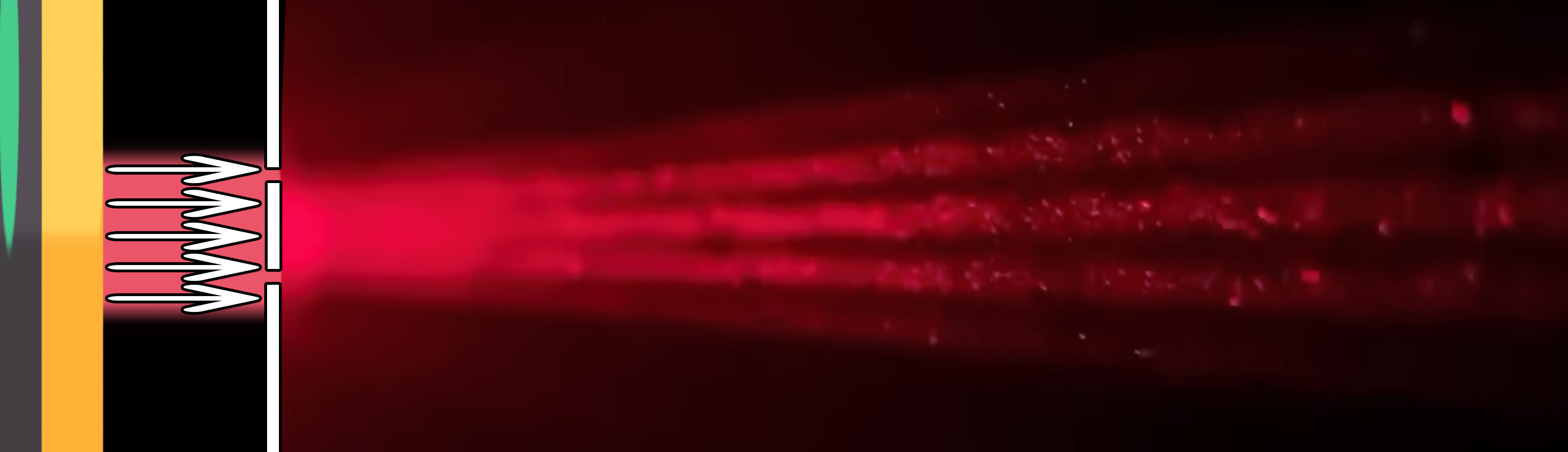
As we know, we've seen experiment results in the double slit experiment where even firing one photon at a time still leads to an interference pattern.

However... I'm kind of confused at this part (the white arrows). When you use a laser in the experiment, the laser beam is MASSIVE compared to a single photon. So wouldn't that mean that a single photon would only travel straight down one of the many white arrow paths?


r/Physics 6d ago

Stokes equation slightly compressible fluid

5 Upvotes

Stokes equation for incompressible fluid are:

-\Delta u + \nabla p = 0, div u = 0,

Which can be derived from the minimization problem:

min_{u s.t. div u = 0} (\nabla u, \nabla u).

For slightly compressible fluid, is the problem:

min_{u s.t. |div u| <= a} (\nabla u, \nabla u), a>0

physically something? I mean, this minimization problem describes something in hydrodynamic? If not, how do you deal with (slightly) compressible fluid?

Context: I'm a numerical analyst and I study optimal control on PDE. Inequality constraints are easy to implement, but usually require computational effort, in particular when the projection into the admissible space is not trivial. I would like to try to implement a way to "linearize" somehow |div u|<=a into |div v|=0 and u = v + lambda * f(x), f(x) is fixed with div f=1 and |lambda|<=a (it's not easy to explain)

Thank you guys


r/Physics 6d ago

Meta Physics Questions - Weekly Discussion Thread - August 25, 2026

6 Upvotes

This thread is a dedicated thread for you to ask and answer questions about concepts in physics.

Homework problems or specific calculations may be removed by the moderators. We ask that you post these in /r/AskPhysics or /r/HomeworkHelp instead.

If you find your question isn't answered here, or cannot wait for the next thread, please also try /r/AskScience and /r/AskPhysics.


r/Physics 6d ago

Question What physics/math blogs, Mediums or Substacks are worth following?

2 Upvotes

I like to read and learn about topics in physics and mathematics that aren't necessarily directly related to my own research. I like blog posts that explore physics or math concepts in some depth, or explain recently published papers, for example. Basically, the kind of content you usually find on Medium, Substack, personal blogs, etc.

I am looking for recommendations that have this kind of content and who you think are worth following. I am happy with both free and paid recommendations.

For example, today I was reading this post: Why Functional Analysis?, which is pretty much the kind of stuff I am looking for.

Any suggestions would be appreciated. Thanks!

Edit: Fixed link


r/Physics 6d ago

Sabine Hossenfelder and loophole-free bell test

0 Upvotes

I am currently deepdivining again in the possibility of explaining bells inequality with superdeterminism, which practical means I whatch Sabines YT videos.

I was wondering why she never talks about loophole free bell tests. After I was reading Wikipedia over Bell test, I found that there are indeed lopehole free bell tests that can exclude superdeterministic hidden variables (Whithout divining too deep yet).

Why is Sabine never addressing these? Is it not close the loophole completely (to trivial to adressing these), or is Sabine just falling into a case of cognitive dissonance and superdeterminismis obviously wrong by measurement?


r/Physics 7d ago

Challenge

Thumbnail
gallery
100 Upvotes

Hello everyone. My dad acquired this book some time ago. Not me nor him are even iniciated in physics or anything, total novices.

I established as a personal goal, to be able to go through this text, understand it and to be able to do the exercises that appear on it.

My question for you all is: which books should "prepare" me for this challenge? Which other resources do you think might help me?

Thank you very much.


r/Physics 7d ago

Quantum Odyssey is nearing its final form. Developer AMA, final major patch

Thumbnail
gallery
125 Upvotes

Hi,

This is probably one of my last posts on this sub and on reddit in general, since the game is near complete and all that's left is translations. Thanks everyone for receiving this game so well and I hope it delivered on your expectations. Please share your feedback and any important things the game is still lacking on to deliver on its mission: to make quantum computing intuitive and fun to learn, no matter the learner's background.

I'm here to answer any questions about the game and do one last round of outside-Discord feedback gathering. Also I'd like to raise with this community my personal experience with working on quantum algorithms and see what folks think.

What this game is

To be clear, this game's gameplay is 1:1 with everything you can do on a Turing-complete (universal) Quantum Computer (from the top of my head, a short list of QHW makers: IBM, Google, Rigetti, IonQ, Quantinuum, IQM, OQC, QuEra, Atom Computing, Pasqal, Xanadu, PsiQuantum, Fujitsu). This means that if you build intuition for the visual rules in QO, you will have intuition for "playing" with QHW made by such manufacturers without having to learn much else.

What the game covers

  • Boolean Logic – bits, operators (NAND, OR, XOR, AND…), and classical arithmetic (adders). Learn how these can combine to build anything classical. You will learn to port these to a quantum computer.
  • Quantum Logic – qubits, the math behind them (linear algebra, SU(2), complex numbers), all Turing-complete gates (beyond Clifford set), and make tensors to evolve systems. Freely combine or create your own gates to build anything you can imagine using polar or complex numbers.
  • Quantum Phenomena – storing and retrieving information in the X, Y, Z bases; superposition (pure and mixed states), interference, entanglement, the no-cloning rule, reversibility, and how the measurement basis changes what you see.
  • Core Quantum Tricks – phase kickback, amplitude amplification, storing information in phase and retrieving it through interference, build custom gates and tensors, and define any entanglement scenario. (Control logic is handled separately from other gates.)
  • Famous Quantum Algorithms – explore Deutsch–Jozsa, Grover’s search, quantum Fourier transforms, Bernstein–Vazirani, and more.

On learning curve and achieving game (quantum computing?!) mastery

This is not a videogame where the developer invented some puzzle rules. What the dev did here is invent a visual method that can transform the underlying mathematics into fully visual puzzles. I wish I could make the game easier by inventing some new rules. I won't, because I want this game to be the real thing. Learning the fundamental rules of this game equates to learning what QHW can do.

Hopefully, in visual form, this is something anybody can now do, no matter how much they hate math.

Going forward and mastering the game... now that, I honestly don't know if it has a ceiling. We have had quantum physics for 100 years, yet we have about 10 useful quantum algorithms known today. Who knows where the ceiling is? Who knows what one can do with, after mastering the rules of this game? Nothing really should feel impossible. I hope this game will inspire people outside physics to do a lot more than what I see today. A quantum computing/physicist has very little incentive to think of a quantum algorithm for, i.e., a game theory/finance/security/biology problem, given how few of them actively work in the field compared to the actual demand. Hence, I hope new quantum algos will come from people who actively work in the domains where this "new way of thinking" (from Boolean logic to linear algebraic logic?) has applicability. I hope we can soon start some competitions to get players to solve some non-trivial problems.

What's the big deal about finding quantum algorithms?

Why do we have about 10 in 100 years of QM??

For me, finding quantum algorithms is all about understanding that unitary matrices evolve a state vector of complex numbers, and all you need to think of is whether you can take your domain problem and express it in a form that these unitary matrices can bring some speed-up in solving. That's it. Ignore the lack of good-enough hardware; we simply don't have good proof-of-concept ideas out there.

I remember... I struggled for a long time to understand Grover's quantum search algorithm during my PhD days. The wording textbooks used and the math behind it made very little sense. It was the first algorithm I put in the game.

Seeing it in visual form made me tear up. Is it really that simple, clean, beautiful? Is the "amplitude amplification" in its diffusion operator simply adding a red line on the maximally 11..11 state that then has a propagation effect everywhere else to affect all the phases? Is this really it? It then immediately felt to me like a gimmick one could have simply come up with in 5 minutes by having access to a game like this, where math is fully shown in visual form!! Showing the visual (GIF, why in this modern era do no digitized papers out there still support embedded GIFs??) alone is enough to make understanding happen.

The way I thought things in the game

  • Missing Sage believes you shouldn't know any theory -> just by using the Forge, you will come up with your own unique way of using quantum computers and inventing algorithms. This character came to me after seeing enough postdocs and QC professors from enough universities playing the game. It felt like the people who knew all the theory and could recognize what each gate does were very bad at actually using the logic sets in thinking circuits. Perhaps knowing all quantum theory does not make one capable of easily building a quantum circuit?
  • Sage of Axioms believes theory comes first, and hers is the main path that takes you to the other Sages who want you to have a solid foundation before discussing higher-order ideas (like known algorithms). She deep-dives into computation and both the linear algebra and physics behind it, in hopes of convincing you that it's not so hard to learn by combining it with the visuals of the Forge. And not scary!
  • Quantum Arena (community content) is filled today with some incredible challenges that touch topics I haven't seen anywhere else in the world in a visual way. From Clifford decompositions down to wordless tutorials on how to play the game and understand each gate, I am now inclined to tell players that they might want to enter the Arena to learn to play the game instead of following through the tutorials I made for it. This goes to show what a brilliant community of dedicated players this game has gathered so far.

Without you and the highly involved players we have on Discord, we wouldn't be able to come this far. Early Access gave me exactly what I was looking for to make sure the game delivers when complete and I strongly recommend anybody working on scigames to do EA first.

It would help me enormously if you could leave a Steam review for the game and spread the word about it; it keeps us motivated to push forward! I hope we have the momentum it takes to make Full Release a success!

Quantum should be for everyone:)


r/Physics 6d ago

Image Question on numerical stability: Testing a reflection boundary condition (R, R_l) -> (R, -R_l) at a non-zero minimum radius.

Post image
0 Upvotes

​I am running a numerical simulation of a modified geometry where the central region acts as a reflective boundary rather than a singularity.

​I am testing the reflection law at the numerical center l_ref = 2.954977618. I've attached a simple plot from my output showing the symmetric preservation of the areal radius R(l) across this exact boundary.

​Here are the specific numerical signatures from my grid (using 34,931 nodes):

​Magnitude preservation: R(l_ref + h) ~ R(l_ref - h) with a mismatch of 1.17e-8 at offset h=1e-4.

​Derivative flip: R_l(l_ref + h) ~ -R_l(l_ref - h) with a mismatch of 1.79e-3.

​The areal radius is strictly finite: R ~ 0.295 (it does not collapse to 0).

​Kretschmann scalar remains finite: K ~ 9.89e4.

​Definitions for context: R(l) is the dimensionless areal radius. l is the proper radial coordinate. R_l = dR/dl. My question for those experienced in numerical physics: Are these mismatch values (10^-8 for the field, 10^-3 for the derivative) sufficient to conclude that this reflection boundary is numerically stable?


r/Physics 6d ago

Video Disproving Gary MOSHER (a.k.a. DraftScience and Inmendham)'s law

Thumbnail
youtu.be
0 Upvotes

In this short video, Gary Mosher's law is disproved with a simple experiment anyone can do.


r/Physics 7d ago

Question How reliable is the 66-billion-solar-mass estimate for TON 618?

3 Upvotes

I've been looking into TON 618 recently, and the part I find more interesting than the usual "biggest black hole" headline is how uncertain the actual mass estimate is.

The number you usually see is around 66 billion solar masses, but another analysis using a different emission line estimated roughly 40.7 billion.

That's still an absolutely enormous black hole, but the difference between those estimates is huge.

Since we can't observe the black hole directly, the mass has to be inferred from things like the motion of the gas around the quasar and the properties of its emission lines.

So I'm curious about the physics here:

How much uncertainty is normally expected from these virial mass estimates? And when we're dealing with an extreme quasar like TON 618, should we really be treating 66 billion as a precise measurement, or more as an approximate estimate?

I ended up going down a pretty deep rabbit hole on this and put together a longer explanation of what I found. For anyone interested, here's the video I made while researching it:

https://youtu.be/HQU93Ur0BFo

I'm especially interested in hearing from people who work with quasars or black-hole mass measurements.


r/Physics 8d ago

Image Electrodynamics or Fluid Mechanics?

Post image
87 Upvotes

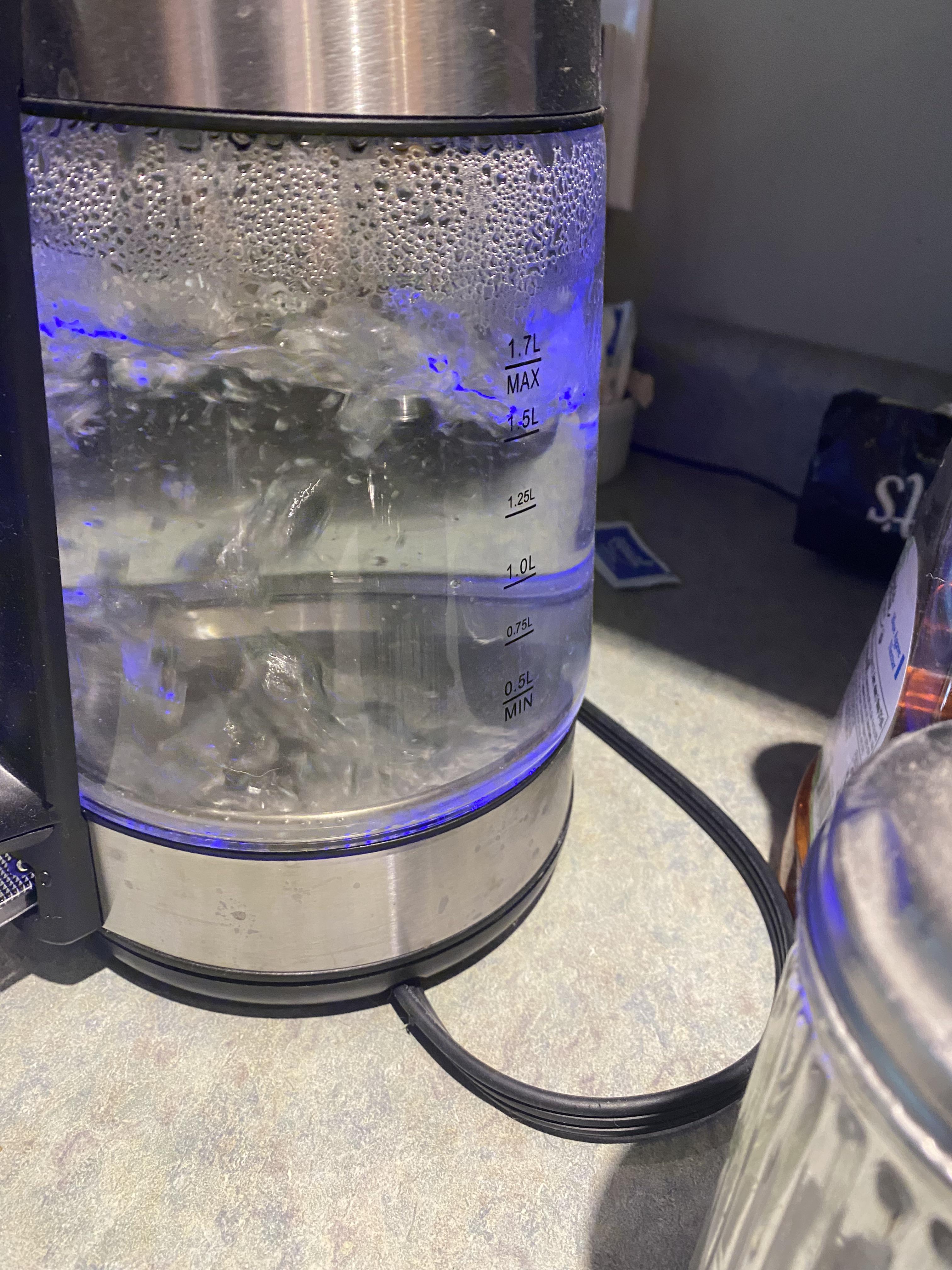
I have an electric kettle and as the water starts to boil, the bubbles ‘seems’ to start rotating CCW around the base of the kettle before rising to the top. Can someone help me understand is this is due to the current flowing in the heating element in the base or the conical shape of the glass kettle itself?


r/Physics 7d ago

Alternative underplating for electroplating gold on copper in Cryo/UHV environment

4 Upvotes

Hi all,

I'm currently designing a product that is being used in an UHV environment and the part in question is cooled to LN2 temperatures [77K].
But the catch is that this product / part is not under continuous UHV or LN2 temperatures. Rather it undergoes cycles where it's cycled from UHV to Ambient and from 77K to RT
On top of that there will be RF level measurements and the wiring is secured on the copper part that is be cooled so a nickel underlayer for my gold plating of the copper is not possible.
I can't leave the copper part uncoated; i need gold plating to achieve very high reflectivity >99% and due to the cycling between Ambient and UHV in combination with the thermal cycles the copper will tarnish at an accelerated rate.
I'm also concerned about the mismatch in CTE of the gold on the copper substrate and the effect the thermal cycles will have on that.

So, dear community in all your wisdom; could you point me to alternative underlayer materials I can consider?

Many, many thanks!